
Have you ever noticed how life quietly shrinks when you stop asking questions? You do the job the way it has always been done, talk to the same people about the same safe little topics, scroll past anything unfamiliar, and call it "being realistic." Very adult, very sensible. And then somewhere along the way the world starts feeling flat. Your motivation is limping. Other people seem to be stretching, changing, growing, and you're mostly just... maintaining the furniture.
Curiosity is the skill that keeps your mind from folding in on itself like an old camping chair. If you've been feeling bored, oddly defensive, uninspired, or low-key intimidated by anything new, there may be a curiosity shortage hiding under all that. And if that lands with a tiny uncomfortable thud, well. Good, actually. That means we found the door.
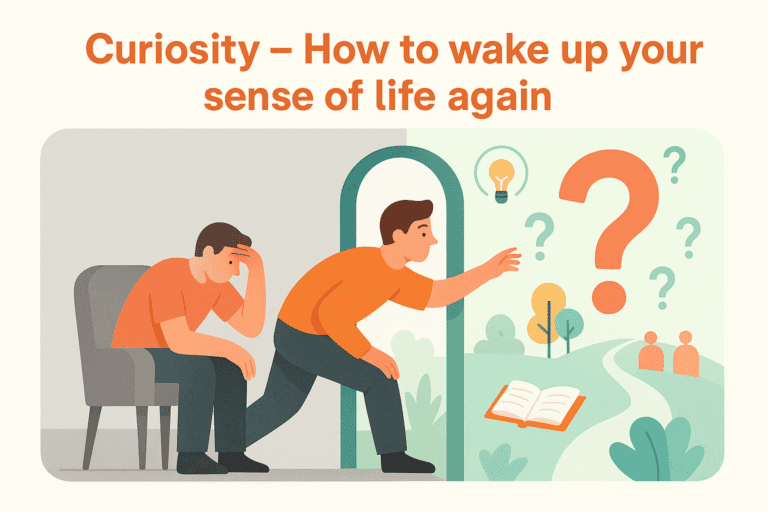
Table of contents:
Curiosity, without the quirky-genius costume
It is a way of moving toward the unknown
Curiosity is not just liking facts, collecting random trivia, or being the person who somehow knows three deeply unsettling things about volcanoes at dinner. It's simpler and more useful than that. It's the habit of leaning toward what you don't understand yet.
A curious person notices a gap in their knowledge and, instead of recoiling like they touched a hot pan, moves a little closer. Their inner voice goes, "Huh. What's happening here?" Which sounds small, I know. But that one little question changes how people learn, work, listen, argue, travel, and even how they sit through awkward conversations without mentally leaving the building.
It shows up in questions, attention, and little acts of exploration
In daily life, curiosity looks almost boring from the outside. That's part of its charm. You ask one more follow-up instead of smiling politely and changing the subject. You read past the headline. You notice that some system exists at work, in a city, in a family and wonder how it actually runs behind the curtain.
Curious people gather information the way some people collect odd pebbles from the beach: one from psychology, one from design, one from history, one from that neighbor who knows an alarming amount about compost. Then, later, those bits start connecting. That's where analytical thinking often gets sharper, because patterns are easier to spot when your mind has more material to compare, test, and mash together. Sometimes in ways that feel, frankly, a little unfair.
It includes tolerance for not knowing yet
This part matters more than most adults like to admit. A lot of people hate the feeling of not knowing so much that they rush to fill the gap immediately with an opinion, a joke, a shrug, a confident little "Well obviously..." even when obviously is doing a lot of heavy lifting.
Curiosity can sit in uncertainty for a minute. It doesn't turn ignorance into shame. Instead of "I should already know this," the inner sentence becomes, "Interesting. I don't know this yet." Same situation. Totally different emotional weather. If not knowing instantly makes you feel smaller, it may help to notice what low self-respect quietly does to a life, because people who doubt their own worth often rush to certainty just to avoid feeling exposed. That's why curiosity isn't just an intellectual skill. It's emotional too, and yes, your nervous system notices the difference.
It cares about the process, not only the payoff
Curious people are often pulled by learning itself, not only by what they can cash in later. They read about city design even if they don't work in urban planning. They ask how coffee gets grown, how courtrooms function, why fungi behave like tiny anarchists in the forest. Not because it's "strategic." Just because they want to know.
And oddly enough, that's exactly why it becomes useful later. Ideas travel. Something you learn in one area wanders off, bumps into a totally different problem, and suddenly helps solve it. That is part of what strong strategic thinking changes in real life, because curiosity gives you more dots to connect before you make a choice, not just more facts to carry around. Also important for the quiet people in the back you do not need to be loud, flashy, or socially turbocharged to be curious. That stereotype is worth questioning if you have ever wondered how to build charisma without becoming a caricature, because both curiosity and presence tend to grow from genuine attention, not performance. Plenty of deeply curious people are quiet as library socks. They just notice more. And they keep tugging at the thread.
What opens up when curiosity gets stronger
Learning stops being something that only happens to you
When curiosity gets stronger, learning becomes active. You stop waiting to be told what matters and start pulling knowledge toward yourself. That changes the speed of growth in a very real, not-inspirational-poster way.
At work, it means faster onboarding, better questions, and fewer moments of pretending you understood the thing when you absolutely did not. In life, it means your skills keep expanding instead of hardening at "pretty decent for now." And here's the mildly annoying truth: the curious person often ends up outgrowing the merely experienced one. Not always because they're smarter. Sometimes they're just more awake. That same habit is useful in leadership too. When you stay interested in people, systems, and what is actually going on beneath the surface, what changes when leadership gets stronger becomes much easier to understand, because good leadership usually starts with better questions long before it turns into confident decisions.
People become more interesting, and relationships get less mechanical
Curiosity also does something lovely to relationships. It makes people less flat. Instead of filing them into quick categories difficult, dramatic, boring, intense, whatever you start wondering what shaped them, what they meant, what sits underneath that weird reaction or strong opinion.
Conversations get richer. The same habit also strengthens empathy, because genuine interest in another person helps you listen for what's underneath the words, not just react to the first sentence like a smoke alarm. Conflict gets less ridiculous too. "What happened for you there?" is often far more useful than launching into your own courtroom speech with imaginary dramatic lighting. It also connects naturally to how to build social influence without becoming fake, because people are much more open to you when they feel understood instead of handled.
Does curiosity fix every relationship problem? No, of course not. Let's not get weird. But it does reduce the number of misunderstandings you create through lazy assumptions, and honestly that alone is a pretty nice upgrade. Have you ever had someone ask you a real question and actually wait for the answer? Feels different, doesn't it.
Change feels less like an attack
New software, new city, new team, new rules, new culture none of this suddenly becomes delightful. Curiosity is not a magic wand. But it gives your mind a better job than panicking.
Instead of "This is awful, I hate this, bring back the old version immediately," the question becomes, "Okay... how does this work?" That shift matters. Curious people adapt faster because they investigate instead of only resisting. If that's something you want to build more deliberately, it helps to learn how to train adaptability, so change feels less like a threat and more like a situation you can work with. They still feel awkward, sure. They just don't build a small emotional shrine to the awkwardness and live there for six weeks.
Motivation and creativity come back online
Boredom often loosens its grip when curiosity returns. Not because life turns into a fireworks show, but because you start noticing texture again. The same street has architecture, tiny habits, little social rituals, clues about money, taste, class, history. The same job has hidden patterns, better questions, strange inefficiencies, overlooked options. Life gets less beige.
Curiosity can also make your work more original, because interesting ideas usually come from crossing wires between things that looked unrelated five minutes ago. That's a practical example of what creativity is and how it shows up in everyday life, especially when one sideways fact suddenly makes an old problem crack open a little. Have you had that happen? Some odd detail from a book, a podcast, a random conversation and then click, the thing makes sense. That's curiosity doing its quiet little magic. I hope you get more of those moments, truly.
When curiosity goes missing
You harden into quick certainty
One of the first things to disappear is openness. Without curiosity, people settle into conclusions too early. They stop checking, stop exploring, stop updating. It can feel efficient, even mature. Sometimes it even gets praised. But often it's just mental convenience wearing a nice blazer.
The problem shows up fast once you know what to look for: you become easier to mislead, easier to polarize, and more likely to repeat old assumptions long after reality has changed the furniture. A mind that never lifts the lid tends to mistake the packaging for the truth. Which well, that's not ideal.
Your growth becomes narrowly transactional
When curiosity weakens, you learn only what you have to learn. New tools feel irritating. Unfamiliar subjects feel pointless. Anything outside your role, identity, or tiny fenced-off area becomes "not really my thing." That sounds harmless. It isn't, not over time.
This is how people end up on a quiet plateau. Still competent. Still busy. Still answering emails and attending meetings and looking functional from the outside. But not really expanding. Careers stall that way. Ideas start repeating themselves. And there's often this nagging feeling that other people are somehow moving faster on the same twenty-four hours. Often they're not working more. They're just exploring more, poking around more, noticing more.
Conversations get thinner than they need to be
A lack of curiosity does something a little sad to relationships. You stop asking real questions, so people give you the standard public version of themselves. You do the same. Friends become predictable. Colleagues become labels. Even long-term partners can start feeling strangely familiar in the worst way less like living people, more like furniture you care about but no longer really see.
And the key question is not who they were three years ago. It's who they are now. Without curiosity, connection slowly gets replaced by maintenance. Efficient, maybe. But also kind of lonely. Maybe very lonely, actually.
Your world shrinks before life even asks it to
This may be the deepest cost. You skip the class, the museum, the event, the unfamiliar book, the article, the neighborhood, the conversation with the person outside your usual type. Not because all those things were bad fits. Mostly because unfamiliarity itself starts to feel tiring.
Then boredom grows. Confidence drops a bit, quietly. The world begins to look smaller and duller than it really is. And here's the irritating part: people often mistake this for maturity. "I know what I like." Maybe. Sure. Or maybe your mind has gotten a little stingy with its own aliveness. Worth sitting with, no?
How to wake curiosity back up in ordinary life
Keep a small question shelf
Most questions vanish because nobody catches them. So catch them. Keep a note on your phone, a scrap of paper, the back of a receipt whatever works and write down a few things each day that you don't understand yet. Nothing grand is required. Why do some neighborhoods feel welcoming within ten minutes? How do cargo ships get routed? What does that acronym at work actually mean, and why has nobody explained it in plain English?
Then pick one and spend fifteen or twenty minutes following it. That's enough. Curiosity strengthens when questions stop evaporating the second they bump into your schedule.
Borrow someone else's expertise
Once or twice a week, ask someone to explain something they understand and you don't. Their job. Their hobby. How they plan trips. How their side business works. Why they chose that method instead of another one. And then this is the part people skip stay with it long enough to ask a follow-up.
Most people become much more interesting when you stop treating them like background scenery and start treating them like a living archive. Also yes, this is excellent for friendships. People can feel when they're being genuinely discovered. It lands differently than polite small talk about weather that nobody believes in.
Take deliberate detours
Curiosity needs fresh input. Not chaos, not a lifestyle overhaul, just a bit of new terrain. Visit one place a week you wouldn't normally choose, online or offline. Walk through an unfamiliar neighborhood. Spend half an hour in a local museum you've ignored for years. Read a forum about birding, transit systems, old maps, fountain pens whatever sits outside your algorithm cage.
The goal is not to become an expert by bedtime. Relax. The goal is to remind your brain that unfamiliar does not automatically mean dangerous. Sometimes it just means... not pre-chewed.
Interrogate one certainty
Pick one opinion each week and tug on it a bit. Yours or someone else's. Why do I believe this? What evidence supports it? Where did I pick it up? What would the smartest opposing view say? What am I ignoring because it's inconvenient or emotionally expensive?
This is not about becoming spineless or vague. It's about turning fixed opinions back into living thoughts. Very often, the most interesting mystery in the room is your own confidence. Slightly rude, but there it is.
Leave a curiosity receipt
After a podcast, lecture, article, documentary, or long conversation, write down two things: what surprised you, and what you still want to ask. That second part is where the real training happens. Passive consumption creates the feeling of knowledge. Curiosity takes one small step further and says, "Okay, but what am I still missing?"
If you want to stretch it a bit, take one familiar field and learn one weird corner of it. Designer? Peek at 3D modeling. Marketer? Explore how recommendation systems shape attention. Teacher? Look into how memory and smell interact. Small crossovers wake the mind up fast. Not glamorous, maybe. Still delightful.
Should curiosity be your focus right now?
Not always. Some people really do need more curiosity. Others are dealing with exhaustion, grief, overload, or a life structure so cramped that adding more input would just create prettier clutter. If your brain already feels like a browser with forty tabs open and one angry red battery icon, curiosity may not be the first lever to pull. Fair enough.
It helps to choose your growth focus based on the real blockage, not just the trait that sounds nicest on paper. Some people need safety before openness. Some need discipline before exploration, because a little structure often creates the mental space curiosity needs. And some people, bluntly, need rest before anything else is going to take root. If that sounds familiar, it may help to explore the lazy way to build self-discipline, because even a small amount of structure can make curiosity easier to act on instead of leaving it as a nice idea in your head.
If you want a cleaner read on that, AI Coach can help you sort out what deserves attention first and give you a simple plan for the next three days. Useful when every soft skill sounds important and your brain is going, "Sure, let's improve absolutely everything by Monday."
Frequently Asked Questions (FAQ)
What is curiosity in simple terms?
Curiosity is the habit of moving toward what you don't understand yet. It shows up as interest, questions, attention, and a willingness to explore instead of shutting down too fast. In plain English, it's the part of you that says, "Wait what is this?" and actually sticks around for the answer.
Why is curiosity important for adults, not just for kids?
Because adult life keeps changing whether we approve of the timing or not. Curiosity helps you learn faster, adapt better, understand people more deeply, and keep your thinking from going stale. It also protects against that dry, flat feeling where life starts looking repetitive simply because you stopped investigating it.
Can curiosity be developed, or are you just born with it?
It can absolutely be developed. Some people do start with a more naturally inquisitive temperament, sure, but curiosity also grows through behavior. Ask better questions, explore unfamiliar areas, stay with confusion a little longer, and the skill gets stronger. Like many human qualities, it's partly temperament, partly training.
Why do some adults seem to lose their curiosity?
Usually not because they became less interesting people. More often it's stress, overload, shame about not knowing, rigid routines, or environments that reward quick certainty instead of thoughtful exploration. When the nervous system is tired, curiosity often gets replaced by efficiency mode. Useful in an emergency. Not great as a permanent setting.
Is curiosity the same thing as intelligence?
No. They overlap, but they're not the same thing. Intelligence helps you process information. Curiosity helps you go looking for it in the first place. A very bright person can still be mentally lazy. A less naturally quick person can learn an enormous amount because they keep asking, checking, and exploring. Research also suggests curiosity supports learning and memory; one well-known paper is Gruber, Gelman, and Ranganath, 2014
What is the difference between curiosity and nosiness?
Curiosity wants understanding. Nosiness wants access without enough care or respect. Healthy curiosity is interested, but it still respects boundaries. It asks, "Would knowing more help here?" Nosiness barges in because the private detail itself feels exciting. One builds connection and insight. The other makes people want to fake a power outage and leave.
How does curiosity help at work?
It makes you faster at learning, better at problem-solving, and harder to trap inside outdated habits. Curious employees ask the extra question, understand systems sooner, and often spot options that more rigid thinkers miss. Managers also tend to trust people who investigate rather than just repeat. Not because curiosity is adorable, but because it's genuinely useful.
Can introverts be highly curious?
Very much so. Curiosity is not volume. It doesn't require being socially dominant, chatty, or dramatic about your interests. Many introverted people are deeply curious; they simply explore in quieter ways through reading, observing, asking careful questions, or going deep on a subject when nobody is making noise around them. Sounds lovely, honestly.
Can too much curiosity become a problem?
Yes, if it turns into constant distraction. You can chase novelty so hard that you stop finishing things, or keep opening new tabs because the current task suddenly feels less exciting than a fresh one. Healthy curiosity needs a little steering. Otherwise it becomes intellectual window-shopping with great lighting and terrible follow-through.
What is one daily habit that strengthens curiosity quickly?
Write down one thing you noticed, one thing you didn't understand, and one question you want to follow tomorrow. Tiny habit, big effect. It trains attention and keeps your mind from sliding back into autopilot. If you want a psychology lens for why unanswered questions can feel mentally sticky, George Loewenstein's "information-gap" idea is a good one
How can I be more curious in conversations without sounding fake?
Stop trying to perform "good questions" and look for what is genuinely unclear or interesting to you. Ask what they meant, how something worked, why they chose that route, what changed their mind. Then listen long enough to ask one more thing. Real curiosity usually sounds warm and specific. Fake curiosity sounds like networking in a blazer.