
Creativity is not just for artists, startup people, or that one coworker who says, "Okay, hear me out..." before every meeting. When this skill goes quiet, life can start to feel weirdly flat: same solutions, same dead ends, same mental hallway with the same flickering light. You may even catch yourself saying, "I'm just not a creative person," while your brain quietly settles into safe little loops. If that line hits a nerve - yeah, that's not bad news. It usually means there's still a door there, and it's not locked.
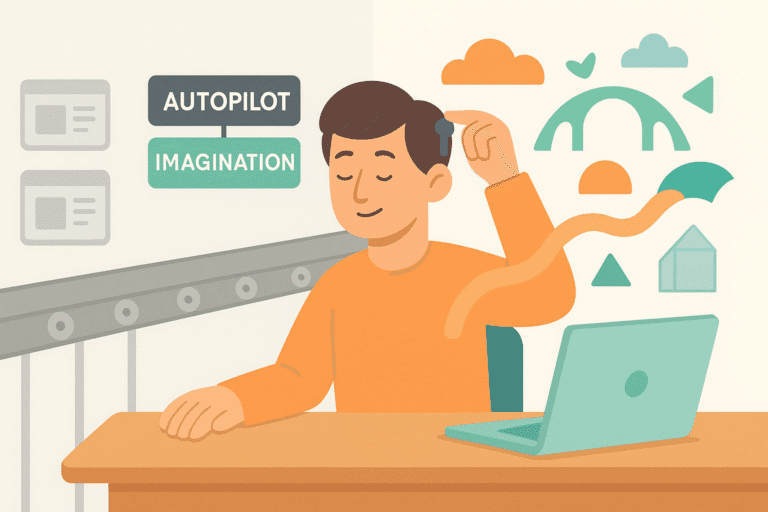
Table of contents:
Creativity in Real Life: How It Actually Works
More than "having ideas"
In real life, creativity is the ability to notice that there's more than one way through. It's not nonstop inspiration, and it's definitely not random chaos dressed up as genius. In fact, it works best when it can cooperate with logical thinking, so ideas do not just appear - they actually become usable. A creative person can look at a problem, a conversation, a routine, even a dull Tuesday afternoon, and think, "Wait... is there another way to do this?" Sometimes the answer is big and obvious. More often, it's small - a better phrase, a smarter sequence, a softer response, a slightly different angle that changes everything.
How it shows up in behavior
Creativity usually shows up as behavior, not as some dramatic identity label. You notice it in people who mix ideas from different areas, ask odd-but-helpful questions, test rough versions before polishing, and stay curious just a bit longer than everyone else. They can sit through that awkward phase where nothing makes sense yet. Which, honestly, is huge. A lot of people are not "uncreative" at all - they just leave the room too early, right before the good thought walks in.
Another sign? Flexibility when the situation is messy. Real creativity is not "I can do anything." It's more like, "Okay... given these limits, what can still work?" Budget is tight. Time is short. The brief changed. The kid has a fever. Your energy is somewhere under the couch. And still, somehow, a person finds a workable move. Not perfect. But alive, useful, real.
Creativity is both imagination and selection
There's a common myth that creative people only generate ideas, like human confetti cannons. Not quite. Creativity has two parts. First, you open the field: alternatives, associations, weird combinations, experiments, half-baked sketches. Then you narrow it: which idea actually fits the goal, the people, the timing, the context? Without the first part, life gets rigid. Without the second, you get a pile of exciting nonsense. Healthy creativity can dream and edit. That combo matters.
That's why creativity works in engineering, parenting, management, teaching, sales, relationships - not just in art. A manager redesigns a meeting so people actually speak honestly. A parent turns resistance into a game instead of a power struggle. A salesperson shifts a conversation from pressure to problem-solving. Same skill. Different outfit. And when that creativity is paired with aesthetic sense, people often communicate ideas more clearly, because the solution is not only smart but also easier to grasp and engage with.
The emotional side of creativity
Creativity is also emotional, quietly, almost sneaky like that. To make something new, you need a little courage: to look silly, to try a rough draft, to hear "no," to be wrong in front of people and survive it. People with stronger creativity are not fearless geniuses floating above embarrassment. Usually they're just better at surviving imperfection. They treat first attempts as material, not as a verdict on their worth. This gets much harder when embarrassment hardens into toxic shame when the problem feels like you, because then a rough attempt can feel like proof that you are the failure, not just the draft, and that shuts down experimentation before it has a chance to turn into something useful. That becomes much easier when you are also working on emotional regulation without turning into a robot, because you spend less energy fighting every wave of frustration, shame, or self-doubt and more energy staying in the process long enough for a useful idea to appear. And that shift - small on paper, huge in real life - changes the whole game.
What Growing Creativity Gives You
You stop living in one-script mode
When creativity grows, your life stops depending so much on one perfect plan working exactly right. You stop thinking in a single script: "If this fails, I'm done." Instead, you start seeing branches. A project stalls - maybe there's another format. A conversation goes sideways - maybe there's another way to say the same truth. A goal feels too big - maybe there's a smaller entry point. The difficulty doesn't magically disappear, no. But the feeling of being trapped gets weaker, and that alone can calm you down more than people realize. That overlap matters, because part of creativity's value is also emotional: it supports the same kind of flexibility you build when stress resistance gets stronger, especially when plans break at the worst possible moment.
Better problem-solving at work
At work, creativity often looks less like brilliance and more like usefulness. Very unglamorous, very effective. You simplify messy processes. You notice patterns other people keep stepping over. You connect feedback from customers, teammates, and data instead of defending your first idea like it's family honor. People start trusting you not only to execute, but to find fresh options when the obvious route is blocked. That's real career leverage, by the way. In a lot of teams, the person who can produce workable alternatives becomes wildly valuable.
There's also a speed benefit - not because creativity makes you rush, but because it helps you stop wrestling with dead plans for too long. If Plan A is clearly limping, creative thinking lets you pivot earlier instead of spending three weeks trying to prove it "should" have worked. Less ego. Less drama. More movement.
Stronger relationships and communication
Creativity helps in relationships too, and this part gets underestimated all the time. It gives you more response options than your default habit. Instead of sarcasm, shutdown, or attack, you can try a different tone. Instead of replaying the same argument, you can ask a better question. Instead of forcing closeness, you can create a better setting for it - a walk, a note, a pause, a joke at the right moment, tea first and then the hard conversation. Creative people are not magically conflict-proof. They just have more relational tools in the drawer.
Confidence that feels earned
Developing creativity builds a specific kind of confidence, and it's a very good one: not "I always know the answer," but "I can figure something out." That confidence is steadier. It survives uncertainty better. You stop waiting for perfect conditions because you trust your ability to adapt when things get weird (and they do, regularly). And after you've watched yourself generate ideas again and again, the old story - "I'm not creative" - starts sounding suspicious. Like an old label on a box you forgot to throw out.
More energy and meaning in everyday life
And then there's this, maybe the nicest part. Creativity puts color back into ordinary life. Cooking becomes experimenting. Planning becomes design. A walk becomes noticing. Work feels less like pushing buttons and more like participating. Even problems can become, sometimes, a puzzle instead of pure punishment. Not always - let's be adults, bills are still bills. But often enough that life feels less like copy-paste and more like something you're actually inside of.
When Creativity Is Missing: The Hidden Cost
Rigid thinking starts masquerading as realism
When creativity is underfed, people often become proud of being "practical" while quietly getting stuck in repetitive thinking. They reach for the same solution, the same explanation, the same reaction - then call it maturity. But sometimes it's not maturity. Sometimes it's fear of change in sensible shoes, and that shift makes experimentation feel riskier than it really is. Sometimes it's fear in sensible shoes. The cost can be subtle at first: less experimentation, fewer chances taken, slower learning, more of that "why does everything feel the same?" feeling.
Problems feel bigger than they are
A low-creativity state makes problems look final. One approach fails, and the brain starts acting like the entire goal is impossible. That creates emotional heaviness: frustration, helplessness, irritation, that flat "what's the point" mood. You can work really hard and still feel ineffective because all your effort keeps feeding the same blocked route. It's exhausting. Like pushing on a door with your full body while the handle is right there. Painfully human, honestly.
Career growth can stall in an invisible way
In a lot of jobs, people hit a ceiling not because they lack discipline or technical skill, but because they solve only familiar problems in familiar ways. They do what's asked - which matters, yes - but they rarely improve the process, reframe the task, or spot new possibilities. Over time, they may be seen as dependable but replaceable. A rough phrase. Still, it happens. Creativity is one of the qualities that turns execution into contribution.
And no, this is not about becoming loud or "visionary" or turning every meeting into a TED Talk. Quiet creativity also works best when it is balanced: alongside experimentation, people often need intuition without becoming gullible, so they can sense which idea is worth testing and which one is just noise. Quiet creativity counts. The person who redesigns a template so the team saves an hour each week? That's creativity. The person who rewrites one onboarding message and cuts confusion in half? Also creativity. Without this skill, you end up spending extra effort where a redesign would have solved the problem faster. And if that sounds familiar, it is often not only a creativity issue but also a consistency issue - the ability to keep testing and refining ideas is closely related to building diligence without turning your life into punishment.
Relationships become predictable in a bad way
When creativity is missing in personal life, conflicts can start looping. Same trigger, same argument, same ending, same silence after. You may genuinely care about each other and still get trapped in a script nobody likes. Creativity helps break that interpersonal autopilot. Without it, people often act like there are only two options - "say nothing" or "explode" - and forget there are a dozen workable shades in between.
The inner story shrinks
Maybe the deepest loss is internal. Without creativity, your identity can get narrow: "I'm just this kind of person," "I can't do that," "people like me don't think that way." A less creative mind doesn't only produce fewer ideas; it imagines fewer versions of the self. And then growth starts to feel unavailable even when time, support, and resources are actually there. The cage becomes mental first. The practical part comes later. And when that narrowing goes on for too long, it can start to feel a lot like when life stops feeling like it belongs to you, because even ordinary choices begin to feel disconnected from who you are and what you actually want.
How to Train Creativity Without Waiting for Inspiration
Use "quantity before quality" on purpose
Pick one small real-life problem - messy mornings, a weak article title, an awkward team update, whatever is currently poking you - and write ten possible solutions in five minutes. Ten, yes. Not three polished ones. The whole point is to get past the obvious. Ideas four to seven are usually clunky. A little embarrassing, even. Ideas eight to ten are where your brain starts improvising because it runs out of safe answers. Most of them may be bad. Good. Bad ideas are often the bridge to useful ones.
Practice cross-pollination
Creativity grows when different worlds bump into each other. Once a day, borrow one idea from an unrelated field and ask how it might apply to your situation. What can project planning learn from restaurant menus? What can parenting learn from product design? What can writing learn from stand-up timing? It may feel slightly ridiculous at first - that's fine, keep going - but this trains associative thinking, and associative thinking is one of creativity's main engines.
Build a "friction notebook"
Keep a note on your phone (or actual paper, if you're that person and I mean that lovingly) and collect tiny frictions for a week: repeated confusion, delays, boring steps, misunderstandings, things you keep grumbling about. Don't solve them yet. Just collect. Then look at the list and choose one item to redesign. Creativity gets much easier when it has material to work with. People wait for inspiration, but useful creativity often starts with irritation. It also helps to protect a slightly hopeful mindset here: a small dose of optimism makes it much easier to treat friction as raw material instead of proof that "nothing will work anyway." "Why is this still annoying?" can be a fantastic doorway.
Change the constraint, not only the effort
When you're stuck, don't only push harder. Change one condition. Shorten the time (15-minute draft). Change the medium (voice note instead of typing). Change the audience (explain it to a teenager, or to your friend who hates jargon). Change the place (walk while thinking). Change the rule ("I'm not allowed to use my usual solution"). New constraints wake up new pathways. Same brain, different setup - suddenly, different result.
Train recovery from bad drafts
A lot of people don't lack creativity. They lack tolerance for ugly beginnings. So make recovery the exercise. Create intentionally rough first versions and practice improving them instead of judging them to death. Write a clumsy paragraph. Sketch a silly concept. Say a half-baked idea in a safe setting - then revise it. This teaches your nervous system that "messy" is not danger, it's stage one. And that lesson... honestly, it's gold.
If you want a weekly rhythm, keep it simple: one day collecting inputs, one day generating many ideas, one day choosing, one day testing, one day tweaking. Light. Flexible. Not precious. Creativity usually likes repetition more than drama, even if movies keep pretending otherwise.
Should You Work on Creativity Right Now?
Not necessarily. A lot of people rush toward creativity because it sounds exciting, while their real bottleneck is something else - sleep, discipline, emotional regulation, boundaries, plain old focus. If your foundation is shaky, "be more creative" can turn into a shiny distraction. A fun one, sure, but still a distraction.
Try a simpler question instead: where do I lose the most energy right now? If the answer is "I keep getting stuck, repeating myself, and I can't find alternatives," then creativity is probably a strong next move. If the answer points somewhere else, start there. No prize for picking the most glamorous skill first. And if "somewhere else" looks like ten important things fighting for your attention at once, it may help to check whether prioritization is actually your next step, because creativity is much easier to use when your energy is not scattered across everything at the same time.
If you want a clearer priority, there's a practical option: AI Coach. It can help you figure out which skill is worth developing first and give you a simple 3-day starting plan. Sometimes that outside structure saves a lot of random self-improvement zigzags. If creativity is your next lever, great. If not, also great. The point isn't to collect skills like fridge magnets - it's to improve the life you're actually living.
Frequently Asked Questions (FAQ)
Is creativity a skill or a talent?
Both can matter, but in everyday life creativity behaves mostly like a trainable skill. Natural tendencies may give someone an easier start, sure, yet habits - noticing, experimenting, combining ideas, revising - usually make the bigger difference over time.
Can creativity be learned if I feel "not creative"?
Yes. A lot of people confuse lack of practice with lack of ability. If you always grab the first obvious answer, your creativity muscle stays sleepy. It wakes up through repeated use, not through some dramatic personality makeover.
How do I become more creative at work without becoming chaotic?
Use a two-part rhythm: generate options first, then evaluate them against goals, deadlines, and constraints. Creativity is not the opposite of structure. The best creative work usually has structure holding it up.
What blocks creativity the most?
Fear of bad ideas, over-control, constant rushing, and harsh self-judgment block it fast. If every first draft has to be impressive, your brain will start playing it safe - and safe gets repetitive very quickly.
Does creativity matter outside art and design?
Absolutely. It matters in problem-solving, communication, sales, parenting, management, learning, and conflict resolution - basically anywhere life gives you more than one possible response. Which is... most of life.
Can routines kill creativity?
Rigid routines can, yes. Supportive routines usually help. A stable rhythm frees up mental energy, and then creativity has room to play inside that structure instead of fighting basic chaos all day.
How long does it take to improve creativity?
You can often feel a shift within a couple of weeks if you practice consistently. Bigger changes take longer, but early signs - more options, less rigidity, better drafts - tend to show up sooner than people expect.
Why do I get ideas in the shower or while walking?
Because your attention softens. When you stop forcing a solution, the brain can connect ideas more freely. Movement and low-pressure states often make room for creative associations to show up, kind of out of nowhere.
Is brainstorming the best way to develop creativity?
It's one tool, not the whole toolbox. Solo idea generation, constraint-based exercises, observation, reframing, and quick testing can work just as well - sometimes better, especially if group brainstorming turns into people performing confidence.
How can I help a child or partner become more creative?
Start with psychological safety. Less ridicule, fewer instant corrections, more curiosity. Ask follow-up questions, invite experiments, and treat imperfect attempts as part of learning - not as proof they "don't have it."