
Optimism is the quiet habit of believing life can still tilt in your favor, even when today feels like a shopping cart with one busted wheel and a handle that sticks for no reason. When this quality runs low, every setback starts to feel weirdly final. Not like a situation. Like a sentence. You try, you push, you keep going because, well, what else are you supposed to do - and somewhere in the background there's that dull little voice going, "Why even bother?" Not dramatic. Just persistent. Which is almost worse.
But when optimism is alive, life does not turn into a motivational poster. It just becomes playable again. You notice side doors. Retries. The half-lucky break that wasn't there yesterday. Little openings. Human-sized chances. And if any of that hits a nerve, stay with me.
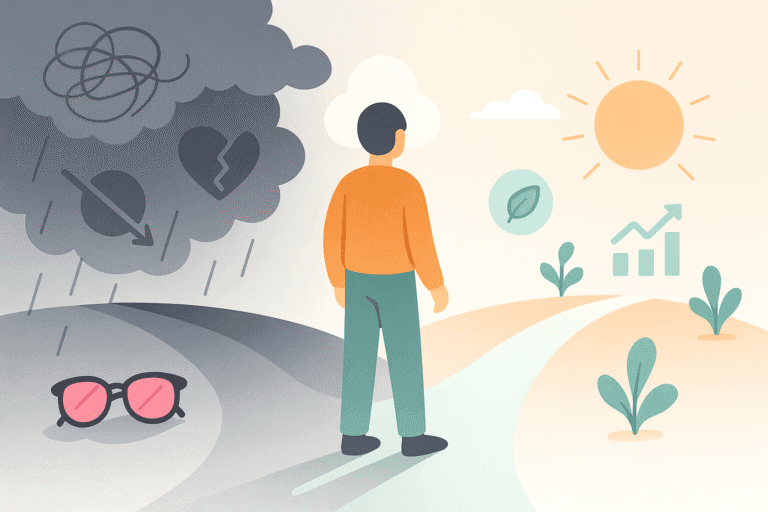
Table of contents:
Optimism in real life, not on a greeting card
It is hope with shoes on
Optimism gets misunderstood all the time. People hear the word and picture someone beaming at oatmeal, sunlight, traffic, inboxes - the whole glittery package. That is not it. Real optimism is much less sugary, and honestly more useful. It is not "nothing bad is happening." It is "something hard is happening, and I still think my actions count." Big difference. One floats above reality like a helium balloon. The other walks straight through it, a little rumpled maybe, but moving.
At its core, optimism is a way of relating to the future. An optimistic person tends to believe that things can improve, that problems can be influenced, that effort is not automatically a waste of perfectly good energy. This does not make them naive. Usually it makes them harder to flatten. They get disappointed, of course. They get snappy. They lose patience, mutter something unprintable, maybe eat a dramatic snack over the sink. Still - they do not hand the keys to despair quite so quickly.
How it shows up in everyday behavior
You notice optimism less in slogans and more in rhythm. In how someone recovers after the bad call, the awkward meeting, the rejected pitch, the week that felt cursed for no obvious reason. You also see it in people who stay mentally open and keep asking useful questions instead of collapsing into certainty. That kind of forward-looking attention has a lot in common with curiosity, because hopeful people are often still willing to explore what they have not tried yet. Optimistic people are more likely to ask, "Okay, what can I still do here?" instead of building a tiny emotional museum around the failure and charging themselves admission.
In teams, they often create movement. They do not magically solve everything. That would be nice, sure. But they remind people that being messy is not the same as being doomed. And that matters. When one person in the room still believes there is a next step worth taking, panic loosens its grip a little. Shoulders drop. People think better. The air changes. That is one of optimism's sneaky talents: it shifts the emotional weather around it without making a big theatrical fuss.
Optimism is not denial
This part matters. A lot. Optimism is not toxic positivity in a nice outfit. It is not slapping a "good vibes only" sticker over grief, stress, fear, anger, or plain old exhaustion. Healthy optimism lets pain be pain. It does not rush to tidy it up. It just refuses to treat pain as the full and final version of reality.
You can be scared and still hopeful. You can be disappointed and still open. You can cry in the kitchen and, later that same day, send the email anyway. Those things can exist together. A little awkwardly, maybe - like distant relatives at one dinner table - but they can.
It is also different from fantasy. Blind optimism says, "It'll all work out somehow," and then just vibes in a corner. Mature optimism says, "It may turn out better than I think, so I should stay engaged." That is why this skill is more practical than it looks. It pushes people toward action, not just mood decoration.
The inner mechanics of an optimistic mind
Under the hood, optimism usually comes with a few mental habits. First, flexibility: a setback is treated as a situation, not a personality diagnosis. That mindset also makes room for staying teachable, because when a mistake feels like information instead of a verdict, people adapt faster and keep moving. Second, sustained effort: if improvement feels possible, trying still makes sense. Third, emotional rebound: hard moments sting, but they do not swallow the whole week every single time. And maybe the kindest piece of all - optimism stops the self from shrinking too much.
You do not become "the person nothing ever works out for." You remain someone with unfinished options. Someone still in motion. That is a much better story to live inside, really.
What grows in your life when optimism gets stronger
You act sooner and freeze less
One of the biggest gifts of optimism is movement. When you believe there is a point in trying, you make the call. You send the draft. You apply for the role, repair the conversation, book the appointment, ask the awkward question. That momentum gets even stronger when hope is paired with goal orientation, because it is easier to act when your energy has somewhere specific to go. Not because you suddenly turned fearless. Because the future stops feeling nailed shut.
This matters more than people think. A lot of stuckness is not laziness at all. It is a low expectation to wear the costume of caution. It sounds sensible. Mature, even. But underneath it, there is often a quiet assumption that effort will go nowhere - so why risk looking foolish?
Optimism gives effort somewhere to land. It turns "why bother" into "let's see." That shift becomes even more useful when it is backed by determination, because hope may open the door, but determination helps you keep walking once the first burst of energy wears off. If you can feel that spark of hope but still struggle to stay aimed at something concrete, learning how to develop goal orientation can make optimism far more useful in daily life, because it gives your energy a direction instead of letting it wander. Tiny phrase. Huge shift.
Pressure becomes easier to carry
Life does not get neat just because you become more optimistic. Bills still show up. Bodies still get tired. People still send texts like "Can we talk?" with zero context, which - let's be honest - should be a minor crime. But optimism changes the load-bearing part of the mind. Stress feels less eternal. Problems look more workable. One rough season stops masquerading as proof that your whole life is secretly off the rails. This is also why stress tolerance matters so much in ordinary life: when your nervous system is not constantly bracing for impact, hope becomes easier to hold onto, and you can respond with more clarity instead of pure alarm.
That shift protects energy. Instead of spending all of it on catastrophizing, you can spend more of it on response. And response works best when it has structure. This is where simple habits of planning make optimism more practical, turning vague hope into a next step you can actually take today. In real life this looks almost boring, which is part of the charm: sleeping a bit better, recovering faster after a setback, not spiraling for three days because one email sounded colder than you hoped. Ordinary changes. Big consequences.
Your relationships get lighter, but also deeper
Optimistic people are usually easier to be around because they do not leak doom into every room they enter. They tend to notice what is still possible in a conflict, a friendship wobble, a family mess, a project that is hanging together by dental floss. That makes them more encouraging, yes, but often more honest too.
Why? Because if you believe a relationship can survive the truth, you do not have to tiptoe around every difficult conversation like the floor is made of antique glass. You can say the real thing. More gently, hopefully, but still plainly. In practice, that overlaps with empathy: the ability to stay honest without becoming cold, and to hear another person's tension without instantly making the whole moment heavier. That kind of grounded hope also becomes more convincing when it is backed by integrity in everyday life, because people relax more around optimism that feels consistent, honest, and lived rather than polished for effect.
There is also something quietly contagious about optimism. A hopeful person can lend stability to other people's nervous systems. They help others imagine the next move, not just the worst-case ending. It also shows up in public speaking, where optimism keeps a shaky voice from turning into total silence and helps a useful idea actually reach the room. And that matters in friendship, in parenting, in leadership, in sales, in teamwork - basically anywhere humans are trying not to unravel before lunch.
You build ambition without turning bitter
Optimism is one of the reasons growth can stay emotionally sustainable. You can want more from life without becoming permanently sour when progress is slow. You can chase a goal and still remain a person while it is unfolding, rather than a bundle of clenched expectations in decent shoes.
That balance is precious. Without it, ambition curdles. It turns into resentment, that heavy internal monologue: "I work so hard, nothing changes, what is even the point." With optimism, the story shifts. Not into fantasy - into stamina. "This is slower than I hoped, but I'm still here. I'm still in it."
And yes, there is confidence in that. Not the loud, polished kind. Not stage-light confidence. More like a grounded sense that tomorrow is not fixed in concrete, and your choices still matter. That kind tends to age well.
When optimism is missing, the world starts shrinking
Setbacks start feeling strangely permanent
Without enough optimism, the mind becomes a dramatic little fortune teller. One mistake at work and suddenly your career is clearly wobbling toward collapse. One bad date and apparently love is a scam run by emotionally unavailable people in nice jackets. One slow month and all your effort starts to feel pointless. Charming, right?
The problem is not sadness itself. Sadness is human. The problem is how fast the brain starts making everything global, permanent, and personal. One event turns into a forecast. Then a pattern. Then, before you notice, a whole identity. And once that happens, resilience drops fast. You do not just feel bad about what happened - you start expecting more of the same, which drains motivation before the next attempt even begins.
You begin to protect yourself by not trying
Low optimism often hides behind the phrase "I'm just being realistic." Sometimes that is true. Sometimes, though, it is self-protection with a respectable haircut. If you expect disappointment, then not hoping can feel clever. Safe. Adults. But the cost is rough.
You stop testing possibilities that might actually help. You hold back in relationships. You underplay your ideas at work. You avoid the conversation that could clear the air. You do less, not because you lack ability, but because internally the future has already gone dim. Over time, that retreat can become a habit, and the way out is rarely motivation alone. It usually takes small repeated actions, which is why discipline matters here too: not as harsh self-pressure, but as a steady way to keep moving before your mood gives permission. That pattern also overlaps with how learned helplessness sneaks into ordinary life, because after enough disappointment people often stop reaching not because nothing can change, but because they no longer expect their effort to matter. Life gets smaller by inches, which is sneaky because inches do not feel dramatic while they are happening.
Have you ever noticed that? The way a person can become trapped not by one giant failure, but by ten careful little retreats. That is often what low optimism looks like from the inside.
Mood and energy take a hit
Chronic pessimistic thinking is exhausting. It makes everything heavier because the expected reward keeps evaporating before you even begin. Why start if it will fail. Why rest if tomorrow will be just as bad. Why ask if the answer will probably be no anyway. It is a tiring way to move through the day. Like carrying a wet coat around and insisting it's fine.
This does not always look dramatic on the outside. Sometimes it shows up as passivity, irritation, sarcasm, endless postponing, low-grade numbness, that dull "meh" that drags over everything. Very common. Very expensive. If that flat, muted state has started to feel less like a passing phase and more like your default setting, it is worth looking at how emotional numbness quietly starts running your life, because what looks like pessimism on the surface is sometimes a nervous system that has gone emotionally offline for protection.
And then there is the social side. People often struggle to stay open around someone who shoots down every possibility early. Not because they are cruel. Because hopelessness spreads fast. One person's "nothing will work" can shrink a whole room.
You lose access to opportunity even when it exists
This may be the sneakiest consequence of all. A person low in optimism can walk right past real chances because they already rejected them privately, before reality even got a vote. They miss the useful contact. The half-open door. The skill they could learn. The second path that appears after the first one fails.
Opportunity rarely arrives wearing a glowing sign and a trumpet soundtrack. Usually it shows up awkwardly, inconveniently, a little underdressed. Optimism helps you stay engaged long enough to notice it.
Without that quality, you can end up living inside conclusions you never truly tested. And that stings. Because after a while the cage starts to feel objective, even when part of it was built from expectation.
How to build optimism without lying to yourself
Practice a wider view of the future
Take ten quiet minutes and write about one ordinary day a year from now if things go reasonably well. Not fantasy-island well. Not "I live in a villa and answer emails from a hammock." Just honestly better. What time do you wake up? How does work feel? What feels calmer in your body? Who do you talk to more? What has become less chaotic?
The point is detail. A foggy future is easy to fear. A pictured future is easier to move toward.
Then write down five reasons this better version is actually plausible. Maybe you will have more experience. Better boundaries. Stronger routines. Different people around you. One good decision repeated until it becomes a life. Optimism grows when the future stops feeling magical and starts feeling buildable. If even this kind of realistic future feels hard to imagine, the issue may be deeper than a temporary slump. In that case, it can help to explore ways to loosen learned helplessness without turning yourself into your own drill sergeant, because sometimes the mind is not resisting hope out of cynicism, but out of exhaustion after too many moments that felt out of your control.
Catch the brain right after a hard moment
When something goes wrong, pause and write two versions of the story. The first is your automatic gloomy interpretation. The second is a fairer one. Not fake-cheerful. Fair. Grounded. Something like: "That meeting was rough, so I blew it and they probably lost respect for me" becomes "That meeting was rough, I was underprepared in one part, and I can fix that before the next one."
Same reality. Less doom opera.
This matters because optimism is not only about feeling better. It is about interpreting better. The mind loves speed after a painful moment, and speed is often where distortion sneaks in. Slow it down a little. Give the story a second draft.
Train your attention to spot what still works
At the end of the day, write down three things that were decent, useful, or unexpectedly good. Keep them specific. "The coffee was excellent." "My friend replied right away." "I handled that annoying call better than last month." Tiny things count. Especially tiny things, actually.
This is not a gratitude performance. You do not need to become a moonbeam about it. It is attention training. You are teaching your brain not to overlook workable goods because it is too busy scanning for threat, disappointment, and possible embarrassment at all times. A very overcommitted security guard, basically.
Another helpful drill: when something irritating happens today, force yourself to find one possible gain, lesson, or hidden convenience in it. Not ten. One. Train delays, mistakes, awkwardness, all of it, to produce at least one scrap of value. That small mental move adds up.
Lend hope outward, then bring it back to yourself
Optimism often gets stronger when you express it, not just admire it in theory. Support someone who is going through a rough patch. Tell them what you genuinely think is still possible for them. Keep it concrete. Keep it honest. Not "everything happens for a reason" - nobody needs that. More like, "You're in a mess, yes, but I can still see a way through this with you."
Then turn some of that same energy toward your future self. Write a short note you will read in a week. Something simple: "You are not done. This patch is real, but it is not the whole map." Corny? Maybe a little. Effective? More often than people expect.
And while we are here - spend less time with people who worship hopelessness as if it makes them profound. It usually just makes them loud and tiring.
Do you actually need to work on optimism right now?
Not always. Sometimes optimism is not the first domino. You may be underslept, overworked, grieving, burned out, underpaid, stuck in chaos, surrounded by noise - in that case, trying to "think more positively" can feel like putting lip balm on a flat tire. Wrong tool. Wrong day.
It helps to ask a blunt question: is your real bottleneck hopelessness, or is it exhaustion, lack of structure, weak boundaries, fear of conflict, uncertainty, plain old depletion? If you start with the wrong skill, your effort scatters. You work hard in circles. Which is deeply irritating, and also very human.
That is where AI Coach can be useful. It can help you figure out which quality is most worth building first, and give you a simple plan for the first three days so you are not left poking at your life with a stick and calling it self-development. Sometimes one clear starting point matters more than ten noble intentions. Feels better, too.
Frequently asked questions about optimism
What is optimism in simple words?
It is the tendency to believe that things can improve and that your actions can influence what happens next. Not magic. Not denial. More like a working belief that tomorrow is not sealed shut.
Is optimism the same as positive thinking?
No. Positive thinking often means trying to swap unpleasant thoughts for nicer ones. Optimism is broader than that. It shapes how you interpret setbacks, how much possibility you still notice, and whether you stay engaged when life feels messy.
What is the difference between optimism and toxic positivity?
Toxic positivity dismisses pain and demands a good mood on schedule. Optimism leaves room for pain, disappointment, fear, anger - all of it - but does not let those feelings become the only forecast. One flattens reality. The other stays in contact with it.
Can optimism be learned, or are you just born that way?
Partly temperament plays a role, yes. Some people seem naturally sunnier. But a large part of optimism is trainable. People can learn to reinterpret setbacks, notice what is still possible, and build a more flexible relationship with the future through repetition.
Can you be optimistic and realistic at the same time?
Yes. In fact, the healthiest optimism is realistic. It sees the problem clearly, admits the risk, and still asks, "What can be done?" Realism without hope turns into paralysis. Hope without realism turns into nonsense. Neither is especially helpful.
Why do optimistic people often seem more resilient?
Because they are less likely to treat one painful event as permanent, total, and defining. That keeps them trying, adjusting, asking for help, and recovering faster after setbacks. Resilience is not just toughness. A lot of it is interpretation.
Does optimism help at work, or is it just a personality thing?
It helps at work a lot. Optimism supports initiative, steadier motivation, better recovery after rejection, and calmer leadership under pressure. Teams usually work better when at least one person still believes there is a constructive next move. Not a miracle. Just a move.
Can too much optimism be a problem?
Yes. When optimism turns into denial, impulsive risk-taking, or refusal to prepare for downsides, it stops being a strength. Healthy optimism needs contact with facts, feedback, and consequences. Otherwise it becomes expensive optimism, which sounds cute until the bill arrives.
How do I know if I am low in optimism?
A few signs: you assume bad outcomes early, struggle to imagine improvement, stop trying quickly after setbacks, or call hopelessness "just being realistic" a little too often. One bad week does not mean much. The pattern does.
What is one daily habit that genuinely helps build optimism?
Keep a short evening note with three specific things that went well, plus one reason tomorrow could still go a bit better. Tiny habit, yes. But tiny things done daily are often what change a mind. Strange but true.