
Planning is the skill that keeps your life from turning into a pile of urgent-looking nonsense.
When it is weak, the day keeps grabbing you by the sleeve: one message, one errand, one tiny fire, and suddenly it is 6:40 p.m., you are tired, and the important thing still sits there untouched, staring at you like a bill on the kitchen counter. When planning gets stronger, time stops feeling slippery. You do not become a robot with color-coded socks. You just stop donating so much of your life to avoidable chaos.
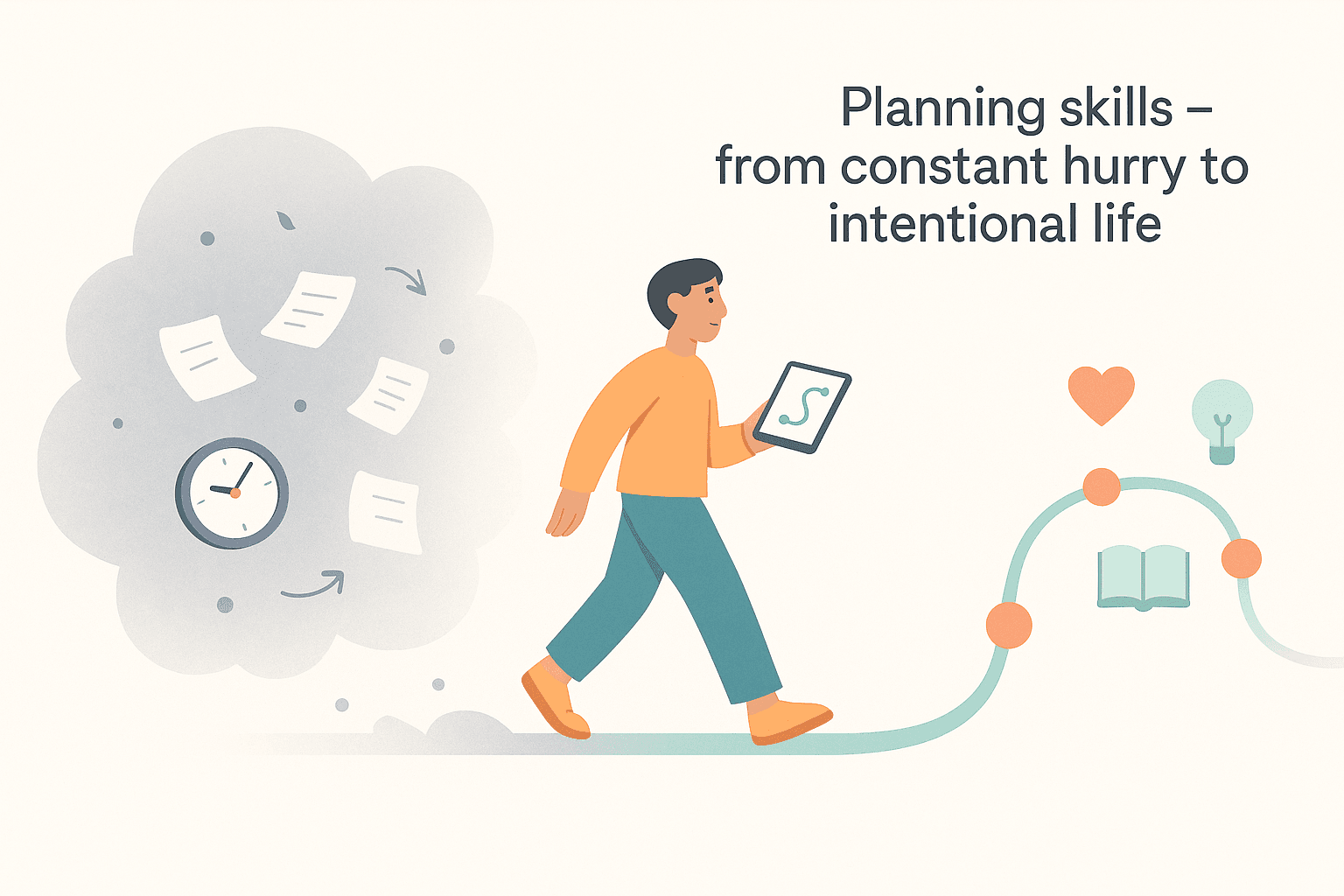
Table of contents:
Planning: What It Really Looks Like in Daily Life
It is not just making lists
A lot of people think planning means writing twelve tasks in an app and feeling briefly superior. Nice fantasy. Real planning is more selective than that. It is the ability to look at a situation, decide what matters most, and arrange actions in an order that gives you a decent chance of getting there. In other words, planning is less about collecting intentions and more about giving effort a route.
That route can be simple. "Do the budget before lunch, call the contractor after, leave the admin sludge for late afternoon." Or bigger. "Finish the certification this quarter, save this amount by fall, make space for family stuff without pretending work will politely shrink on its own." Planning turns a foggy wish into something your Tuesday can actually cooperate with.
It starts with priorities, not with activity
One of the clearest signs of planning skill is that a person does not treat every task like it arrived wearing a sheriff's badge. They sort. They rank. They notice that replying to four low-stakes emails is not the same as preparing for tomorrow's interview, even if the emails are easier and far more seductive.
This is where planning overlaps with judgment. You ask, "What moves things forward?" not only "What can I finish fast?" It also leans on responsibility in real life, because once you decide what matters, you still have to follow through when easier tasks start waving for attention. People who plan well usually have a decent feel for sequence too. They know that some steps are groundwork. Some are leverage. Some are basically decorative parsley on the plate. Lovely, but not the meal.
Good planning includes room for reality
Planning is often confused with control, and that is where many people start hating it. They imagine some brittle masterpiece of a schedule that collapses the second a coworker Slacks them, the dog throws up, or the train decides to become a philosophical concept instead of transportation.
Healthy planning is not rigid like that. It includes alternatives. In practice, that looks a lot like training adaptability, where the point is not to avoid disruption but to respond without losing the thread of the day. It leaves breathing room. It assumes that fresh information will appear and that moods, delays, and other humans will do what they do. A person with strong planning skills can adjust without mentally flipping the table. They do not say, "Well, the whole day is ruined now." They say, "Fine. New route. That flexibility matters for more than efficiency, too. It is often the reason creativity has some room in real life, because the mind works better when it is not trapped in constant last-minute scrambling."
It connects today with later
The deeper part of planning is time linking. You stop living in isolated little islands of urgency and begin connecting today's actions to next week's consequences and next year's opportunities. That changes behavior in a very practical way. You prep before the deadline bites. You book the appointment before the problem gets theatrical. You think about energy, money, and time as resources to be placed, not just spent.
And yes, planning has an emotional side too. It creates a quieter inner climate. When you know what you are doing, why you are doing it, and what comes after, your brain spends less time pacing in circles like a confused hotel guest. Not zero time. You are still human. But less.
What Gets Easier When Planning Stops Being an Afterthought
Your mind wastes less energy on re-deciding
One of the biggest gifts of planning is that it reduces all the tiny negotiations that chew through a day. What first. What later. Do I start the report now. Should I answer messages. Maybe coffee first, maybe research, maybe stare into the middle distance and call it "getting ready." Exhausting little circus.
When a plan exists, even a modest one, your brain does not need to hold the whole mess at once. It can move. That lowers decision fatigue and frees attention for actual work, not just work about work. Strange how much calmer a day feels when you are not repeatedly asking yourself what you should be doing every twenty minutes.
Important work finally stops losing to easy work
Without planning, urgent and visible tasks tend to bully their way to the front. Planning pushes back. It protects the meaningful stuff that has no alarm attached yet: the proposal, the portfolio, the course, the financial clean-up, the health thing you've been "meaning to get to" since weather was colder.
That matters because progress on bigger goals usually does not happen through heroic bursts. It happens because someone kept making space for the right tasks before life filled every inch of the day with noise. Planning helps you do that on purpose. It is also part of what ambition expands in real life, because bigger goals need actual time, protected attention, and repeated follow-through before they become anything more than a nice idea. And once that rhythm starts, bigger goals stop feeling like decorative fantasies you mention over brunch and never touch again.
Other people experience you as steadier
Planning is not only private. It changes how dependable you feel to others. You show up more prepared. You miss fewer handoffs. You communicate earlier when timing needs to change. And when your plans involve other people, it also helps to understand persuasion in plain English, because even the smartest timeline needs clear buy-in if you want priorities, deadlines, and expectations to hold under pressure. That creates trust, and trust is practical currency. Over time, this is exactly why reliability changes your work relationships and future, because people remember who can be counted on when plans need to turn into action. People give more freedom to someone who does not constantly act surprised by their own calendar. This becomes even more obvious when your work involves guiding other people, because mentorship skills in real life depend a lot on thinking ahead, making room for check-ins, and giving support before small issues turn into avoidable chaos.
There is a personal version of that trust too. Self-trust. A very useful beast. If you keep making plans that vanish by noon, your own mind stops taking you seriously. But when your plans become realistic and you follow them often enough, your inner voice changes. Less "yeah right." More "okay, we actually do things now."
You get more room for rest, not less
This part gets missed all the time. People assume planning makes life tighter, more packed, more joyless. Bad planning can do that, sure. Good planning often does the opposite. It prevents random sprawl. It stops three small tasks from leaking across an entire evening like spilled soup.
When work has edges, rest becomes cleaner. You can stop. You can be with your family without half-writing tomorrow's to-do list in your skull. You can enjoy Saturday without that vague background dread that whispers, "Aren't you forgetting something?" Planning does not remove responsibility. It gives it a container. That is why, done well, it feels less like restriction and more like relief.
What a Lack of Planning Quietly Does to a Person
Everything starts feeling equally urgent
When planning is weak, the day becomes a popularity contest for whatever is loudest. The phone buzzes, so that wins. Somebody asks for a quick thing, so that wins. A minor task looks finishable in ten minutes, so that wins too. By evening you may have done a lot, technically, and still feel weirdly cheated by your own effort.
That is the sneaky misery of poor planning: motion without traction. You stay busy enough to feel depleted, but not structured enough to feel satisfied. A grim combo, honestly.
Small delays turn into expensive messes
A missing plan rarely explodes all at once. Usually it leaks. You forget prep time. You underestimate how long the task will take. You fail to leave a buffer for interruptions. Then the delay spreads into the next commitment, and the next one, and now your day looks like a suitcase someone sat on to force shut.
This creates a lot of unnecessary rework. Rushed decisions. Sloppy handoffs. Last-minute apologies. Sometimes even conflict, because other people are now adjusting around your lack of structure whether they wanted to or not. And they usually did not.
Stress becomes background noise
Not all stress comes from poor planning, obviously. Life can be objectively hard. Still, weak planning adds a very specific flavor of strain: the constant sensation that something important is drifting just out of reach. You cannot relax because you are not sure what is coming. You cannot focus because too many loose threads keep tapping you on the shoulder. And when that kind of mental clutter drags on for too long, it can start resembling that hollow feeling has a pattern, where life stays busy on the surface but feels oddly disconnected underneath.
Over time, that can turn into avoidance. If planning feels unpleasant, you stop looking closely. You "just get through the day." That is often how procrastination runs the show: not as obvious laziness, but as a quiet habit of postponing decisions because everything already feels messy. Then the day gets through you right back. If that loop feels familiar, this guide on how to stop procrastinating without starting a war with yourself can help you rebuild momentum in a way that feels calmer and more realistic. That pattern does not mean you are lazy or broken. It often means you have lost contact with the structure that would make effort feel manageable again.
Your confidence takes odd little hits
Here is the part people do not always connect. Chronic under-planning can damage self-respect. Not in some dramatic movie-monologue way. More quietly. You begin to notice that your intentions sound better than your follow-through. You promise yourself a focused afternoon and somehow end up doing fragments, errands, and damage control till dinner.
After enough of that, the mind gets cynical. It stops believing your good intentions. And when self-trust drops, even simple goals feel heavier than they should. So yes, planning affects productivity. But it also affects dignity a bit. The ordinary kind. The kind that says, "My day is not random. My choices count."
How to Build Planning Without Turning Into a Spreadsheet Person
Give tomorrow only a few fixed bones
If your plans keep collapsing, they may be too crowded. Try a lighter structure. Before bed, sketch only the backbone of the next day: one main task that really matters, one support task, and the non-negotiable things already sitting there like meetings, school pickup, or the dentist who will absolutely charge you if you ghost them again.
Then add one open pocket on purpose. Not because you are lazy. Because life is rude and likes to improvise. This teaches your brain that planning is not wishful packing. It is capacity management. Big difference.
Start each task with a tiny route card
Before beginning a piece of work, write three short lines on paper or in a note: what "done" means, what the first visible step is, and what could derail you. Thinking this way also helps with developing your problem-solving skills, because you start spotting obstacles early instead of acting shocked by the same snag every week. That last one matters more than people think. If you already know the report will stall because you need numbers from finance, or the workout will vanish unless you lay clothes out now, you can handle the snag before it starts acting mysterious.
This little pre-brief takes maybe a minute. But it saves a shocking amount of wandering.
Use a weekly map, not just a daily scramble
Daily planning helps. Weekly planning changes the game. Once a week, look at the next seven days as a whole and mark the heavy zones, the recovery zones, and the deadlines with teeth. You are not trying to predict every hour. You are spotting pressure before it sits on your chest at 4 p.m. Thursday.
A simple trick works well here: give each day a role. One day for meetings and coordination. One for deep work. One for errands and loose ends. One with extra margin because your household, your team, or your kids tend to throw surprise confetti into it. That kind of pattern makes plans easier to keep because they fit real life better.
Review the misses without putting yourself on trial
Planning grows fast when you study where it broke. At the end of the day, ask: what took longer than expected, what interruption should have been predictable, and what did I schedule out of guilt rather than realism? Those answers are gold. Slightly annoying gold, but gold.
Also try one side-by-side experiment this week. Take a task you often do in a muddle and run it with a simple plan first. Then compare the result with your usual freestyle method. Notice speed, stress level, and quality. Most people get their answer right there. Planning stops feeling like a moral instruction and starts feeling like a practical advantage. Much easier to stick with, then.
Should Planning Be Your Next Growth Focus?
Not always. Some people really do need stronger planning. Others are blaming planning for a problem that is actually overload, bad boundaries, poor sleep, or a life structure that would make almost anyone feel scrambled. If your calendar is already packed beyond reason, the first fix may not be a prettier plan. It may be a smaller load.
It helps to choose one development priority at a time. Otherwise you end up trying to become organized, disciplined, confident, calm, decisive, and mysteriously well-hydrated all in the same week. Noble idea. Terrible method. If your main pain is missed priorities, constant rushing, and the sense that your days keep escaping your control, then planning is probably worth real attention.
If you want a cleaner read on that, AI Coach can help. It gives you a way to sort what skill matters most right now and offers a simple three-day starting plan, which is often more useful than spending another month vaguely "trying to get it together."
Frequently Asked Questions (FAQ)
What is planning in simple terms?
Planning is the ability to decide what matters, arrange the right steps in the right order, and prepare enough for reality that your goals actually have a chance. It is not just writing tasks down. It is giving your time direction.
What is the difference between planning and scheduling?
Planning is the bigger thinking. It covers priorities, sequence, resources, risks, and desired outcomes. Scheduling is narrower: it puts things into time slots. You can schedule badly if the planning underneath is weak. Plenty of people do, daily.
Why do I make plans and then ignore them?
Usually because the plan is too vague, too ambitious, emotionally unrealistic, or disconnected from how your days really work. Sometimes the plan is basically a wish written in bullet points. A usable plan respects energy, interruptions, and time limits.
How far ahead should I plan?
Far enough to reduce panic, not so far that you start writing fiction. For most people, a daily view plus a weekly view works well. Bigger goals can be mapped monthly or quarterly, then translated into near-term actions that your real life can support.
Can planning become too rigid?
Yes. When planning turns into over-control, it stops helping. The healthy version leaves margin, expects change, and allows revision without emotional drama. A plan should guide action, not punish you for being alive in an unpredictable world.
What if my workdays are unpredictable?
You can still plan. You just plan differently. Instead of locking every hour, build anchors: one must-do task, one or two flexible tasks, and a buffer for surprises. In unpredictable jobs, planning is less about precision and more about protecting the essentials.
Does planning help with anxiety?
Often, yes. Not because it erases every problem, but because it reduces uncertainty you can actually influence. A decent plan gives the mind fewer open loops to spin around. It turns "everything is floating" into "here is the next move."
Should I plan my free time too?
Sometimes. Not every minute, obviously. But if rest keeps getting eaten by errands, doomscrolling, or leftover work, a little planning helps protect it. Free time usually feels better when it has some shape, even a loose one.
Is paper planning better than digital planning?
Neither is automatically better. Paper is great for visibility and focus. Digital tools are handy for reminders, moving pieces around, and recurring tasks. The best tool is the one you actually return to instead of abandoning after a brief honeymoon period.
What is one sign that my planning skill is weaker than I think?
If you regularly end the day saying, "I was busy the whole time, so why did the important thing not happen?" that is a strong clue. Another is constant last-minute rushing around tasks that were predictable days ago. Planning problems often look like time problems at first.
How do I get better at estimating how long things take?
Track a few common tasks for a week. Not forever, just long enough to catch your patterns. Most people underestimate prep, switching time, and interruptions. Once you see your real numbers, plans become less flattering to the ego maybe, but much more accurate.
Can planning make me less spontaneous or creative?
Bad planning can feel stiff, yes. Good planning actually protects creativity because it frees mental space. When basic priorities are handled, your brain has more room for ideas, play, and better thinking. Chaos is not the same thing as spontaneity. That mix-up causes a lot of suffering, weirdly.
Why do overwhelmed people often avoid planning?
Because planning forces contact with reality, and reality can feel sharp when everything is already too much. Looking closely means admitting limits, trade-offs, and unfinished things. Still, gentle planning usually reduces overwhelm faster than continued vagueness does.
Should I plan every hour of the day?
For most people, no. Hour-by-hour planning can work in short bursts or on demanding days, but used constantly it often becomes fragile. A better rhythm is usually a few firm anchors, a clear priority, and enough open space that one disruption does not wreck the whole day.
Is planning mostly a work skill?
Not at all. It shapes money, health, family life, travel, study, home projects, even rest. Anyone who has ever wondered how a simple Saturday turned into laundry, errands, takeout, and mild resentment has already met the non-work side of planning.
What should I do today if I want to start improving planning right away?
Pick one task that matters, define what "done" means, decide when you will do it, and remove one likely obstacle before you begin. Small, clean, real. That is enough for day one. Planning grows through repeatable clarity, not through grand declarations and seventeen new apps.