
Responsibility is that slightly awkward moment when your words stop floating around like pretty little balloons and start landing with a thud. They mean something now. And when this skill is shaky, life gets weirdly sticky. Unread messages. Half-made promises. That tiny electric jolt in your chest when a notification lights up and you already know, deep down, exactly which thing you forgot.
From the outside, you can still look busy. Even competent. Maybe especially competent. But inside? There's often this low, scratchy annoyance with yourself, plus the creeping suspicion that other people trust you more than you trust you. And that stings. When responsibility gets stronger, the whole inner forecast changes. You feel steadier. Cleaner somehow. Less like you're running around the house with paper towels while three different pipes leak at once.
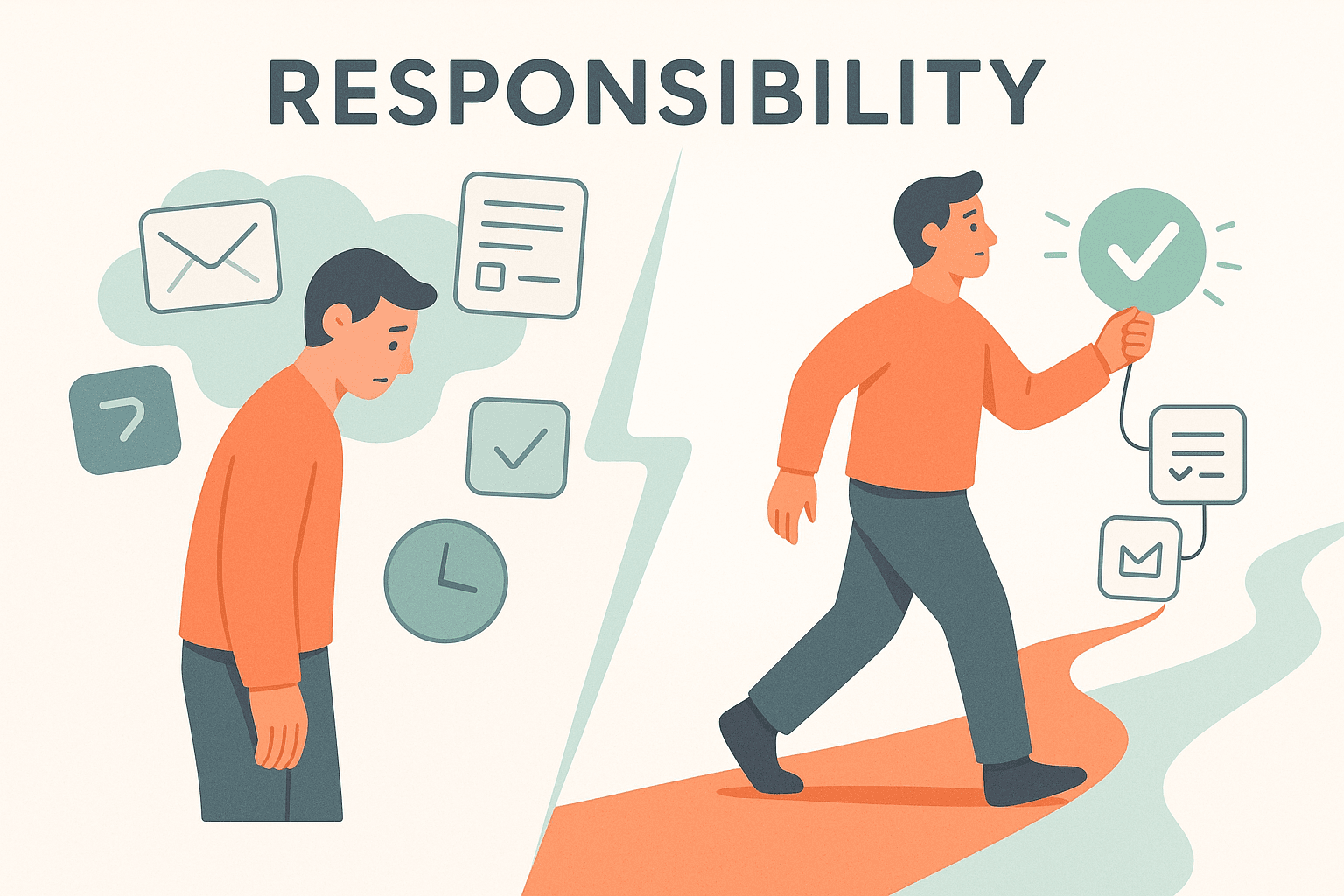
Table of contents:
Responsibility, Stripped of the Noble-Sounding Packaging
It starts with ownership, not perfection
Responsibility is not sainthood. Not halo-polishing. Not being endlessly available, endlessly useful, endlessly "good" in that exhausting, shiny way. It's simpler than that, and honestly a bit more uncomfortable: you notice that your choices have consequences, and you stop acting surprised every single time they do.
A responsible person does not need to be flawless. Thank heaven. They do need to stay in contact with reality. If they agree to something, they remember that the agreement exists. If they made a mess, they don't immediately sprint toward excuses like a cat hearing the cupboard door crack open. They stay with it. They say, yes, that was mine.
That's why responsibility feels so adult, even when the task itself is tiny. Sending the file. Showing up when you said you would. Admitting, "I dropped that." Not glamorous. Not cinematic. Still very powerful.
Your promises stop being casual noise
One of the clearest signs of responsibility is this: your "yes" stops sounding like confetti tossed in the air just to make a moment feel nice. You don't promise things because the silence feels awkward, because you want to seem kind, or because in the future-you have somehow become this mythical creature with endless energy, perfect focus, and no need for sleep.
You pause first. You check the boring but important stuff. Time. Bandwidth. Mood. Other commitments. Then you answer.
That pause matters more than people think. It turns responsibility into a thinking skill, not just a moral slogan stitched onto a decorative pillow. If you want to make that pause more useful, critical thinking helps you check reality before you commit, so your decisions are less emotional, less rushed, and much easier to stand behind later. You're not merely hardworking. You're calibrated. Your commitments fit reality better, so your reliability stops being random luck. And that changes things in work, friendship, dating, family life - all of it, really. People relax around someone whose yes actually means yes.
It shows up most clearly when things get inconvenient
Anyone can sound responsible on a calm Tuesday morning, coffee in hand, inbox under control, life still pretending to be tidy. The interesting part begins later. When energy drops. When plans shift. When there's that tempting little escape hatch marked, very politely, "ignore this until it becomes embarrassing."
Responsible people feel that temptation too. Of course they do. They're human, not toaster ovens. The difference is what happens next.
They follow through, or they speak up early. They don't vanish and quietly hope the whole situation will die in a corner without making eye contact. That kind of follow-through gets much easier when you build determination, because it helps you keep moving when the task becomes annoying, awkward, or emotionally inconvenient, instead of dropping it the second the mood changes. They update people. They renegotiate. They own the change. And when circumstances genuinely change, life gets easier when flexibility gets stronger, because adapting the plan without dodging ownership is often what real responsibility looks like under pressure. In real life, responsibility often looks a lot less like heroic endurance and a lot more like timely honesty. Which is less dramatic, yes - but much more useful.
There is also a moral side to it
Responsibility is not only about ticking boxes or finishing tasks. It has an ethical spine to it. That is why it naturally overlaps with honesty: not only telling the truth when asked, but being willing to face what is true about your actions before somebody else has to point it out for you. It shapes whether you admit an error nobody noticed. Whether you protect someone's trust when it would be easier not to. Whether you refuse a convenient shortcut that dumps the cost, mess, or awkwardness onto another person. Cheap move, that.
In that sense, responsibility overlaps with dependability, integrity, and that quiet inner feeling of, "This is mine to handle," instead of, "Well... maybe someone else will sort out the fallout."
So no, responsibility is not the same as obedience. And it's not just efficient wearing a serious face. It's a way of relating to your own actions. It says: my choices count, my word counts, and my absence counts too. That last part has a bite to it, doesn't it. A useful bite, though.
What Changes When Your Word Starts Carrying Weight
People stop bracing around you
When you're responsible, other people exhale. They don't need three reminders, a backup plan, and a quiet little prayer circle just because you said you'd handle something. That shift is bigger than it sounds. In teams, it reduces friction. In ordinary human language, it means people stop spending extra energy checking whether you really meant what you said.
And trust is not some fluffy bonus feature. It changes what people bring your way. Better opportunities. More freedom. More honest conversations. More room to move without being watched like a toddler holding grape juice near a white sofa.
You build self-trust, which is a different beast
A lot of people think responsibility is mostly about reputation. How others see you. Whether they think you're dependable. Sure, that matters. But the deeper win is internal, and it's quieter.
You begin to believe your own plans. And that inner shift has a lot in common with confidence, because self-trust grows when your actions stop contradicting your intentions and start giving you real proof that you can rely on yourself. If that still feels unfamiliar in practice, learning how to build confidence can make responsibility feel less like pressure and more like grounded trust in your own ability to follow through, especially when self-doubt keeps trying to rewrite the story. If that still feels unfamiliar in practice, learning how to build confidence can make responsibility feel less like pressure and more like grounded trust in your own ability to follow through, especially when self-doubt keeps trying to rewrite the story.
You put something in your calendar and it no longer feels like fiction. You make a promise to yourself and your brain doesn't instantly smirk and go, "Mhm, we'll see." That kind of self-trust is subtle, but it changes nearly everything. Goals feel less imaginary. Decisions feel less slippery. Even confidence starts feeling less performative. Less pep talk, more evidence.
You said you would do the thing. Then - tiny miracle, really - you did the thing.
Chaos loses some of its favorite hiding places
Responsibility does not make life tidy in a Pinterest sort of way. No one suddenly becomes a beige-toned productivity oracle with labelled baskets and lemon water. What it does is better: it cuts down the mess you could have prevented.
Fewer missed deadlines created by wishful thinking. Fewer awkward silences after overpromising. Fewer little lies told just to buy another day. And the gain isn't only productivity, not even close. It's mentally spacious. Air. Room in your own head.
Once you stop leaking energy through unfinished obligations, your attention starts coming back online. You can think again. Rest properly. Be present with people. Not perfectly - nobody lives like a monastery bell - but much more than before.
Your relationships get less theatrical and more solid
Responsibility strengthens relationships because it turns care into behavior. "I value you" sounds lovely, sure. Replying when you said you would. Owning your tone after a bad argument. Remembering the thing that mattered to the other person without needing a marching band and fireworks - that lands much deeper.
It also reduces all that exhausting blame-shuffling. You stop wasting hours trying to prove that your bad moment was technically understandable. Maybe it was understandable. Fine. Responsibility asks the better question: what part is still mine?
That question changes conversations. Funny enough, when people hear it from you, they often soften. Not always. People are people. But often enough that it matters. A lot, actually.
What Low Responsibility Quietly Does to a Person
You start living in pre-damage-control mode
When responsibility is weak, life develops a strange soundtrack. A little avoidance. A little bargaining. A steady hum of "I'll sort it out later." You keep things technically alive but emotionally abandoned. Nothing has fully exploded yet, which almost makes it worse. The stress stays low-grade and constant, like a fridge buzzing in the next room when you're trying to sleep. If that pattern feels uncomfortably familiar, it helps to notice how procrastination sneaks into ordinary days, because many responsibility problems do not begin with dramatic failure - they begin with small delays that slowly become a way of life.
Not dramatic enough to force change. Draining enough to wear you down anyway.
This is one reason people with low responsibility can look busy while feeling completely stuck. They spend their energy managing fallout instead of making clean choices. It's a miserable trade.
Shame grows in the gap between intention and action
Most irresponsible behavior does not come from evil. Or laziness. Or some cartoon-villain lack of character. Usually it grows out of discomfort avoidance. You don't want to disappoint, so you overpromise. You don't want conflict, so you disappear. You don't want to admit a delay, so you become weirdly optimistic for no good reason and hope tomorrow's version of you will be made of steel.
Then the gap widens. Between who you meant to be and what you actually did.
And that gap hurts. It breeds shame, defensiveness, irritability. For some people it also turns into touchiness, where even mild feedback feels sharper than it should because it lands on top of unfinished guilt and a part of you already expects to be exposed. You may even get touchy around feedback because some part of you already knows where the bruise is. The criticism doesn't land on healthy skin. It landed where it was sore already.
Your reputation gets edited without your permission
People rarely sit you down and announce, "Just so you know, I trust you less now." They simply adapt. Quietly. They stop giving you the important task. They stop leaning on you emotionally. They double-check. They ask someone else first. They build around you.
That's how unreliability damages a life. Not always through one spectacular disaster, but through a hundred tiny downgrades in how people place you. Less trust. Less scope. Less room.
Responsibility and accountability are not identical, but they're close cousins. One is about owning the task and commitment. The other adds answerability for what happened. In daily life, both matter because once people can't predict your follow-through, they reduce your role. Harsh? Maybe. Real? Very.
You may overcorrect and become responsible for everything
Here's the twist. Some people don't lack responsibility at all. They misapply it. They swallow other adults' tasks, moods, consequences, and emotional clutter as if they personally got hired to manage the whole planet. That is not a healthy responsibility. That is boundary confusion in a nice coat.
If you are constantly rescuing, reminding, overfunctioning, smoothing things over, carrying the emotional admin for everyone within a ten-mile radius... you may look responsible while quietly cooking yourself into resentment.
So yes, too little responsibility creates mess. But distorted responsibility creates exhaustion, anger, and that martyr energy nobody actually requested. The healthy version sits in the middle: I handle my part fully. I do not adopt the entire solar system.
How to Build Responsibility Without Becoming Rigid and Miserable
Audit your loose ends like a detective, not a judge
Take twenty minutes and list every open loop you can think of. Messages you owe. Promises you made. Tasks you accepted. Decisions you've been half-avoiding with suspicious creativity. Don't do this to punish yourself. Do it to get out of vagueness.
Responsibility grows fast when things become visible. The mind loves fog because fog lets it pretend. Paper is much ruder. The paper says, "Here. This is the pile." A little rude, yes. Very helpful.
Now circle three items only. Not twelve. Finish one. Reschedule one with a real date. Cancel one honestly. That small move can shift a lot. Suddenly responsibility is not a personality crisis. It's a behavior. A very doable one.
Lower the number of casual yeses
For one week, stop answering requests on autopilot. No instant yes just because the moment feels uncomfortable. Replace it with one simple sentence: "Let me check what I can realistically do." That line is gold. Honestly, frame it if you need to.
It gives your frontal lobe a chance to join the meeting. Then decide based on actual capacity, not politeness panic.
This matters because responsibility begins before the promise, not after it. A realistic no is often far more responsible than a warm, enthusiastic yes that later rots in silence. Not the prettiest truth, maybe. Still a very useful one.
Practice visible ownership in small daily moments
Choose one tiny action each day where you deliberately step into ownership. Send the update before anyone asks. Admit the misunderstanding first. Finish the annoying task before wandering off toward some shinier, more flattering project. Say, "I forgot - that's on me, here's the fix."
These moments look ordinary from the outside. Almost boring. But inside, they change something. Bit by bit, they teach your identity a new rhythm: I face things. I don't wriggle away from them. I don't decorate them with excuses and hope no one notices.
The point is repetition. Responsibility is less like lightning and more like brushing your teeth. Not sexy. Wildly useful. Miss a day? Continue anyway.
Train consequence tolerance
A hidden piece of responsibility is learning to survive the discomfort that comes after honest action. Maybe someone gets annoyed because you changed the deadline instead of pretending. Maybe you have to admit you mishandled something. Maybe you choose the necessary option, not the popular one. None of that feels fun. Let's not lie to each other.
Responsible people are not fearless. They're just less ruled by the urge to escape immediate discomfort.
Try this: once a day, do one small right thing that has a social cost. Clarify a boundary. Correct an error. Say you can't take on more. Stay warm, stay decent - but don't get slippery. Over time, your nervous system learns that consequences are often survivable. And once that clicks, a lot starts changing.
Do You Need to Work on Responsibility Right Now?
Not always. Sometimes responsibility really is the bottleneck. Sometimes it only looks like the bottleneck, while the deeper issue is anxiety, people-pleasing, weak boundaries, or plain old exhaustion. If your nervous system is stuck in constant alert mode, even small obligations can start to feel strangely heavy, so it may help to notice how hypervigilance quietly warps daily life before you decide that the whole problem is simply a lack of discipline. If your responsibility problems show up most clearly in business - rushed decisions, overpromising, or treating downside like a problem for later - it may help to ask whether caution should be the next thing you work on, because some follow-through problems are really poor risk calibration in disguise. A person can't build a clean follow-through very well if they're running on fumes and calling it discipline. That usually ends badly. And if your commitments keep going sideways because your inner signal is always noisy - you say yes too fast, ignore hesitation, then regret it later - it may be worth learning how to train your intuition, so your decisions feel clearer before they turn into obligations you have to carry.
So it helps to choose one main growth theme instead of launching a full-scale attack on your personality with a spreadsheet and a guilty expression. If your follow-through keeps breaking down because your goals are vague or borrowed from other people, it may also be worth looking at ambition, because responsibility works much better when you actually care about the direction your effort is serving. If responsibility is the thing tripping you up - missed commitments, broken trust, constant avoidance, too many loose ends clinking around in your head - then yes, this may be the right place to begin.
If not, forcing it can turn into self-scolding with fancier vocabulary. And who needs that.
There's also a simpler way to sort priorities. AI Coach can help you figure out which quality is worth focusing on first and give you a practical plan for the first three days. Sometimes the smartest move is not "push harder." It's "work on the right thing first." Worth thinking about, isn't it?
Frequently Asked Questions (FAQ)
Is responsibility the same as accountability?
Not exactly. Responsibility is more about owning tasks, choices, and commitments. Accountability usually adds answerability for results and consequences. In ordinary life, though, the two overlap so much that people mix them up all the time. A useful shortcut is this: responsibility asks, "What is mine to handle?" Accountability adds, "And how will I answer for what happened?"
Can you be a responsible person and still miss deadlines sometimes?
Yes, absolutely. Responsibility does not mean a spotless record. It means you handle misses cleanly. You warn early. You explain clearly. You repair what you can. And you learn from the pattern instead of behaving like the deadline attacked you personally in a dark alley.
What is the difference between responsibility and people-pleasing?
Responsibility is doing your part with clarity. People-pleasing is saying yes to avoid discomfort, tension, or disapproval. One builds trust. The other usually builds overcommitment, resentment, and eventually unreliable behavior because too many of the yeses were fake from the start.
Does responsibility make life heavier?
At first, a little. You stop hiding from things, and reality has edges. But over time it usually makes life lighter, because you carry fewer loose ends, fewer excuses, and less background guilt buzzing under everything. Heavy in the short term. Spacious in the long term.
Why do some smart people still struggle with responsibility?
Because intelligence does not automatically produce follow-through. Responsibility depends on habits, emotional tolerance, self-regulation, and the ability to face consequences without instantly squirming away. A very bright person can still avoid, delay, overpromise, or vanish the minute discomfort enters the room.
Can responsibility be learned in adulthood?
Yes. Plenty of people start late. Upbringing, culture, family dynamics, and work environments can train responsibility early - or muddy it terribly. Adulthood is still more than enough time to build better ownership, clearer commitments, and more honest patterns. Late is not the same as impossible. Not even close.
How does responsibility affect romantic relationships?
It creates steadiness. Responsible partners don't just say they care in a tender voice and call it a day. They show up. They repair ruptures. They own their tone. They carry their share of shared life. That builds trust and helps prevent that awful parent-child dynamic that can sneak into adult relationships when one person is always chasing and the other is always "forgetting."
Can someone be too responsible?
Yes. Over-responsibility is real. It happens when you take charge of other adults' emotions, reminders, tasks, or consequences as if everything is somehow your burden to carry. That usually leads to burnout and a very simmery kind of anger. Healthy responsibility includes limits. An important word, that: limits.
What are everyday signs that my responsibility is weaker than I think?
A few clues: vague promises, late updates, strong discomfort around admitting mistakes, lots of "I meant to," open loops everywhere, and a habit of hoping problems will dissolve if ignored long enough. Charming strategy. Rarely effective.
What is the fastest way to start improving responsibility today?
Do one thing you already owe. Not a fun thing. Not the identity-flattering thing. The owed thing. Send it, finish it, clarify it, or cancel it honestly. Responsibility becomes real the moment your word and your action finally meet in the same room.