
Confidence is that inner steadiness that lets you move before the marching band of approval shows up. When it is missing, life starts to feel a bit crooked. You overthink small decisions. You rewrite a two-line message like it is testimony in court. You hand extra weight to people with louder voices, not because they are wiser, but because they sound sure. And plenty of very capable people live exactly like this, by the way. From the outside? Totally fine. Inside, they are holding emergency meetings over things that really should not require a panel.
If that felt annoyingly familiar, well... there is probably something worth looking at here. The nice part is that confidence does not turn you into some peacocking, look-at-me creature. It gives you something much more useful: a calmer head, cleaner decisions, and the quiet relief of feeling like your own voice counts in your own life. Which, frankly, seems fair.
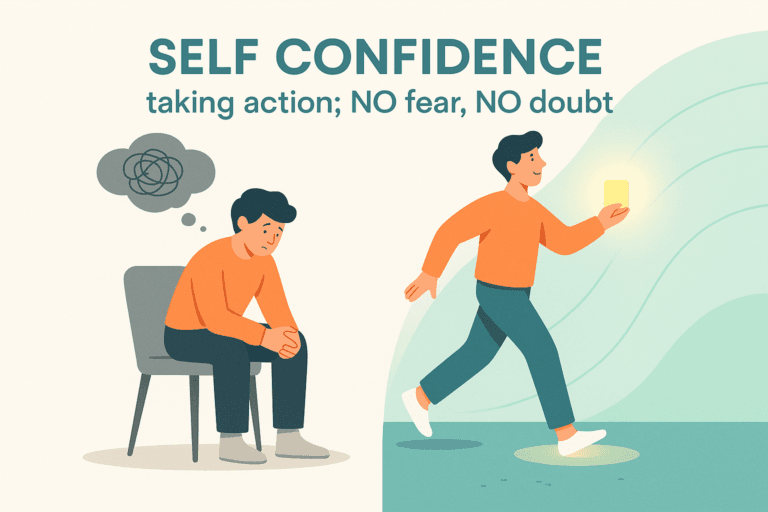
Table of contents:
Confidence: what it really is when you strip away the movie version
It is self-trust, not stage performance
Confidence gets confused with loudness all the time. We picture the person who talks first, laughs biggest, takes up space like charisma is paying the rent. Sometimes that really is confidence. Sometimes it is just volume with good posture. Real confidence is usually quieter. It is trusting your ability, your judgment, and your capacity to handle what comes next, even when the outcome is foggy and slightly inconvenient.
That last bit matters more than people think. A confident person is not walking around thinking, "I will definitely win." It is closer to, "I can deal with this." Very different energy. Less fantasy, more footing. Confidence is not believing nothing will go wrong. It is believing you will not completely unravel if something does.
You can see it in how a person decides
One of the clearest signs of confidence is decision ownership. Confident people still ask for advice - of course they do. They are not allergic to other viewpoints. In fact, confidence gets sharper alongside how to become more open-minded without becoming gullible, because listening to other people should widen your thinking, not replace it. But they do not automatically treat everyone else's opinion as more legitimate than their own. They listen, weigh things up, choose, and stay with that choice long enough to learn from it. There is a bit of backbone in that. It also overlaps with what justice really means in everyday life, because confidence is not only having a view - it is being willing to stand by what feels true, fair, or necessary when the room starts leaning the other way.
You see it in tiny moments. Speaking in a meeting before you have rehearsed every sentence into dust. Saying yes to an opportunity before you feel 112 percent ready. Saying no, too, when something clashes with your values, your energy, or your already-overstuffed week. Confidence makes action less sticky. Not reckless. Just... less jammed up by the fear of looking foolish.
It stays present under a little social heat
Another clue: confidence helps people stay relatively steady when they are visible. Not perfectly calm, not drifting through life like a zen housecat, but present. They can speak while being watched. They can tolerate disagreement without turning to vapor. They can survive not being the smartest, funniest, most polished person in the room for five entire minutes. Which is useful, because adult life keeps arranging little public moments whether we ordered them or not.
This is why confidence spills into body language. Not because posture is magic - it is not - but because self-trust leaks into the body. Eye contact gets easier. The voice stops sounding like it is apologizing for existing. The shoulders stop giving off that "I would like to exit this conversation through the floorboards" vibe.
It includes risk tolerance, but not recklessness
Confident people are usually more willing to take sensible risks. They apply, ask, pitch, begin, try. Not because they are adrenaline junkies. Mostly because they do not need total certainty before they move. They trust that if things wobble, they can respond.
And maybe that is the heart of it: confidence is flexible self-belief. It grows from evidence, experience, and repeated contact with challenge. You build it when you use your strengths on purpose and notice - with actual proof, not wishful thinking - that you are more capable than your fear keeps insisting. Not invincible. Capable. Better word, honestly.
What starts changing when confidence gets stronger
Work stops feeling like one long audition
When confidence grows, work gets less emotionally expensive. You burn less energy trying to sound flawless, predict every reaction, or sand down every rough edge before anyone can notice it. That frees up a ridiculous amount of attention. Instead of performing competence all day, you can actually use it. Novel concept, I know. That matters even more in shared projects, because confidence makes it easier to contribute without overediting yourself first, and what gets easier when you can work well with people often starts with being willing to speak, coordinate, and stay engaged while the work is still unfolding.
This shows up everywhere: meetings, interviews, negotiations, presentations, awkward check-ins with someone senior who says "quick chat" and ruins your nervous system for twenty minutes. A confident person is more likely to speak while the idea still matters, not three hours later in the shower when the conversation is over and the shampoo bottle is your only audience. They also recover faster when challenged. Feedback still stings sometimes - because they are human, not plywood - but it does not instantly become "I am inadequate." It becomes information. Irritating information, maybe. Still useful.
Relationships get clearer and less twisty
Confidence improves relationships in a surprisingly practical way: you become easier to understand. You ask for what you need more directly. You are less likely to shape-shift for approval, laugh at things you dislike, agree when you mean maybe, or say maybe when you very much mean no. That cuts down on a lot of quiet resentment. It also works beautifully alongside what empathy is, its main traits and manifestations, because understanding someone else's feelings matters a lot more when you have not gone missing from your own.
It helps with attraction too, though not in the cheesy pickup-line way. Confidence feels good to be around because there is less emotional static. People do not have to keep decoding whether you mean what you say. There is less reassurance-fishing, less hiding behind vagueness, less shrinking yourself to seem harmless or lovable. Cleaner contact, basically. And cleaner contact is underrated.
You learn faster because failure gets less dramatic
Stronger confidence makes growth easier because it changes your relationship with mistakes. If your self-worth is hanging by a thread, every error feels like proof that the thread had concerns. But confidence gives you breathing room. A bad attempt can remain what it is: a bad attempt. It does not have to become a grand diagnosis of your whole personality.
That is a big shift. It means you try more things. You experiment. You ask the question, send the draft, begin before mastery arrives in a golden chariot. And because you act more, you get more real feedback from life - which is where competence actually grows. Funny little loop, that. Confidence helps action, action creates evidence, evidence strengthens confidence. This is also where how to develop curiosity in real life becomes unexpectedly useful, because curiosity turns mistakes from humiliation into data. Not delightful data, always. Still data.
Your presence becomes steadier, and people feel it
There is also a bodily, emotional shift. With more confidence, your nervous system is not constantly patrolling for signs that you are about to be exposed as a fraud, a nuisance, or some accidental guest in your own life. You can settle. Breathe. Stay in the room without mentally preparing your exit speech.
People notice this, even if they cannot explain why. A confident person does not need to dominate to feel solid. They can be quiet without seeming erased. Warm without becoming over-accommodating. They can walk into uncertainty and still look like they belong there. And that feeling - that simple "I can be here" feeling - changes more than it seems. Careers shift on it. Relationships soften on it. Whole identities, honestly, get a little less cramped.
What low confidence quietly does to your life
You start borrowing other people's certainty
When confidence is shaky, louder voices get too much power. Someone sounds polished, decisive, sure of themselves, and suddenly your own judgment starts wobbling like a shopping cart with one deeply cursed wheel. Even when you know your stuff. Even when your instinct was good two minutes ago. Low confidence does that. It makes your inner authority strangely easy to overrule.
So you wait for permission. You poll the room too early. You ask, "What do you think?" before you have even let yourself think. Over time, this becomes a miserable habit. You stop practicing trust in your own mind, which makes you even more dependent on outside reassurance. Neat little trap. Not neat in a fun way. And often that trap gets reinforced by inner critic traits and telltale patterns, where self-doubt starts sounding so familiar that you mistake it for objectivity and let it overrule you before reality has even had a chance to answer.
Ordinary risks start feeling strangely huge
Without enough confidence, normal life gets inflated. Sending the email feels loaded. Joining the conversation feels risky. Applying for the role feels almost theatrical, like - sorry, who exactly do you think you are? The action itself may be small, but inside it carries the weight of possible shame.
That is why low confidence so often disguises itself as procrastination or "just being careful." Sometimes it is caution, sure. Often it is fear in sensible clothes. You stay in preparation mode too long. You tell yourself you need more time, more certainty, more polish, one more tweak, one more podcast, one more sign from the universe. Meanwhile the moment moves on. Then comes that specific little ache of watching other people step into spaces where you froze. If this keeps happening, it helps to separate insecurity from when time management is weak the day starts bossing you around, because not every delay means you are afraid - sometimes your day is simply running you instead of supporting you, and that makes hesitation even louder.
Feedback becomes too personal, too fast
Another cost is how quickly low confidence turns correction into injury. Someone questions your idea, points out a mistake, or simply responds without much enthusiasm, and your whole system jumps to a brutal conclusion: I am not good enough. I embarrassed myself. I should have stayed quiet.
That reaction is exhausting. It also makes growth harder than it needs to be. If every imperfect moment feels like a verdict on your worth, you will naturally avoid the exact situations that build skill. Then life gets smaller. Safer, maybe, on paper. Inside, though? Often tighter, duller, more frustrating than it has any right to be.
You begin living below your real capacity
This is the part that really stings. Low confidence makes people underuse themselves. They become the person with the good idea who never says it. The person who wants more but keeps choosing the smaller, familiar version. The person waiting to "feel ready" as if readiness arrives by courier.
After a while, this creates a quiet sadness. Not always dramatic. Sometimes it is just a background hum - the sense that your life is somehow narrower than it could be. And if that narrowing starts to feel less like caution and more like disconnection, it helps to notice when loneliness starts running the show, because low confidence often shrinks your world before you fully realize what it is taking with it. You know there is more in you, but it does not quite reach the surface. And that gap, between what you could express and what you keep containing, can turn into self-doubt, envy, resentment, even a weird kind of numbness. Not because you are weak. Because an underused self gets tired of hiding. Who wouldn't?
How to build confidence without pretending to be someone else
Keep proof, not vague compliments
Confidence grows best on evidence. So start collecting some. Not in a cringey "I am amazing" scrapbook way - easy now - but in a plain record of what you genuinely do well. Write down five strengths and, next to each one, one concrete piece of proof. Maybe you calm people down in conflict. Maybe you explain messy things clearly. Maybe you finish what you start when everyone else has drifted off for snacks. The proof is what matters. "I built the dashboard." "My manager trusts me with difficult clients." "Friends call me when things go sideways."
Your brain forgets success at an almost insulting speed and stores awkward moments like rare collector's items. A written record helps rebalance that. It gives your mind something sturdier than mood.
Let your opinion arrive before the room's does
For one week, try a small rule: before asking anyone else what they think, pause and decide what you think first. About a purchase, a plan, a draft, a social situation, whatever is in front of you. You can still gather input after that. If forming an opinion feels weirdly exhausting rather than simply scary, it may help to understand decision fatigue in plain English, because an overloaded mind can look unconfident when it is actually just worn out by too many choices. The point is not to become stubborn. It is to stop treating your own judgment like a backup singer.
This is especially useful if you tend to crowdsource your confidence. Forming an opinion first builds traction inside. It reminds you that your perspective is not automatically the weakest one at the table. Sometimes it is the clearest one - awkward, maybe, for the loud guy in the room, but still.
Practice deliberate exposure in tiny doses
Confidence is not built by thinking brave thoughts in a very intense notebook. It is built by doing slightly uncomfortable things and discovering you survive them. So pick one situation where you usually shrink a little and step into it on purpose. Speak once in the meeting. Introduce yourself first. Ask the follow-up question. Wear the thing you keep overthinking. Volunteer for the short presentation instead of becoming mysteriously fascinated by your notes.
Start small enough that you can actually do it without spiraling, but real enough that it counts. Repetition matters more than drama here. Confidence likes reps. It is weirdly gym-like in that sense - not glamorous, just effective.
Use the body, then make one clean move
Your body can help your mind catch up. Before an important moment, plant both feet, drop your shoulders, exhale slowly, and look at one fixed point for a second before you speak. It sounds almost too simple. Still works. The goal is not to look intimidating or perform "power." It is to stop sending your own brain the message that danger is everywhere and you should probably become wallpaper.
Then pair that physical steadiness with action. Choose one decision you have been dragging around like a rattly suitcase and make it today. A clear yes. A clear no. A first step without three more rounds of validation. You can also make yourself a short confidence phrase that feels believable, not cheesy. Something like, "I can handle this conversation," or, "I know enough to begin." Say it, then move.
That last part is the trick, honestly. Confidence usually shows up after contact with action, not before. Annoying? Absolutely. Also true.
Should confidence be the thing you work on right now?
Not always. Some people really do need more confidence. Others are already pushing themselves hard enough, and what they actually need is rest, healing after criticism, stronger boundaries, or less time around people who make them feel small for sport. In cases like that, it helps to understand what a lack of boundaries quietly does to a life, because confidence rarely grows well in places where your limits keep getting crossed. If the soil is bad, yelling "be more confident" at the plant is not exactly genius gardening.
It helps to pick one growth priority at a time. Otherwise you end up trying to become more confident, more disciplined, more social, more focused, and less tired all in the same week, which is... ambitious in the least useful way. Look at the real friction in your life. Are you mainly held back by hesitation and self-doubt, or is something else draining the battery first? If you want a more structured way to sort that out, AI Coach can help you see whether confidence is truly the issue or whether another skill needs attention first, which makes the next step much clearer.
Frequently Asked Questions (FAQ)
Why do I seem confident in private but freeze around other people?
Because confidence is often context-specific. You may trust your ability just fine when no one is watching, then lose access to that trust the second social evaluation enters the room. The issue is not always lack of skill. Often it is fear of exposure, judgment, or getting something wrong in public. That is why small, repeated moments of visibility help more than endlessly thinking about confidence in the abstract.
Can confidence exist alongside anxiety?
Yes, very much. A person can feel nervous and still act with confidence. Confidence is not the absence of adrenaline. It is the ability to stay connected to your own capacity while your body is doing background drama. Plenty of confident people feel stress before interviews, dates, speeches, or hard conversations. They just do not mistake that stress for a stop sign.
What is the difference between confidence and self-esteem?
Self-esteem is your broader sense of worth. Confidence is more about trusting your ability to handle specific situations. You can have decent self-esteem and still lack confidence at work, in dating, or in conflict. You can also look confident in one area and still feel shaky about yourself overall. They influence each other, sure, but they are not twins. More like cousins who borrow each other's clothes.
Why does my confidence disappear around certain people?
Because some relationships wake up old patterns fast. Maybe that person is critical, dominant, dismissive, unpredictable, or reminds you of someone whose approval once mattered too much. Confidence is harder to access when your nervous system slips into "stay small, stay safe" mode. In cases like that, building confidence may need to include stronger boundaries - not just pep talks in the mirror.
Is confidence something you are born with, or can it really be learned?
It can absolutely be learned. Temperament plays a role, and early experiences matter, but confidence grows through evidence, practice, and repeated contact with challenge. People build it when they act, survive awkwardness, develop skill, and begin noticing that they are more capable than their fear predicted. Slow work, yes. Real work too. And worth it.
Can body language actually make me more confident, or is that overhyped?
Body language will not magically transform your whole identity by Tuesday. But it can help. When you breathe more slowly, lift your gaze, and stop folding in on yourself, your brain often gets a steadier signal: we are not under attack. It is not fake confidence. It is physical support for emotional steadiness. Small thing, useful thing.
How do I rebuild confidence after failing publicly?
First, separate the event from your identity. One bad presentation, one awkward meeting, one rejection, one visible mistake - none of that can honestly define your entire capacity unless you keep hiring it for that role. Then go back into action in a smaller, more controlled way. Confidence tends to return faster through re-entry than through hiding and replaying the disaster in cinematic detail at 1 a.m.
Why do praise and compliments help for about five minutes, then fade?
Because borrowed confidence is flimsy. External reassurance can soothe you, and there is nothing wrong with that, but if it is not connected to your own felt evidence, it rarely sticks. That is why concrete proof matters more than generic praise. "You are great" is pleasant. "You handled that messy client call really well, and here is why" gives your mind something firmer to stand on.
Does becoming more skilled automatically make a person more confident?
Not always. Skill helps, but some people keep moving the goalposts and never let competence land emotionally. They improve, then immediately focus on what is still missing. Or they compare themselves upward so aggressively that no progress feels like enough. Confidence grows faster when skill is paired with acknowledgment - seeing what you can do, not only what is left to master.
How can I help a child or teenager build real confidence?
Give them chances to do hard things, not just compliments for existing. Let them try, wobble, improve, and notice their own progress. Praise effort, strategy, courage, recovery, follow-through - concrete stuff. Also, watch the urge to overprotect. A kid who never gets to struggle a bit may look safe, but they do not get much proof that they can cope. And proof, more than pep, is what gives confidence its bones.