
You read about self-development, save tons of "useful" posts, take personality tests - and still catch the same feeling every evening: "I'm trying, but my head is a mess. Where do I even start?" You seem to have goals, potential, a real desire to grow, but every new course only adds more information, not more clarity. Inside, you're quietly annoyed at yourself: "Something's wrong with me if I still haven't figured this out."
An AI coach is a digital conversation partner that helps you sort out that mental chaos, ask better questions, and show you which thread to pull first. If you often feel stuck, doubtful, scattered - you're almost certainly missing exactly this kind of tool. If none of this sounds like you, you can close the page. But if there's even a small "yes, that's me" inside, keep reading: you'll see how an AI coach works, what it can actually do for you, and how to start using it safely.
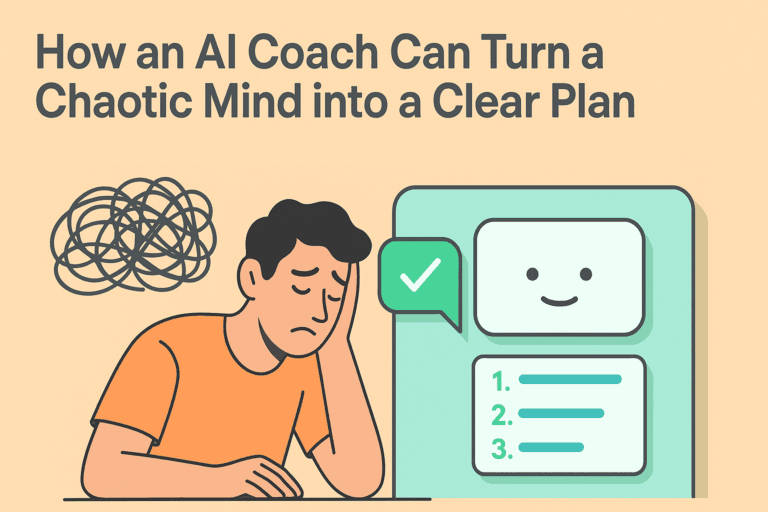
Table of contents:
AI coach: a personal mentor that's always with you
A digital mentor that asks questions instead of giving lectures
An AI coach is not a "smart toy" and not another chatbot throwing motivational quotes at you. It's a system that leads you through a structured conversation: it asks clarifying questions, helps you look at a situation from different angles, and guides you toward a specific goal and next step. It feels more like talking to a thoughtful mentor - someone who doesn't pressure, doesn't criticize, and doesn't hand you ready-made answers.
Important: an AI coach doesn't think
instead of you. It helps you think about yourself more honestly and more deeply than you usually do on the run, in your own head.
Personal focus instead of generic "advice for everyone"
Most articles and courses tell you that you "need to develop communication, leadership, and time management." But who needs what, exactly - you usually figure out by trial and error. An AI coach builds the whole conversation around your specific role, task, and context: "product lead in a small tech team," "marketer on the edge of burnout," "specialist preparing for a move into management."
Questions and recommendations don't appear out of nowhere; they are based on your answers. As a result, you don't get a list of 15 vague qualities - you see what is actually most critical for you right now.
A calm companion, no judgment, no shame
For many people, it's hard to talk openly about fears, doubts, and failures: shame gets in the way; it feels awkward to "complain" to a real person; there's always the risk of getting unsolicited advice. And if you notice you get easily irritated or "sting" at small comments, that's often not a character flaw - it's a stress signal. This piece breaks down the hidden cost of that pattern: when touchiness becomes a daily tax. An AI coach offers something rare - the chance to say things exactly as they are, without fear of being judged.
You can honestly admit: "Yes, I sabotage my tasks," "Yes, I'm scared to grow into a bigger role," "Yes, I'm afraid people will realize I'm an impostor." If that "impostor" fear sounds familiar, here's a grounded explanation (without drama) of what's actually happening under the hood: imposter syndrome explained without the hype. In return, you won't get a lecture about how you should "be stronger." Instead you get a calm breakdown: where you're stuck, what inner conflicts are getting in the way, and what a realistic starting point for change might be. This lowers internal tension and creates a sense of safe space for thinking.
A set of "mirrors" for different roles and areas of life
You can think of an AI coach as a set of role-specific mirrors. Today, you talk to it as a career navigator: you choose a role like "team lead," "founder," "analyst," and see which personal skills matter most to develop in that role. Tomorrow, you might come with a different focus - say, personal productivity or communication with a partner.
Importantly, an AI coach doesn't trap you in one label ("you're an introvert, deal with it"). It helps you see how your traits show up in different contexts and what is blocking progress in your current role - not "in life in general."
A clear session flow instead of chaotic self-analysis
One of the key features of an AI coach is a clear interaction script. Instead of jumping between "I want to change jobs," "I need more discipline," and "I haven't rested in months," you go through a consistent route: a short intake, clarification of your role, assessment of key personal qualities, picking out one main "bottleneck," and a concrete plan for the next few days.
Many users say that even just going through structured questions already brings their thoughts into order. Where there used to be a knot, you get a map: here's where I am, here's where I want to go, here's the growth point it makes sense to start with.
What an AI coach doesn't do - and where its limits are
Let's be honest about the boundaries. An AI coach does not make medical diagnoses and does not work with severe conditions like clinical depression, panic attacks, or trauma that requires in-person psychotherapy. It doesn't make decisions for you and doesn't take responsibility for your choices.
This is a tool for people who are generally functioning in life, but feel stuck in development: can't choose priorities, drowning in tasks, constantly postponing important things. If you're facing a crisis connected to mental health, serious suicidal thoughts, violence, or addiction - you need a human professional and emergency help. In that case, an AI coach can be a supplement at best, but not the main way of working on yourself.
How an AI coach turns mental chaos into a clear action plan
Bringing order to your goals and expectations
The main benefit of an AI coach is helping you turn the vague "I want to grow" into a concrete, grounded request. Instead of fuzzy desires like "be confident," "earn more," "find my thing," you gradually arrive at formulations like: "as a manager, learn to set boundaries and delegate," or "as a marketer, stop missing deadlines because of perfectionism."
A clearly formulated request is already half the solution. When you see what exactly you want to change, it becomes easier to drop the extra, stop copying others, and stop chasing fashionable trends. You get the feeling: finally, I'm working on my stuff, not chasing what looks cool on LinkedIn or Instagram.
Reducing overwhelm and the "I know a lot, but do little" syndrome
An AI coach helps you choose one main growth point instead of trying to "upgrade everything at once." The system highlights which personal quality is currently slowing down your role the most: responsibility, discipline, ability to negotiate, self-confidence, emotional regulation, and so on.
Instead of randomly testing new habits, you get a single priority and a short action plan for the next few days. This lowers anxiety and mental noise: you don't need to hold twenty development tasks in your head - it's enough to do three clear steps. In real life, this kind of focus is what usually creates the first noticeable shifts.
Helping you get out of procrastination without beating yourself up
When you drag tasks out for weeks, the standard advice is "just start." But procrastination almost always hides fear of judgment, mixed expectations, a conflict between "have to" and "want to." If you want a deeper, practical breakdown of what procrastination really is (and why "just start" fails), use this guide as a companion: procrastination up close: what it is and how it shows up.
An AI coach doesn't shame you for postponing things. It helps you gently unpack what you're actually afraid of, where the resistance comes from, and how to make the first step feel safer. Sometimes the answer is to shrink the task to a tiny action. Sometimes it's to make a clear deal with yourself on a deadline and a reward. Sometimes it's to admit honestly that this task isn't truly yours - and let it go.
As a result, the feeling of inner violence fades, and you start acting more out of self-care than out of guilt.
Supporting you at career crossroads and in role changes
Career growth almost always means a shift in what people expect from you as a professional. Yesterday, they wanted solid individual work; today, they want you to handle people, conflicts, and leadership expectations.
An AI coach helps you see which personal qualities become critical at a new level: where you're already strong, and where it's still a "weak spot." It doesn't tell you "yes, take the promotion" or "no, you're not ready." It helps you weigh risks and resources.
This is especially useful when you're thinking about accepting an offer, changing direction, or taking on a team. Instead of throwing darts in the dark, you get a more honest conversation with yourself.
Saving you time and money on random courses and challenges
One hidden benefit of an AI coach is that you stop buying random stuff "just in case." Once it's clear what you'll be working on in the next weeks, it's much easier to filter out the noise. You can consciously pick one course or book for your exact task instead of collecting programs that sit untouched.
You stop investing in "development in general" and start investing in a specific skill that actually drives your income, confidence, or influence. That's not just budget savings - it also reduces that nagging guilt about "dozens of paid programs I never finished."
Turning insights into action instead of pretty notes
Many people are great at "developing themselves in notes": they make summaries, save quotes, post insights on social media - and then live exactly the same way. An AI coach is designed so that each conversation ends not with ideas, but with simple actions: what you'll try in the next three days, how you'll know it's working, and when you'll come back to reflect.
This "awareness - experiment - reflection" loop integrates changes into real life much better. Over time you build a habit: if I realize something about myself, the natural next step is to run a small test in reality - not just admire my own depth.
Who an AI coach tends to work especially well for
Entrepreneurs and business owners
Entrepreneurs have a special pain: every decision is on you, every risk is on you, and in the daily chaos it's hard to even see where
you as a person are stuck. An AI coach helps separate business issues from personal ones: it shows that the core problem isn't a lack of tools, but maybe fear of delegating, a need to control everything, or difficulty saying "no."
Instead of "I need to get my business in order," you see something like: right now it's critical to build team responsibility - and for me personally, to learn to set boundaries. That reduces the feeling of loneliness and overload, because you finally have a clear direction for your energy.
Managers and team leads
Managers are often squeezed between expectations from above and from below. The team wants support, inspiration, and clarity; leadership wants results at any cost. It's an easy recipe for burnout, micromanagement - or avoiding responsibility.
An AI coach helps you honestly look at which of your personal habits are making leadership harder: difficulty giving feedback, wanting everyone to like you, fear of conflict, tendency to do everything yourself. By focusing on one key growth area, it becomes easier to build new patterns: clearer agreements, honest conversations, realistic expectations for yourself and your team.
Experts, consultants, and freelancers
Independent specialists live in a special mode: you're the product, the salesperson, the marketer, and the accountant all at once. Your personal traits show up instantly in your income: it's hard to ask for money, you struggle to finish projects, you're afraid of approaching bigger clients.
An AI coach helps you see which traits are currently cutting your revenue: insecurity, lack of structure, fear of sales, perfectionism. The conversation isn't about a vague "build your personal brand," but about specific steps: how to talk about your fees, how to plan your workload, and how not to miss deadlines.
As a result, not only do your professional skills grow - your self-respect as an expert grows too.
Employees who feel stuck under a career ceiling
If you've been in a job for a while and feel like you're spinning at the same level without understanding why you're not advancing - an AI coach can act as that "honest mirror." It helps separate actual market limits from internal ones: insecurity, passive attitude, fear of changing jobs, a habit of "not sticking your neck out."
Instead of waiting for the "perfect moment" or ideal employer for years, you start changing what is in your control: how you talk to your manager, how much initiative you show, how you discuss your results. You regain the sense of influence over your own career - something that's often missing in corporate environments.
Students and career changers
Switching into a new field always comes with a flood of questions: "What if I can't handle it?", "What if I'm too late?", "What personality traits matter in this job at all?" An AI coach helps you not drown in others' expectations and trendy advice, but figure out what fits you personally, how you already show up, and what's worth developing first.
Instead of "I'm a complete beginner, I need everything," you see: here are my strengths, here's what's getting in the way, here's what to start with in the next few weeks. That reduces anxiety and gives the sense that this transition can be done gradually, step by step - not as a jump into the void.
Teams and HR who want structured people development
If you're responsible for people - as an HR, team lead, or department head - you face the question: how do you develop employees in a way that actually helps the business, not just "ticks a box"?
An AI coach can be used as an entry point: people go through short diagnostic sessions, get their main growth areas, and you see an aggregated picture across the team. This helps launch targeted programs for specific needs instead of generic "soft skills for everyone": some need discipline, some communication, some ownership.
Employees feel that development is tailored to them, not template-based - and they engage much more willingly.
How an AI coach "thinks": what its questions and insights are based on
Bringing together the best of classic approaches
An AI coach isn't a random list of questions. It's a careful mix of proven approaches. Under the hood are ideas from coaching, organizational psychology, research on personality traits, and practical career counseling.
It's not "pure theory" - it's what actually helps people make decisions and change behavior. The system asks questions so that you look at both emotions and facts at the same time: what you feel, what you've already done, what situations keep repeating. A useful side effect is sharper thinking: you get better at separating evidence from assumptions, especially when you're stressed. If you want to train that skill directly, start here: what critical thinking is. It's closer to a good session with a live specialist than to a typical online test that spits out a dry "INFJ" and leaves you alone with a PDF.
Inspired by leading psychometric models
When designing the logic of questions and interpretations, the creators lean on major psychological models: Big Five / OCEAN, HEXACO, StrengthsFinder, 16PF, and approaches underlying MBTI and MMPI. But - and this is important - the AI coach doesn't try to replace clinical diagnostics or stick medical labels on you.
It uses the underlying principles: how different traits show up, how they relate to work behavior, how combinations of qualities influence your decision-making style and how you interact with others. That's why the result is not "you have high neuroticism," but something more grounded, like: "you struggle with uncertainty, and that's why you burn out quicker."
Role-specific models instead of abstract "personality profiles"
Another key ingredient is focusing not on abstract personality, but on concrete roles. Different jobs emphasize different qualities: one set for an engineering team lead, another for a project manager, a third for a solo founder.
An AI coach doesn't compare you to an average "ideal person." It looks at what's critical in your current role, here and now. This reduces the useless feeling of "I'm just not the right kind of person" and shifts the conversation to: here are the demands of the context, here's what helps you meet them, here's what gets in the way, here's what is worth working on first.
Deep analysis of answers and hidden patterns
On the technical side, an AI coach uses a language model trained on carefully curated data: example conversations, descriptions of professional situations, and soft-skills development cases. This lets it do more than just count checkboxes in a questionnaire. It can pick up nuances in wording and contradictions.
For example, you say that you often miss deadlines, but you're also extremely hard on your own work. The system sees the link between perfectionism and procrastination, not just two separate facts. That's why the recommendations feel closer to a live conversation: "here's where you actually get tired," "here's why you avoid important tasks," "here's what you can try differently this week."
Memory, comparisons, and progress tracking
One of the big advantages of a digital coach is that it doesn't forget and carefully stores your context. Your session history, answers, chosen qualities, completed exercises - all of this can be used to analyze your dynamics over time.
You see not only a one-time "portrait," but how your scores on different qualities shift. That helps you not dismiss small steps: maybe you still get nervous before presentations, but you no longer cancel them; you still worry about mistakes, but you bounce back to working mode faster.
This more objective view of progress supports motivation better than yet another inspirational post on social media.
Common sense and ethical guardrails
Underneath any responsible AI coaching service there aren't just algorithms, but ethical boundaries. The system doesn't give financial, medical, or legal advice, doesn't encourage risky behavior, and always suggests reaching out to a human professional in serious situations.
The model is tuned so that it doesn't manipulate, doesn't weaponize shame, and doesn't pressure your guilt. The focus remains on awareness, respect for your boundaries, and support for your autonomy. In the end, an AI coach becomes not an "oracle that knows better," but a partner that helps you lean on your own adult judgment.
Why an AI coach is not a psychologist, not a test, and not "just ChatGPT"
Compared to a live coach or therapist
A human specialist gives a depth of contact that no algorithm can truly replace. But that format has its constraints: good coaches and therapists are expensive and hard to find; there's always the risk of not clicking in style or personality. And there's the human factor: tiredness, subjectivity, personal beliefs.
An AI coach wins in other dimensions: it's available 24/7, doesn't get tired of the same complaints, doesn't judge, and doesn't project its own story onto you. It's easier to start with if you're scared to go to a live specialist. At the same time, for heavy emotional topics it's better to see an AI coach as a supplement, not a replacement for personal therapy.
Compared to free online tests
Most free tests give you a label or a generic profile: "logical-intuitive extrovert," "strong analyst, weak empath." That can be fun and occasionally useful - but it rarely answers the real question: "what do I do with this tomorrow at work?"
An AI coach doesn't output a dry report; it holds a conversation. It clarifies how your traits actually show up, in what situations you get stuck, which goals matter for you right now. And most importantly, it helps you choose one concrete focus and gives a micro-plan of actions.
In other words, it turns "personality type" into a simple route: what to try, what to observe in yourself, which signals to treat as progress.
Compared to books and motivational content
Books, articles, podcasts - they're great for expanding your worldview. But they have one downside: they're talking to everyone at once, not to you in particular. You read about "billionaires' morning routines" and feel guilty because your life looks nothing like that.
An AI coach starts from your reality: your schedule, your energy level, your limits. Instead of the universal "wake up at 5 a.m.," it might suggest something like: have one honest conversation with your manager this week or spend 15 minutes in the morning on the most unpleasant task.
This helps you stop torturing yourself with other people's standards and adjust your development to your actual life, not to a perfectly curated Instagram feed.
Compared to general AI models like ChatGPT
If you just open a generic language model and ask, "What should I do with my career?", it will most likely give you a generic checklist: define your goals, make a plan, develop skills. That's not wrong - it's just very blurry.
A specialized AI coach is built for a different purpose: to diagnose your current situation, assess role-relevant qualities, highlight priorities, and suggest a short, concrete route. It has a pre-designed question flow, rating scales, and logic for interpreting and turning answers into recommendations.
You don't need to master prompt engineering or invent clever queries to "turn on coaching mode" - that mode is built-in. That's why the conversation feels more structured and purposeful than a random chat with a general AI model.
When you really do need a human, not an AI coach
There are situations where an AI coach is not suitable and can even be harmful if you try to replace real help with it. These include serious mental health conditions, trauma, violence, addiction, suicidal thoughts, and heavy family conflicts.
In those stories, it's not just about what is said - you need a live presence, the ability to see non-verbal signals, react quickly, and even involve emergency services when needed. In such cases, it's better to go straight to a therapist, doctor, or crisis center.
An AI coach works best when we're talking about growth, career, daily behavior patterns, and the search for a higher quality of life - not about basic survival.
How to combine an AI coach with other formats
In practice, the strongest effect often comes not from choosing "either-or," but from combining tools. An AI coach can quickly clarify your situation, shape your request, and highlight a key growth area. You can then take that into work with a live coach or therapist, saving time on a long warm-up phase.
Or the other way around: between therapy sessions, you can use an AI coach for self-reflection, progress tracking, and habit support. Books and courses don't go anywhere either - you just start choosing them for a specific focus instead of out of FOMO.
In the end, you stop jumping between tools and start building your own development system where each element has its place.
Ways to work with an AI coach: from quick diagnostics to ongoing support
An AI coach isn't just one single format - it's a whole family of ways to interact.
The most intuitive option is a chat-style conversation, where you talk to a digital mentor the way you'd message a person: ask questions, describe situations, get follow-up questions and suggestions. This format works well for daily reflection, handling specific conflicts, and small decisions: "how do I talk to a colleague?", "what do I say to this client?", "how do I prepare my thoughts before an important meeting?". When that "important meeting" keeps looping in your head, a simple planning framework can calm the noise and give you a next step - here's a practical guide: how to develop planning skills.
The second format is diagnostic sessions in the form of a questionnaire. You choose a role or profession, answer a series of questions, and get an assessment of key personal qualities with prioritization. That's exactly how our AI coach currently works: a short free mini-session highlights several important traits and gives a simple three-day plan so you can try the format right away. A full session scans the whole role profile and identifies the main "bottleneck" for growth.
On top of that, you can add progress tracking and regular check-ins. Both chat-style and questionnaire-based sessions are saved in your profile. They're analyzed and turned into analytics and stats about your development. This way you see not just one-off insights, but your actual trajectory over time.
Frequently asked questions (FAQ)
What is an AI coach and how does it work in practice?
An AI coach is a digital conversation partner that uses artificial intelligence to ask you questions, analyze your answers, and help you build a clear picture of where you are now and what makes sense to do next. Unlike a simple chatbot, it doesn't just give "canned advice" - it adapts the conversation to your role, goals, and current challenges. Many modern AI coaching services focus on personalization, 24/7 availability, and progress tracking over time - that's what sets them apart from one-off tests and articles.
How is an AI coach different from a regular chatbot or ChatGPT?
A general-purpose AI like ChatGPT is a Swiss army knife: it writes text, explains theory, generates ideas - but it doesn't "know" where you personally want to go. A specialized AI coach is built specifically for development: it has question flows, logic for evaluating answers, an understanding of roles and professions, and a focus on your next step, not on fancy explanations. You don't need to invent complex prompts for it to "switch into coach mode" - that mode is its default. That's why the conversation feels more structured and goal-driven than a random chat with a general model.
Who is an AI coach best suited for, and what kinds of requests do people bring?
Most often, entrepreneurs, managers, professionals, and students turn to AI coaching when they feel, "I'm stuck, but I don't know exactly where." This could be scattered priorities, procrastination, burnout, career uncertainty, or fear of taking on more responsibility. AI coaches also work well for developing soft skills: communication, self-discipline, emotional regulation, leadership. There are also niche solutions: career AI coaches, public speaking coaches, communication coaches, and so on.
How much can I really trust an AI coach's recommendations?
It's important to understand that an AI coach is not a prophet or perfect expert, but a tool for self-awareness. It helps you see patterns and offers reasonable next steps, but you still make the final decisions. It's healthy to treat its conclusions as hypotheses: "It looks like this might be my bottleneck - let me test this in reality." If the suggestions resonate and work, you keep them in your system. If not, that's a signal to refine your request or discuss the topic with a human specialist. Healthy skepticism and personal responsibility are not a bug here - they're part of the design.
What if I disagree with the AI coach's results?
Disagreement is a normal reaction, especially when an AI coach highlights something painful. First step: don't argue immediately. Put the results aside for a day or two and revisit them with a calmer head. Ask yourself: "Where does this still feel a bit true?", "In what situations do I actually behave like this?" Then it's worth testing at least some of the suggested actions. Sometimes resistance fades once you see the practical benefit. If after that everything still feels "off," treat the session as a failed hypothesis and either refine your request or explore the topic with a live coach or therapist.
Is it safe to share personal information with an AI coach?
Serious AI coaching services use encryption, restricted data access, and clear privacy policies: they don't share your conversations with third parties or publish them. But it's still wise to be cautious: don't share exact financial data, passwords, or other people's personal details. Describe situations in a way that doesn't expose specific companies or individuals if that worries you. Anything that involves legal risk, medical issues, or criminal matters is better handled offline with appropriate professionals, not any AI system.
Can I use an AI coach for career development and choosing a profession?
Yes - that's one of the most obvious use cases. Career AI coaches help you assess your skills and interests, compare different paths, highlight strengths and growth areas, prepare for interviews, rehearse answers, and even refine your resume. Importantly, you don't just get a list of "matching professions" - you see how your personal traits align with the requirements of specific roles. That makes your choices less random and more realistic, especially if you're torn between several directions.
Do I need any preparation before I start using an AI coach?
No special knowledge is needed. Your job is simply to describe your situation honestly and with enough detail: not "everything is bad at work," but "I miss deadlines on these types of tasks and I'm afraid to talk to my manager about it." The clearer your request, the more precise the questions and recommendations will be. Some services also offer pre-set scenarios like "career pivot," "burnout," "growing as a manager," and so on. You can start with these so you don't have to invent a request from scratch - and then move to freeform conversations once you feel comfortable with the format.
How do I build AI coaching into my life so I don't drop it after a week?
The "small doses" approach works best. Choose one focus for the next 1-2 weeks - say, "relationship with my manager" or "daily structure." Do a short session every few days, note one or two concrete steps, and come back to reflect. Many AI coaching platforms offer reminders, progress tracking, and regular check-ins - all of that helps keep the topic from dissolving in the day-to-day. A good sign that you've built the habit is when you don't have to force yourself anymore; you find yourself opening the AI coach naturally, the way you might reach for a shower - but for your head.