
Burnout is what happens when your effort keeps clocking out and nothing in you really clocks back in. You still do the meetings, reply to texts, rinse the coffee mug, maybe toss a decent joke into the group chat. From the outside, fine. Inside? Everything feels worn thin, like a dish sponge that should've been retired three weeks ago. Tiny tasks start feeling weirdly offensive, and rest stops behaving like rest.
If that hit a little too close, stay with me. What waits on the other side of burnout is not some shiny new personality. It's better than that, honestly: steadier energy, cleaner focus, and that very ordinary but precious thing actually caring about your own life again.
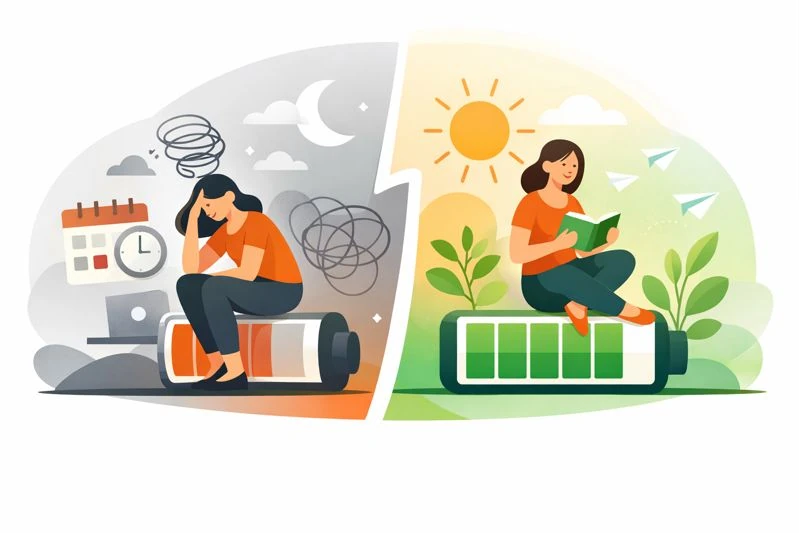
Table of contents:
When burnout starts running your system
More than being tired
Burnout is not the same thing as a rough week, a Sunday spent horizontal, or that dramatic little spiral you have when your inbox looks like a raccoon got into it. In the formal sense, the World Health Organization describes burnout as a work-related state that grows out of chronic stress that has not been managed successfully. In regular human language: effort keeps pouring out, recovery never really comes back in, and your brain starts treating normal demands like one insult too many.
It changes your engine, not just your mood
One of the biggest tells is exhaustion that sleep doesn't neatly fix. You rest, technically, but the battery still feels dented. Then distance creeps in. Work that used to feel interesting starts feeling flat, irritating, or just way too expensive emotionally. A lot of people get pricklier too more cynical, more numb, less patient, less willing to care. And then comes the drop in effectiveness, which is rude, frankly. Tasks take longer. Small decisions feel absurdly heavy. You stare at a simple email like it's asking for your blood type, tax returns, and a brief essay on the meaning of life.
It leaks into the rest of your life
Burnout may start around work, but it almost never stays there like a polite houseguest. You snap faster at home. You cancel plans because even nice people feel like one more demand. The body often joins in too: headaches, lousy sleep, stomach weirdness, tense shoulders, more colds, that awful wired-but-tired state where coffee feels both necessary and completely pointless. And under all of it there's often a quieter shift you stop looking forward to much. Ever notice that? That's usually the part that stings later.
It usually grows in people who are trying
This is the annoying bit. Burnout doesn't only land on careless people, lazy people, or people who can't operate a calendar. It often hits the responsible ones square in the face. The people who overfunction, stay reachable, absorb extra work, smooth things over, say "I'll recover later. For some people, that pattern is closely tied to when caring turns into self-erasure, where being needed starts to matter more than having limits, and burnout can wear the costume of loyalty for much longer than it should." Later, of course, turns into a mythical kingdom no one has actually visited. Sometimes that pattern is tied to healthy perfectionism taken too far, when high standards quietly turn into constant self-pressure and make rest feel undeserved even when the system is clearly running on fumes. Add weak boundaries, low control, constant urgency, value conflict, or the feeling that your work takes a lot and gives very little back, and the slide gets steeper. In some cases, the pattern is also reinforced by low self-respect, where your own limits keep getting treated as negotiable and your needs always seem to rank below the next demand. That is also why structure helps more than people think, because clear priorities, protected time, and visible limits reduce the background chaos that keeps stress simmering. So no burnout is not a personal flaw in a trench coat. It's usually a long mismatch between demands, recovery, support, and meaning.
People often notice it late
Part of the trouble is that burnout can look oddly respectable for a while. You still show up. You still answer messages. You may even look productive, just joyless and permanently clenched, like you're doing life with your jaw first. A lot of people call it laziness, a motivation problem, or "just stress" and keep pushing. In practice, that can look a lot like how self-sabotage sneaks into ordinary life, because you override warning signs so many times that depletion starts feeling normal, and then Without analytical thinking, it's easy to throw all of that into one vague bucket, and then you miss the difference between being temporarily stressed and being chronically depleted. But ordinary stress usually carries at least some belief that things will calm down after the deadline, the launch, the exam week. Burnout feels different. The tank is low, the point gets blurry, and even the reward stops feeling like a reward.
What opens up when burnout loosens its grip
You get your mind back
When burnout starts easing, one of the first changes is mental bandwidth. Not superhero focus. Nothing cinematic. Just enough clear space to think a full thought without resentment crawling all over it. Decisions stop feeling so sticky. You can prioritize again, remember what you were doing, finish a task without needing three pep talks and a snack as a bribe. There's less emotional static too. You stop taking every request like a personal attack. That matters at work, sure, but it matters at home too, where other humans generally prefer not to be treated like the final straw. Your attention stops leaking out of ten tiny holes at once. Weirdly, even boredom becomes more tolerable, which is usually a sign the nervous system is settling down.
Your body stops living on fumes
Recovery often shows up in the body before people trust it emotionally. Sleep gets a little deeper. Your shoulders drop half an inch. You stop waking up already annoyed at the existence of morning. Hunger, digestion, libido, immunity all those unglamorous but important systems start acting less personally offended by your lifestyle. This doesn't mean every ache vanishes in a puff of light. It means your body isn't spending quite so much time in defend-and-survive mode. And that changes mood more than people expect. A more regulated body isn't the whole answer, no, but it is a much friendlier place to live from. You also get better at noticing stress earlier, before it grows teeth.
Curiosity and care come back
One of the saddest things about burnout is how small life can get inside it. When it starts lifting, interest usually returns in flickers. A book holds your attention for more than two pages. A walk feels kind of nice instead of like an obligation wearing sneakers. You laugh without forcing it. You care about the quality of your work again, not just about surviving the day with minimal damage. That return of interest matters. Growth depends on engagement. It's hard to learn, make things, connect with people, or imagine a future when your inner response to everything is basically, "Please. Not another thing." With more energy, you stop managing life only at emergency level and start choosing it again.
Relationships get less brittle
Burnout makes people unavailable in sneaky ways. Not always absent just emotionally stretched so thin you can practically hear the fabric complaining. As recovery kicks in, you become easier to reach. You can listen without secretly counting how many minutes are left in the conversation. You can say no earlier instead of saying yes, overextending, and then resenting everybody within a ten-mile radius. That alone can rescue a marriage, a team, or at least one family dinner. There's a trust benefit too: when you're not running on depletion, your promises get more realistic. That is one quiet part of trustfulness, because people feel safer around someone whose yes and no are both honest, and you stop feeling like you're constantly negotiating with your own limits. And self-trust starts stitching itself back together, because you stop making vows in a panic and breaking them from exhaustion. You feel less like a terrible roommate to your own life.
How burnout distorts a person's life
Rest stops working the way it should
Early on, people think a long weekend will do the trick. Later they realize they can sleep nine hours, scroll half of Saturday into oblivion, and still feel internally overdrawn. That's one of the meaner features of burnout: the usual forms of rest lose their punch because the system isn't simply tired, it's dysregulated. You may feel exhausted and still unable to switch off. Bedtime becomes a negotiation. Time off gets stuffed with recovery chores, guilt, or numb little habits that don't actually restore anything. Then Monday arrives and your body reacts like it's been betrayed, personally. That's when people start asking, "Why doesn't rest work anymore?" Fair question.
Your personality starts feeling wrong
Then there's the identity wobble, which is nasty in a very private way. People in burnout often say, "I'm not myself lately," and they're not being dramatic. Warm people get snappy. Curious people go flat. Competent people start doubting ordinary tasks. In some cases, that fog starts feeding imposter syndrome, so every slow reply, missed detail, or tired mistake feels like evidence that you were never really capable to begin with. You may stop caring about things that used to matter a lot, which can be genuinely frightening. Was that passion fake? Am I turning cold? Usually no. Usually the system is just protecting itself by shutting down the expensive functions first: enthusiasm, generosity, creativity, patience. The lights are on, but only the bargain bulbs. That gap between who you are and how you're showing up can create a lot of shame and shame, very helpfully, burns even more energy. Great little cycle, that.
Life shrinks to maintenance mode
As burnout deepens, life gets stripped down to basics, and not even the fun basics. You do the minimum at work, the minimum at home, the minimum socially. Over time, that pattern can start looking a lot like when loneliness starts running the show, because isolation rarely arrives as one dramatic moment; more often it builds quietly while your energy keeps saying no on your behalf. Hobbies gather dust. Exercise becomes a lovely theory. Even fun starts requiring admin you just do not have in the tank. This shrinking makes sense for a while; the mind is rationing. But after a bit it turns into a trap. The fewer sources of pleasure, movement, connection, and competence you've got, the more every scrap of meaning depends on the very area that's already draining you. That's a rotten deal. People often read this as laziness when it's much closer to depletion with a clenched jaw.
Your body and judgment begin to bargain badly
Chronic burnout can make you surprisingly easy to corner. You reach for quick relief because quick relief is all your brain can picture. More caffeine. More doomscrolling. More wine. More takeout. More "I'll just push through this week" speeches, which by the sixth round start sounding like internal propaganda. Physical symptoms may pile up too: chest tightness, frequent colds, jaw clenching, migraines, digestive trouble, palpitations, higher anxiety. Not every symptom points to burnout, obviously. But burnout often makes the body louder and judgment narrower. You start trying to solve a long problem with short fixes, and the bill shows up later. Usually with interest.
Ways to climb out without pretending you're a machine
Call it by its real shape
The first move is diagnostic, not heroic. Don't ask only, "How do I cope better?" Ask, "What exactly is burning me out here?" Too many hours is one answer, but not the only one. Burnout also grows from low control, constant interruptions, emotional labor, muddy expectations, value mismatch, or never truly being off duty in your own head. Write your main drains in plain language. If your inner critic immediately turns that exercise into "I'm just bad at coping," slow it down and stick to observable facts, because shame is terrible at solving system problems. Not "work stress." Too foggy. Try: "I get interrupted every eight minutes," "I dread my manager's late-night messages," "I'm doing work I don't believe in," "I carry everybody else's emergencies." Specific drains are much easier to work with than one giant gray cloud. Otherwise you keep treating smoke and ignoring the wiring.
Lower the load before you optimize yourself
A lot of people answer burnout by trying to become more efficient. Sometimes that helps a bit. Often it just turns you into a faster version of an overwhelmed person, which well, not exactly the dream. Burnout recovery usually needs subtraction. What can be postponed, delegated, automated, declined, shortened, or done badly on purpose for one season? Yes, badly. Some things do not deserve your gold-star effort right now. Make a stop-doing list, not just a to-do list. If the real problem is chronic overload, prettier color-coding is not going to save you. Fewer demands, cleaner boundaries, and more predictable off-time might. Less glamorous, much more honest.
Rebuild recovery as a daily floor
Big restorative weekends are lovely when life allows them. Burnout tends to improve faster when recovery stops being occasional and becomes part of ordinary days. Start with the boring basics: daylight, regular meals, water, movement, decent sleep windows, real breaks that don't involve another screen if you can help it. Then add what actually settles you. A quiet walk. Music in the kitchen. Stretching. Ten minutes where nobody needs anything from you. Build a tiny recovery menu and pick from it before you're desperate. That part matters because a fried nervous system makes terrible choices about rest. It wants the nearest numbing tool, not the thing that will genuinely help. Small repeated repair beats the dramatic collapse-and-recover cycle. Less cinematic, more useful.
Have the conversation burnout hates
If work conditions are feeding the burnout, private coping only gets you so far. At some point you may need a real conversation with a boss, a partner, a client, or yourself. Name the facts. Say what isn't sustainable anymore. Ask for one concrete change: fewer after-hours messages, clearer priorities, a lighter caseload, a shifted deadline, one day off, childcare help something real, not vibes. People avoid this because they don't want to look weak or difficult. Fair enough. But silence is expensive. Burnout thrives in vague arrangements where everybody quietly assumes you'll keep carrying more than is reasonable. Say it earlier than feels elegant. Elegant is overrated anyway.
Should burnout be your next growth focus?
Not everyone needs to make burnout their main growth project right now. Sometimes what looks like burnout is grief, depression, terrible sleep, a job that simply asks too much, or a season of life that would flatten almost anybody. Different knot, different first move.
That's why it helps to pick one priority instead of attacking your whole life with a motivational shovel. If your clearest pattern is emotional exhaustion, rising cynicism, and that awful feeling that even rest doesn't restore you, then burnout deserves real attention. If the actual bottleneck is boundaries, health, money panic, or unprocessed loss, start there.
If you want a cleaner read on that, AI Coach can help you sort out what actually needs attention first. It can point to the likeliest growth priority and give you a simple three-day starting plan, which is often more useful than spending another month saying, "Something's off," while doing heroic amounts of guessing.
Frequently Asked Questions (FAQ)
What are the main signs of burnout?
The classic pattern has three parts: deep exhaustion, growing detachment or cynicism, and a drop in effectiveness. In everyday life that might look like waking up tired, feeling oddly hostile toward ordinary tasks, struggling to focus, losing interest in work you used to care about, and noticing that rest doesn't really put you back together.
How is burnout different from ordinary stress?
Stress usually feels like too much. Burnout feels like too much for too long, followed by depletion. With stress, people often still believe relief is coming after the deadline or the busy week. With burnout, even the finish line stops feeling satisfying, and the system stays flat, tense, numb or all three in rotation.
Can you burn out even if you love your job?
Yes. Loving the work does not protect you from chronic overload, low control, weak boundaries, moral conflict, or being reachable all the time. In fact, caring a lot can make people ignore their limits for longer, which is very human and very inconvenient.
Is burnout a medical diagnosis?
Strictly speaking, the World Health Organization describes burnout in ICD-11 as an occupational phenomenon, not a medical condition. The effects are still very real. It can shape mood, sleep, concentration, physical health, and relationships in ways that are anything but theoretical.
How long does it take to recover from burnout?
There isn't a neat universal timeline. Mild burnout can improve in weeks if the main drivers are reduced quickly. Deeper burnout can take months, especially if the environment stays the same. Recovery usually moves faster when both load and recovery are addressed, not just one of them.
Can a vacation fix burnout?
Sometimes it helps a little. Rarely, by itself, does it fix the whole thing. If you return to the same overload, the same after-hours availability, the same value conflict, or the same impossible expectations, your nervous system notices. A break helps much more when it comes with actual changes in regular life.
Can burnout cause physical symptoms?
Yes. People often report headaches, muscle tension, insomnia, digestive trouble, frequent colds, palpitations, jaw clenching, and that grim wired-but-exhausted feeling. Not every physical symptom means burnout, of course, but burnout very often drags the body into the story.
What can I do if I cannot take time off right now?
Start with what you can change inside ordinary days. Name your main drains. Cut one demand. Protect one off-duty boundary. Build a basic recovery floor with sleep, meals, daylight, movement, and real breaks. And if work conditions are part of the problem, ask for one concrete adjustment instead of waiting until you're completely fried.
Should I quit my job because of burnout?
Sometimes yes, but not automatically. First look at the drivers. If the main issue is temporary overload or poor boundaries, a role change, schedule change, or workload conversation might help. If the culture is chronically unhealthy, your values get stepped on daily, and every attempted fix keeps failing, leaving may be the sane move.
How do I tell burnout from depression?
They can overlap, which is why this gets confusing. Burnout is usually tied closely to chronic work stress and often improves when demands, recovery, and boundaries improve. Depression tends to spread more widely across life and may include deep hopelessness, loss of pleasure everywhere, and symptoms that don't lift much even when work eases. If the picture feels severe, blurry, or unsettling, take it seriously. Your nervous system isn't making things up.