
Most people barely think about ethics when life is humming along. Bills paid, Slack messages friendly, nobody side-eyeing anybody - lovely. You usually notice ethics later, when trust starts going a bit... off. A friend replies with that weirdly formal tone. A team stops saying what they really think. Or you catch yourself in the shower rehearsing a half-truth and dressing it up as "strategy," which, come on, your nervous system is not buying.
That dull, clingy feeling isn't always full-blown guilt. Sometimes it's subtler than that. More like a hairline crack between the person you believe yourself to be and the one you're slowly becoming. Weak ethics often charges interest in that currency. Strong ethics won't make you dazzling at parties, no. But it does let you sleep, speak plainly, and look people in the eye without needing a whole acrobat routine in your head. That counts for a lot.
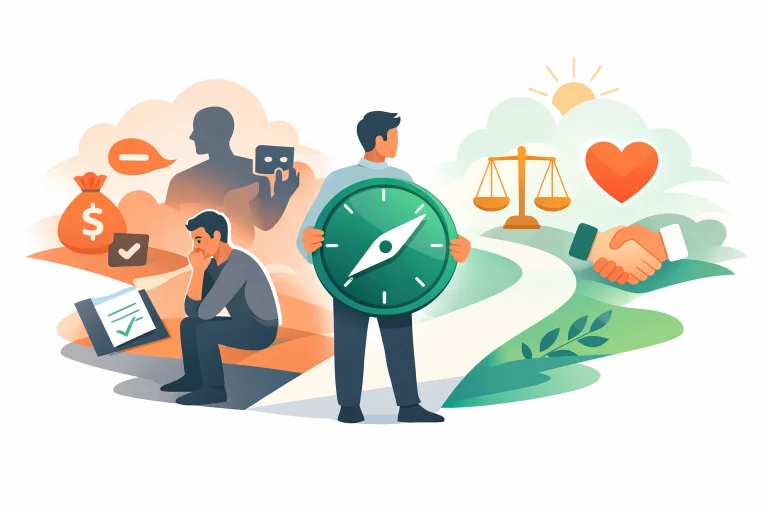
Table of contents:
Where ethics actually lives
More than knowing right from wrong
Ethics is not just knowing the "correct" answer in theory. Plenty of people can give a beautiful little speech about values and still behave like raccoons near an open trash can when pressure hits. Ethics is the ability to act from principles instead of impulse, convenience, ego, fear - the usual rowdy gang. It shows up in those tiny moments when you could bend the truth, hide your part, stay quiet, swipe credit, exploit someone's blind spot because, well, it would work.
An ethical person has an inner line. Not a neon sign. More like a steady boundary they can feel, even when no one else sees it. They know some wins cost too much. Usually that line includes honesty, fairness, respect for other people's choices, and a willingness to say, "Yep, that part was on me." Not glamorous. Very real.
What it looks like on an ordinary Tuesday
In daily life, ethics can look almost painfully uncinematic. You give honest feedback instead of fluffy fake praise that sounds nice and helps no one. You point out an overpayment instead of treating it like the universe slipped you a tip. You mention the fee, the risk, the catch, the conflict of interest - even when it would be easier, and maybe more profitable, to mumble past it.
In relationships, ethics means not playing mind games just because directness makes your palms sweat. At work, it means you don't build progress on manipulation, conveniently cropped data, hidden clauses, or that old classic where something shady gets polished until it sounds "basically fine." You know the move. Most of us do. Ethical behavior rarely looks flashy in the moment, but it leaves the room cleaner.
The moment values become expensive
Here's the real test: ethics doesn't prove much when the right choice is also the easy one. Of course it's simple to be honest when honesty costs nothing. The interesting moment is when telling the truth might embarrass you, lose you money, slow down a deal, or make a room go awkwardly silent for thirty seconds. Oof. That's where character stops being a nice idea and becomes behavior.
Ethical people do not always look impressive in the short term. Sometimes they look inconvenient. They pass on dodgy shortcuts. They admit mistakes before someone corners them with a screenshot. They say, calmly, "I'm not comfortable with this," while everyone else is staring at the table and hoping the issue will sort of evaporate. Ethics has a backbone. Not loud, not dramatic - just there.
Not perfection. Consistency.
And no, ethics is not about floating around like a morally superior swan, judging everyone from a safe little island. People with strong ethics still get tempted. They still misread situations, protect their ego, rationalize nonsense, get tired, get prickly, want the easier version. They're human, not carved from some expensive marble. If you tend to confuse ethics with never slipping up, it helps to understand healthy perfectionism, because strong standards are useful only when they lead to honesty and repair instead of brittle self-punishment.
The difference is they come back to their values faster. They repair. They own their part. They don't turn "I made a bad call" into "I am secretly a terrible person and now everything is ruined," which, oddly enough, helps a lot. Ethics is less about purity and more about being reliably decent even when no applause is coming. Especially then, actually.
The soft skill underneath many others
And yes, ethics really is a soft skill. Funny label, considering how hard its consequences can hit. But it shapes how you handle people, power, pressure, temptation, status, all that messy human stuff. It affects whether others trust you with information, money, leadership, second chances, the truth. It even shapes planning: you can organize tasks beautifully on paper, but without principles, good structure can become a neat way to justify bad choices, and that is a much less impressive talent than it sounds. That is also why learning to hold a target steady matters: direction is useful only when the way you pursue it still lines up with your values, rather than quietly rewarding whatever gets results fastest.
It also sits quietly underneath a lot of other strengths. Responsibility without ethics can turn bossy fast. Ambition without ethics becomes appetite in a blazer. Confidence without ethics? That's basically danger with good posture. Strange, isn't it - one invisible quality can change the flavor of everything else you bring into a room.
What gets better when ethics grows
Trust stops feeling so fragile
When your ethics get stronger, relationships start to feel different in the body. Lighter. People relax around you. They don't waste half their energy wondering what you really meant, whether you'll quietly change the rules later, or if your warmth expires the second it stops benefiting you. That kind of safety is gold - in teams, friendships, partnerships, even in boring admin conversations nobody wants to have.
When people trust your word, everything gets less sticky. Less double-checking. Less suspicion. Fewer defensive emails written like tiny legal documents. You may not get applause every time you act ethically, and honestly, you probably won't. But you do get something rarer: credibility. And credibility keeps paying rent long after dramatic, shiny people have burned through the room.
Decisions get cleaner
Ethics also clears out a surprising amount of mental clutter. If your standards change every time money, attraction, panic, status, or fear walks into the room, then every decision becomes a wrestling match in a fog. Exhausting. But once you know your lines, a lot of choices get simpler. Not easier - let's not get carried away - but simpler. This is one reason it helps to learn how to reduce decision fatigue without turning into a robot, because when your mind is less drained, it is much harder to rationalize choices that feel convenient in the moment but quietly pull you away from your values.
You stop spending an hour arguing with yourself over whether a misleading promise is "technically okay." You don't need ten excuses taped together to support one action. Your mind gets quieter. Your language gets cleaner too. There's a kind of peace in not needing to perform acrobatics just to live with your own choices.
Your reputation starts compounding
In work life, ethics makes you reliable in a way talent alone just can't. Plenty of talented people are impressive and exhausting at the same time. They dazzle, then wobble. Ethical people become the ones others bring into delicate conversations, hiring decisions, client work, money questions, crisis moments. Why? Because they're less likely to panic, conceal, spin, or toss someone else under the bus to save face.
Over time, that matters more than people think. Referrals, leadership opportunities, long-term clients, partnerships - these things tend to drift toward people who don't turn every pressure point into a moral coin toss. Slow build, yes. But sturdy. And sturdy beats flashy more often than Instagram would like us to believe.
Self-respect stops leaking out of the room
Then there's the private benefit, the one nobody can hand you. Ethics protects self-respect. Not performance, not "look how good I am," not virtue in a cute outfit. I mean the steadier feeling that your actions and your values are at least on speaking terms. That matters. More than people admit, maybe because it sounds embarrassingly earnest. If that link feels easy to underestimate, it helps to look at what opens up when self-respect gets stronger, because ethics is one of the quiet ways that inner steadiness starts showing up in real life rather than staying a nice idea in your head.
When your behavior keeps crossing your own lines, anxiety sneaks in through side doors. You get irritable, defensive, strangely tired. Little things feel louder. Sometimes that inner friction gets mislabeled as burnout or imposter syndrome, when the quieter truth is that part of you knows you have drifted off your own standard, and it is protesting in the only language it has. On the other hand, doing the right thing - especially when it costs you something - creates a quiet kind of strength. You trust yourself more. And once that happens, confidence stops feeling like a costume you have to keep adjusting.
You improve the air around you
Ethics is personal, sure, but it also changes the atmosphere around you. One person's integrity often gives everyone else permission to stop pretending. A manager who says, "I made the wrong call there," makes honesty less dangerous for the whole team. A colleague who refuses manipulative messaging raises the quality of the work for everybody, even if nobody throws them a parade.
An ethical friend becomes a reference point too: oh right, we can do this without being shady. That influence is subtle, but it spreads. Rooms get cleaner. Conversations get straighter. Success loses that weird greasy aftertaste of compromise. Small thing, big ripple. Worth thinking about, isn't it?
What weak ethics quietly costs you
Gray zones start swallowing everything
When ethics is weak, bad behavior rarely storms in wearing a villain cape. It arrives as convenience. A tiny omission here. A flattering distortion there. A little "they don't need the full picture" on an otherwise normal Tuesday. And because nothing explodes immediately, your standards begin to stretch.
What once felt off starts feeling practical. Then normal. Then necessary. That's what makes ethical drift so sneaky. Most people do not wake up and decide to become untrustworthy before breakfast. They just keep making exceptions until the exceptions start looking suspiciously like personality. That's the chilling part. You barely notice the slide while you're sliding.
People become careful around you
Other people notice more quickly than you think. Maybe not every detail, but they catch the pattern. They sense spin. They hear the selective honesty, the polished defensiveness, the way credit somehow glides toward you while blame floats outward like smoke. People are not stupid. Their nervous systems pick up a lot, even when their words don't.
And once that pattern sets in, relationships change shape. People share less. They confirm more. They become polite instead of open. Professional instead of warm. Functional instead of real. That is also why ethics and altruism are not the same thing: you can sound generous on the surface, but if people sense hidden motives, your helpfulness will still feel unsafe. That kind of mild distrust is its own special misery - nothing dramatic, everything still "fine," and yet the whole week feels colder than it should. Ugh. That kind of social chill can look a lot like how loneliness quietly shows up in daily life, except here the distance is often created by eroded trust rather than simple lack of company. Different cause, similar ache.
Short-term wins turn brittle
Weak ethics can absolutely produce short-term wins, which is, frankly, very annoying. Sometimes the manipulative pitch lands. Sometimes hiding a mistake saves face. Sometimes the person cutting corners looks efficient, sharp, unstoppable even. For a minute.
But those wins are brittle. They depend on nobody checking too closely, remembering too clearly, comparing notes, asking one inconvenient question. One lie creates maintenance work. One shady move invites another to support it. Before long, you're not building a life or a career - you're managing exposure. That's exhausting. It also makes success fragile, because what rises on distortion has to keep being fed distortion. Nobody really relaxes in that setup. Not even the person running it.
You split away from yourself
Then comes the part people often mislabel. Even if no one calls you out, your system usually notices. You may feel edgy after conversations, over-explain simple choices, replay exchanges at 1 a.m., or feel that odd urge to rewrite reality in your own favor. Sometimes we call that stress, burnout, impostor syndrome, overthinking. And sure, sometimes it is.
But sometimes it's simpler - and a little more uncomfortable. You crossed your own line, and now your mind is trying to glue things back together without naming the crack. That inner split erodes confidence from the basement up. You start trusting your charm more than your character. Bad trade. Really bad trade.
The damage rarely stays private
A weak ethical core doesn't stay tucked away in some private corner. It leaks. Into teams, where people learn honesty is risky. Into families, where promises start meaning less. Into business, where customers turn into targets instead of humans. Into your self-image, where cleverness starts outranking decency. Bit by bit, the whole thing gets warped.
The saddest part isn't only that other people get hurt. It's that you can get used to being the kind of person you once would have kept at arm's length. That realization stings - as it should. But it's also useful. If it stings, something alive is still in there. Something that still knows the difference. And that's more hopeful than it sounds.
Ways to strengthen ethics in real life
Choose your lines before pressure shows up
Ethics gets easier when you decide a few things in advance. Not everything, of course - life is messy - but enough to stop improvising your values every time pressure walks in wearing expensive shoes. Pick three to five principles that matter to you in real life, not in poster-slogan form. Maybe it's "I don't mislead to make money." Maybe "I don't take credit that isn't mine." Maybe "I tell the truth about mistakes while they can still be repaired."
Keep the wording plain. It is also one reason why life gets so patchy when you only react: when choices are made only under pressure, your values are more likely to wobble with the moment instead of guiding it. Then, for a week, check each evening whether your day matched those lines. No melodrama, please. You're gathering data, not auditioning for sainthood. If pressure tends to scramble your judgment, building stress resistance alongside ethics can help, because people rarely betray their values in calm weather; it usually happens when fear, urgency, and fatigue all start shouting at once. Clear lines make murky moments less murky. Not magical, just practical.
Catch the smooth little narrator in your head
Most unethical behavior arrives with a very polished internal sales pitch. You know the voice. "This is how the industry works." "I'm protecting them from unnecessary details." "It's only temporary." "Technically it's true." Ah yes, technically - one of the slipperiest words in the language.
Start noticing that narrator. When a choice feels fuzzy, write down two short sentences: what you want to do, and your cleanest reason for doing it. Then rewrite that reason as if a blunt friend were translating it over coffee. The gap between those two versions can be darkly funny... and very revealing. Ethics gets stronger when self-deception loses its fancy vocabulary.
Train on small moments, not heroic ones
Don't wait for some grand moral crisis with dramatic music in the background. Train on tiny moments. Correct the minor billing error. Say, "That was my oversight," in the meeting instead of letting vagueness take the fall. Tell a friend, kindly, that you can't promise what you won't follow through on. Refuse the manipulative phrasing in the email even if it would probably convert better. Yes, even then. Real creativity is useful here, because the challenge is not to become stiff and moralistic; it is to find honest ways to persuade, solve, and communicate without sliding into manipulation.
These little acts matter because they teach your body that honesty is survivable. Nothing catches fire. You don't dissolve into dust. Each small decent choice lowers the drama around doing the right thing next time. Ethics becomes less of a performance and more of a reflex, which is exactly what you want when pressure hits fast.
Build a pause before important choices
Before any important decision, create a small pause. Just a beat. A walk around the block, a saved draft, ten quiet minutes before you hit send. Boring tools, honestly - but ethics often lives inside boring tools. Pressure loves speed because speed hides discomfort.
Run the choice through three simple questions. Would I be okay if this were explained publicly, in normal human language? Does this respect the other person's ability to choose freely? Will I still feel okay about it tomorrow, when the adrenaline has left the building? If the answers start getting slippery, slow down. Big moral failures are often just fast behavior wearing good excuses.
Repair quickly when you miss
You will get this wrong sometimes. Everyone does. The goal is not spotless purity. The goal is faster recovery. When you notice that you shaded the truth, stayed quiet when you should've spoken, or benefited from something unfair, repair while the trail is still warm.
Acknowledge what happened. Correct the record. Accept the consequence without turning it into a one-person tragedy with dramatic lighting. Then ask yourself what pulled you off course - fear, vanity, exhaustion, greed, the desire to avoid discomfort, whatever it was. That part matters. Otherwise you only apologize; you don't actually become safer for other people to trust. And that, really, is the whole thing.
Do you need to work on ethics right now?
Not automatically. If your life is currently held together by caffeine, late replies, and vibes, ethics may not be the very first lever to pull - even if it still matters. People grow in layers. Sometimes the urgent job is sleep, boundaries, focus, emotional regulation. No point polishing your principles while running on fumes and snapping at everyone by lunch. You're not a monastery bell; you're a tired mammal.
Still, it helps to look at the pattern honestly. If you keep feeling uneasy after decisions, if trust around you feels thinner than it should, or if your wins come with a sour little aftertaste, ethics may deserve more attention than you think. A lot of people chase confidence or productivity first when the real leak is somewhere else entirely. And if you pick the wrong starting point, you end up trying five fixes at once and changing... basically nothing.
If you want a clearer read on that, AI Coach can help you sort your priorities. It can show whether ethics is the real growth edge for you right now and help you sketch out a simple plan for the first few days, so you're not just guessing in the dark and hoping for the best.
Frequently Asked Questions (FAQ)
What is ethics as a soft skill?
It's the ability to make choices that stay aligned with your values, even under pressure. In real life, that means honesty, fairness, respect, accountability, and not using manipulation or hidden advantage to get what you want. Less about looking good, more about being safe to trust.
Can ethics actually help my career, or does it just slow me down?
It helps - often more than people expect. Ethics builds credibility, and credibility opens doors talent alone often can't. Ethical people are more likely to be trusted with clients, sensitive information, leadership, and long-term partnerships. It may not give you the fastest win this week, but it usually gives you sturdier wins over time.
How is ethics different from honesty?
Honesty is part of ethics, but not the whole thing. You can tell the truth bluntly and still be unfair, careless, selfish, or weirdly cruel. Ethics adds context: respect, responsibility, transparency, and concern for how your actions affect other people. Truth matters. So does how you handle it.
What are signs I'm compromising my ethics without fully noticing?
Watch for rationalizations. If you often hear yourself saying, "This is just how things work," "It's not technically a lie," or "They don't need the full picture," pause. Other clues: feeling defensive after simple choices, sensing trust thinning around you, or noticing that success keeps arriving with a strange aftertaste. That feeling is information.
Can I stay ethical in a highly competitive workplace?
Yes, but clear lines matter. Competition tends to blur judgment and reward speed, so it helps to decide in advance what you won't do. Ethical people can still compete hard - they just refuse to do it through deception, coercion, or unfair advantage. You can be sharp without becoming slippery.
What should I do if my manager asks for something that feels unethical?
Slow the moment down. Ask clarifying questions. State your concern plainly. And try not to join the action while pretending you're fine with it, because that usually gets expensive later. A calm sentence like, "I'm not comfortable presenting it that way," can do more than dramatic rebellion. Quiet clarity often lands better.
Is ethics rigid, or can it adapt to context?
Context matters. Ethics is not blind rule-following with a stiff collar. Gray areas are real. But gray is not the same thing as anything goes. A useful test is whether your choice respects another person's ability to make an informed decision - and whether you could explain what you did publicly without playing word games.
Can adults really develop ethics, or is it fixed early in life?
Adults can absolutely strengthen it. Ethics grows through reflection, repetition, and repair. When you define your principles, notice your rationalizations, practice small honest actions, and correct mistakes quickly, your character gets steadier over time. Slowly, yes. But very much for real.
How do I encourage ethics on a team without sounding preachy?
Model it before you talk about it. Be transparent about mistakes. Give credit accurately. Make it safe for people to raise concerns without being punished for being inconvenient. Teams learn ethics less from posters and slogans, and more from what leaders reward, ignore, and quietly excuse. Always that.
What's one simple daily habit that keeps ethics sharp?
Try a two-minute evening check-in. Ask yourself where you felt tempted to take the easy, slippery route and what you chose instead. That tiny habit keeps your values active instead of theoretical. Funny enough, awareness alone already changes a lot. Sometimes more than a grand plan does.