
Intuition is that quiet little nudge that shows up before logic has even found its glasses. When it is underused, you can talk yourself into the wrong relationship, the wrong job, the wrong yes, all while ignoring the odd little signals that were there from the start. Then, three weeks or three months later, comes the deeply irritating sentence: I knew something was off.
If you keep overriding your gut, getting stuck in mental traffic, or trusting polished words more than the whole vibe of a situation, there may be a gap here. And no, strong intuition does not make you mystical, dramatic, or the sort of person who lights a candle before answering emails. It just makes you quicker in uncertainty, steadier around people, and less likely to betray your own read because someone else sounded very sure of themselves.
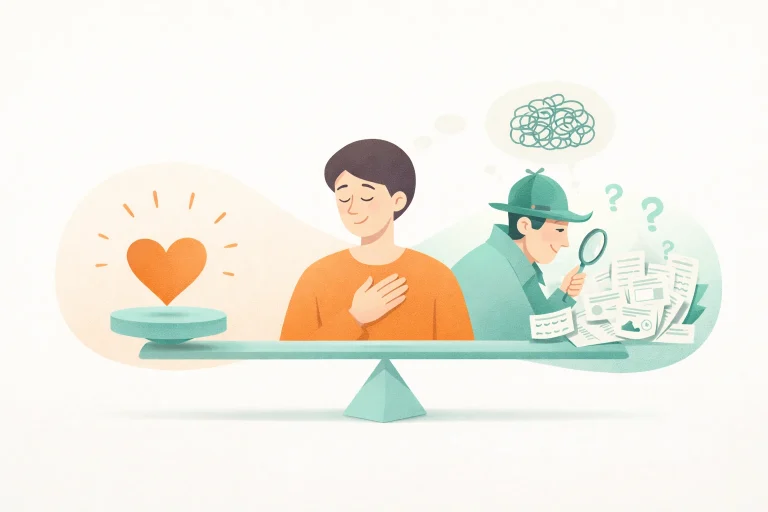
Table of contents:
Intuition: what it is really made of
Not magic, not mind-reading
A lot of people hear intuition and immediately picture moonlight, incense, and someone saying, "I just know." Lovely image. Not quite everyday reality. Most of the time, intuition is fast pattern recognition. Your brain notices tiny cues, old experience, tone changes, timing, inconsistencies, body language, context - all the small stuff - and forms an impression before you can explain it neatly.
That is why intuitive people can seem a bit mysterious from the outside. They are often processing more than they can translate into language in real time. Research on "thin-slicing" points in that direction too: people can make surprisingly accurate judgments from very brief exposure to behavior, especially in areas they know well. Not flawless judgments, obviously. We are still human, not lie detectors in cardigans. But the mind picks up a lot, fast.
It hears what words are trying to cover
One of the clearest signs of intuition is sensitivity to what is not being said. Someone says all the right things, but the energy is slippery. A job offer looks excellent on paper, yet the conversation leaves you oddly cramped inside. A plan sounds reasonable enough, but the timing feels wrong in a way you cannot quite pin down. Intuition often lives in those little mismatches.
This is where it brushes up against empathy. You are not only hearing the content. You are catching undertones - tension, warmth, strain, avoidance, sincerity, all that invisible social weather. People with stronger intuition often notice when the mood in a room shifts before anyone names it. Useful skill, honestly. Slightly annoying too, because once you clock the weirdness, you cannot really un-clock it. Bit like hearing a dripping tap at night.
Your body is part of the message
Intuition is not just a thought. Very often it shows up in the body first. Tight chest when someone starts pushing too hard. Sudden ease when the right option appears. That heavy, sinking feeling right before you agree to something you do not actually want. The body is a messy little messenger service, but a useful one.
That does not mean every sensation is truth, of course. Anxiety can be loud. Bias can barge in. Sometimes what feels like a brilliant gut read is really raw frustration looking for a target, so it helps to recognize anger issues before mistaking emotional heat for intuition. Old wounds can dress up as wisdom and make a whole performance out of it. Which is why intuition works best when it cooperates with clear thinking. The gut points. The mind still has to check what exactly it is pointing at. In practice, that often means learning to become more cautious without turning into a coward, because healthy intuition notices risk without turning every awkward moment into a full emergency.
Good intuition is quick, but not chaotic
Healthy intuition is not impulsiveness in a leather jacket. It is not "I do whatever I feel, consequences be damned." Real intuition has a grounded quality to it. It helps you orient quickly when the information is incomplete - which, if we are honest, is most of adult life. A therapist may sense a client is holding something back. A manager may notice a deal feels rushed for the wrong reasons. A parent can tell that "I'm fine" is, shall we say, theater.
So intuition is less a magical power and more an inner radar built from attention, memory, emotion, and experience. Sometimes it whispers. Sometimes it bangs a saucepan in your internal kitchen. The trick is learning the difference between a real signal and plain old internal weather.
What changes when intuition gets stronger
Decisions stop feeling like wet cement
One of the biggest shifts is speed under uncertainty. Not reckless speed. Cleaner speed. When intuition gets stronger, you do not need to over-process every decision that comes without a guarantee, which is, frankly, almost all of them. You sense direction earlier. That saves an absurd amount of mental energy.
Instead of circling a choice until it goes stale, you start noticing your first honest read. Which option gives you a bit more room to breathe? Which one makes your whole system contract? Which person feels solid, not just impressive? Intuition helps narrow the field before logic comes in with its clipboard. Life starts feeling less like a courtroom drama and more like movement. Finally.
You read people better, and get fooled less often
Strong intuition is excellent social equipment. It helps you notice sincerity, hesitation, charm used as camouflage, real enthusiasm, fake enthusiasm - and no, those are not the same thing. Your nervous system often knows the difference before your brain finishes typing the report. This matters in dating, hiring, leadership, friendships, sales, teamwork... anywhere humans are being gloriously human, which is to say everywhere. And when that sensitivity is paired with well-developed extrovert qualities, it becomes easier to connect quickly, read the room, and still keep your judgment intact instead of being swept away by charisma in nice shoes.
That social radar becomes especially helpful when it teams up with caution. You are less likely to be dazzled by polish alone. You notice the person who sounds right but feels off. You also notice the opposite: the awkward one who is genuine, the quiet one with actual substance, the client who needs space instead of pressure. Good intuition makes judgment warmer and sharper at the same time. That is a nice combination, honestly.
Creativity and timing get better
Intuition is not only for spotting danger or red flags. It is also brilliant with timing, ideas, and opportunities. You get a feel for when to push and when to pause, when a concept has real life in it, when a conversation is ready, when the room can handle humor, honesty, or a direct ask. That kind of timing is hard to fake and, sorry spreadsheets, very hard to quantify. That is also why intuition often supports visionary thinking: it helps you notice emerging possibilities before they are obvious, while experience and reflection keep those possibilities grounded in reality.
This is one reason intuition works so well with creativity and adaptability. It helps you improvise without turning into chaos with a laptop. You sense which path has energy before the evidence is fully visible, then you test it. The result is often not only better decisions, but more alive ones. Less wooden. Less "technically correct but somehow dead." It also overlaps with the benefits that aesthetic sense brings, since both rely on noticing subtle harmony, friction, and timing before those impressions get translated into neat explanations.
Self-trust starts growing back
Maybe the deepest shift is self-trust. When you learn to hear and verify your own intuitive signals, you stop handing all authority to louder people, endless opinions, or whatever argument was delivered with the best posture. You start feeling, quietly but unmistakably, Oh. I can listen to myself and not immediately get lost. That changes a person.
This kind of confidence is not swagger. It does not say, "I am always right." It says, "I can notice what I notice, stay with it, and examine it honestly." That makes uncertainty less humiliating. You do not need to know everything in advance. You need to be able to sense, adjust, and stay awake. Intuition helps with exactly that, and life gets a little less foggy because of it.
What life feels like when intuition is underused
You keep asking other people about things you already know
When intuition is weak - or just constantly ignored - people often over-consult. They ask five friends, three podcasts, two coworkers, and that one article written by someone with suspiciously intense opinions. Meanwhile, their first inner reaction has been buried under all the noise. This can look thoughtful. Sometimes it is. Sometimes it is self-abandonment dressed up as research.
The issue is not getting input. Input is useful. The issue is losing your own signal completely. You start living from borrowed certainty, and borrowed certainty always feels shaky because, well, it is. Other people can advise you. They cannot feel the full texture of your life from the inside. No one else lives in your nervous system. And if your own read collapses the moment it appears because you instantly doubt, minimize, or judge it, it is worth looking at how shame quietly warps a life, since shame has a sneaky way of making your honest inner signals feel less trustworthy than everyone else's confidence.
Red flags appear, and you start negotiating with them
Low intuition often shows up as the painful habit of explaining away discomfort. "Maybe I am overreacting." "Maybe they were just tired." "Maybe this weird pressure is normal." Maybe! Sure. But if something keeps feeling off and you keep talking yourself out of it, the cost builds quietly. Relationships drag on past their truth. Jobs keep draining you. Deals move ahead on a smile and a glossy PDF while your stomach is filing a private complaint. This is also where intuition quietly supports justice in everyday life, because it helps you notice when something looks acceptable on the surface but feels wrong in a deeper, more human way.
This is not always because someone is naive. Often they just do not trust their own perception enough. They wait for courtroom-level proof when the earlier, softer clues were already there. By the time the evidence becomes obvious, the damage has usually moved in, hung up its coat, and made tea.
Overthinking starts climbing the walls
Without intuition, every choice can become painfully cerebral. You analyze, compare, re-compare, imagine twelve future scenarios, then somehow feel less clear than when you started. The mind keeps searching for certainty because it does not have a real relationship with inner knowing. So it compensates with more thought. And more thought. And then, for variety, a little more thought.
This is one reason weak intuition is often mistaken for a decision-making problem or plain indecisiveness. Sometimes the deeper issue is that your inner yes and no have become too muffled to hear. If that sounds familiar, it does not mean you are broken. Usually it means your quieter signals have been talked over for a very long time.
Your life can look fine and still feel quietly wrong
Here is the sneaky part. A person can be competent, responsible, productive even, and still end up deeply misaligned because they are not reading themselves accurately. They say yes when they mean maybe, maybe when they mean no, and no when fear is wearing wisdom's coat. On paper, everything can look decent. Inside, there is this faint rubbing feeling. Like wearing a sweater that is not exactly painful, just wrong all day. You know the one.
Over time, that mismatch can drain confidence, flatten motivation, and make relationships feel confusing in a very private sort of way. People tell you what you should want, and eventually you start believing them more than your own response. That is rough. Not dramatic in a cinematic, glass-shattering scene. More the slow kind of rough, the kind that chips away at clarity until you no longer quite believe yourself.
How to sharpen intuition without getting yanked around by every feeling
Start with low-stakes choices
Do not begin by making giant, irreversible life decisions based only on a flutter in your ribcage. That is a lovely way to become suspicious of intuition forever. Start smaller. Choose the coffee shop. The route home. The order of your tasks. The person you sit next to. The book you pick up first in the shop even if the cover is slightly ridiculous. Let your first internal pull choose once or twice a day. If that feels oddly hard, it is worth exploring how to be more spontaneous, because spontaneity and intuition often grow together when you practice acting on a small, honest signal before overthinking takes the wheel.
The point is repetition. You are teaching yourself to notice the first quiet signal before your mind storms in wearing a tie and carrying fourteen objections. And if you want this habit to stick, a bit of structure helps: strong motivational skills make it much easier to practice consistently, and consistency is what turns random hunches into something you can actually test and trust.
Keep a "first read" journal
When you meet someone, walk into a meeting, get an offer, or feel a sudden yes or no, write down your first read in one sentence. Keep it plain. "Feels rushed." "Warm and solid." "Looks great, but something is thin." Then leave it alone. Come back later and compare that first read with what actually happened.
This is how intuition gets calibrated. Not worshipped, calibrated. You start seeing where your gut is sharp, where fear distorts it, and what patterns your system reliably catches. A big part of that is learning to actually read your own patterns, because otherwise old fear and real insight can feel annoyingly similar at first. Very useful. Occasionally humbling. Fine, often humbling.
Listen to the body before the explanation arrives
Several times a day, especially around decisions, pause for twenty seconds and ask: what is happening in my body right now? Expansion, contraction, heaviness, ease, pressure, calm, static? Try to notice before you explain. That order matters. Explanation arrives carrying old stories. Sensation usually arrives a bit cleaner.
If you want to go one step further, do this right before saying yes to something. A surprising number of bad yeses come with a very informative body signal that gets ignored because the social script is already halfway out of your mouth. And then - too late - there you are.
Watch tone, pace, and mismatch
In conversations, shift part of your attention away from the literal words and toward delivery. Is the person speaking too smoothly? Too fast? With warmth that reaches the eyes, or only the teeth? Does their story match the mood in the room? Intuition often grows through this kind of noticing. You are learning to read congruence, not just content.
No need to become a tiny detective at every coffee chat. That gets exhausting, and frankly a bit weird. Just notice what repeats. Your inner radar gets stronger when you stop treating language as the whole event.
Make room for quieter signals
Intuition hates constant noise. If your mind is full of notifications, commentary, stress, and three tabs screaming for attention, subtle signals get drowned out. Ten minutes of silence helps. A walk without audio helps. Sitting in the car before going inside helps too, oddly enough. So does choosing music on impulse now and then, or picking a film without reading twelve reviews first. Small acts like that loosen the grip of over-control.
And one more thing: after any decision you regret - or feel unexpectedly good about - ask yourself, "What did I know earlier than I admitted?" That question is gold. Slightly rude gold, but still gold. It teaches your intuition that you are finally willing to hear it. Not worship it, not obey it blindly. Just hear it properly.
Should intuition be your next growth focus?
Not always. Some people really do need stronger intuition. Others think they lack intuition when the real problem is exhaustion, anxiety, people-pleasing, or a complete flood of outside noise. And sometimes what feels like sharp intuition is really what cynicism does when it starts running too much of your life, when mistrust starts masquerading as insight and makes every person or possibility look suspicious before you have actually seen them clearly. If your system is stressed to the hilt, every inner signal can sound either too loud or not trustworthy enough. In that case, intuition may not be the first domino to nudge.
It helps to ask where life is actually snagging. If your main pain is slow decisions, ignored red flags, weak self-trust, or that frustrating feeling of understanding things a beat too late, then intuition is probably worth real attention. If your bigger issue is poor boundaries, chronic burnout, or simply not having enough information, start there. Otherwise self-development turns into that familiar hobby of trying to fix twelve things badly at once. Heroic. Useless.
If you want a clearer read, AI Coach can help you sort out which skill deserves priority and give you a simple three-day starting plan. Sometimes a bit of outside structure is enough to stop the random zigzagging and make growth feel more honest, more grounded, a little less like guesswork.
Frequently Asked Questions (FAQ)
What is intuition in simple terms?
It is the ability to sense what is likely true, useful, or off before you can fully explain why. In ordinary life, intuition is fast pattern recognition mixed with subtle emotional and bodily signals. Not magic. More like your brain and body noticing more than your conscious mind can summarize on the spot.
How can I tell intuition from anxiety?
Intuition is usually quieter and more specific. Anxiety tends to be louder, repetitive, and very fond of inventing ten disasters before breakfast. Intuition often says, "This person feels off," or "Not this option." Anxiety keeps spinning, adding drama, urgency, and a full soundtrack. If you are unsure, write the signal down and compare it with outcomes over time. That is boring advice, maybe, but it works.
Can intuition be wrong?
Absolutely. Intuition is powerful, not perfect. It can be distorted by fear, bias, old hurt, wishful thinking, or lack of experience. That is why the healthiest version is not blind trust in every feeling. It is intuition plus reflection. Notice the signal, then test it where needed.
Is intuition the same as instinct?
Not quite. Instinct is more basic and automatic, closer to built-in survival responses. Intuition is usually shaped by experience, memory, context, and learned pattern recognition. Instinct might slam the brakes. Intuition might say, "This meeting sounds fine, but something in the timing and tone is off." Related cousins, different jobs.
Can analytical people have strong intuition too?
Yes - and that combination is often the most useful one. Intuition helps you notice where to look. Analysis helps you check what you found. People sometimes act as if you must choose between gut feeling and logic, but real life rarely works that way. The best decisions often use both. One spots the signal. The other tests it.
Why do I keep ignoring my gut feeling?
Usually because, somewhere along the way, you learned to trust external approval more than your own perception. Sometimes it comes from people-pleasing. Sometimes from fear of seeming irrational. Sometimes from growing up in places where your feelings were minimized or brushed off. The habit can change, but it takes repetition and a fair bit of honesty about the moments when you override yourself.
Does intuition get stronger with age?
It can, especially when experience is paired with reflection. Simply getting older is not enough. A person can repeat the same blind pattern for twenty years and call it wisdom - happens all the time. Intuition grows when you notice outcomes, learn your own signals, and stop dismissing what you felt earlier than you admitted.
Is intuition useful at work, or mainly in relationships?
Very useful at work. It helps with hiring, timing, negotiation, reading team dynamics, spotting weak offers, sensing when a client is not ready, and noticing when something looks fine on paper but feels unstable in practice. Work is full of incomplete information and human behavior, which is exactly where intuition earns its tea.
What weakens intuition the most?
Constant noise, chronic stress, rushing, over-explaining, and ignoring body signals weaken it quickly. So does living too much through other people's opinions. If every choice gets filtered through approval, appearances, or fear of being wrong, your own inner read becomes much harder to hear.
What is one good first step to improve intuition today?
Pick one low-stakes choice and make it from your first honest internal response instead of a pros-and-cons list. Then notice how it felt and what happened. Small repetitions matter more than grand declarations here. Intuition usually grows the same way trust grows - through evidence, not speeches.