
Fear of Change is what happens when the next chapter stops looking like an open door and starts feeling like one of those basement trapdoors in horror films. You want a different job, a relationship that does not feel like emotional admin, maybe just a life that fits your actual shape a little better - and then the minute something begins to move, your whole system clings to the railing like the ship is going down. Bit rude, honestly. One part of you is bored out of its mind. The other is shouting, "Nope. We live here now."
If that tug-of-war feels painfully familiar, there is a decent chance this is one of the quieter brakes in your life. Not dramatic, not flashy, just always there with its hand on the emergency lever. And when this fear starts to loosen, people usually do not become reckless chaos-goblins making life-altering decisions over eggs Benedict. They tend to get steadier. More flexible. Less pushed around by the unknown. Research on anxiety and intolerance of uncertainty points in that direction too, which is oddly comforting.
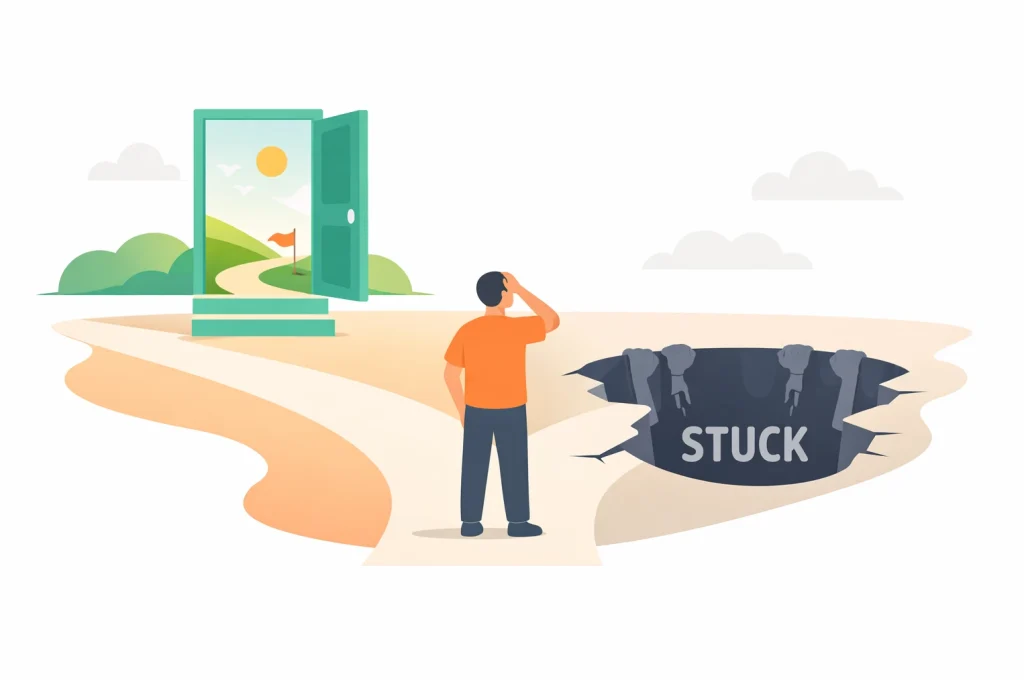
Table of contents:
Fear of Change: how it shows up before you even call it fear
It is rarely about change alone
Most people say they are afraid of change, but that is only half the story, maybe less. Usually they are afraid of what change might drag in behind it: loss of control, failure, embarrassment, regret, money stress, loneliness, the deeply humbling experience of being bad at something for a while. Change is just the front door. The mind is panicking about the rooms behind it.
That is why Fear of Change can look almost ridiculous from the outside. Someone stays in the same stale job for years, keeps putting up with the same maddening relationship dynamic, delays the same decision so many times it starts to look like a hobby. Friends go, "But you are miserable there. Why stay?" Because familiar discomfort has a weird grip. Even when it pinches, it is still known. And the nervous system often prefers known discomfort to an unknown maybe. That link between uncertainty and anxiety is well documented, by the way. Not flattering, but human.
It often disguises itself as practicality
This is one of its favorite costumes. Fear of Change does not always barge in yelling, "I'm scared!" Sometimes it clears its throat, straightens its jacket, and says, "I'm just being realistic." Or, "Now isn't the right time." Or the old classic: "I just need a bit more time to think." A bit more, naturally, which somehow turns into six months, two spreadsheets, seventeen tabs open, and a background headache that never quite leaves.
To be fair, caution is not the villain. Some changes really do need thought. But in this pattern, thinking gets sticky. It stops helping and starts looping. That is exactly where logical thinking becomes useful, because it helps you separate an actual decision from a never-ending spiral of mental static before overthinking eats the whole afternoon. The person keeps circling without getting any closer. They research, compare, imagine, delay, second-guess, reopen the case, then collapse on the sofa exhausted - not from the change itself, but from living in permanent pre-change. That limbo becomes its own grubby little routine.
Your body usually knows before your words do
Fear of Change is not just a thought issue. Quite often, the body clocks it first. Tight shoulders before a conversation about work. A churny stomach when you are about to send the message. Sudden suspicious tiredness the second you start thinking seriously about moving, leaving, beginning again, admitting something out loud. You tell yourself you are "not ready," but sometimes what you really mean is, "My whole system just hit the brakes."
That does not make you weak. It makes you very, very normal. Change messes with prediction, and prediction is one of the brain's favorite ways to feel safe. Even good change can trigger stress because the old map stops working. NHS mental health guidance says it pretty plainly: change and uncertainty can raise anxiety, even when the change is positive. Annoying? Yes. A personal flaw? No.
It can get attached to identity, not just circumstances
Sometimes the deeper fear is not, "What if this goes badly?" It is, "Who will I be if this actually works?" That part gets less airtime, but whew, it matters. People get attached to being the dependable one, the quiet one, the low-maintenance one, the one who never asks for too much, the one who survives by staying small and predictable. Then growth strolls in and asks them to act like somebody else. Oof. No wonder the whole thing feels loaded. If that pattern feels painfully familiar, it may help to look at what too little arrogance costs you, because sometimes what looks like caution is really a long habit of making yourself smaller than you need to be.
So yes, Fear of Change may show up as procrastination, overplanning, avoidance, irritability, or endless internal debate that begins at breakfast and is somehow still going at 11 p.m. But underneath, it is often a knot of uncertainty, safety, and identity all tangled together. Which explains why it can feel so weirdly hard to name, let alone shift.
What opens up when this fear stops running the room
You stop wasting energy on resisting your own life
One of the biggest changes is not glamorous at all. It is relief. Simple, almost boring relief. When Fear of Change softens, your energy is no longer spent wrestling reality every time life moves one chair two inches to the left. You still get nervous, sure. But the whole day is not swallowed by inner friction. And that matters more than people think.
A lot of tired people are not only exhausted by work, family, money, or hard decisions. They are tired from bracing. From rehearsing bad outcomes in the shower. From clinging to something that obviously no longer fits while insisting, with a perfectly serious face, that this is "stability." When that grip loosens, even a little, there is more space for focus, humor, curiosity. Your mind stops treating every crossroads like a courtroom drama with moody lighting.
You make decisions closer to your actual values
When fear is driving, people often choose whatever reduces discomfort fastest. Not whatever fits them best. That is how someone stays in the sensible job they quietly dread, keeps saying yes from habit, or avoids the one conversation that might finally clear the air. Short-term relief, long-term cost. Pretty rotten deal, if we are honest.
When Fear of Change loses some of its grip, decisions get cleaner. You can ask, "What matters here?" instead of only, "What feels least terrifying by Friday?" That does not make choices easy. It makes them more honest. And if fear keeps scattering your attention, learning to hold a target steady can make change feel less like chaos and more like a direction you are choosing on purpose. And honest choices usually build a life that feels more like yours, not just one you kept maintaining because it was already assembled and no one left instructions.
Your confidence becomes less performative
Real confidence is not the absence of fear. It is the growing proof that you can keep moving while fear rattles around in the back seat, muttering nonsense and offering terrible directions. That kind of confidence is sturdier. Less shiny, more useful. People who work through Fear of Change often become less dramatic about uncertainty, not more heroic. They start trusting their ability to adapt, learn, recover, ask for help, tweak the plan. In other words, they stop demanding guarantees before every tiny step.
That kind of self-trust is gold. Quiet gold, yes, but still gold. And it tends to spill into other parts of life too: relationships, work, health, creativity. Once you have proof that you can survive a transition, the next unknown thing stops looking like a personal apocalypse wearing a smart coat.
Your world gets larger again
This may be the most human shift of all. Life gets less narrow. Fear of Change makes people live inside smaller circles than they need to. Same places. Same choices. Same stories about why things "have to" stay the same. Same tiny permissions. Everything starts feeling fenced in, even if - technically speaking - the gate was never locked.
As that fear loosens, possibility comes back online. This is also where optimism gets stronger, not as fake sunshine pasted over reality, but as the ability to imagine that the future might hold more than disaster, regret, and administrative chaos. New skills start to feel available. Better boundaries feel possible. A different city, a new role, a harder but truer conversation - none of it sounds quite so absurd. Not because risk disappears. Because your relationship with risk changes. Research on intolerance of uncertainty suggests that when this vulnerability softens, anxiety symptoms often soften too. That gives a person more psychological room to move, and breathe, and maybe even surprise themselves a bit.
What Fear of Change quietly does when it gets too much power
You get stuck in "almost"
One nasty effect of Fear of Change is that life starts filling up with almosts. Almost applied. Almost left. Almost spoke up. Almost started therapy. Almost moved. Almost admitted the relationship was over six months before the relationship itself got the memo. From the outside, this can look like hesitation. From the inside, it feels like being glued to the floor while your mind keeps pacing ahead without you. Maddening, honestly.
That kind of stuckness hurts because, over time, it changes the way you see yourself. You stop feeling like someone who chooses. You start feeling like someone who hovers, delays, waits for the perfect feeling, then never quite gets it. Have you caught yourself doing that? Sitting there, half-ready and half-frozen, promising that next week will be different? Yeah. That one lands.
Small transitions start feeling absurdly big
When fear builds up, even ordinary change can start feeling hilariously oversized. A new manager. A changed routine. A child starting school. A haircut, for heaven's sake. Not because the event itself is massive, but because your system has begun reading unpredictability as danger. So the reaction swells far beyond the trigger.
That is one reason people often feel embarrassed by this issue. They think, "Why am I reacting like this? It is not even that big a deal." But shame usually makes fear worse, not better. If that self-judgment starts becoming part of the pattern, it helps to notice how shame quietly warps a life, because once fear gets tangled up with shame, even small changes can feel heavier and more personal than they really are. Now you are afraid and also judging yourself for being afraid. Lovely combo. Very efficient if your goal is to feel trapped in your own skin.
You begin to confuse safety with stagnation
This part is sneaky. Stay with the familiar long enough and the mind can start calling it safety, even when it is slowly flattening you like an old cardboard box. Same dull job. Same brittle relationship. Same habits that keep you small, but hey, at least they are predictable. The absence of visible chaos gets mistaken for well-being.
And yet many people who fear change are not actually calm. They are cramped. Restless. Irritable. Quietly grieving the life they keep not choosing. Sometimes this does not come from fear alone but from plain depletion, and the signs can look a lot like what happens when burnout gets too big, especially when even small decisions start to feel oddly heavy. That chronic tension can show up as anxiety, rumination, sleep problems, or that vague sense that something is off all the time and you cannot quite grab it. Research keeps linking intolerance of uncertainty with stronger worry and more severe anxiety, which helps explain why this pattern can wear a person down so thoroughly.
Relationships and work start bending around the fear
Fear of Change does not stay politely in one corner. It leaks. It affects how you show up with other people. You may avoid hard conversations so long that resentment starts fermenting in the background. And if part of the problem is not knowing how to say what you mean without making things worse, it helps to learn ways to become easier to understand and easier to hear, so the conversation feels less like a threat and more like something you can actually handle. In close relationships, this fear can also slide into when caring turns into self-erasure, where keeping the bond starts costing you your own voice, and that makes any change feel bigger than it is. You may cling to roles that no longer fit, then feel bitter that nobody somehow guessed you were unhappy. At work, you might resist helpful shifts, hide ambition, or quietly sabotage opportunities because starting fresh feels too exposing.
Sometimes the cost is not one dramatic collapse. It is a decade of quiet under-living. A thousand small self-betrayals dressed up as "stability." That line stings a bit, I know. It is supposed to. The good news, though, is that patterns built through fear can be softened through practice. They are not welded into your bones. They can change - yes, I hear the irony too.
How to loosen Fear of Change without pretending to love uncertainty
Shrink the time horizon
People with Fear of Change often try to solve the entire future in one sitting. Should I move? What if I hate it? What if I fail? What if I ruin everything? What if, what if, what if. By question seven, the brain is basically chewing the furniture.
Try a shorter frame. Ask, "What is the next honest move in the next seven days?" Not the whole reinvention. Just the next move. That is often where proactivity matters, because it shifts your focus from waiting for certainty to taking one small, deliberate step while the future is still fuzzy around the edges. This is also where healthy perfectionism becomes useful, because it helps you act with care and standards without waiting for the perfect plan, the perfect mood, or total certainty before you begin. Send the email. Book the call. Visit the neighborhood. Update the resume. Spend one weekend acting as if the change were real and notice what happens in your body. NHS guidance on coping with uncertainty leans this way too: short-term focus, practical rhythm, less trying to control the whole horizon at once. If you want a more practical way to build that habit, how to master proactivity breaks it down into simple moves you can actually use when your brain is demanding guarantees before action.
Separate facts from forecasts
Fear loves prediction. It tells you what will happen, how awful it will be, how exposed you will feel, how everyone will react, how you definitely will not cope. And it delivers all this like a weather report. Very official. Very dramatic. Not always very accurate.
Take a sheet of paper and split it in two. On one side, write what is actually true right now. On the other, write what your mind is forecasting. For example: "I have never changed careers before" is a fact. "I will be humiliated and end up broke and irrelevant" is a forecast wearing theatre makeup. This exercise sounds simple because it is simple. It still works. Sometimes the plain stuff works best, irritatingly enough.
Practice chosen discomfort
One useful way to train this muscle is to make small, deliberate changes before life forces bigger ones on you. In practice, this is closely related to training tolerance in everyday life, because you are teaching yourself to stay present with discomfort instead of bolting the second it shows up. Nothing ridiculous. Take a different route home. Speak first in the meeting once this week. Try a class where you are not instantly competent - humbling, but weirdly good for the soul. Rearrange a routine you have been doing on autopilot since the dinosaurs. The point is not novelty for novelty's sake. It is teaching your system, in a practical, body-level way, that change does not automatically equal danger.
Repeated exposure to manageable uncertainty is one reason cognitive-behavioral approaches can help with fear-based patterns. Not because they hypnotize people into loving chaos - imagine - but because they weaken the learned link between "new" and "unsafe." Step by step, the nervous system learns something it did not know before: discomfort is not always a threat.
Build a transition ritual, not just a decision
Some people keep waiting to feel ready. That feeling may never arrive in the neat, cinematic form you had in mind. What often helps more is a ritual around the shift. A Saturday hour for planning. A goodbye note to the old season. A conversation with one trusted person before the step. A tiny object that marks the change. It sounds almost silly, maybe. Until you try it and realise the body likes markers. Humans are ceremonial little creatures, even the skeptical ones.
And one more thing - do not force giant change when you are severely depleted. Sometimes the first move is not "be braver." Sometimes it is "sleep, regulate, get support, then decide." Fear of Change gets louder in an exhausted system. No big mystery there. So if you are tired to the bone, I hope you are gentle with yourself first.
Is this the thing you need to work on right now?
Not always. Some people really are held back by Fear of Change. Others think change is the issue when the deeper problem is burnout, low self-trust, shaky boundaries, or a life setup that would make almost anyone feel cornered. If exhaustion is doing most of the talking, it is often smarter to look at whether burnout is the real priority before pushing yourself into bold new decisions your nervous system has no energy to carry. If your system is running on fumes, demanding reinvention right this minute may create more drama than growth.
It helps to choose the pressure point that matters most right now. Otherwise you try to become braver, calmer, more disciplined, less anxious, more decisive, and somehow better hydrated all in the same week. Noble. Completely ridiculous.
If you want a clearer read on that, AI Coach can help you sort out which area deserves attention first. It can also give you a simple plan for the first three days, which, honestly, is often far more useful than spending another month pacing around the same question in your head.
Frequently Asked Questions (FAQ)
What is Fear of Change in simple terms?
It is a strong resistance to situations that might alter your routine, identity, relationships, or future. A little fear is normal. It becomes a real issue when it keeps blocking choices you genuinely want or need. Some sources also use the term metathesiophobia for an intense fear of change - not exactly a cosy word, but there it is.
Why am I afraid of change even when my current situation is making me unhappy?
Because the mind does not neatly compare "bad now" with "better later" the way people imagine. It often compares "known now" with "unknown later," and the unknown can feel more threatening than familiar disappointment. So yes, people sometimes stay loyal to situations they have clearly outgrown. Humans are odd like that.
Is Fear of Change the same as anxiety?
No. It is closer to a pattern that can be fueled by anxiety. Fear of Change often overlaps with intolerance of uncertainty, anticipatory worry, and avoidance, but it is not identical to every form of anxiety. Think of it as one very specific way anxiety can organize behaviour.
Can fear of change affect relationships?
Very much. It can keep people in relationships they already know are wrong, stop them from setting new boundaries, or make honest conversations feel so threatening that silence starts to look safer. The relationship may stay "stable" on paper while becoming emotionally stale in real life. Which is a rough kind of loneliness, really.
Why does positive change still make me nervous?
Because your nervous system responds not only to danger, but also to unpredictability. A promotion, a new city, a healthier relationship, even wanted change can bring unfamiliar demands. So you may feel excitement and fear at the same time. Inconvenient? Absolutely. Normal too.
How do I know whether I am being cautious or just avoidant?
Ask two questions. First: am I gathering information so I can move, or gathering information so I can delay? Second: does my caution lead to a clearer next step, or only to more circling? Real caution usually sharpens action. Avoidance tends to stretch time and offer only brief relief.
Can Fear of Change become physical?
Yes. People often feel it in the body before they can explain it in words: tension, stomach discomfort, restlessness, poor sleep, irritability, fatigue, that revved-up feeling before a decision. Anxiety commonly shows up physically as well as mentally and behaviourally. The body tends to blurt out what the mouth is still trying to phrase.
What is one good first step if I have been stuck for a long time?
Do not start with a total life overhaul. Start with one bounded experiment. One conversation. One application. One appointment. One week of acting on the assumption that change is allowed. Fear usually shrinks faster when it meets action in small doses than when it meets another month of abstract thinking.
Should I force myself into big change to "get over it" faster?
Usually no. Throwing yourself into a giant transition while already overwhelmed can backfire and teach your system to trust change even less. Gradual, chosen discomfort tends to work better than dramatic self-bulldozing. Slow does not mean weak. Quite often, it means sustainable.
When should I get extra support for Fear of Change?
If the fear keeps you from working, sleeping, functioning, making necessary decisions, or if it is tied to panic, persistent anxiety, or depression, get support. At that point, the issue is no longer just "I'm nervous about a new chapter." It is starting to run too much of your life. Evidence-based psychological treatment can reduce intolerance of uncertainty and anxiety symptoms, which is one reason support can help so much. And truly - if this is where you are, I hope you go easy on yourself.