
Ever notice how a day can disappear without you choosing a single important thing in it? One message pulls you here, one small problem pulls you there, and by evening you've been "busy" for hours while somehow feeling absent from your own life.
That odd blend of usefulness, irritation, and waiting is often a proactivity problem. When this quality gets stronger, you stop living like a reply button with a pulse. You begin to set direction instead of merely absorbing it.
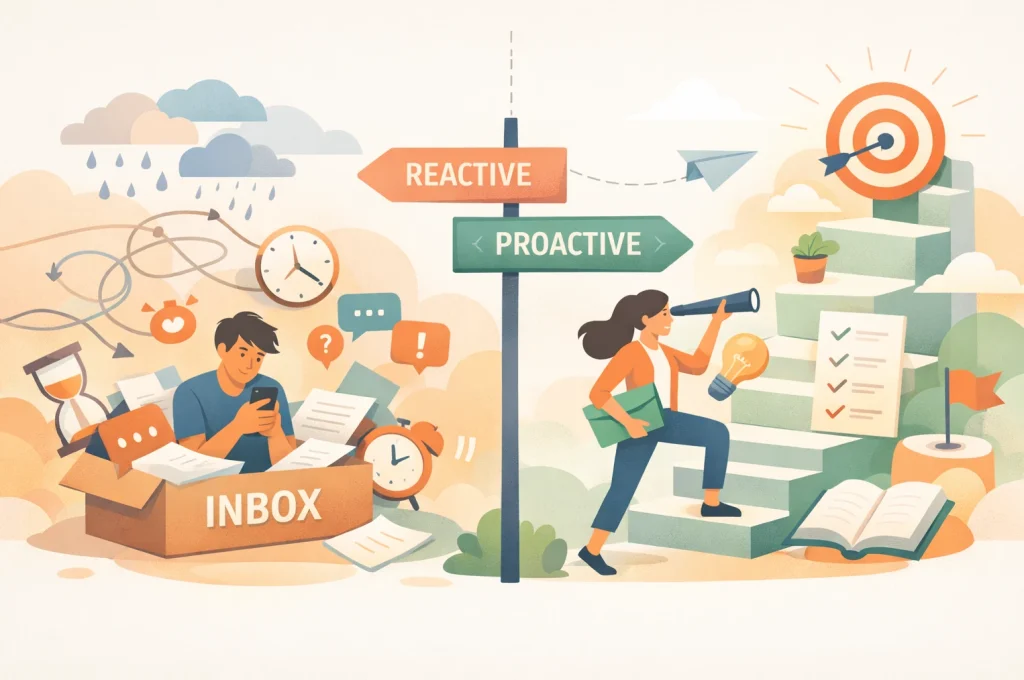
Table of contents:
Proactivity: moving before the nudge arrives
It starts with seeing the next move early
Proactivity is the habit of noticing what will matter a little sooner than most people do, and then doing something about it before the room gets uncomfortable. Not because you enjoy dramatic heroics. Quite the opposite. A proactive person sees that the client is getting vague, the project has a hole in it, the family plan is wobbling, the bill still needs sorting, the conversation nobody wants to have is not going to magically solve itself in a drawer. So they move.
This is why proactivity is closely tied to personal agency. You stop treating life as a series of weather reports and start acting like you can, in fact, open a window, grab an umbrella, call the electrician, send the draft, ask the question. Tiny actions. Big difference.
It takes initiative without waiting to be picked
A proactive person does not need constant prompting to begin. They can enter a situation, scan it, and say, "Right, here is something useful I can own." At work, that may mean proposing a cleaner process before deadlines start slipping. At home, it may mean booking the appointment, replacing the dead smoke alarm battery, or finally creating the shared calendar that saves three people from the same weekly confusion. Glamorous? No. Helpful? wildly.
And no, this is not the same as bossiness. Bossy people often want control. Proactive people want movement. They are less attached to being the main character and more attached to making things happen before avoidable friction hardens into a routine. If control matters more than progress, it may be worth noticing when arrogance goes unchecked, because that pattern can look energetic on the surface while quietly making trust and cooperation worse.
There is pace in it, but not recklessness
People often assume proactivity means bouncing around like you've had six coffees and a dangerous idea. Not really. Healthy proactivity includes speed, yes, but it is purposeful speed. Quick decisions. Timely follow-up. Energy that turns into action rather than endless internal speeches. That distinction matters even more in work and business settings, where moving early helps only if you can also balance caution and risk instead of mistaking speed for good judgment, and that is usually what keeps initiative useful rather than chaotic.
It also includes ownership. If you act early, you usually accept that your action will shape what happens next. That requires a certain sturdiness. A willingness to say, "I'll take first pass," or "I'll draft an option," or "I'll handle this part." You do not wait for perfect clarity. You create enough clarity to begin.
It is not hustle culture in a nicer outfit
This matters. Proactivity is not constant motion, chronic over-functioning, or trying to rescue everyone within a ten-foot radius. It is not frantic helpfulness. Sometimes what looks like admirable readiness is really hypervigilance when your inner lookout never really clocks off, so you stay on alert for every possible issue and mistake anxiety for initiative. It is not being unable to sit down because silence makes you itchy. Sometimes the most proactive move is to ask early for missing information. Sometimes it is to prevent unnecessary work. Sometimes it is to say no before a messy yes gets expensive.
So if the word makes you picture an exhausting productivity goblin, leave that image by the door. Real proactivity is more grounded than that. It is the ability to meet reality a little ahead of schedule, with enough initiative, awareness, and nerve to shape what happens next instead of forever arriving after the fact.
What changes when you stop living on incoming
You spend less of your life in waiting rooms
One of the biggest gains from proactivity is simple: less hanging around for other people, other moods, better timing, clearer signals, magical motivation, whatever. You stop postponing useful action until the universe sends a formal invitation embossed in gold. You write the email. You ask the awkward question. You put the first draft on the table. You create motion.
That shift saves more time than people expect. Not because you become superhuman, but because delays stop breeding in the corners. A task touched early is usually smaller, cleaner, and far less emotionally gross than the same task touched late. You know that already, probably.
People start giving you more room
Proactive people tend to be trusted with more freedom. Managers worry less. Colleagues loop them in earlier. Partners stop feeling like they must carry the invisible admin for two people. Why? Because initiative is reassuring. It tells other humans, "You won't have to drag me into reality. I'm already here."
That trust can quietly change a career. You get offered stretch work. Your ideas land faster. And if you want those ideas to travel further once you speak up, training persuasion without becoming manipulative makes proactivity more effective, because spotting the next move matters most when you can also help other people see why it is worth taking. People ask what you think before the mess gets dramatic. In ordinary relationships, it changes the atmosphere too. You feel less like another person to manage and more like someone who can be leaned on without a whole ceremonial sequence of reminders.
Problems stay smaller for longer
Proactivity is excellent at catching things while they are still a little ugly rather than fully grotesque. A strained dynamic gets addressed before it turns cold. A weak system gets tweaked before it starts eating hours. A missed detail gets fixed before it becomes a chain of embarrassing follow-ups. This is one of the least sexy benefits and one of the best.
There is a real emotional payoff here: less dread. Fewer background worries buzzing around because you know, somewhere in your ribcage, that several small things are ripening into future annoyance. Proactive people still have stress. They just meet more of it while it is manageable. That is also part of what gets easier when stress resistance grows, because pressure does not vanish, but it stops ambushing you quite so often once you act before things pile up.
You feel more like an author and less like a bystander
This may be the deepest benefit. Proactivity strengthens self-trust because it gives you evidence that you can influence your circumstances. Not control everything. No one gets that deal. But influence? yes. You see a need, respond, and watch life bend a little because you acted. That lands in the nervous system in a very particular way.
Over time, you stop identifying quite so much with passivity, hesitation, or "maybe later." Your confidence becomes less theatrical and more practical. Not "I'm amazing." More like, "I know how to begin." And honestly, that sentence has carried more people forward than a mountain of inflated self-belief ever did. In that sense, proactivity also supports healthy pride without becoming obnoxious, because the self-respect it builds comes from follow-through, not from trying to look important.
What reactive living quietly costs
You keep doing second-hand priorities
When proactivity is weak, your day gets shaped by whatever arrives loudest. Requests. Pings. Other people's forgotten tasks. Small inconveniences with surprisingly good marketing. You respond, and respond, and respond again. By nightfall you may have been useful all day and still not touched the thing that actually matters to you.
That creates a strangely hollow kind of fatigue. Not the satisfying tiredness of real progress. More the feeling of having donated your attention in little slices until nothing substantial was left. A person can live like that for years, by the way, and call it responsibility. Rough deal. If that pattern has been running your days for a while, it can start to feel a lot like when life feels jammed in neutral, where nothing is fully collapsing but forward motion keeps getting quietly replaced by maintenance.
Opportunities pass because nobody officially handed them to you
Low proactivity often hides behind politeness, caution, or "I just didn't want to overstep." Sometimes that is true. Sometimes it is fear wearing a neat shirt. If that pattern feels painfully familiar, it may help to look at self-sabotage in real life, because repeated hesitation can seem reasonable on the surface while quietly stopping you from stepping forward. You wait to be chosen. Wait to be told. Wait for the role to be clearly offered, the path clearly explained, the chance clearly approved. Meanwhile, more proactive people step in early, ask, suggest, try, and end up closer to the action.
This can hurt in ways that are hard to name. Not only missed promotions or projects. Also missed influence. Missed learning. Missed visibility. You remain capable, maybe very capable, but oddly peripheral. Like someone standing near the stage with a perfectly good voice and no habit of reaching for the mic.
Dependence starts to feel normal
If you repeatedly wait for direction, your brain learns a quiet little lesson: other people start things, I join later. That pattern can become so familiar you stop noticing it. You ask what to do next before thinking. You see a problem and assume someone else must own it. You feel frustrated that nothing changes while behaving as though change belongs to management, your partner, the market, the timing, the stars. Pick your favorite external force.
Again, this is not always laziness. Sometimes it is learned passivity. Sometimes burnout. Sometimes a long history of being corrected whenever you took initiative. Still, the result is the same: your influence shrinks because you stop using it.
The emotional cost is sharper than people admit
Weak proactivity often creates a low-grade blend of resentment and self-doubt. You resent being overlooked, but you did not step forward. You resent always reacting, but you did not set a direction. You resent the chaos, or the missed chance, or the sloppy system... but you stayed in complaint longer than in action. That tension bites.
After a while, it can chip away at dignity. You stop fully believing your own intentions because so much of your energy goes into responding rather than initiating. Even small things start to sting: seeing someone else solve the obvious issue, watching a simpler version of an idea get praised because they voiced it first, realizing you have been waiting for permission from people who were barely thinking about you at all. Not pleasant. Also, very changeable once you see it clearly.
How to build proactivity without becoming exhausting
Give yourself one unassigned move each day
Pick one useful action daily that nobody asked you to do. Small is fine. Draft the summary before the meeting follow-up gets messy. Refill the thing that always runs out. Flag the missing step in a process. Answer the question behind the question. The goal is not to become everyone's unpaid savior. The goal is to teach your brain, by repetition, that initiative belongs to you too.
If this feels oddly hard, good clue. It usually means you've been living more reactively than you realized.
Stop ending interactions with fog
A lot of passivity sneaks in right at the end of conversations. "Let's circle back." "We'll figure it out." "Someone should handle that." Murky little phrases, aren't they. Train yourself to leave exchanges with a visible next move: who will do what, by when, or what first step you will take if the answer is still unclear.
This one habit changes a lot. Meetings become shorter. Text threads become less swampy. Your own mind relaxes because it no longer has to keep re-opening half-finished loops like a browser with 38 tabs and an attitude problem.
Turn irritation into a draft, not a monologue
When something annoys you, ask one blunt question: "Can I turn this complaint into a proposal?" Not always, but often. If deadlines keep slipping, sketch a simpler timeline. If communication is messy, suggest a shared note. If handoffs are vague, write a rough template. It does not need to be elegant. It needs to exist. This is also where it helps to learn how to develop creativity, because proactivity works better when you can generate practical options quickly instead of only spotting what is wrong.
This is one of the fastest ways to train proactivity because it reroutes energy you already have. Frustration is fuel. Wasteful fuel, if you only mutter into your tea. Useful fuel, if you make a first draft out of it.
Use language that puts you back in the chair
Listen to how you talk to yourself during the day. "I have to." "I guess I should." "They want me to." Sometimes those phrases are accurate. Sometimes they quietly drain ownership out of your actions. Try swapping a few of them for "I choose to," "I'll start with," or "I'm taking care of this now because..."
Cheesy? A bit. Effective? also yes. Language shapes posture. When your words sound less dragged and more chosen, action gets easier. Not magically. But enough to matter.
Ask where friction lives, then fix one corner of it
Once a week, ask two people you work or live with a very practical question: "What's making this harder than it needs to be?" Then do not defend yourself. Just listen. Usually the answers point to tiny but high-value fixes: unclear updates, missing information, clunky handoffs, too many back-and-forths, that one recurring misunderstanding everybody has quietly adapted to.
Choose one friction point and improve only that. Proactivity grows best through concrete edits to real life, not through grand declarations about becoming a new person by Monday. And if you want an extra challenge, pick one task you have been weirdly postponing even though it matters to you, then give it your best hour on purpose. Full attention. No dabbling. That kind of self-directed push wakes something up.
Should this be your next area to work on?
Not necessarily. Some people really do need more proactivity. Others are already taking initiative all over the place and are actually short on boundaries, rest, or discernment. If you are constantly overreaching, overhelping, or solving everybody else's problems before they have located them themselves, more proactivity is probably not the medicine.
It helps to look at your actual pattern. Are you often stuck in waiting mode, hoping clarity will arrive from outside? Do you keep seeing what needs doing and still hold back until someone officially names it? Then yes, this quality may deserve attention. If your real issue is exhaustion, fear of conflict, or poor prioritizing, start there instead. Otherwise you end up polishing the wrong skill very earnestly, which is a classic self-improvement hobby. And if the stuckness feels heavier than hesitation - more numb, flat, or strangely hard to care about - it may help to read about depression in real life, because not every lack of initiative is really a motivation problem.
If you want a cleaner way to sort that out, AI Coach can help. For a practical example, see how it turns mental chaos into a clear action plan, especially when several issues are tangled together and you need a starting point, not another round of overthinking. It can show which skill is most worth focusing on right now and give you a simple plan for the first three days, so you're not stuck guessing and calling it reflection.
Frequently Asked Questions (FAQ)
What is the difference between being proactive and being reactive?
Reactive people act mostly after something happens: a problem appears, a request arrives, a deadline bites, tension becomes visible. Proactive people act earlier. They notice patterns, predict likely friction, and move before the situation gets louder. The point is not to predict everything like some elegant fortune teller. It is to reduce how much of your life gets dictated by late responses.
Is proactivity the same as initiative?
They overlap, but they are not identical. Initiative is the act of starting something. Proactivity is broader. It includes noticing what is needed, anticipating consequences, creating momentum, and often preventing issues before they fully form. You can show initiative once in a while and still live pretty reactively overall. Proactivity is more like a pattern of orientation.
Can you be proactive if you are not in charge?
Absolutely. You do not need a management title to clarify the next step, flag a risk, draft an option, improve a small process, or ask a useful question early. Proactivity is less about authority and more about ownership. Of course, context matters. In a rigid workplace you may need tact. Still, there is usually more room to act than passive habits first suggest.
Why do some people struggle so much with proactivity even when they care?
Usually because something emotional gets tangled in the skill. Fear of doing it wrong. Fear of seeming pushy. A history of being shut down when they took initiative. Burnout. Low self-trust. Sometimes even plain old habit. If your brain learned that it is safer to wait, then waiting can feel "reasonable" long after it stops being useful. That does not mean the skill is missing forever. It means the nervous system may need retraining, not just a lecture.
Can proactivity become annoying or controlling?
Yes, if it loses respect for other people. Healthy proactivity creates movement and solves real friction. Unhealthy proactivity barges in, grabs ownership nobody offered, and acts offended when others do not clap. The difference is important. Good proactivity stays aware of context, consent, and actual value. It helps without colonizing the whole room.
Does proactivity matter more at work than in personal life?
No. It matters everywhere. At work, it helps with visibility, trust, and smoother execution. In personal life, it changes everything from money admin to health appointments to difficult conversations to household fairness. A surprisingly large amount of relationship tension is not about love at all. It is about one person always having to notice, remember, and initiate first. So yes, proactivity is very much a life skill, not only a career one.
Can introverts be highly proactive?
Of course. Proactivity is not loudness. It is not charisma on tap. An introvert can be extremely proactive by preparing early, sending thoughtful follow-ups, spotting gaps, proposing clear next steps, and handling issues before they spread. Some proactive people are outspoken. Others are quiet and wonderfully effective. The common thread is not volume. It is ownership.
How do I show proactivity without overstepping at work?
Use a simple formula: notice, propose, check. Notice the issue clearly. Propose a next move or first draft. Then check whether that direction fits the priorities of the team. That approach shows initiative without acting like you have declared yourself emperor of operations. It also helps to frame your input practically: "I noticed X. I drafted Y as a starting point. Want me to run with it?" Clean. Adult. Much less annoying than dramatic freelancing.
What is one sign that my proactivity is getting stronger?
You begin creating movement sooner. You speak up earlier. You leave fewer vague loose ends behind you. You catch yourself turning "someone should..." into "I'll start with..." Another good sign is emotional: you feel less trapped inside waiting. Even before the external results show up, your inner position changes. You start relating to problems and opportunities as things you can influence, not merely endure.
How can I practice proactivity when I feel tired and unmotivated?
Lower the size, not the standard. Do one anticipatory action instead of five. Send the first message. Make the appointment. Outline the idea. Ask the question now rather than mentally carrying it for three days. Proactivity is not an all-or-nothing personality performance. It is a repeated choice to create a little movement before inertia hardens. On low-energy days, a small self-directed action still counts. Honestly, those days count the most.