
Discipline is the deeply unsexy skill of doing the thing you said you'd do... after the mood has wandered off, shut the door behind itself, and left you alone with your calendar. If your plans look smart and noble at 9 a.m. but weirdly negotiable by 2 p.m., if tiny comforts keep beating the stuff that actually matters, there's usually a discipline gap sitting there in plain sight, pretending to be "just how life is."
The reassuring part? Discipline is not a personality transplant. You do not need to become one of those terrifying people who meal-prep in glass containers and enjoy waking up at 5:12 for fun. It grows through structure, repetition, and a handful of ordinary, slightly boring choices that make your days hold together better.
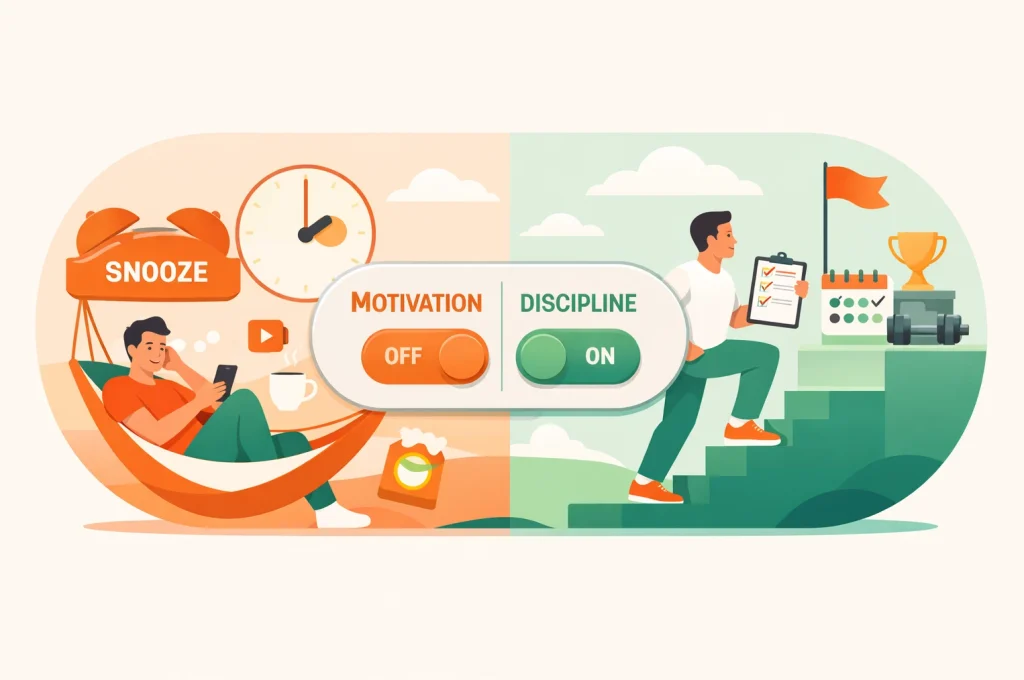
Table of contents:
What discipline quietly fixes in a life
Your promises start meaning something
When discipline starts getting stronger, the first payoff usually isn't some big shiny achievement. It's self-trust. You stop making tiny agreements with yourself and breaking them before lunch. You say you'll send the invoice, go for the walk, close the laptop at eleven, and more often than not you actually do it.
That sounds basic. Almost suspiciously basic. But honestly, it's huge. Self-respect is built in these tiny kept promises, the dull ones nobody applauds. And once that trust comes back, decisions get cleaner too. You spend less energy haggling with yourself every hour like a tired market vendor. That's also why efficiency gets easier to build: your attention stops leaking into endless internal debates and can go back to the task in front of you. Less "maybe later." Less dramatic bargaining over a ten-minute task. Less of that weird guilt-fog trailing behind you while the laundry basket silently judges your character.
Work gets less dramatic
People love imagining discipline as something you use for giant, cinematic goals. In real life, it helps with plain old follow-through. You reply when you said you would. You read the material before the meeting instead of trying to contribute through eye contact and optimism. You meet deadlines before they become a household crisis with coffee, panic, and snacks.
That steadiness changes how other people experience you. And it's closely tied to where ethics actually lives: not in dramatic speeches about values, but in ordinary moments when your actions line up with your word. Colleagues stop building backup plans around your delays. Clients unclench a little. Even at home, discipline makes you easier to live with, because "I'll do it later" stops floating around the house like a dusty little ghost. Reliable behavior isn't flashy, no. Still, it saves an absurd amount of stress, rework, awkward apologies, and that low-grade embarrassment nobody orders but somehow keeps getting delivered.
Freedom gets less fake
This one catches people off guard. Discipline looks strict from the outside, but from the inside it often feels like relief. When you stop postponing the basics, your evenings open up. Bills get paid before they turn into nasty little envelopes. Workouts happen before your brain drafts a legal defense for the sofa. You're not free because you escaped structure. You're free because the important stuff isn't stalking you anymore.
There's less emotional whiplash, too. Fewer heroic days followed by three foggy ones. Less "new me" energy on Monday and potato-era regret by Thursday. A disciplined routine smooths the week out. And when that structure stays flexible rather than rigid, spontaneity starts getting easier too, because you're choosing from stability instead of using chaos as your only source of aliveness. Not perfectly, obviously. You're still a person, not a Swiss train. But the ground under your life feels firmer. Less wobble. More room to breathe.
Long goals finally have a chance
Most worthwhile goals are kind of boring in the middle. That's just the truth. Learning a skill, saving money, rebuilding your health, fixing your sleep, writing anything longer than an annoyed email all of it asks for repetition. Discipline is what carries you through that stretch where novelty has died, motivation has gone on holiday, and the results are still taking their sweet time.
This matters emotionally, not just practically. Progress becomes visible. You can point to reps, pages, sessions, finished tasks not just good intentions and a nice Notes app list. That shift is bigger than it sounds. It replaces vague hope with evidence. And evidence is calming. Have you noticed how much easier it is to keep going once you can say, "I did this three times last week"? Discipline gives effort a memory. That's a very different life from restarting every Monday like a politely haunted gym member.
When discipline stays shaky
You keep outsourcing your future to your current mood
Weak discipline often looks like endless emotional voting. Do I feel like it? Maybe after coffee. Maybe after one episode. Maybe once the desk is cleaner, the weather improves, my soul is aligned, and Mercury stops doing whatever people say it's doing. The task keeps moving because the decision keeps getting handed to a mood that changes every three and a half minutes.
That's why capable people can still look inconsistent. It isn't always laziness not even close. Sometimes people confuse mood with instinct, even though intuition is made of something quieter and more grounded than whichever excuse happens to be shouting the loudest. Sometimes it's a dependence on feeling ready. And feelings are lovely companions. Terrible managers. If your behavior swings with your emotional weather, progress will wobble no matter how sincere you are.
Simple tasks become weirdly heavy
When discipline is shaky, ordinary actions collect drama they never asked for. Starting a report feels like stepping onto a stage under bright lights. Washing up after dinner turns into a peace negotiation. Replying to one email somehow requires a playlist, a beverage, a snack, and maybe a sign from the universe. You know the task is small. Your body reacts like it's been asked to drag a piano up four flights of stairs.
Part of that weight comes from delay. Tasks don't stay neutral when you avoid them. They gather guilt, and guilt makes action feel sticky. So you put them off longer, which creates more guilt, which makes the task feel even bigger. Lovely little system. Horrible results. That's how one missed day turns into a week of low-level avoidance before you even realize what happened.
Your identity takes small hits
A lack of discipline doesn't just slow down your goals. It changes the story you tell about yourself. After enough broken plans, you start saying things like "I'm just not consistent," "I never finish anything," or the old favorite, "I work best under pressure," which let's be honest sometimes means "I keep cornering myself and calling it a method."
Those labels matter more than people think. Your brain listens. If you keep treating inconsistency as your personality instead of your current pattern, you'll start protecting it without meaning to. Then even success feels suspicious. One good week? Fluke. One finished project? Must have been luck. Weak discipline can quietly turn effort into identity confusion, and that's one reason people stay stuck longer than they need to. Painfully longer, sometimes.
You swing between control freak and total shrug
A lot of undisciplined people are not relaxed at all. They alternate. For two days they become a strict little dictator: early alarm, impossible schedule, no sugar, no scrolling, new notebook, giant expectations. Then life happens, energy dips, one plan slips, and the whole system gets thrown out like a failed sourdough starter.
That swing is exhausting because it teaches the wrong lesson. You assume the answer is to try harder, tighten more, be stricter with yourself. Usually the real issue is that your system was too brittle to survive actual life. Discipline grows from repeatable standards, not temporary self-attack. If your routine only works under ideal conditions, it doesn't really work. It's a performance, and performances are very tiring to maintain in a kitchen full of dishes and unanswered texts.
How to be disciplined
Shrink the promise until you stop lying to yourself
A very common mistake is choosing goals that sound impressive and are impossible to repeat. "I'll wake up at 5, work out for an hour, do deep work till noon, and never touch my phone." Right. On one cinematic Tuesday, maybe. Real discipline usually starts smaller. Pick one behavior you can do daily with mild resistance, not maximum heroism. Ten focused minutes before checking messages. Dishes before sitting down. One page. Lights out by 11:30.
Then keep that promise for a week. Same cue, same standard, no dramatic renegotiation because today feels special or unusually cursed. This matters because discipline isn't built from intensity. It's built from evidence. Your brain needs to see, repeatedly, that your word survives ordinary moods not just bursts of enthusiasm and nice weather.
Make the desired action the easier action
People often treat discipline like a moral showdown. A duel between your higher self and your worse instincts. Sometimes it's much less philosophical than that. Sometimes it's just an environment problem wearing a fake mustache. If your phone is on the desk, your snacks are in sight, your running shoes are in the car, and your project file is buried under seventeen tabs, you're asking discipline to do the job of setup. That's rude, frankly.
So rig the room a little. Put the charger outside the bedroom. Open the document before you stop work for the day. Leave gym clothes where they're mildly annoying to ignore. Use website blockers during one protected focus block instead of trusting raw virtue. Disciplined people do use willpower, sure but they also stop making the right action unnecessarily uphill.
Use rules for the moment your brain starts bargaining
Discipline tends to break in the same few moments: right before you begin, right after discomfort shows up, or right after one small slip. So prepare for those moments in advance. Not with glittery affirmations, just with plain rules. "When I notice I'm stalling, I do two minutes." "If I miss the morning session, I switch to the smaller evening version not to nothing." "When I want to scroll during work, I write the urge down and finish the paragraph first."
If you're especially gifted at inventing very convincing excuses, learning how to improve your critical thinking can help you tell the difference between a real obstacle and a convenient story. That's useful. Otherwise the bargaining part of your brain turns into a smooth-talking lawyer and hijacks the whole afternoon.
And yes, this is boring. Good. Boring is helpful here. A rule saves you from re-deciding under temptation, and that's the trick really. The more often you decide in advance, the less often you get mugged by the version of yourself who suddenly has twelve reasons why today shouldn't count.
Measure recoveries, not perfection
If you want discipline to grow, stop judging it only by streaks. A streak is nice. Recovery is the real skill. Did you restart after the bad day, the late meeting, the cold, the weekend trip, the argument, the random Tuesday slump? That tells you much more than one clean week ever will.
Keep a very plain log for two weeks. Nothing fancy, no life dashboard that makes you feel like a failing air-traffic controller. Just note three things: what you planned, whether you did the minimum version, and how quickly you restarted after a miss. Patterns will show up. Maybe evenings work better than mornings. Maybe hunger wrecks your focus. Maybe one skipped task triggers a full "screw it" spiral. Annoying, yes but useful.
If other people rely on you, that same habit can strengthen mentorship skills, because it models something real: disciplined people do slip, they just recover faster and with less drama. That's encouraging to watch. Discipline becomes trainable the moment it stops being a vague complaint and starts leaving tracks.
Should discipline be your next growth focus?
Not always. Some people genuinely need more discipline. Others are blaming "lack of discipline" for a problem that is really exhaustion, grief, untreated stress, a chaotic workload, or goals they never truly chose in the first place. Sometimes the drag is emotional rather than logistical: when jealousy warps a life when it gets overfed, it can quietly pull your focus into comparison, suspicion, and mental replays instead of the routines you were actually trying to build. And sometimes the real friction is that fear of change shows up in real life as procrastination, overthinking, or clinging to familiar routines, which can look like weak discipline from the outside. If every day already feels packed to the ceiling, adding more self-pressure may only make you harsher, not steadier. In that kind of season, adaptability may be the better skill to work on first, because the real challenge is adjusting to shifting demands without falling apart, not forcing yourself into a stricter routine at any cost.
It helps to choose one growth focus at a time. Otherwise you end up trying to become disciplined, confident, organized, calm, healthier, and somehow financially responsible before next Tuesday. Noble idea. Messy method. If your main pattern is broken promises to yourself, constant drifting, and trouble sticking with plans once the novelty wears off, then yes discipline is probably worth your attention.
If you want a clearer read on that, AI Coach can help you sort out what deserves attention first. It gives you a short assessment and a simple three-day starting plan, so you're not guessing based on guilt, mood, or one suspiciously productive Monday.
Frequently Asked Questions (FAQ)
What is discipline, really?
Discipline is the habit of following a standard on days when your feelings are being deeply unhelpful. It's not the same as being cold, rigid, or magically productive from sunrise to sunset. In real life, it means you can begin tasks, stick with them, and return after a slip without turning the whole week into a personal tragedy with background music.
Why do I start strong and then fall off?
Usually because the plan is too big, too vague, or way too dependent on enthusiasm. You aim for a full personality makeover, hit one rough day, then decide the whole system failed. More often, the system was just oversized. Discipline sticks better when the rule is small, clear, and survivable on an average Tuesday not only when the stars align.
Is discipline more reliable than motivation?
Motivation is great for ignition. Discipline is better for mileage. When you feel inspired, almost anything seems possible for a few hours. Discipline matters later, when the task is familiar, your phone is nearby, and no one is cheering. They work well together, but discipline is the steadier engine by far.
How long does it take to build discipline?
Faster than people think, slower than the internet promises. A lot of people can feel a real shift within a couple of weeks if they keep one or two simple rules consistently. The deeper change takes longer, because what's really changing is trust: your brain learning that your plans are not decorative. They mean something now.
Why am I disciplined at work but not at home?
Because work often comes with built-in structure: deadlines, witnesses, consequences, routines, sometimes a boss who would quite like that report today, thanks. Home usually has softer edges, more temptation, and fewer external signals. If you want more discipline at home, you often need to create the structure that work provides automatically.
Do disciplined people need strict schedules?
Nope. Some disciplined people love detailed schedules. Others work better with a few firm anchors and plenty of flexibility around them. What matters is not whether every hour is planned. What matters is whether your key actions happen reliably enough that your goals stop depending on chance, chaos, or random guilt.
What should I do after I break my routine?
Don't turn one miss into a personality statement. Restart with the smallest valid version as soon as you can. If your normal workout was forty minutes, do ten. If your writing session was a page, write a paragraph. Recovery trains discipline much better than guilt does. Guilt mostly just sits there looking busy.
Can discipline become unhealthy?
Yes. When discipline turns into rigidity, self-punishment, or constant control, it stops helping. Healthy discipline supports your goals and keeps life workable. Unhealthy discipline leaves no room for illness, grief, changing circumstances, or plain human error. If the system can't bend, it usually breaks and often takes your mood down with it.
What if stress, distractibility, or ADHD make discipline harder?
Yes, those things can make discipline much harder because attention, energy, and emotional regulation are already under strain. In that case, smaller steps, visible cues, fewer decisions, and outside support matter even more. The answer usually isn't harsher self-talk. It's better design, lower friction, and a more realistic minimum. Gentler, but smarter.
What is one useful thing I can do today?
Choose one rule you often break and keep it for the rest of today with no exceptions. Maybe no phone during meals. Maybe lights out at a set time. Maybe finishing one postponed task before anything entertaining. One kept rule is better training than ten dramatic promises. Small, yes. Still powerful.