
Open-mindedness is the thing that stops your first opinion from kicking the door open and declaring itself king of the house. Without it, the mind gets a bit stuffy. New people, unfamiliar ideas, odd opportunities they keep showing up, and instead of feeling interesting, they mostly feel annoying, suspicious, or instantly sorted into the mental drawer marked "not for me." Handy, maybe. Also a pretty efficient way to make your life smaller.
And yes, that tightness has a price. You argue faster, learn slower, and end up living in a little museum of your old conclusions. Same labels. Same reactions. Same emotional furniture, still squeaking in the corner. If that pinches a bit... well, there's probably something here worth looking at.
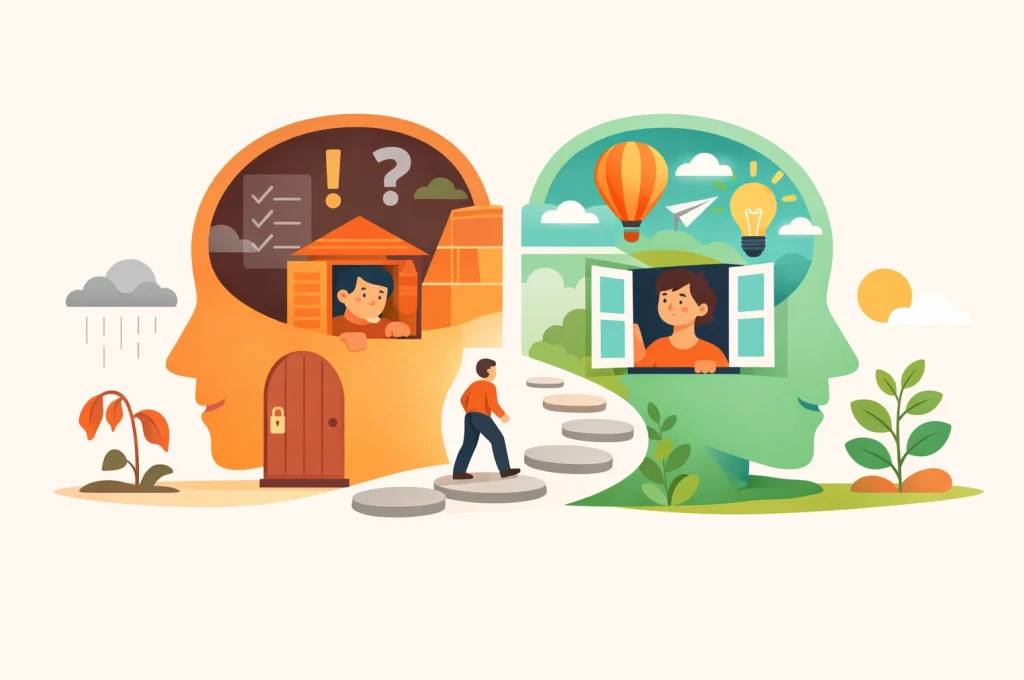
Table of contents:
Open-mindedness: what it looks like when a person actually has some mental space
It is not the same thing as having no opinion
A lot of people hear open-mindedness and imagine someone who agrees with everybody, nods along to every bizarre theory, and has all the backbone of wet cereal. Not it. That's not openness, that's drift.
Real open-mindedness means you can hold a view without welding it to your identity. You can still be grounded, still have determination, still say, "This is where I stand." The difference is, you leave a window cracked for new evidence. You don't treat changing your mind like a humiliating public ceremony. You treat it like learning. Which, somehow, people keep acting shocked by.
They listen for meaning, not just for a gap to jump into
One of the clearest signs of open-mindedness is how a person listens. Not that polite, still-faced listening where the eyes look calm but the brain is already sharpening its comeback. Real listening. The kind that tries to catch what the other person actually means, what shaped their view, where they're coming from and whether there's anything useful in there, even if the whole package isn't your thing.
This is where the skill leans right up against empathy. You don't have to agree with someone to understand them properly. And once you do understand them, your own thinking gets less lazy. Fewer stereotypes, fewer knee-jerk reactions, more contact with reality. Helpful at work, in friendships, in marriage, in team projects, at family dinners. Especially family dinners, honestly. That's where half the population seems to earn their emotional endurance badge.
They can tell the difference between discomfort and danger
Open-minded people tend to notice one very useful thing: unfamiliar does not automatically mean bad. "This feels weird" and "this is wrong" are not the same sentence, even if your nervous system likes to blend them together in a panic smoothie.
That little gap matters more than it seems. It gives you enough breathing room to actually look at a new idea, a different culture, an unusual person, a method you'd normally reject on sight. And no, that doesn't make you gullible. Healthy open-mindedness works best with analytical thinking, and it gets even more valuable when paired with strategic thinking. Because let's be fair, not every fresh idea is brilliant. Some are nonsense wearing expensive shoes. The point isn't to swallow everything whole. The point is to look before you swat it away.
They update instead of clinging for dear life
Maybe the deepest part of open-mindedness is mental flexibility. A person with this skill can revise. They notice new evidence. They question assumptions. They can admit that context changes things which sounds obvious, right up until you watch people argue with reality as if reality has personally insulted them.
And this isn't only about politics or debates or those cafe conversations where everyone pretends to be chill while defending their worldview like it's a family heirloom. It shapes personal growth too. If you're open-minded, you can question your own habits, your own stories, your own favorite line: "That's just how I am. That kind of reflection gets much more useful when you also learn how to be honest with yourself, because without honesty, "self-awareness" can turn into a very polished form of self-protection." Sometimes it is. Sometimes it's just an old sentence that's been squatting in your head rent-free for years. That's where change sneaks in. Quietly. Sideways.
What starts opening up when your mind does
You learn faster because you stop wrestling the lesson
People with stronger open-mindedness usually grow faster, and not because they're some dazzling, rare-breed genius. Usually it's simpler than that. They don't spend half their energy defending what they already think. New information comes in, and instead of folding their arms at it, they work with it.
That changes a lot. Feedback lands better. Mistakes become information instead of proof that you're secretly hopeless. A new tool, method, or perspective gets a fair shot instead of an automatic eye-roll. If you've ever watched someone improve suspiciously fast, there's a decent chance they weren't just disciplined. They were teachable. Big difference, actually.
Relationships get less brittle
Open-mindedness makes people easier to be close to. Not because they become endlessly agreeable honestly, that would be exhausting but because they don't treat difference like betrayal. A partner can like things you don't like. A friend can read the same situation differently. A coworker can challenge the plan without becoming the enemy of civilization.
That softens conflict in a very practical way. You ask more questions. You jump to fewer conclusions. And when this habit is backed by benevolence, people feel the shift quickly, because your curiosity stops sounding like an interrogation lamp and starts sounding like care. You become capable of saying, "Okay, I don't see it yet help me understand." That one sentence saves a ridiculous number of relationships. It pairs beautifully with tolerance too, because respect gets much easier when your mind isn't always scanning for reasons to shut the door.
Better decisions start showing up at work
At work, open-mindedness is absurdly useful. It helps you notice possibilities other people dismiss too early. It makes brainstorming less stiff, collaboration less territorial, and problem-solving less precious. Add motivational skills to the mix, and good ideas have a much better chance of surviving the meeting instead of dying quietly in somebody's notebook.
If one approach isn't working, you're not emotionally married to it. You can pivot without behaving as if reality has offended your entire bloodline. That's a serious advantage in changing environments. Open-minded people can take in unusual input, listen to a junior colleague, test the oddball idea, borrow a tactic from another field. They also tend to do better with creativity, because new ideas need a little oxygen before they become useful. Smother them too early and well, that's that.
Your identity gets more breathable
This one is more personal, and kind of beautiful really. Open-mindedness gives you room to outgrow old labels. "I'm not that kind of person." "People like me don't do that." "That would never work for me." Maybe. Sure. Or maybe that's just a sentence you've repeated so many times it started wearing the costume of truth.
When your thinking gets more flexible, shame often loosens its grip a little. You can experiment without feeling as if every new step threatens your whole self-image. Life starts to feel less like protecting a fixed character and more like finding out what's actually possible. Lighter somehow. More alive. Definitely more interesting than spending years guarding the same dusty version of yourself like a museum volunteer.
What closes down when open-mindedness is missing
You start rejecting things before you've really met them
When open-mindedness is weak, the mind gets twitchy. Different opinion? Nope. Strange-looking idea? Pass. Person from another background? Bit suspicious. Method you didn't invent yourself? Obviously inferior, thanks so much. The funny part is, this can look like confidence from the outside, so people don't always see what it's costing them.
And the cost is real: missed connection, missed learning, missed chances. You might call yourself practical, realistic, hard to fool. Fair enough. But sometimes what feels like strength is just rigidity in sensible shoes. And rigidity makes the world smaller than it needs to be. Smaller, duller, harsher too.
Feedback feels like an attack
Without enough open-mindedness, correction gets weirdly personal. Someone suggests another way, points out a blind spot, questions your take and your whole system reacts like a burglar just came through the kitchen window. You explain. Justify. Counter. Defend. Fast.
That pattern is exhausting. It also blocks growth almost instantly. If every challenge to your opinion feels insulting, you'll naturally avoid the exact conversations that could help you expand. Over time, this creates that stale, stuck feeling people often notice in fear of change: the world keeps moving, but your inner map stays laminated. Nothing new sticks to it.
Relationships begin to harden around your certainty
People don't always fight with a closed mind. Often they just stop bringing things to it. They share less. Explain less. Offer fewer ideas. Why bother, if they already know the response will be a brick wall with eyebrows?
This shows up everywhere couples, families, teams, friendships, all of it. A person who can't seriously consider another angle becomes difficult to work with, even if they're smart and capable in other ways. The issue isn't only that they might be wrong. It's that nothing new can land. After a while, people start going around them instead of through them. Never exactly a glowing review, is it.
Your own growth gets quietly capped
Maybe the biggest loss happens inside. If you're too attached to your current view, you stop updating the story of who you are. Then the same patterns keep looping. Same reactions, same emotional traps, same preferences dressed up as destiny. Different year, same furniture. Same creaky chair in the corner too.
And here's the sneaky part: low open-mindedness can feel safe. Predictable. Protective, even. But it often breeds boredom, isolation, and that odd little cocktail of arrogance and fragility. You feel solid right up until life throws you something your usual mental toolkit can't explain. Then the whole thing wobbles. A mind that never stretches doesn't become stronger. It just becomes easier to threaten.
How to become more open-minded without becoming gullible
Try a short "disagreement diet"
For a few days, deliberately read, watch, or listen to one thoughtful piece of content from outside your usual lane. Not rage-bait. Not nonsense for entertainment. Something decent from a person, field, or worldview you'd normally brush off with a quick "ugh, not my thing."
Your job is not to agree relax. Your job is to stay with it long enough to understand its inner logic. What problem is this person trying to solve? What fear, value, or life experience sits underneath their view? This trains your brain to examine first and judge second. Small shift. Big payoff.
Ask questions that crack the window open a little
When you're talking to someone who sees things differently, give yourself a simple rule: ask three honest questions before offering your own take. Nothing fancy. "What led you to that?" "What might I be missing?" "Where does this actually work in real life?"
That changes the emotional weather of a conversation almost immediately. You stop performing intelligence and start gathering reality. Funny how useful people become when they no longer feel like they're being cross-examined. And yes, you may still disagree at the end. But it'll be a smarter disagreement less noisy, more grounded.
Keep a tiny "maybe" file
Pick one idea you usually reject and write two short notes under it: what seems weak about it, and what might still be worth stealing from it. Not because the whole thing is correct. Just because a lot of ideas are mixed bags, and grown-up thinking means you can tell the difference.
You can do this with work habits, parenting advice, lifestyle trends, social views, even your own old assumptions. The point is to train nuance. Open-mindedness grows when the brain learns it doesn't have to sort everything into sacred truth or total garbage. There's a lot of usable life in the middle. Messy middle, yes. Still useful.
Practice the pause when your ego flares up
Notice that moment when you want to interrupt, correct, or dismiss. That little heat spike. That internal "oh, absolutely not." Instead of reacting straight away, stay quiet for ten more seconds and see what shows up.
Sometimes the other person clarifies and the whole thing changes. Sometimes you realize you misunderstood. Sometimes and this is irritating but helpful you notice the intensity came from pride, not substance. A bit of healthy pride helps here too, because when your self-respect is not on trial, you can stay curious without needing to win every exchange. If you often confuse certainty with strength, this pause is gold. Not glamorous, no. But quietly effective in the way that actually matters.
Handle weird ideas like a researcher, not a bouncer
Every now and then, take an idea that sounds a bit ridiculous and pull it apart calmly. What part is unusable? What part is interesting? Under what conditions could one piece of it work? This is great practice for teams, creative work, and personal growth, because some very good ideas arrive wearing clown shoes. First impressions are not always your friend.
You can build this skill in tiny, ordinary ways too. Try a food you usually dismiss. Walk into a shop you never enter. Talk to the colleague whose style gets on your nerves. Read outside your field. Test a format you secretly think is "not me." Open-mindedness often grows faster in everyday life than in grand dramatic debates, weirdly enough. Tiny reps count. Maybe more than the speeches do.
Should open-mindedness be your next growth focus?
Not always. Some people genuinely need more open-mindedness. Others are already so open to every outside voice that the real issue is weak boundaries, shaky self-trust, or a habit of being swayed by whoever speaks with enough confidence and dramatic hand gestures.
So the better question is: where does your life keep getting jammed? If you're constantly clashing with people, rejecting useful feedback, feeling oddly threatened by different views, or repeating the same mental loops, then yes open-mindedness probably deserves your attention. And if part of that tension comes from when someone else's life starts acting like your report card, your mind can get defensive long before it gets curious. If the bigger issue is exhaustion, indecision, or people-pleasing, start there instead. Sometimes that exhaustion is tied to revenge bedtime procrastination, where late-night freedom quietly steals the energy you need to think clearly, stay flexible, and actually work on yourself the next day. And if that exhaustion has hardened into numbness, hopelessness, or losing interest in things that used to matter, it may be wiser to look at depression in real life before treating everything like a soft-skill problem. No point fixing the wrong thing just because the label sounds noble.
If you want a clearer read on that, AI Coach can help you figure out which skill needs attention first and give you a simple plan for the first three days. Which, frankly, is much more useful than vaguely promising yourself you'll "be better" by next Monday. Lovely intention. Usually terrible method.
Frequently Asked Questions (FAQ)
What is open-mindedness in simple terms?
It's the ability to consider new ideas, unfamiliar people, and different perspectives without rejecting them on contact. In daily life, that means you can listen, think, and update your view when the evidence really calls for it.
Is open-mindedness the same as agreeing with everyone?
No. Not even close. Open-mindedness is not automatic agreement; it's fair consideration. You can hear someone out, understand their reasoning, and still decide their view doesn't hold up. The difference is that you actually looked before deciding.
How is open-mindedness different from gullibility?
Gullibility skips the checking part. Open-mindedness doesn't. A gullible person absorbs ideas too easily; an open-minded person stays curious long enough to test them. That's why this skill works best alongside clear thinking and healthy skepticism. Curiosity with a spine, basically.
Can I be open-minded and still have strong values?
Absolutely. In fact, values often get stronger when they've been examined instead of inherited on autopilot. Open-minded people are not value-free. They're just less afraid to inspect what they believe, and why.
Why do I get defensive so quickly when someone disagrees with me?
Usually because your brain reads disagreement as threat. If your opinion is tightly fused with your identity, any challenge can feel personal. Open-mindedness helps loosen that fuse. Then a different opinion becomes something to examine, not an emergency alarm.
Does open-mindedness help in relationships?
Very much. It makes conflict less rigid and conversations more useful. You ask more, assume less, and stop treating every difference in style, preference, or belief as proof that the other person is impossible. Tension doesn't magically vanish, but it becomes workable which is often enough.
Can open-mindedness make me better at work?
Yes. It helps with feedback, teamwork, creativity, and decision-making. People who can consider unusual ideas without rolling their eyes too early tend to learn faster and collaborate better. They also adapt more smoothly when the obvious approach stops working, which happens more often than any of us would like.
What usually blocks open-mindedness the most?
Fear, ego, habit, and social identity are the big ones. Sometimes people aren't rejecting a new idea because it's weak. They're rejecting it because accepting even part of it would threaten their image, their group loyalty, or their sense of certainty. And certainty can be weirdly addictive.
How do I practice open-mindedness in a heated topic like politics or religion?
Start smaller than your emotions want to. Please don't begin with the most explosive subject at a holiday dinner for the love of peace. Practice first on medium-stakes topics: work methods, parenting styles, cultural habits, lifestyle choices. Build the muscle of asking questions, tolerating discomfort, and separating "different" from "dangerous." Then bring that steadier version of yourself into harder conversations.
What is one sign that my open-mindedness may be weaker than I think?
If you often decide what you think before the other person has even finished talking, that's a pretty strong clue. Another one: unfamiliar ideas irritate you faster than they interest you. That doesn't make you a bad person. Usually it just means your mind has become more protective than curious.
Can open-mindedness be developed later in life, or is it mostly fixed?
It can absolutely be developed later. In fact, people often become more open-minded once they've gained enough emotional steadiness to stop treating every challenge as a threat. Like many soft skills, it grows through practice: better listening, slower judgment, wider exposure, and a little more willingness to say, "Huh. I hadn't thought about it like that." Not dramatic, maybe. Still life-changing.