
Your phone was supposed to be a tool. Useful little rectangle. Instead, for a lot of people, it has become the thing that slices the day into tiny noisy pieces, steals the quiet, and somehow still leaves you feeling behind. You put it down, pick it up again thirty seconds later, and then wonder why your brain feels like it has been living inside a shopping mall.
If your attention feels thin, your evenings disappear into scrolling, and actual rest somehow never arrives, there is a decent chance this is not "just modern life." It is a real growth problem. And yes, it can be loosened.
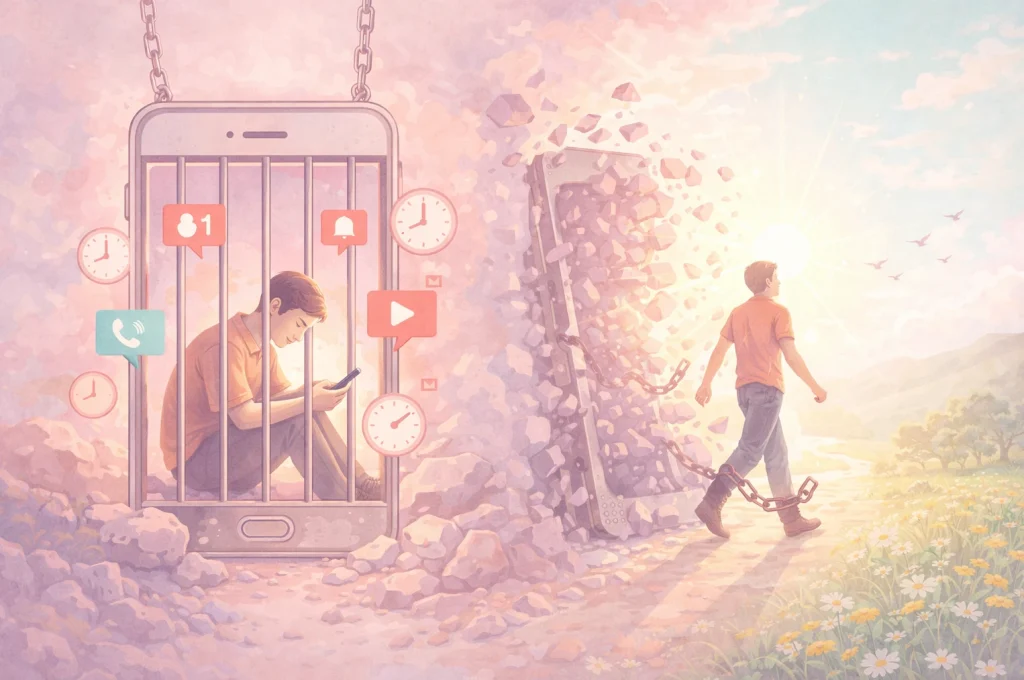
Table of contents:
Phone Addiction and Digital Overload: when your attention stops belonging entirely to you
A tool turns into a reflex
Phone addiction rarely looks dramatic at first. No villain music. It looks ordinary. You unlock your phone to check the weather, and six minutes later you are in somebody else's vacation photos, a news alert, two messages, a random video about cast-iron pans, and your original intention has quietly died somewhere in the hallway. That is one of the clearest signs: the phone is no longer something you use on purpose. It is something you reach for before you have even fully noticed the urge.
That automatic reach matters. It means the behavior is starting to skip conscious choice. Waiting in line? Phone. Tiny awkward feeling? Phone. Hard task? Phone. Two spare minutes? Phone. The device becomes the default response to almost any gap in life.
Your attention gets chopped into scraps
Digital overload is not only about "too much screen time." It is also about too much switching. Message, email, clip, headline, notification badge, back to work, back to text, quick glance at sports scores, where was I again? The brain can do this, technically. It just does it badly and expensively. Concentration gets shallower. Memory gets patchier. Reading a few calm pages starts to feel weirdly hard, which is... not a great sign. When that starts happening, learnability quietly suffers too, because staying teachable gets much harder when your mind has been trained to expect a new stimulus every few seconds.
There is research behind this, by the way. One well-known study found that even the mere presence of a smartphone can reduce available cognitive capacity. So yes, sometimes it is not you being lazy. Sometimes your attention is being nibbled at all day.
The phone starts doing emotional labor for you
This part is sneakier. For many people, the phone becomes a fast escape hatch from discomfort. Not huge pain, even. Just the small stuff: boredom, uncertainty, loneliness, irritation, the faint dread before starting something difficult, the odd emptiness of a quiet evening. Scroll a bit, message a bit, refresh a bit. The feeling softens for a moment. Then it comes back, and now you are also annoyed at yourself. Lovely combo.
Used that way, the phone stops being entertainment and starts acting more like emotional padding. Convenient. Also costly, because it blocks the tiny moments where self-awareness normally shows up.
It leaks into sleep, relationships, and your sense of being here
Once phone use gets sticky enough, it starts spilling everywhere. You take it to bed "for ten minutes" and suddenly it is 12:47 a.m. You sit with another person while half-monitoring the screen. You watch a show while also checking comments about the show, which is such a strange little species of modern nonsense when you think about it.
Over time, life can start feeling less vivid. Not because nothing is happening, but because you are only half-arriving for it. That is the core of the problem, really. Not the device itself. The gradual erosion of presence, choice, and mental room.
What starts coming back when the phone loosens its grip
Your mind can hold a thought again
One of the first benefits is almost embarrassingly basic: you can think in full sentences again. Not always, not instantly, but the mind stops skittering off every forty seconds like a terrier hearing a wrapper. Reading gets easier. Writing gets less painful. Work that used to feel unbearable for twenty minutes becomes doable because your attention is no longer being constantly tempted away by a glowing side door.
This matters far beyond productivity. Attention is not just a work skill. It is the thing that lets you understand a book, follow a feeling, learn something properly, or stay with a conversation long enough for it to become real.
Your nervous system gets less jangly
Constant digital input keeps the body in a low-grade state of alertness. Ping, buzz, badge, headline, update, maybe something urgent, maybe nothing, better check. When that rhythm eases, people often notice a strange sensation: quiet. Not boring quiet. Restorative quiet. The kind where you do not feel yanked around by invisible strings all day.
And with that quieter baseline comes something underrated: less urgency theater. Every thought no longer arrives dressed as a mini-emergency. You can respond instead of twitching.
Real life gets more texture
Reducing phone dependence does not turn a person into a monk with excellent cheekbones. It just gives ordinary life a chance to feel... fuller. Food tastes like food when you are not also reading four opinions about it. A walk can actually settle you if it is not stuffed with clips, texts, and three half-listened podcasts. Even boredom changes flavor. It becomes less like punishment and more like mental compost. Unsexy word, useful process. That fuller experience is closely related to aesthetic sense in ordinary life - the ability to notice texture, atmosphere, and small details instead of sliding past them on autopilot.
People also tend to feel more connected in conversation. You catch tone. You notice faces. You stop offering that weird split-attention version of yourself that says, "I'm here, sort of, unless my pocket vibrates." That kind of presence also strengthens mentorship skills in real life, because people are far more likely to trust your guidance when they can feel you are actually listening.
Self-respect returns in small, solid ways
There is also a dignity piece here. When you stop obeying every impulse to check the phone, you start trusting your own steering again. That shift is closely tied to what comes back when you reclaim your own say, because even small acts of directing your attention instead of surrendering it rebuild a sense that your life is not being run entirely from the outside. You say you are going to read, and you read. You mean to sleep, and you sleep. You sit through ten uncomfortable minutes without anesthetizing them with scrolling. That builds a quieter form of confidence than most people expect.
Time feels different too. Not magically abundant, no. Still, many people discover that what looked like "I have no time" was partly "my attention keeps leaking out in hundreds of tiny drips." Fix some of those leaks, and the day starts feeling less stolen.
What too much digital input quietly does to a person
You begin checking before you have even chosen to
A heavy phone habit often shows up as compulsion disguised as normality. You check while the kettle is boiling. During the trailer before the movie. Mid-conversation. At traffic lights. In the bathroom. In bed. During the two-second lull in a podcast you are already barely listening to. None of these moments look huge on their own. Together, though, they teach the brain that every pause must be filled immediately.
That makes stillness harder and urges stronger. Some people even feel a little spike of anxiety when the phone is in another room, out of battery, or face down for too long. That is not nothing.
Deep focus starts feeling strangely uncomfortable
When your brain gets used to fast, varied, bite-sized stimulation, slower tasks can begin to feel almost physically irritating. Long articles. Quiet work. A difficult spreadsheet. Sitting with one question long enough to understand it. The problem is not just distraction. It is tolerance. Your system loses practice at staying with one thing when that thing does not reward you every few seconds.
Then people misread the result. They assume they are lazy, unmotivated, maybe even "bad at focus." Often the issue is more mechanical than that. Their attention has been trained into constant expectancy.
Your mood gets pulled around by information you never needed
Doomscrolling is a special little thief. You open the phone for one harmless check and end up absorbing outrage, disaster, comparison, celebrity nonsense, economic panic, a perfect kitchen from a stranger, and a headline engineered to make your pulse kick up. That is a lot for a nervous system before breakfast, honestly. And if that daily stream is mostly outrage and contempt, it can slowly harden into cynicism as a habit, where expecting the worst starts feeling less like a defense and more like common sense.
Digital overload often produces an odd mood cocktail: restlessness, irritability, low-grade envy, mental fatigue, and the heavy feeling of having consumed plenty but digested nothing. You are full and undernourished at the same time. Very modern, very bleak.
Sleep, memory, and relationships all get thinner
Phone use late at night does not only steal time. It keeps the mind engaged when it should be downshifting. The CDC specifically recommends avoiding screens before sleep. Yet plenty of people end the day with a face full of light, conflict, novelty, and shopping suggestions. Then they wonder why sleep feels shallow and mornings feel cursed.
Relationships take a hit too. Not always through big fights. More through dilution. Half-heard stories. Broken eye contact. Shared silence replaced by parallel scrolling. It is hard to feel deeply met by someone whose thumb is still doing little refresh laps.
How to reduce phone addiction without pretending you live in a cabin
Start by catching the exact moments you reach
For three days, do one simple thing: each time you pick up the phone without a clear purpose, jot down what happened right before it. Were you bored? Avoiding a task? Feeling lonely? Waiting? Mentally tired? This tiny record is useful because vague guilt helps nobody. Patterns do. And if "avoiding a task" keeps showing up, it is worth looking at perfectionism minus the flattering mythology, because a surprising amount of compulsive checking is really an escape from work that feels emotionally loaded.
Most people discover that the phone is tied to very specific triggers. Transition moments. Emotional friction. Work avoidance. Social uncertainty. Sometimes the urge is less about the device and more about needing reassurance that nobody is disappointed, annoyed, or pulling away, which starts to overlap with people pleasing without the cute excuses, where constant checking becomes a way to manage other people's reactions before they have even had one. It can also be reinforced by how touchiness keeps hijacking ordinary days, especially when every delayed reply, flat-toned message, or vague comment starts feeling bigger and more personal than it is, and that makes the phone feel less like a tool and more like a constant reassurance device. Once you can see the pattern, you stop treating the habit like some mystical force with Wi-Fi powers.
Make the device a little more annoying to use
Willpower is fine. Environment is better. Move the most sticky apps off your home screen. Turn off non-human notifications. Switch the display to grayscale for part of the day if bright colors pull you in like a magpie. Keep the charger outside the bedroom. Use a real alarm clock if your phone keeps "accidentally" becoming a midnight casino.
The goal is not punishment. It is friction. Tiny bits of friction break mindless loops. If you have to search for the app, log back in, or physically go to another room, the automatic reach loses some momentum. Not glamorous. Weirdly effective.
Create small offline anchors that happen every day
Huge detox plans are dramatic and often short-lived. Daily anchors work better. Pick two moments that are phone-free on purpose. Maybe the first twenty minutes after waking and the last twenty before sleep. Maybe meals. Maybe the walk to the train. Maybe any conversation that matters more than the weather.
These anchors retrain your brain to remember that not every empty moment requires digital stuffing. They also give you quick wins. And quick wins matter, because the brain loves evidence more than noble speeches.
Replace the function, not just the object
If the phone has become your cure for boredom, stress, or loneliness, you need substitutes that actually serve those jobs. A paper book for waiting rooms. A pocket notebook for restless thoughts. A short walk without headphones when your brain feels overcooked. A real call with one friend instead of twenty minutes of social media grazing. Different tools for different needs.
And when you slip, do not turn it into a character assassination. Adjust the setup and continue. Shame is a terrible app blocker. What works better is steady redesign: fewer triggers, better substitutes, more moments where your attention gets to be your own for a while. Then longer. Then, if you keep going, honestly quite a lot longer.
Should this be the growth issue you tackle right now?
Not always. Some people truly need to get their phone use under control. Other people are using the phone as a symptom-management device for something deeper: loneliness, burnout, chronic stress, anxiety, or a life that feels so flat they keep reaching for stimulation because silence feels unbearable. If that is the real knot, attacking the screen alone may help a bit, but it will not solve the whole thing.
It helps to choose the right starting point. Otherwise you end up trying to fix attention, sleep, mood, discipline, relationships, and workload all at once, which sounds ambitious and usually turns into a very fancy mess.
If you want a clearer read on what actually deserves priority, AI Coach can help sort it out. It is useful for seeing whether phone overuse is the main issue or just the loudest symptom, and it gives you a simple plan for the first three days. That tends to work better than swearing at your screen on a Sunday night.
Frequently Asked Questions (FAQ)
How can I tell whether I am addicted to my phone or just using it a lot?
The biggest clue is loss of choice. If you keep checking without meaning to, feel edgy when the phone is unavailable, or repeatedly use it longer than intended even when it hurts sleep, work, or relationships, that is more than "a lot of use." Volume matters, yes. Compulsion matters more.
Why do I grab my phone without even thinking?
Because the habit has attached itself to tiny triggers: boredom, discomfort, waiting, fatigue, uncertainty, even walking from one room to another. After enough repetition, the reach becomes automatic. That is why noticing the trigger chain works better than calling yourself lazy.
Can heavy phone use really hurt attention span?
Yes. Constant switching trains the brain toward short bursts of attention and high novelty. Slower tasks then feel harder than they used to. Research has also found that even having a smartphone nearby can reduce available cognitive capacity.
Is doomscrolling making my anxiety worse?
Often, yes. Doomscrolling floods the mind with threat, outrage, comparison, and uncertainty, usually in a state when you were already tired or vulnerable. It may feel like "staying informed," but the emotional effect is often more like marinating your nervous system in alarm.
Why is nighttime scrolling so hard to stop?
Because at night your self-control is usually weaker, your brain wants easy reward, and the phone offers endless novelty with no real stopping point. It also delays sleep. The CDC recommends avoiding screens before bed for a reason.
Are notifications really that disruptive if I do not open all of them?
Yes, they can be. Even when you do not fully engage, a ping or banner still pulls a bit of attention and creates an internal "maybe I should check" loop. That mental residue adds up. If your phone chirps all day, your focus rarely gets a clean runway.
Should I delete social media apps completely?
Maybe, but not always. For some people, deletion is the cleanest move. For others, adding friction works well enough: logging out, removing apps from the home screen, muting notifications, using browser-only access, or setting specific check windows. The best option is the one that breaks the automatic loop.
What is a realistic screen-time target for adults?
There is no magic number that fits everybody. The better question is functional: does your phone use interfere with sleep, concentration, mood, or closeness with other people? If yes, reduce the parts that do damage first. A focused hour online for work is not the same as two hours of accidental scrolling.
How do I cut down without becoming unreachable for work or family?
Use boundaries, not disappearance. Keep calls and key people available. Silence everything else. Tell close contacts when you are offline. Check messages at chosen times instead of continuously. You do not need to vanish into the woods. You just need to stop living on permanent digital standby.
What should I do instead of scrolling when I need a break?
Pick a break that actually matches the need. If you are mentally tired, try a brief walk, stretching, water, or staring out a window like a Victorian with unresolved thoughts. If you are lonely, message one real person or call them. If you are bored, read, doodle, or let yourself be bored for five minutes. That last one is better for the brain than it sounds.