
Revenge bedtime procrastination is that oddly specific thing where you stay up way later than you meant to, not because the night is magical and full of jazz and possibility, but because it finally feels like it belongs to you. You know sleep would help. Your body knows. Your face in the bathroom mirror definitely knows. And still - there you are at 12:43 a.m., watching three strangers renovate a kitchen in a city you will never visit.
It tends to show up when the day felt crammed, managed, chipped away by work, family, errands, messages, obligations, the usual parade. If your evenings keep turning into a tiny act of rebellion followed by a groggy, annoyed morning, then yes, this may already be living in your life like an uninvited houseguest. Slippers on. Acting innocent.
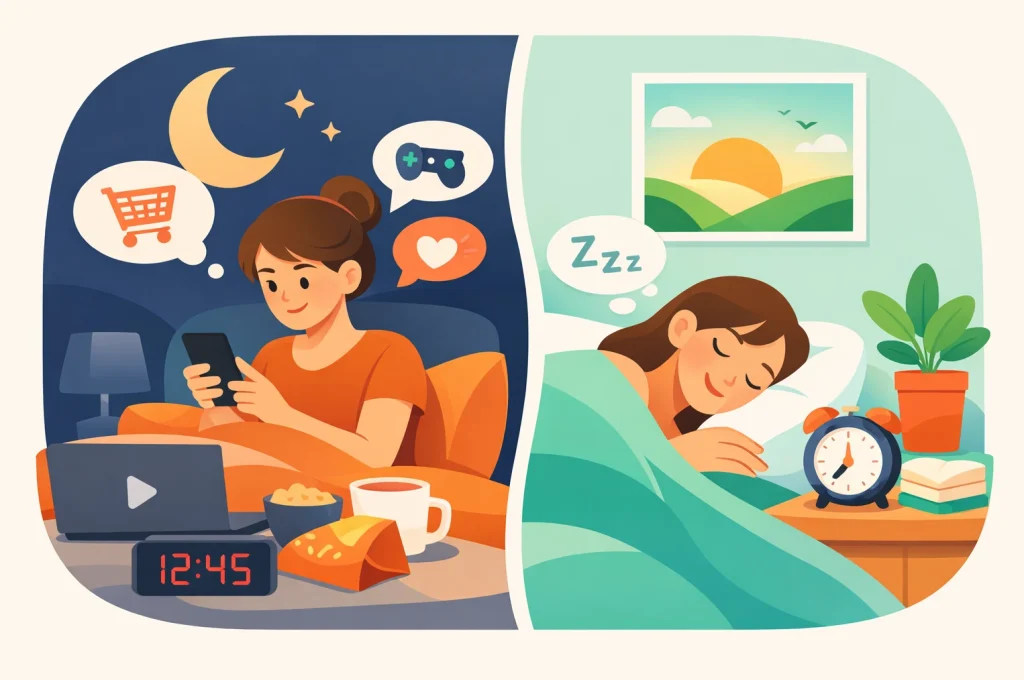
Table of contents:
Revenge Bedtime Procrastination: the late-night tug-of-war nobody planned for
It is not simple laziness
From the outside, this habit can look almost ridiculous. You are tired. The bed is right there. No locked gate, no paperwork, no dragon guarding the duvet. And yet you stall. So people call themselves lazy, weak, chaotic, hopeless with routines - all the usual insults we keep in the drawer for ourselves. But that diagnosis is usually too cheap. Very often, the first layer is not laziness at all but self-judgment, and once shame quietly warps a life, it becomes much harder to notice what you actually need instead of just blaming yourself for needing it.
With revenge bedtime procrastination, the issue is rarely that you do not care about sleep. Most people very much care. They miss it! The issue is that going to bed starts to feel like giving up the last bit of the day that was yours. Bedtime begins to feel less like care and more like surrender. In that sense, it can look a lot like self-sabotage in real life: the short-term comfort feels earned, even necessary, while quietly making tomorrow harder.
And that is why sheer discipline so often flops here. The night is doing emotional work. It is handing you autonomy, numbness, pleasure, silence, space to exist without being useful for five whole minutes. Of course you keep stretching it, even while yawning like a pensioner at the opera.
The night starts carrying emotional weight
That is the part people often miss. Evening is not just "free time" anymore. It turns into compensation. A quiet little refund for a day that took too much.
Maybe work was relentless and every message sounded urgent. Maybe your kids finally fell asleep and the house, for one blessed moment, stopped needing things from you. Maybe you spent all day being competent, pleasant, available, responsive - which, honestly, is an exhausting set of hobbies. Then midnight rolls around and something in you goes, "My turn."
That "turn" may look like scrolling, gaming, online shopping, snacking over the sink, texting people you barely have energy to like, or simply sitting in the dark in magnificent silence. From the outside it can seem irrational. Inside, though, it often feels like the most honest part of the day. That is why it is sticky. You are not just avoiding sleep. You are trying to reclaim yourself.
It often gets confused with insomnia, but it is not the same
These two get mixed up all the time, and fair enough - both involve being awake when you wish you were asleep. But they are not the same thing.
With insomnia, you try to sleep and cannot. With revenge bedtime procrastination, you could head to bed earlier, but you keep postponing the moment. One is trouble sleeping. The other is trouble ending the day. Those are cousins, maybe, not twins.
Of course they can overlap, which is deeply rude. Screens do not help either. And because those feeds are full of polished little highlights, a tired brain can slip into comparing yourself to others, which is a brilliant way to feel worse without getting any actual rest. And if that endless checking starts to feel like proof that you have to keep up, it may be a sign that fear of missing opportunities starts running your life, which makes closing the apps at night feel oddly harder than it should. Endless feeds, autoplay, late-night "just browsing," tiny dopamine snacks every few seconds - all of it is built for a tired brain that wants relief without effort. Add bright light and mental stimulation and now you have a lovely little trap: you delay sleep, then make sleep harder to reach once you finally show up. Terrible for humans. Excellent for platforms.
The emotional pattern is strangely predictable
A lot of people move through almost the same sequence night after night. First comes relief: finally, nobody wants anything. Then defiance: I deserve this, leave me alone. Then time goes weird - because ten minutes on your phone has a suspicious habit of turning into seventy-six. Then regret arrives, usually right when you check the clock and your soul leaves your body a bit.
The phrase revenge bedtime procrastination caught on after Chinese social media users described staying up late as a kind of revenge against daytime control. And honestly, the wording stuck because it fits. The whole pattern is soaked in mixed feelings: resentment, depletion, entitlement, comfort, guilt, a bit of sadness if we are being real. If that word keeps snagging your attention, it may help to look at why resentment is not just anger, because unprocessed frustration has a sneaky way of settling into your evenings and making late-night rebellion feel strangely justified. If you see yourself in that jumble, it does not mean you are broken. It more likely means your nights are trying to patch over a problem your days keep creating.
What gets easier when you stop using midnight as compensation
Mornings stop beginning in debt
One of the first changes is not mystical at all. It is gloriously practical: you wake up less wrecked. Not reborn as one of those suspiciously cheerful dawn people who journal before sunrise and own matching water bottles. Just... less behind.
When revenge bedtime procrastination loosens its grip, the morning stops opening with a deficit you created six hours earlier while insisting you were "unwinding." That shifts the whole feel of the day. It also makes it easier to notice why the cost of weak punctuality is bigger than it looks, because a lot of "late" mornings really start the night before. Sleep debt steals calm long before breakfast.
You need less emergency caffeine. Your brain comes online faster. Small tasks stop feeling weirdly offensive at 8:15 a.m. And because you are not dragging yourself through the day half-charged, you are less likely to spend the afternoon chasing quick rescues - more sugar, more scrolling, more coffee, more anything that promises instant relief. The day stops feeling like a recovery mission. That is a bigger gift than it sounds.
Your mood gets less jagged
Sleep is not a cure-all. Would be nice, sure, but no. Still, when you stop shaving off your own recovery time every night, your nervous system has more room to behave like a civilized creature.
That can mean fewer random tears over an email that was probably neutral. Fewer petty arguments that are really just fatigue in a trench coat. Fewer afternoons where someone asks one completely normal question and you want to dissolve into a blanket burrito. People often say they feel less brittle. Less quick to snap. Less likely to swing between "I can handle this" and "I need to disappear for six months."
And that steadiness matters. It helps at work, in relationships, and in your own inner dialogue, which - let us be honest - is where half the drama starts anyway.
Free time becomes something you can enjoy without stealing it
This one sneaks up on people. When all pleasure gets shoved into the last hour before sleep, free time starts to feel desperate. Like you are smuggling joy past customs. Every episode, snack, scroll, or quiet minute carries this panicky little undertow: this is my only chance.
When that pressure eases, leisure gets nicer. Simpler. You can watch a show, read a chapter, sit on the sofa doing absolutely nothing, take a bath, play a game - whatever it is - without that frantic feeling that you must squeeze every drop from the night before it disappears. You stop having to choose between feeling human now and functioning tomorrow.
That is not a tiny improvement. It is oddly emotional, really, when your life no longer requires small acts of sabotage just to feel livable.
Self-trust comes back in a very unglamorous way
There is also a dignity piece here, and it matters more than people expect. If every night you tell yourself, "Just one episode," or "Five more minutes," or "I'll go after this video," and then you steamroll right past your own limit again, your mind notices. Not dramatically. More like a quiet internal eye-roll. It is also part of why integrity makes life less complicated, because when your actions stop quietly disagreeing with your intentions, even ordinary evenings create less friction inside your own head.
Over time, that chips away at self-trust. You become the person who makes deals with yourself and then immediately wriggles out of them. Charming? Not especially. But when you start closing the day with more honesty, the reverse happens. You become someone whose decisions count, even at 11:18 p.m. when nobody is watching and the algorithm is doing jazz hands in the corner.
That kind of trust spills. Into work. Food. Money. Boundaries. Follow-through. A person who can end the day without casually betraying tomorrow tends to feel steadier in other places too. Not flashy confidence - better than that, actually. Something quieter and more useful.
When the pattern gets too comfortable, the rest of life pays for it
Sleep debt starts pretending to be your personality
When this pattern becomes chronic, tiredness starts wearing a fake moustache and introducing itself as "just who I am." You hear it in the little identity statements: "I'm just not a morning person." "My brain doesn't work until noon." "I've always been a mess before coffee." Sometimes those things are partly true. And sometimes it is sleep debt doing improv.
Night after night, you nibble away at the one thing your body is trying to collect. Then you wonder why everything feels heavier, slower, more annoying than it should. Headaches start sneaking in. Hitting snooze turns into a competitive sport. Mornings vanish. Guilt follows. Then, because the next day feels awful, the evening becomes even more precious as compensation. Round and round. A very annoying carousel, no music, all consequences.
Your attention gets patchy and your impulses get louder
Too little sleep makes the next day feel oddly porous. Focus leaks out. You reread the same sentence four times and still cannot tell what the first line said. You walk into the kitchen and forget why. You open one tab to answer a message and somehow emerge twenty minutes later looking at trainers you do not need and cannot afford. How did we get here? No idea.
Hunger and craving get louder too, especially for quick comfort - salty snacks, sugar, more caffeine, more stimulation, anything with the emotional energy of "help immediately." That is one reason this pattern can quietly affect work, health, and money all at once. A tired brain is not evil. It is just very interested in fast relief and not all that impressed by future consequences.
So yes, late-night scrolling gets easier. But the next day also gets sloppier, more reactive, less skillful. Bad bargain, when you look at it in daylight.
Your relationships get the frayed version of you
People do not usually think of bedtime procrastination as a relationship issue, but it absolutely can be. When you keep staying up to reclaim private time, the people around you often get the worn-out version of you the next day. Partners get the short fuse. Kids get the thinner patience. Coworkers get delayed replies and foggier thinking and that brittle "what now" tone that sneaks into conversation before you even hear it yourself. And once fatigue starts shaping your tone, timing, and patience, it can quietly feed the quiet mess created by weak communication, where ordinary conversations begin to feel sharper, messier, and more draining than they need to be.
And if you are responsible for children, teammates, or younger colleagues, fatigue also makes it harder to grow people, not just correct them. Tiredness tends to shorten patience before it shortens opinions. You can feel that one in real time.
There is another twist. If late night becomes the only time that feels free, you start guarding it like a dragon guards treasure. Then a perfectly normal request at 9 p.m. can feel outrageous. Not because it is outrageous - because your nervous system has already marked those hours as sacred. So the damage is not just exhaustion. The whole emotional economy of the evening gets tense, defensive, weirdly fragile.
You end up needing the night more and enjoying it less
This may be the sneakiest cost of all. The later you stay up, the more the night starts to feel like rescue. But because you are exhausted, you often do not use that time in a way that actually restores you. You do whatever is easiest to consume. More scrolling than savoring. More numbing than delight. More accidental time loss than real pleasure.
Then bedtime slides later, sleep gets worse, the next day feels more oppressive, and the urge to "take back" the evening grows stronger. See the trap? The night becomes sacred and unsatisfying at the same time. That is a miserable combination.
If you have ever looked at the clock at 1:07 a.m. and thought, "I'm not even enjoying this, so why am I still here?" - well. That is the pattern, standing in plain clothes pretending it is not the problem.
How to loosen revenge bedtime procrastination without making evenings joyless
Start by asking what the night is doing for you
Before you try to fix the habit, get curious about the payoff. Not "Why am I like this?" That question is useless and a bit rude. Try this instead: what am I getting from staying up?
Maybe it is quiet. Maybe it is choice. Maybe it is a break from caretaking, a delay before tomorrow starts, a chance to exist without performing competence. Write down the real answer for a few nights. The honest one, not the respectable one. People are often surprised by how specific it gets. Sometimes the issue is not resistance to sleep at all. It is a shortage of privacy, decompression, play, or unclaimed time.
Once you know what job the habit is doing, you can stop treating bedtime as the villain and start addressing the real deprivation underneath. That changes everything, or at least it changes the right thing.
Move one small piece of freedom earlier in the day
This part gets skipped all the time, and then people wonder why willpower keeps collapsing at 11:30 p.m. But if the whole day feels like duty, the night will keep trying to stage a coup. Makes sense, really.
So sneak one small, non-useful pocket of freedom into the daylight hours. Ten minutes in the car before you go inside. Fifteen minutes with a book before dinner. A walk without podcasts, errands, children, or "self-improvement" lurking in the bushes. The amount can be small. Tiny, even. What matters is the message: my life is not only obligations with a secret dessert at midnight.
When you give yourself a little choice earlier, the evening stops carrying quite so much emotional pressure. Not perfectly. Still, it helps more than another stern lecture delivered by your exhausted inner headmistress.
Create a bridge, not a cliff, into sleep
A lot of adults treat bedtime as if they should be able to go from full-speed living to immediate unconsciousness on command. That works about as well as slamming a laptop shut during a software update.
It helps to build a transition. A small bridge. This is also where aesthetic sense changes more than your surroundings, because the feel of a space can tell your brain "we're safe, we're winding down" before sleep actually arrives. Dim a light. Wash your face slowly instead of like you are in a car wash. Put on music that does not sound like it wants to sell you trainers. Stretch a little. Journal half a page. Fold laundry, if you are one of those mystical people for whom that is soothing. Make tea, assuming caffeine is not hiding in it like a tiny criminal.
The point is not to become a glowing wellness lantern. The point is to give your nervous system an off-ramp. When your body gets clear signals that the day is ending, bedtime feels less abrupt, less punishing, less like being dragged off stage mid-scene.
Make endless evening behaviors slightly harder to continue
You do not need monk-level restraint or a cabin in the woods. You do need a little friction. Put the charger across the room. Log out of the apps you inhale most mindlessly. Leave the remote somewhere mildly inconvenient. Switch to a lamp so the room itself stops yelling "keep going!"
If "just one more episode" is your downfall, be honest about which shows are safe for weeknights and which ones are basically narrative cocaine. Some content is simply not bedtime content for you. Same way some people cannot casually open a bag of crisps and then wander off after three. Know your own nonsense.
This is not punishment. It is strategy. You are not dealing with your wisest self at midnight; you are dealing with a tired little goblin who thinks one more scroll will fix everything. It won't, but goodness, it tries.
Aim for a repeatable cutoff, not a perfect bedtime identity
Do not make the goal "become a person who loves sleep and never procrastinates at night." That is too grand, too shiny, and frankly a bit exhausting. Start with one repeatable cutoff instead. Screens off by 11:15. Bedroom by 10:45. Lights low before the second wave of nonsense arrives. Something you can actually do more than once.
Keep it steady for a week before getting ambitious. That matters even more if change feels dangerous even before anything happens, because a calmer evening routine can still feel strangely threatening when your body is used to getting its freedom in a different, messier way. That kind of quiet consistency has a lot in common with training determination without turning into a robot. It is much more useful than one dramatic night of perfect behavior followed by three chaotic ones and a speech about "starting fresh on Monday."
And if you slip, do not put yourself on trial. Study the evening instead. What happened first? Stress, loneliness, unfinished work, a fight, an accidental nap, doomscrolling, the dangerous confidence of "I can handle one video"? Patterns always leave clues. You are not trying to win a purity contest here. You are trying to stop paying for tonight's emotional leftovers with tomorrow's energy.
Should this be the thing you work on right now?
Not always. Some people really are tangled up in revenge bedtime procrastination. Others are dealing with a newborn, shift work, grief, burnout, anxiety, ADHD, or just plain overload - and the late bedtime is more symptom than starting point. If your evenings are chaos because your whole life is chaos, sleep may not be the first knot to untangle. Fair enough.
It helps to find the real pressure point. Otherwise you end up trying to fix your sleep, your mood, your boundaries, your focus, your phone habits, and half your personality before Thursday. Noble idea. Usually a mess.
If you want a clearer sense of what deserves your attention first, AI Coach can help you sort that out. It can point to the likeliest growth priority and give you a simple plan for the first three days - which is often far more useful than making one heroic bedtime promise and breaking it, beautifully, the very same night.
Frequently Asked Questions (FAQ)
Why do I keep delaying sleep even when I am obviously exhausted?
Because exhaustion is only part of the story. A lot of people are not staying up for energy, they are staying up for ownership. If the day felt crowded, controlled, or emotionally expensive, the night starts to feel like compensation. You are not really choosing alertness over sleep. You are choosing a last scrap of freedom over one more responsible decision.
Is revenge bedtime procrastination the same thing as insomnia?
No. With insomnia, you try to sleep and cannot. With revenge bedtime procrastination, you postpone going to bed even though you could do it sooner. The two can overlap, yes, which is extremely inconvenient. But they are different patterns and usually need different kinds of help.
Does doomscrolling count as revenge bedtime procrastination?
Very often, yes. The scrolling is not the whole phenomenon, but it is one of the most common delivery systems for it. When your brain wants easy relief, distraction, novelty, or numbness, a feed is basically an all-night vending machine. That is why people look up and discover midnight has somehow become 1:17 a.m. again. A classic, sadly.
Why does this hit parents, caregivers, and people in demanding jobs so hard?
Because those groups often have the least unscheduled time and the highest emotional load. If most of your day belongs to work, children, clients, logistics, family needs, or everyone else's emergencies, nighttime becomes the only place where nobody is asking for anything. The more starved you are for private time, the more tempting it is to protect late hours - even when they rob you blind the next morning.
Is revenge bedtime procrastination just bad self-control?
Not really. Self-control matters, sure. But reducing the whole thing to discipline misses the bigger drivers: lack of autonomy, stress, resentment, mental overload, weak transitions, and digital stimulation that is practically engineered to melt your resolve. If you only shame yourself for not having enough willpower, you may miss the fact that your nights are trying to meet needs your days keep ignoring.
Can ADHD make revenge bedtime procrastination worse?
Yes, it can. People with ADHD may struggle more with time blindness, task switching, impulse control, late-night stimulation, and stopping something that still feels rewarding. That does not mean every delayed bedtime is ADHD. It just means ADHD can pour a little rocket fuel on the pattern. In those cases, extra structure and a bit of friction matter even more.
Is this a sign that I am secretly a night owl?
Sometimes people do have a naturally later rhythm. That is real. But a genuine night-owl pattern and revenge bedtime procrastination are not identical. If you naturally feel more alert at night and your life is built around that rhythm, that is one thing. If you stay up late on autopilot, regret it every morning, and feel trapped in the cycle, that is something else. One is rhythm. The other is rebellion with collateral damage.
Why do I want snacks, online shopping, or random treats late at night too?
For basically the same reason the bedtime gets delayed: your tired brain is hunting relief. Sleep loss makes impulse control wobblier and quick rewards more tempting. Add the emotional logic of "I deserve something after this day," and suddenly crisps, cookies, online carts full of nonsense, and baffling skin-care purchases at 12:08 a.m. start to seem very reasonable. For about seven minutes.
Can I make up for this pattern by sleeping in on weekends?
Weekend catch-up sleep can help a bit, but it usually does not fully erase the effect of repeated short nights. And it does not fix the emotional loop that created the habit in the first place. If Saturday becomes the rescue mission, you may feel slightly less awful - but the setup stays the same: the day drains you, the night pays you back, the morning sends the bill.
What is the smallest useful step if I want to change this without failing by tomorrow?
Do one honest thing first. Either figure out what the late night is giving you, or set one repeatable cutoff that comes before your usual point of no return. Not a saintly goal. A workable one. If you usually lose the plot after 11:45, try being off your most absorbing app by 11:20 for a week and just watch what happens. Small shifts are not glamorous. They are, however, how this cycle actually starts to loosen.