
There is a very specific kind of sadness in deciding the answer is "probably no" before life has even finished the sentence. You stop applying, stop asking, stop pushing back, stop trying the thing that might actually work, and then call the whole retreat "being realistic." Learned helplessness is what happens when repeated frustration trains the mind to expect failure so automatically that effort starts to feel almost embarrassing.
If you keep hearing yourself think, "What's the point?", this may be closer to your life than you want. And if that little line has been quietly steering your choices for a while... yeah, that matters.
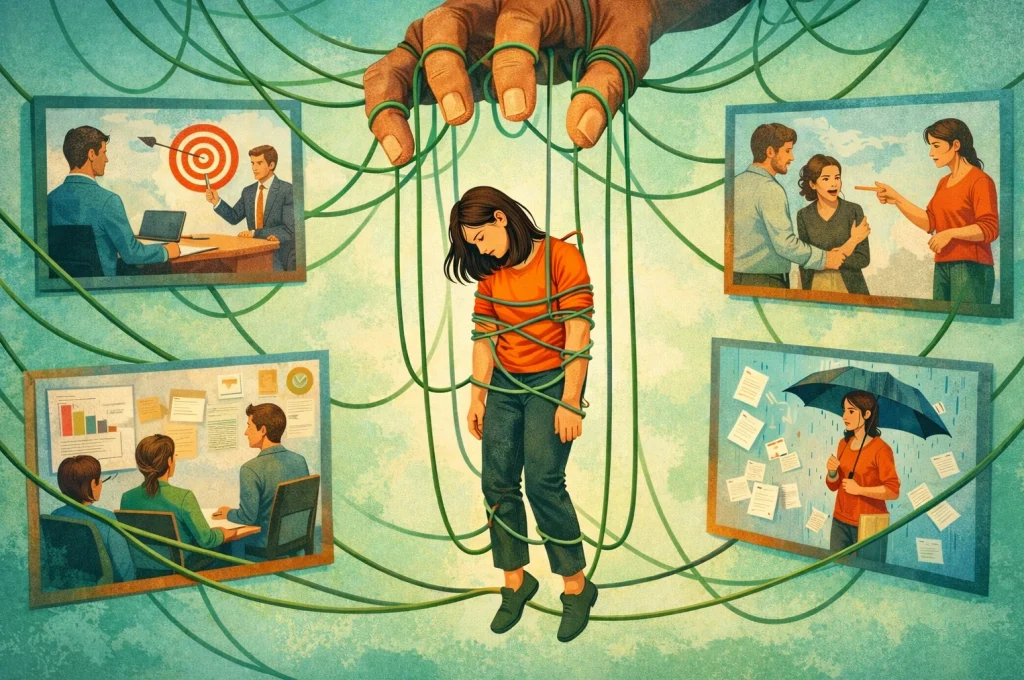
Table of contents:
When the Brain Learns to Say "Why Bother?"
It usually begins in a stretch of life that felt unwinnable
Learned helplessness does not fall from the sky because you were born dramatic. It tends to grow in situations where your efforts repeatedly failed to change the outcome. A harsh boss who moved the goalposts every week. Parents who punished you whether you spoke up or stayed quiet. A relationship where every honest conversation somehow boomeranged back as your fault. Chronic stress can do it too. If your system has been overloaded for a long time, building stress resistance in real life can help you notice when a situation is truly stuck and when your brain is replaying an older sense of defeat. So can school environments where trying hard still brought shame, not progress. The term came out of research by Martin Seligman and Steven Maier, but real life is messier than a lab, obviously. Still, the core idea holds: when the nervous system keeps meeting "nothing I do matters," it starts learning that lesson a bit too well.
Your mind begins predicting defeat on your behalf
After enough of those experiences, the brain gets economical in a rather annoying way. It starts saving energy by assuming effort will fail anyway. That means you may hesitate before you ask for help, negotiate pay, start a project, leave a bad setup, or even make a small change at home. Not because change is impossible in that moment, but because your inner forecast has already decided the weather. This is why learned helplessness can look deceptively calm from the outside. The person is not always panicking. Sometimes they are just flat. Shruggy. Weirdly resigned. The system says, "Let's not waste fuel on a door that never opens," even when this particular door might, in fact, open just fine.
Then it starts leaking into places that did not cause it
That is the sneaky bit. The pattern often begins in one area and then spreads like spilled tea across the table. Maybe work taught you that speaking up is useless, and now you also stay quiet in friendships. Maybe a controlling childhood trained you to wait for permission, and now you do that with money, career choices, even your own weekends. A person can be highly capable on paper and still carry this pattern in daily behavior. They over-accommodate. They under-ask. They assume rejection before evidence arrives. If you have ever wondered why self-sabotage can quietly shrink a life, learned helplessness is often one of the engines underneath it.
It is not laziness, and it is not your entire personality
This distinction matters. Laziness is usually the insult people throw when they do not understand shutdown. Learned helplessness is closer to a learned expectation of powerlessness. The person often wants change. They may ache for it. But their system has stopped trusting effort. That is different. Also, it is not your identity. It is a pattern. Patterns can be updated. Slowly, awkwardly, with a few relapses and some muttering under your breath maybe, but updated all the same. The trap gets stronger when you confuse an old adaptation with who you are. "I am just passive." "I am not the kind of person who makes things happen." Maybe not. Maybe you are a person whose brain got over-trained by bad conditions and now needs better evidence.
What Opens Up When You Stop Living Under That Expectation
Effort starts feeling sensible again
One of the first changes is wonderfully ordinary. You begin to act before certainty arrives. You send the email. You ask the question. You try the smaller version instead of abandoning the whole idea in your head. Not because you suddenly become fearless and start leaping over sofas like a motivational ad, but because effort no longer feels automatically stupid. That alone changes a lot. Life gets more responsive when you re-enter it. This is also where goal orientation, when effort finally has an address, becomes surprisingly helpful, because even modest action starts feeling less like random effort and more like movement with direction. You notice which situations really are blocked and which only felt blocked because an old template was running the show. Action becomes information again. Very useful, that.
Your self-respect gets less bruised
Helplessness does not only affect outcomes. It affects how you experience yourself. Every time you swallow a need, back away from an opportunity, or give up before checking what was actually possible, something in you notices. Quietly, but it notices. When this pattern loosens, self-respect starts rebuilding from behavior, not from pep talks. You become someone who at least checks. Someone who gives life a chance to answer back. That shift often softens the kind of inner collapse described in low self-esteem, because the mind gets new evidence: I can influence more than I thought. Not everything. Enough.
Setbacks stop sounding like final verdicts
Another benefit is that failure becomes specific instead of cosmic. If one attempt does not work, you are less likely to turn it into "See, nothing ever changes for me." You can say, "That strategy did not work with that person, in that setup, on that day." That is a much healthier sentence. It leaves room for adjustment. Learned helplessness collapses everything into one bleak moral of the story. Unlearning it brings detail back. And detail is freedom. Once the mind can distinguish between one bad outcome and a permanent law of the universe, resilience gets a lot less theatrical and a lot more practical.
Your relationships become less one-sided
People with this pattern often over-adapt without realizing it. They expect not to be heard, so they pre-cancel themselves. They expect disappointment, so they stop asking for repair. They expect nothing to improve, so they settle into arrangements that are merely tolerable. In close relationships, this can start to overlap with when codependency runs the show, where keeping the peace slowly becomes more familiar than expressing what you actually need. When helplessness weakens, relationships get more honest. You voice preferences earlier. You challenge unfairness sooner. That is often where what starts straightening out when your sense of justice gets stronger becomes visible, because you stop treating unfairness as something you must silently adapt to. You stop assuming the other person is the weather and you are just standing in it. That can affect work too. You contribute more, negotiate more cleanly, and recover some of the movement that healthy confidence quietly depends on. Not swagger. Contact. Presence. A bit more spine, in the nicest sense.
How This Pattern Quietly Starts Running the House
You stop testing reality and start obeying old conclusions
This is often the clearest sign. You do not actually know the answer, yet you behave as if rejection, failure, or uselessness has already been confirmed. You do not ask for the extension. You do not submit the draft. You do not bring up the issue with your partner. You do not apply for the role because the inner narrator has already stamped it with "not for you." The painful part is that you lose twice. First, you lose the chance itself. Then you lose the information you would have gained by trying. That is exactly why analytical thinking, the habit of seeing what is actually going on, matters here: it helps you test your prediction against reality instead of letting an old conclusion make the decision for you. Old helplessness loves untested assumptions. It feeds on them, really.
Your life gets smaller in very polite ways
Not always dramatic. Usually it looks tidy from the outside. You become the person who says, "It's fine," a lot, and means, "I have given up expecting better." You stop reaching for stretch opportunities. From the outside, this can look a lot like what low ambition quietly does to a life, even when the real issue is not lack of desire but the learned belief that desire will not change much anyway. You stick to familiar disappointments because at least they do not surprise you. Your standards shift downward to match what you think is possible. That shrinking can happen at work, in money decisions, in health, in love, in who you let yourself become. It is a bit like living in a house where half the rooms got locked years ago and now you barely remember they were yours.
Passivity starts dressing itself up as maturity
Learned helplessness is sneaky because it often borrows respectable language. "I'm just being realistic." "I don't want to make a fuss." "Maybe this is simply how life is. When that mindset hardens, it can start to resemble cynicism that stops being a mood and becomes a habit, where disappointment feels so expected that hope itself begins to look naive." Sometimes, sure. But sometimes that is not wisdom. It is surrender wearing a cardigan. If every difficult situation gets translated into "nothing can be done," the pattern deepens. People around you may even reward it at first. You seem easy. Low-maintenance. Undemanding. Meanwhile your own needs are sitting in the corner like unwatered plants. Not dead, just... not thriving, let's say.
Mood, energy, and hope start collapsing into one knot
When helplessness sticks around, it can tangle with procrastination, anxiety, and depression in a pretty miserable braid. If effort feels pointless, motivation drops. When motivation drops, life gets more stagnant. Then the stagnation seems to prove that change is impossible. Round and round. This is one reason the pattern often shows up alongside deeper heaviness. If your whole emotional world has gone flat, not just your initiative, it may help to read about how depression shows up in ordinary life, because the two can overlap. Still, even inside that overlap, learned helplessness has its own signature: the reflexive expectation that your actions probably will not matter.
How to Start Unlearning It in Real Life
Begin with situations where cause and effect are visible
The brain does not unlearn helplessness through lectures. It unlearns through evidence. So start where your action can create a noticeable result, and quickly. Ask one clarifying question instead of stewing in confusion. Change one small household system that has been irritating you for months. Request one specific adjustment at work. Follow up on one loose payment. The point is not to become unstoppable by Tuesday. The point is to remind your nervous system, "When I act here, something moves." Pick targets that are modest but real. A tiny lever that actually works teaches more than a giant dream you are still too flooded to touch.
Separate what is fixed, what is flexible, and what is yours today
Learned helplessness blurs categories. Everything starts feeling equally impossible. Try a plain piece of paper with three headings: fixed, flexible, mine today. Under fixed, write what you genuinely cannot control right now. Under flexible, write what may be influenced but not fully commanded. Under mine today, write the actions available to you within the next twenty-four hours. This exercise looks almost too simple, which is usually a good sign. It reduces that swollen feeling of "nothing can be done" by restoring edges. Often the real issue is not zero agency. It is mixed agency, and your mind has been treating all of it as zero.
Keep an evidence log that embarrasses your old story a little
Your brain is excellent at storing failures and weirdly casual about storing exceptions. So keep a short running note of moments when your action changed something. You got a better answer because you asked again. You understood the task because you requested specifics. You felt less resentful because you spoke sooner. You left earlier, negotiated better, slept better, said no, got help, made the appointment, finished the form. Tiny counts. Very unglamorous. Exactly right. Helplessness survives by acting ancient and inevitable. Counterevidence makes it look less mystical and more like what it is: a habit of prediction. And habits, bless them, can be irritated into changing.
Work with your body and other people, not only your thoughts
If this pattern is deep, especially after trauma or long periods of criticism, pure positive thinking will bounce off it like a pea off a saucepan. You need safer experiences, repetition, and often another nervous system in the room. That might mean practicing harder actions with a therapist, coach, mentor, or sane friend before doing them alone. It might mean noticing when your body goes into freeze and choosing a smaller step instead of calling yourself weak. It might mean pairing this work with a more active follow-through style once your system can tolerate movement again. The goal is not to force yourself into giant acts of bravery. It is to rebuild agency in doses your body can actually digest.
Should This Be Your Main Growth Focus Right Now?
Maybe. Maybe not. Not everyone needs to start by working on learned helplessness. Some people are mainly dealing with exhaustion, grief, burnout, shaky boundaries, or a life setup that would make almost anyone feel defeated for a while.
It helps to look at the pattern honestly. If your main struggle is that you keep assuming effort will fail before reality has answered, this is probably worth real attention. If the heavier issue is lack of rest, ongoing mistreatment, or depression-level shutdown, start there or at least alongside this, otherwise you end up trying to coach a nervous system that mostly needs safety and support.
If you want a calmer way to sort that out, AI Coach can help you figure out what deserves focus first and give you a simple plan for the next three days. Sometimes that kind of clarity is more useful than making one more grand promise to yourself and then feeling guilty by Wednesday.
Frequently Asked Questions (FAQ)
What is learned helplessness in simple terms?
It is a pattern where repeated experiences of powerlessness teach you to expect that your actions will not change much. After a while, you may stop trying even in situations where change is actually possible. The core issue is not lack of desire. It is lack of trust in your own influence.
How do I know if I have learned helplessness or I'm just tired?
Tiredness usually says, "I need rest." Learned helplessness says, "Even if I try, it probably won't matter." A tired person often comes back online after recovery. A helpless pattern keeps showing up as resignation, low initiative, and assumptions of failure even when some energy is available.
What causes learned helplessness?
Usually repeated no-win experiences. Things like chronic criticism, controlling environments, unpredictable punishment, abusive relationships, impossible work conditions, long stretches of failure without support, or situations where speaking up changed nothing. The nervous system learns from repetition, not from fairness.
Is learned helplessness the same as laziness?
No. Laziness is a crude label people often use when they cannot see the internal shutdown. Learned helplessness is more like trained discouragement. The person may care deeply, but their system has learned that effort leads nowhere, so it conserves energy by withdrawing early.
Can adults develop learned helplessness, or is it mostly a childhood thing?
Adults can absolutely develop it. Childhood is one common starting point, but it can also grow after toxic jobs, long unemployment, repeated relationship failures, discrimination, chronic illness, or any environment where action repeatedly meets a wall. Brains keep learning, for better and for worse.
Is learned helplessness connected to depression?
Often, yes. They are not identical, but they overlap. Learned helplessness can feed depression by lowering hope, action, and perceived control. Depression can also make helpless thoughts louder and heavier. A rough rule: if the whole of life feels flat and hard to enter, depression may be in the mix too.
Can learned helplessness show up in relationships?
Very much. It can look like not bringing up problems, assuming repair is pointless, tolerating unfair treatment, waiting for the other person to decide everything, or shrinking your needs before they are even spoken. Over time, that creates lopsided relationships and a lot of silent resentment.
How long does it take to unlearn learned helplessness?
It depends on how deep the pattern is and what keeps reinforcing it. Small shifts can start quickly when you gather fresh evidence that your actions matter. Bigger change usually takes repeated corrective experiences. Especially if the pattern was built over years, it tends to loosen in layers, not in one dramatic revelation over coffee.
What is the best first step if I think this is affecting me?
Pick one small situation where your action can create visible feedback soon. Ask, request, clarify, negotiate, follow up, change one detail, make one move. Then notice the result carefully. Learned helplessness begins to weaken when your nervous system sees, in real life, that effort still has teeth.
Can therapy or coaching help with learned helplessness?
Yes, often a lot. This pattern is easier to shift when you have help spotting where your mind is treating "uncertain" as "impossible." Support also matters because helplessness is not just a thinking problem. It often lives in the body as freeze, resignation, and old expectation. Good help gives you safer experiments, better language, and steadier repetition.