
You know that jumpy little feeling when you say yes too quickly, open six tabs, answer three group chats, and somehow your whole evening gets kidnapped by opportunities you did not even care about an hour ago? That is often what fear of missing opportunities looks like in real life. Not healthy curiosity, not some bold appetite for life - more like a twitchy belief that if you do not grab now, life will slip past you in soft shoes and not bother to circle back.
And it can make smart people act... odd. Hungry in a not-actually-hungry way. Scattered. Weirdly unsatisfied even while doing a lot. If that stings a bit, well, fair enough. There is usually a calmer way to live than treating every invite, bright idea, job post, and shiny possibility like the last slice of pizza at a party.
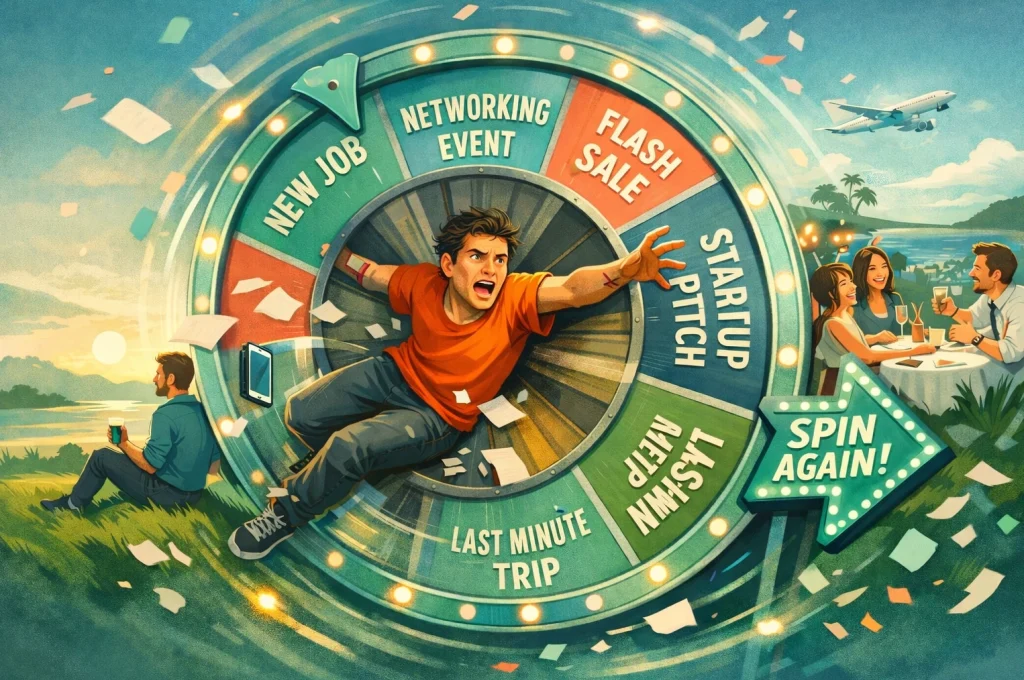
Table of contents:
What Starts Changing When Opportunity Fear Loosens Its Grip
You stop treating every option like a last train
One of the first shifts is almost boringly practical, which is how you know it matters: not everything feels urgent anymore. A webinar next week, your friend's startup pitch, a networking dinner, some "doors close tonight" course, a job opening in another city - they stop arriving in your brain with sirens and flashing lights. You can actually look at them and ask, "Do I want this?" instead of "How fast do I need to grab it before someone else does?" That is a big deal. Your nervous system, at last, gets a chair. Life stops feeling like one long clearance sale.
Your decisions get quieter and sharper
FOMO has a sneaky habit of making movement feel like wisdom. You say yes because yes feels safer than missing out, and then later you stare at your calendar like, who assembled this thing, a raccoon on espresso? When that fear eases, decisions get cleaner. You can feel interested without immediately turning that interest into a commitment. You can let a perfectly decent opportunity pass because it is not right for you, not now, not in this season. That is not laziness. It is discernment - a slightly old-fashioned word, maybe, but useful. And discernment tends to leave a lot less wreckage behind than panic does.
So there are fewer rushed yeses, fewer messy half-promises, fewer Sunday nights spent glaring at a week you built with your own hands. Painfully relatable, I know.
Other people's wins stop rearranging your self-worth
A lot of this fear is social, whether we admit it or not. Someone your age buys a flat, launches a podcast, gets engaged, moves to Lisbon, learns to invest, runs a marathon, starts making sourdough with suspicious confidence - and suddenly your own life feels undercooked. When FOMO loosens, other people's milestones stop behaving like accusations. You can be happy for them. Or neutral. Or vaguely impressed for twelve seconds and then get on with your sandwich.
That matters more than it sounds. Comparison messes with timing. It nudges you toward paths that were never really yours, just shiny in someone else's hands. A steadier mind remembers that lives unfold at different speeds. Annoying answer? Yes. Still true.
You get more depth, not less life
People often assume that if they stop chasing everything, life will shrink. Usually the opposite happens. In real life, it starts to look a bit like what grows in your life when optimism gets stronger: more room to settle, more trust in your own choices, less compulsive peeking over the fence to see whether someone else has a better scene.
When you are not constantly scanning for the next better option, you can actually inhabit what you chose - the relationship, the project, the city, the role, the quiet Saturday, the slow skill-building that does not look flashy online. Presence comes back. So does satisfaction. Not movie-trailer bliss, relax. Just that grounded feeling of being where you are without mentally auditioning five alternative futures at the same time. That steadiness is wildly underrated. It is hard to build anything meaningful when one eye is always wandering toward the next glittery possibility.
How Fear Of Missing Opportunities Starts Running Your Life
Your attention keeps darting toward the next shiny thing
One of the clearest signs is mental restlessness. You are doing one task, but part of your mind is already sniffing around for what else exists. Another job board. Another event. Another app. Another side-hustle thread. Another friend's update that might, somehow, contain the secret map everyone forgot to send you. If that feels painfully familiar, it often overlaps with a mind that treats every maybe like an emergency, which makes each new option feel much more urgent than it really is. This pattern shows up with technology too: every new tool, update, or AI platform can start feeling like something you have to master immediately. That is often a sign you need AI literacy - what it actually looks like in real life, so you can judge what is genuinely useful instead of reacting to every wave of hype.
The issue is not curiosity. Curiosity is lovely. The issue is that your attention never lands long enough to do anything useful with what is already in front of you. A person can look very engaged with life while actually skimming the surface of everything. Which is a bit tragic, honestly.
You commit from excitement, then pay for it in energy
FOMO often shows up as overbooking dressed up as openness. You accept invitations you are only half-interested in. You join things because they might matter. You keep doors cracked open because closing one feels weirdly dangerous, like you are insulting destiny or something. Then the bill arrives: fatigue, split focus, shallow work, and that sour little feeling of being tugged in ten directions at once.
This is why capable, motivated people get stuck here all the time. FOMO does not always look reckless. Sometimes it looks ambitious, connected, "good at opportunities," game for anything. Meanwhile your actual capacity is over in the corner coughing politely and asking whether anyone plans to consult it.
Even good experiences get spoiled by mental wandering
This one is sneaky. You go to the dinner, but spend half the evening wondering whether the other event would have been better. You take the job, then keep checking openings for roles you never even applied to. You start seeing someone kind and attractive, and your brain goes, yes, but technically other people also exist. Very helpful, thank you brain.
FOMO can make reality lose to imagination every single time, because imagination has beautiful lighting and no admin. No commute, no awkward bits, no spreadsheet, no laundry. The result is chronic second-guessing. You do not just fear missing opportunities - you start missing the one you are already in, right there in front of your face, because your mind is busy scanning the horizon like a meerkat with Wi-Fi.
Regret gets louder than evidence
Another common pattern: you build entire emotional epics around roads not taken. "If I had said yes to that move..." "If I had started that business..." "If I had gone to that conference..." Maybe. Maybe not. FOMO survives by editing reality in its own favor. It spotlights the imagined upside of the missed option and conveniently crops out the costs, trade-offs, bad timing, and plain dumb luck that would have come with it.
So the missed chance starts glowing. Your real life, by comparison, looks flatter than it actually is. The loop keeps going because regret feels informative, even when it is mostly fantasy wearing a clever little blazer.
How To Overcome "Fear Of Missing Opportunities"
Decide what "enough" looks like before the next tempting thing arrives
FOMO gets louder when your life has no inner measuring stick. Then every outside option gets a vote, and some of them are very pushy. It helps to define, in simple language, what a good season of life would look like for you right now. Maybe it is steady income. Maybe it is deeper friendships, finishing one qualification, protecting your health, or getting a few calm evenings back with your family. Keep it short. Scribbly is fine. It does not need to sound noble.
The point is to have a home base. A bit of visionary thinking - the skill of seeing what is not here yet helps here, because direction makes random opportunities a lot less hypnotic. Then when some glittery new thing appears, you can ask whether it actually supports this season of your life - or just flatters your imagination for fifteen minutes.
Use a delay between interest and commitment
You do not have to answer every opportunity on the spot. Really, you do not. In fact, if FOMO is your weak spot, fast answers are often where the trouble begins. Build in a little gap. A few hours. A day. For bigger choices, longer if you can manage it.
One sentence does an absurd amount of heavy lifting here: "Sounds interesting. Let me think and get back to you." That line has saved people from so much nonsense it ought to be printed on mugs. The pause gives your excitement time to cool down and your actual preferences time to show up. If the opportunity is solid, it can usually survive one calm breath.
Ask what this opportunity would replace
FOMO loves the question, "What if this works out?" Fair enough. But on its own, it is a terribly incomplete question. Add this one: "What would this cost me in time, focus, sleep, money, recovery, or peace?" Every yes throws a shadow somewhere. A new project may replace rest. A prestigious role may replace simplicity. A fun evening may replace the workout, the early night, the conversation with your partner, the reading time you keep claiming matters.
No melodrama needed. Just honest accounting. Opportunities look very different when you compare them not with fantasy, but with the actual life they would bump aside to make room.
Create an opportunity holding pen
Not every possibility deserves immediate action, but some do deserve a second look. So give them one place to wait. A note in your phone. A document. A notebook page with awful handwriting and coffee marks, whatever works. When a tempting idea pops up, put it there instead of sprinting after it straight away.
Then review the list once a week. That second part matters, because otherwise a holding pen can quietly turn into delay becoming a lifestyle, not an exception, and then you have not become wiser, you have just become decorative about postponing things. The review is where the magic is. You will notice something useful, and slightly humbling: a surprising number of "must not miss" opportunities lose their sparkle after a few days. Good. That means they were urgency-flavored, not value-flavored.
Practice missing small things on purpose
Yes, deliberately. Skip one nonessential thing now and then and just watch what happens. Do not go to the extra event. Do not click the sale. Do not apply for the thing you only half-want. Do not read every update from people whose lives make your nervous system itchy. Sounds small, but it teaches something important.
This is not deprivation. It is exposure therapy for the part of you that thinks every omission is a personal catastrophe. Usually nothing dramatic happens. Life continues. The sky remains attached. And your brain learns a very adult lesson: missing some things is not proof that you are failing. It is how a chosen life gets built in the first place.
Do You Actually Need To Work On This Right Now?
Not always. Some people really are being yanked around by fear of missing opportunities. Other people are mostly dealing with loneliness, burnout, fuzzy priorities, low self-trust, or just a stage of life that genuinely comes with too many decisions at once. Different knot, different fingers. In some cases, it is worth checking whether fear of change is the thing you need to work on first, because FOMO and discomfort with uncertainty can wear surprisingly similar clothes.
It helps to ask what this pattern is actually costing you. If you keep overcommitting, second-guessing good choices, checking what else is out there, and feeling oddly dissatisfied no matter what you pick, then yes - this probably deserves your attention. If your main struggle is exhaustion or emotional flatness, start there, or at least alongside this. Otherwise you can spend a lot of effort solving the wrong problem, which is frustrating in a very specific way.
If you want a calmer way to sort that out, AI Coach can help you figure out which pattern needs attention first and give you a simple plan for the first three days. Sometimes that is more useful than making one more dramatic promise to become "less FOMO-ish" by Monday.
Frequently Asked Questions (FAQ)
What is the difference between FOMO and healthy ambition?
Ambition moves you toward something you genuinely care about. FOMO reacts to whatever feels exciting, scarce, or socially impressive in the moment. Ambition can stay focused. FOMO keeps swiveling its head like it heard another snack bag open in the next room. If your choices leave you energized and coherent, that is one thing. If they leave you scattered and oddly hollow, FOMO may be driving.
Why does FOMO make me say yes to things I do not even want?
Because your mind is not reacting only to the event itself. It is reacting to the fantasy of what saying yes might mean: relevance, connection, success, future payoff, not being left behind. In that state, saying no feels much bigger than it really is. You are not just declining dinner or a project. Emotionally, you are declining a possible better life. No wonder people get tangled up in it.
Can I have FOMO even if I barely use social media?
Absolutely. Social media can pour petrol on it, sure, but it is not the only fuel source. Work culture, family expectations, ambitious friends, dating apps, group chats, and your own imagination can do plenty of damage. Some people barely post at all and still live with that constant hum of "what if the real path is somewhere else?" Very human. Very exhausting.
Is FOMO connected to anxiety?
Often, yes. FOMO has a strong anxiety flavor because it treats uncertainty like danger and missed options like losses before they have even happened. The nervous system starts scanning, comparing, predicting, bracing. That does not mean every anxious person has FOMO, or every FOMO-prone person is generally anxious. But the two do make rather cozy roommates. Bad roommates, to be clear.
How do I know whether an opportunity is right for me or just triggering FOMO?
A good clue is what happens after the first rush of excitement. Real fit tends to stay interesting even when you calm down. FOMO-driven options often feel irresistible only while they are new, scarce, or socially shiny. Another clue is whether the opportunity works with your current values and capacity. FOMO usually asks you to ignore both and trust that future-you will somehow sort out the mess. Future-you would like a word.
Can FOMO hurt my money decisions?
Very easily. It can push people into courses they will not finish, investments they do not understand, trips they cannot really afford, and purchases that are more about identity than need. Scarcity language is catnip for an already activated brain. "Limited drop." "Last seats." "Price goes up tonight." Sometimes that urgency is real. Quite often it is just smart marketing meeting shaky boundaries, and off you go.
Does reducing FOMO mean becoming boring or passive?
No. It means becoming more deliberate. You can still be adventurous, ambitious, social, creative, curious - all of that. The difference is that you stop leaping just because every open door feels like a referendum on your worth. A calmer chooser is not a duller chooser. Usually they just make fewer expensive messes and enjoy their real life a lot more.
Why do I feel regret after making a perfectly reasonable choice?
Because FOMO does not only show up before a decision. It loves the afterparty too. Once you choose, the mind starts romanticizing the path you did not take and airbrushing out its downsides. So a sensible decision can feel wrong simply because the alternative stays imaginary - and imaginary options are always very polished. Reality has admin. Fantasy, mysteriously, does not.
What is JOMO, and is it actually useful?
JOMO usually means the joy of missing out. Slightly cheesy phrase, yes, but the idea under it is solid. It is the growing ability to feel relief instead of panic when you do not chase everything. In everyday life, it looks less like mystical serenity and more like ordinary steadiness: enjoying your evening without checking three other places you could have gone and two people you could have become.
What is the first sign that I am getting better?
You hesitate less before saying no, and you spin less afterward - whether you said yes or no. You notice opportunities without instantly inflating them into life-changing events. Other people's updates sting less. Your week contains fewer random commitments you accepted out of nerves. And maybe the nicest sign of all: you start feeling more present in the life you already chose. Hard to overstate how good, and how quietly powerful, that feels.