
You know that slightly grim moment when someone nearby clearly needs a hand, you could help, and yet your first thought is, "I already have enough on my plate"? Most people have that moment more often than they admit. Weak altruism rarely looks like cruelty. It looks like selective blindness, emotional shrugging, and a life so tightly packed around your own load that other people barely enter the picture.
Then the social air gets weird. Work feels more political, friendships more brittle, the neighborhood more anonymous, everybody quietly keeping score. If that hits a nerve, this is probably not about being "a bad person." More likely, it is a human capacity that never got much real practice.
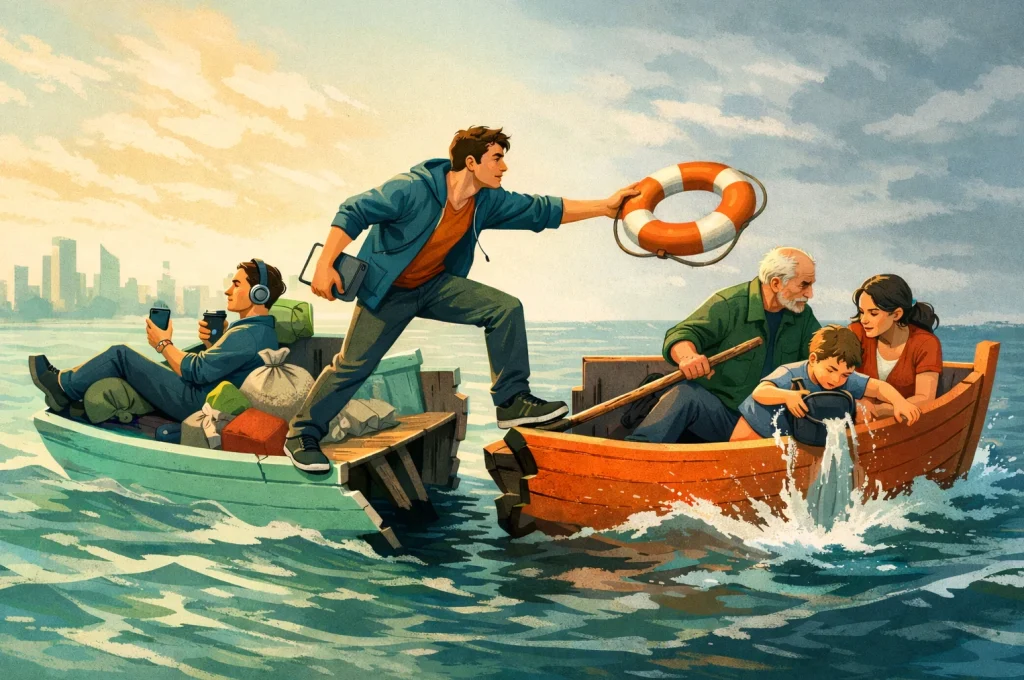
Table of contents:
What starts changing when altruism becomes part of how you live
People relax around you
When altruism grows, other people stop experiencing you as someone who only shows up when there is a reward, a spotlight, or a convenient opening. They feel less handled. Less measured. More safe, basically. That matters at work, in families, in friendships, even in dull little places like apartment hallways and school pickup lines. A person who notices strain and occasionally lightens it creates a very specific kind of trust. Quiet trust. The good kind. That is part of what changes when trust comes a bit more easily: people stop bracing for hidden motives and start meeting you with more openness, which changes the tone of everyday relationships.
Think of the colleague who shares useful credit, not just juicy tasks. Or the friend who hears, "I'm fine," and gently asks again because, come on, nobody says that through clenched teeth for fun. Altruism makes you more responsive to human reality. Not dramatic. Just real.
Your mind gets less trapped inside itself
A selfish mood can feel efficient at first. Protect your time. Guard your energy. Stay in your lane. Fine. But taken too far, it makes the mind small and cramped. You keep circling your own deadlines, your own stress, your own grievances, like a shopping cart with one squeaky wheel that somehow becomes the whole soundtrack. If that loop is fueled by constant self-judgment, it helps to look at the inner critic, the voice that confuses attack with guidance, because people often become more available to others once that mental noise eases.
Altruism interrupts that loop. Helping somebody in a grounded, concrete way often reduces rumination because your attention finally leaves the tiny courtroom in your head. Research on prosocial behavior regularly finds links between helping others and greater well-being, especially when the help feels voluntary and meaningful. Not magic. Not sainthood. Just a nervous system that benefits from connection instead of permanent self-preoccupation.
Relationships stop feeling like accounting
In low-altruism environments, every exchange starts to feel transactional. I did this, so what do I get. You were late, so now I owe you less warmth. I covered that shift, now remember it forever. Exhausting. A home can feel like customer service. A team can feel like a mildly hostile spreadsheet.
Altruism softens that. Not by making people naive, and not by asking anyone to become a cheerful doormat in cardigan form. It changes the baseline. You become more willing to act for the shared good even when nobody is clapping. That makes cooperation easier, conflict less sticky, repair faster. People become less busy defending turf and more able to solve the actual problem.
Meaning gets pulled down from the clouds
A lot of people say they want a meaningful life, which sounds lovely and expensive. Then they ignore the simplest route to it: being useful to someone outside their own ego bubble. Altruism gives meaning a body. It turns vague goodness into behavior. You return the cart. You check on the neighbor. You tell the new hire the thing nobody explained to you. You stay five extra minutes with the lost kid at the station instead of pretending your phone is fascinating.
That kind of life feels different from performative "kindness content." It has texture. It leaves traces. And weirdly enough, it often helps you like yourself more for sane reasons, not inflated ones. You are not admiring your identity. You are seeing your actions line up with the sort of person you actually want to be. Big difference.
What life looks like when altruism stays underfed
Every interaction becomes a tiny trade
When altruism is weak, generosity starts needing a receipt. You help if it is visible, safe, or likely to come back around. You become polite, maybe even charming, while internally running little calculations all day. Is this worth my time. Will they remember this. What do I get if I say yes. The person may still look "nice." But the atmosphere around them gets thin.
Other people feel that thinness faster than you think. They may not say, "Ah yes, your prosocial motivation seems unstable." They just stop opening up. They share less. They trust less. The bond gets practical and somewhat chilly. This is close to what low trustfulness tends to do behind your back: connection becomes more guarded, less generous, and harder to deepen even when everyone still looks perfectly polite.
You miss important chances because nobody announces them
Plenty of opportunities to be altruistic arrive without fanfare. Nobody blows a whistle and says, "Attention, a decent human move is now available in aisle three." Somebody is confused in a meeting. Someone's carrying the social load in a family group chat. A student is left out of the study circle. A friend is making jokes that sound a bit too energetic, which is sometimes sadness wearing glitter.
If your altruism is underdeveloped, you often just... don't see these moments. Not because you are evil. Because your attention is too self-centered or too defended. And that means other people experience your absence where your presence could have mattered quite a bit.
Cynicism starts sounding intelligent
This one is sneaky. People with weak altruism often start calling themselves realistic. "People only help when there's something in it for them." "You can't trust anyone anyway." "If I don't look out for myself, nobody will." There is always a grain of truth in these lines, which is why they spread so easily. But after a while they become less like wisdom and more like armor.
Armor can keep you from being used, sure. It can also keep you from becoming warm, generous, or brave. You stay protected, and also sort of lonely. You avoid disappointment, and also a lot of actual human richness. Not the best bargain, honestly.
Help becomes theatrical or disappears completely
Another strange side effect: without steady altruism, people often split into extremes. Either they do very little for others, or they suddenly perform huge acts of sacrifice when the situation is visible enough. Ordinary kindness feels optional. Big rescue scenes feel noble. So they skip the everyday stuff and wait for moments that make them feel heroic.
But life is mostly not made of heroics. It is made of rides to the clinic, introductions, second chances, quiet advocacy, unglamorous favors, fair sharing, and noticing who keeps getting overlooked. If you cannot do that layer, your altruism stays unstable. It arrives as mood, image, or guilt, then vanishes. And people around you never quite know which version of you they are getting.
How to Cultivate Altruism and Why
Start with noticing, not with noble feelings
Most people wait to feel more compassionate before they act more generously. Backward, mostly. Altruism often grows from attention first. Begin asking one plain question in daily life: who around me is carrying unnecessary weight right now? On the train. In your office. In your home. In the group project where one poor soul is basically babysitting adults with laptops.
This matters because the biggest enemy of altruism is often not cruelty. It is inattention. The mind is busy. The day is loud. We don't see. Train the seeing, and the behavior has somewhere to start.
Make your help specific enough to be useful
Vague kindness sounds warm and does little. "Let me know if you need anything" is emotionally pleasant and often practically useless. Try concrete offers instead: "I can cover the first half of the meeting." "I'm going to the store, want me to grab milk?" "Send me the draft, I'll check the references tonight." Useful altruism lowers friction. It does not create another tiny management task for the tired person.
And yes, ask before charging in. A lot of people enjoy helping in ways that make them feel generous, not in ways that actually match what is needed. That is not altruism. That is self-expression wearing a halo. In practice, this is part of how to train better decisions in real life: notice what is actually needed, choose a useful response, and act before overthinking turns a simple helpful move into an empty intention.
Practice small acts that cost you a little
If your generosity never costs time, comfort, convenience, attention, or credit, it is staying in the kiddie pool. Real altruism involves some genuine giving up of something. Not martyrdom. Just a small, noticeable cost. Let someone else take the easy win. Share the good contact. Stay on the phone a bit longer with the lonely relative. Take the worse parking spot. Give the tip that stings a tiny bit, not the one that lets you feel angelic for eighty-seven cents.
Why does this help? Because altruism is partly a tolerance skill. You are teaching yourself that mild inconvenience is survivable, and that not every resource must be hoarded for the self.
Protect it with boundaries so it does not rot into resentment
This is where many decent people get tangled. They try to be more altruistic, then slide straight into overgiving, exhaustion, and secret bitterness. Not the goal. Healthy altruism includes choice. You can help without becoming available for consumption. You can care and still say, "I can do twenty minutes, not two hours," or, "I can listen tonight, but I can't solve this for you."
Boundaries keep altruism clean. Without them, kindness gets contaminated by fear, guilt, and people-pleasing. Then the whole thing becomes unstable and you start dreading the very trait you were trying to build.
Review the pattern, not your identity
At the end of the week, do a quick and slightly blunt reflection. Where did I notice another person's need early? Where did I miss it? When I helped, was it useful, performative, or resentful? That gives you something measurable. Over time, progress looks like faster noticing, more concrete offers, less scorekeeping, fewer guilt-fueled yeses, and more acts of help that feel steady rather than dramatic.
And the "why" becomes obvious once you live it a bit. Altruism does not only improve other people's days. It changes the kind of social world you help create. One where people are less alone inside ordinary life. A surprisingly big effect for such unflashy behavior, really.
Should altruism be your focus right now?
Maybe. Maybe not. Not everyone needs to start with altruism this month. Some people first need sleep, steadier boundaries, relief from burnout, or a way out of survival mode. If your system is already running on fumes, trying to become more giving can turn into one more moral burden, and that helps nobody.
It is worth looking at the actual pattern. Are you mostly struggling with cynicism, emotional self-absorption, thin relationships, or a habit of treating every interaction like a trade? Then yes, altruism may be a strong growth edge. But if your main issue is overgiving, resentment, or never protecting your own limits, then the first move may be balance, not more generosity. In that case, it can help to ask is adaptability even the right thing to work on first, or whether another skill would give you a steadier base before you focus on becoming more giving.
If you want a cleaner way to sort that out, AI Coach can help you see which skill matters most right now and offer a simple three-day starting plan. Sometimes that is more useful than announcing, in a burst of noble mood, that you are about to become a better human by Tuesday.
Frequently Asked Questions (FAQ)
What is altruism in simple terms?
It is the habit of acting for someone else's benefit even when there is no obvious reward for you. Not always a huge sacrifice. Often it is much smaller than people imagine. A fair word in a meeting. A practical favor. A moment of attention when someone else is overloaded. The core idea is simple: another person's well-being enters your decision, for real.
Is altruism the same as being nice?
No. Niceness is often about smoothness, approval, or avoiding friction. Altruism is about benefit. A nice person may smile, nod, and stay useless. An altruistic person may do something actually helpful, even if it is less polished. Sometimes the kindest act is not soft at all. It is honest, protective, or inconvenient.
Can altruism be learned, or are some people just born with more of it?
It can absolutely be trained. Temperament matters a bit, upbringing matters a lot, and social norms matter more than many people think. People copy what their group rewards and what it ignores. Repeated actions matter too. When you practice noticing, offering specific help, and tolerating small costs, the trait gets stronger through behavior, not just intention.
What is the difference between altruism and people-pleasing?
People-pleasing tries to manage other people's reactions. Altruism tries to create real benefit. A people-pleaser may say yes out of fear, then stew in resentment. An altruistic person may help freely, or say no cleanly when the help would be unhealthy, fake, or impossible. If you lose yourself every time you help, that is not mature generosity. That is poor boundary control with good manners.
Why do I want to be helpful and still pull back in the moment?
Usually because something else fires first: fatigue, distrust, social awkwardness, fear of being used, or simple inattention. There is also the bystander effect. People are less likely to help when responsibility feels shared and blurry. In real life, altruism often fails not at the level of values, but at the level of friction. The good move needs to become easier and more specific.
Can altruism make people take advantage of me?
Yes, if it comes without judgment or limits. Healthy altruism is generous, not gullible. It pays attention to patterns. If someone repeatedly drains you, lies, avoids responsibility, or treats your help as an entitlement, stepping back is not selfish. It is sane. Altruism works best with boundaries because boundaries protect the quality of the giving.
Does altruism actually improve mental health?
Often, yes, though not in a cartoon way. Prosocial behavior is linked with greater well-being, lower rumination for some people, and stronger social connection. One widely cited study found that spending money on others increased happiness more than spending it on oneself. There is also evidence connecting volunteering with better health and well-being in many groups. Still, if helping comes from compulsion or exhaustion, the effect can flip.
How do I practice altruism at work without becoming the office mule?
Help in ways that are useful, bounded, and visible to the right people. Share credit. Clarify confusion. Make a strong introduction. Offer targeted support. But do not quietly absorb everyone else's mess while your own work burns in the corner. A good test is this: does your help strengthen the team, or does it just teach people that you are the easiest person to load up?
Is anonymous giving better than public giving?
Not always better. Just different. Anonymous giving can protect sincerity because there is no applause attached. Public giving can also be useful when it normalizes generosity, raises money, or sets a norm others follow. The key question is not "Was this seen?" but "Was this genuinely for others' benefit, and did the visibility help or distort the act?"
How can I tell whether my altruism is growing?
You notice need sooner. Your help gets more specific. You keep score less. You feel less internal drama around small sacrifices. You say no more cleanly when help would be fake or unhealthy. And other people start experiencing you as steadier, not just kinder in random bursts. That is usually the real sign: less performance, more reliable usefulness.
What is one small thing I can do today to become more altruistic?
Pick one person you will definitely encounter today and make their day lighter in one concrete way. Not symbolic. Concrete. Take a task off their hands, give clear credit, send the information they are missing, make the practical call, or check in when your usual move would be to scroll past. Small, yes. Small still counts. Often that is exactly where the muscle starts.