
There's a very specific kind of tired that comes from trying to say one normal, reasonable thing - and then sanding it down in your head until it sounds weirdly stiff. Like a text written by someone being monitored. Fear of rejection does that. It can turn a plain message, a job application, a boundary, even a harmless joke over dinner into a whole event, as if one lukewarm reaction might confirm your worst private theory about yourself.
If you keep trimming yourself to size, waiting for the perfect moment, or acting "easygoing" while quietly swallowing what you actually want... this fear is probably charging you more than a few awkward moments. And when it starts to loosen, even a little? Life feels less cramped. Not louder, necessarily. Just clearer. More breathable. More like you, without all the costume changes.
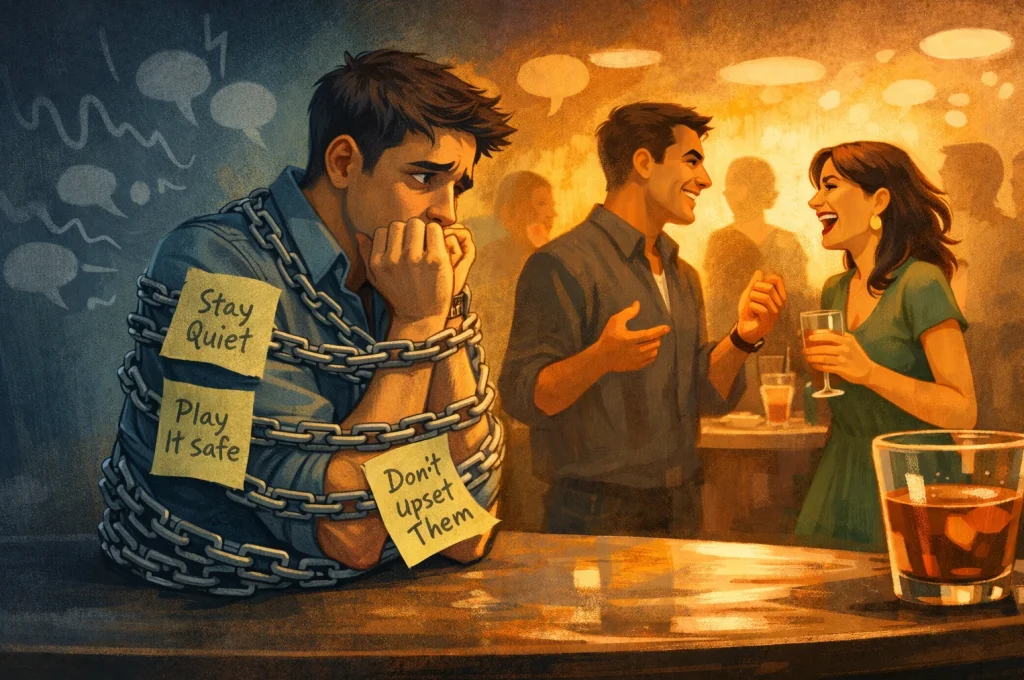
Table of contents:
Fear of Rejection, as It Actually Shows Up
Your brain often treats "no" like danger, not just disappointment
Fear of rejection is not just being "too sensitive" or dramatic or secretly hoping everyone applauds when you walk into a room. It's more physical than that. Human beings are built for belonging; that part is old, ancient-old. For a long time, getting pushed out of the group wasn't merely sad, it was dangerous. So when someone dismisses you, ignores you, laughs at you, cools off, says no thanks - your body may react as if something much bigger is happening. Tight chest. Hot face. Weird little stomach drop. Fun stuff.
That's one reason rejection can feel almost physical. Research on social pain points in that direction too. Which is annoying, sure, but also oddly comforting. You're not ridiculous. You're a person with a nervous system doing its prehistoric best in a modern world full of unread messages and "let's circle back."
It usually wears ordinary clothes
Almost nobody walks around saying, "Hi, I'm deeply afraid of being rejected." It shows up sideways. You over-explain in emails so nobody can possibly misunderstand you. You wait for other people to text first. You ask for less than you want and call it being low-maintenance. You stay in limp, half-dead friendships because, well, at least no one has technically left. At work, you hold back an idea until someone louder says a worse version out loud and gets all the credit. Lovely. When that pattern repeats long enough, it can start to resemble when the brain learns to say "why bother", and then you're not just avoiding pain - you're abandoning your own chances before life has even answered.
Fear of rejection is sneaky like that. It often dresses itself up as being thoughtful, agreeable, chill, strategic, easy to work with. And sometimes it really is those things. But sometimes it's just fear in a decent outfit with good posture.
It turns guessing into a full-time hobby
Another big tell: you start reading into everything. Tone. Delays. Punctuation. Facial expressions. The tiny pause before someone answers. A short reply becomes suspicious. No reply becomes a dissertation. Someone seems distracted and your brain, ever helpful, goes, "Ah yes, obviously this is about us."
This gets pretty close to what psychologists call rejection sensitivity: expecting rejection, spotting it fast, and reacting hard. Which is exhausting, because now you're not just dealing with what actually happened. You're also managing the twelve possible meanings your mind cooked up before breakfast. And then, to avoid getting hurt, you become less direct... which creates even more ambiguity. A ridiculous little loop, honestly.
As this fear loosens, your world gets bigger because your behavior gets bolder in sane, grounded ways. That shift connects closely to why adaptability quietly upgrades your life. The more flexible you become with uncertainty, the less every delayed reply or imperfect reaction feels like a final verdict on your whole existence. Which is nice. Very nice.
Underneath it is often a deeper bargain: "If they like me, I'm safe"
Under all this, there's often a quiet equation running in the background: if they're pleased with me, I'm okay; if they pull away, I'm in trouble. Not everyone thinks it in words, of course. Usually it's more like a reflex. But it can shape a whole life.
That reflex often grows out of old stuff: childhood homes where affection felt conditional, school years full of humiliation, bullying, emotionally unpredictable adults, relationships where love came with fine print. So the fear is rarely about one date, one boss, one friend group, one message left on read. It's about what your system learned rejection means. Exile. Shame. Being too much. Being not enough. No wonder people twist themselves into pretzels to avoid it.
The problem is, after a while the twisting becomes its own cage.
What Opens Up When This Fear Stops Driving
Your voice arrives in the room earlier
One of the first changes is both tiny and huge: you stop needing seventeen layers of internal permission before you speak. You say what you think in the meeting. You ask the follow-up question instead of smiling politely and going home confused. You tell the waiter the order is wrong without turning it into a moral crisis. Nothing cinematic. Just normal life, lived with less flinching.
And those little moments stack up. A person who's less ruled by rejection becomes more visible to life. Not because they suddenly dominate every conversation like an overcaffeinated podcast host. Because they participate. They stop living half a beat behind themselves, forever editing, softening, checking whether their presence is somehow too much for the room.
Relationships get cleaner, which is better than "more popular"
When fear of rejection eases, you usually don't become universally liked. Let's be honest, that was never really on offer. What you do get is cleaner connection. Less guesswork, less performing, fewer weird little emotional contortions. You can disagree without panicking. You can say, "That hurt, actually," before it turns into three weeks of pretending everything's fine and then snapping over cutlery.
You can flirt a bit, clarify, ask, say no, say yes, and survive whatever comes back. That matters because intimacy needs truth. Not all of it at once - we're not trying to terrify the livestock - but enough truth that the relationship is built around who you actually are, not around your best guess at what will keep the other person comfortable. That is a much sturdier floor to stand on. If you're trying to tell the difference between real warmth and anxious approval-seeking, it helps to understand what friendliness really looks like when it is alive in a person, because genuine friendliness leaves room for honesty instead of turning every interaction into a performance designed to avoid disapproval.
Work and opportunity stop slipping through tiny cracks
Fear of rejection quietly taxes careers in the most boring, costly ways. You don't pitch the idea. You don't negotiate. You don't follow up. You don't apply unless you meet every requirement, plus several invented by your inner critic just for sport. You wait too long for feedback. You keep polishing the draft. You tell yourself it's not ready, when really you're not ready for the possibility of someone not loving it. For founders and self-directed professionals, learning how entrepreneurs can balance caution and risk can be especially useful, because not every uncomfortable response is a warning - sometimes it's just the normal price of putting something real into the world.
As the fear loosens, your world usually gets wider. Not because you become reckless, but because you become willing. You ask for feedback while it can still help. You send the draft. You reach out to the person you admire. You can hear "not now" without translating it into "never for someone like you." And that changes outcomes - a lot.
Hard truth: plenty of opportunities are not grabbed by the most brilliant person in the room. They're touched first by the person willing to tolerate being ignored, declined, or mildly misunderstood. Brutal, yes. Also useful.
Self-respect gets less dependent on applause
Maybe the deepest shift happens inside. When you stop organizing your whole life around avoiding disapproval, your self-worth starts resting on something steadier than whatever happens to be flickering across other people's faces that day. You become easier to trust from the inside. You know you can ask, risk, reveal, recover. You know a no may sting, but it won't erase you.
That's a different kind of confidence from charisma, performance, polish, fake certainty - all that shiny stuff. It's quieter. More like: "I can remain myself even when the answer is no." Not poster-on-the-wall confidence. Real confidence. The kind that lets you sleep without replaying one awkward conversation like courtroom evidence.
What This Fear Does When You Leave It Unchecked
You become easier to steer than you realize
People with a strong fear of rejection often look very agreeable from the outside. Pleasant. Flexible. Easy. Low-drama. But sometimes what looks like flexibility is really difficulty tolerating disapproval. You say yes when you mean maybe. You say maybe when you mean no. You laugh at things that actually sting. You let other people - bosses, relatives, clients, partners, whoever's loudest - set the emotional weather because upsetting them feels riskier than losing your own footing.
That can slide into people-pleasing pretty fast. And people-pleasing is expensive. It burns time, leaks energy, attracts the occasional pushy human, and leaves you with the sour little feeling of having helped erase yourself. Not ideal, to put it mildly.
You start treating ambiguity like a verdict
This fear also makes uncertainty heavier than it needs to be. A delayed reply. A neutral face. A meeting invite with no smiley punctuation. Most of life is ambiguous, but rejection fear hates ambiguity and tries to fill the gap immediately. Usually with doom. Naturally. When your mind keeps running these tiny threat calculations all day, it starts to feel a lot like decision fatigue in plain English, because you're burning real energy on imagined verdicts instead of on the next useful move.
So instead of waiting for more information, you brace. Maybe you apologize in advance. Maybe you withdraw first so nobody gets the chance to reject you properly. Maybe you act cool in that very tense, very un-cool way people somehow think is subtle. The problem is, your protective move can create the very distance you were afraid of. Then the brain says, "See? Knew it." Sneaky setup.
Your wants get pushed to the back like they're somehow rude
Over time, fear of rejection can train you to live from the outside in. You check what will be acceptable before you check what you actually feel. Do I want this? becomes less urgent than Will this make things awkward? Should I ask? becomes Would a normal, non-needy person ask? And if you've ever heard that sentence in your own head - oof, yes, there it is.
This shows up everywhere: dating, friendship, family, work, creative projects, all of it. You may tell yourself you're independent, undemanding, adaptable. Maybe you are. Or maybe you've simply gotten very good at pre-rejecting yourself so no one else has to do the messy part. That habit can make life look tidy on the outside and weirdly hollow underneath. Plenty of peace. Not much aliveness.
It often flips into resentment, retreat, or both
Here's the part people miss. Fear of rejection doesn't always make someone endlessly sweet and accommodating. Sometimes it just builds pressure. You stay agreeable too long, hide too much, tolerate too much, and then turn quietly bitter. You feel unseen, but you haven't exactly shown yourself. You feel used, but you kept offering silence as if it were consent.
Eventually some people swing from pleasing to disappearing, or from silence to sharpness. "I'm done with everyone" can sound powerful for a minute. Often it's just a tired nervous system trying to escape the strain of constant self-suppression. If this pattern keeps looping, it can shrink an entire life while looking, from the outside, perfectly functional. Job intact. Smile intact. Soul a bit crumpled though.
Ways to Loosen Fear of Rejection Without Becoming a Robot
Start by catching your personal version of rejection
Not everybody fears the same thing. For one person, the nightmare is being laughed at. For another, it's being ignored. For someone else, it's being seen as needy, awkward, difficult, inexperienced, boring - pick your poison. So for a week or so, pay attention to the exact flavor of the fear. When do you tense up? What kind of "no" hits hardest? What story shows up right after?
Write it down in plain, mildly embarrassing language. "If I ask, they'll think I'm too much." "If I speak up, I'll sound stupid." "If I text first, I'll look desperate." Good. Cringe if you need to. Specific fear is much easier to work with than a vague cloud of dread.
Practice tiny asks that can realistically be declined
A surprisingly useful exercise is making small requests where the answer might genuinely be no. Ask for a different table at the cafe. Ask a coworker if they can swap a slot. Ask the shop assistant whether they can check in the back. Ask your friend for a small favor without wrapping it in six layers of "only if it's easy, no pressure, totally fine, haha."
The point is not to win every time. The point is to teach your body that hearing no does not equal collapse. Boring little reps. Powerful effect. Like physical therapy, but for your dignity.
Swap mind-reading for observable facts
When the spiral starts, pause and split the moment into two piles: what happened, and what you added. "They replied with one sentence" is a fact. "They're tired of me" is a story. "My manager said we should talk tomorrow" is a fact. "I have ruined my career and will soon be living under a bridge" is... let's call it dramatic fan fiction.
This doesn't mean you ignore intuition forever. It means you stop treating every fear-thought like evidence. If you need clarity, ask for clarity. Not constantly, not in a frantic way. Just more often than fear would prefer.
Say smaller honest things sooner
A lot of people imagine courage as one grand speech delivered after months of swallowing feelings. Usually not. Usually the better move is earlier honesty in smaller doses. "Actually, that doesn't work for me." "I'd like to join." "I felt brushed off there." "I'm interested, if you are."
Short. Clean. Alive. Smaller truth is easier on the nervous system and much kinder to your relationships than emotional archaeology six weeks later. The more often you do it, the less every moment of openness feels like jumping off a roof. More like stepping off a curb. Still annoying sometimes, but manageable.
Learn a recovery ritual for after the sting
You don't outgrow fear of rejection by making rejection impossible. That project is doomed, obviously. You get better by recovering faster when it happens. So prepare for the aftermath. When you get a no, try three things: name the feeling without theatrics, refuse the global conclusion, and do one grounding action.
Maybe that's a walk. Maybe a shower. Maybe texting one safe person. Maybe returning to the task you were doing before your brain started composing a tragedy in five acts. What you do next matters. If every rejection becomes a referendum on your entire worth, the fear stays huge. If rejection becomes painful but containable, the fear starts to shrink. That's the game, really.
Should This Be Your Main Growth Focus Right Now?
Not always. Some people genuinely do need to work on fear of rejection. Other people are dealing with burnout, depression, grief, a chaotic environment, or relationships that are actually unsafe - and in those cases the first job is not "be braver." The first job may be rest. Protection. Support. Getting honest about who keeps hurting you, and why you've had to call that normal.
It helps to ask what is creating the most drag in your life right now. If you keep staying quiet, over-accommodating, missing chances, or building your days around avoiding disapproval, then yes, this probably deserves real attention. If your main struggle is numbness, exhaustion, or constant overload, start there - or at least alongside this. No point trying to become fearless when you're running on fumes and cold coffee. If your days already feel clogged by overthinking and endless mental negotiations, start with how to reduce decision fatigue without turning into a robot, because a less overloaded brain is much better at hearing "no" without turning it into a full identity crisis.
If you want a cleaner way to sort that out, AI Coach can help you figure out which growth area matters most right now and give you a simple plan for the first three days. Sometimes that kind of clarity is a lot more useful than trying to reinvent your whole personality by Tuesday.
Frequently Asked Questions (FAQ)
What are the clearest signs that fear of rejection is shaping my behavior?
Look for patterns, not one awkward Tuesday. Common signs include overthinking texts and emails, not asking for what you want, staying overly agreeable, avoiding applications or conversations unless you feel unusually "safe," taking neutral reactions personally, and feeling outsized relief whenever someone approves of you. Another big clue is how often you pre-edit yourself. If your inner process sounds less like "What do I think?" and more like "How do I say this so nobody could possibly dislike me?" then fear of rejection is probably sitting in the room, sipping tea, acting casual. It also tends to show up around dating, networking, creative work, boundaries, and feedback.
Where does fear of rejection usually come from?
Usually from repetition, not one magical origin story. It can grow out of childhood homes where affection felt conditional, criticism that was sharp or unpredictable, bullying, exclusion, humiliating school experiences, unstable relationships, family systems where conflict felt dangerous, or repeated social pain that taught your brain to stay on guard. Temperament matters too. Some people are just naturally more sensitive to social cues. None of this means you're doomed or defective. It means your system learned a strategy: avoid disapproval, stay connected, stay safe. Sensible once. Limiting now.
Is fear of rejection the same thing as social anxiety?
No, though the two overlap a lot. Fear of rejection is specifically about being dismissed, excluded, criticized, or not chosen. Social anxiety is broader. It often includes fear of embarrassment, scrutiny, awkwardness, blushing, saying the wrong thing, or being judged in social situations in general. Someone can fear rejection without being anxious in every social setting. They may be funny, charming, even outgoing, and still fall apart when they have to risk a no. And someone can have social anxiety even when rejection isn't the main fear. Related, yes. The same thing, no.
Why can rejection feel almost physical?
Because the brain isn't being dramatic here. Social pain and physical pain overlap more than people used to think. That's one reason rejection can produce a real body reaction: tight chest, dropped stomach, heat in the face, shakiness, loss of appetite, restless replaying at 1:14 a.m. Naomi Eisenberger's work is often cited on this topic, and for good reason. So if rejection hits your body hard, that doesn't mean you're absurd. It means you're human, with a nervous system still running some very old software.
Can fear of rejection ruin relationships even if I hide it well?
Yes. Quietly, sometimes. It can make you indirect, overly accommodating, hard to read, and strangely unavailable while looking very nice on the surface. You may avoid hard conversations, hide needs, test people instead of asking directly, or agree to things you later resent. In dating, it can create mixed signals: wanting closeness, then pulling back to avoid possible hurt. In friendships, it can turn into never asking for support and then feeling unimportant when nobody magically senses you need it. In long-term relationships, it often fuels scorekeeping and emotional guesswork. People can't reliably meet a version of you built around not upsetting them.
Why do I avoid texting first, following up, or making the first move?
Because first moves are exposing. When you text first, follow up, flirt, pitch, apply, or ask the question, you lose the protective fantasy that maybe it all would have worked if only you'd tried. Suddenly there's data. Some nervous systems hate data when the data might sting. So avoidance becomes a way to preserve hope and dodge pain at the same time. The cost is steep though: no data, no growth, and a life full of maybes. If this is your pattern, start with smaller bids for contact rather than waiting for one giant act of courage. Repetition calms the body better than pep talks do.
How do I stop taking "no" as proof that something is wrong with me?
By separating preference from verdict. A no can mean bad timing, different needs, low bandwidth, limited budget, lack of chemistry, mismatched goals, simple taste, a person having a weird day - human life is messy. Sometimes it really does mean "not for me." Annoying, yes. Still not the same thing as "there is something fundamentally wrong with you." The trick is to ask: what exactly was declined here? The idea? The invitation? The fit? Good. Keep it there. Specific disappointment heals much faster than global self-condemnation. Your job is not to erase every no. Your job is to stop turning each one into a biography.
Is fear of rejection connected to people-pleasing?
Very often, yes. People-pleasing is one of the most common coping styles underneath rejection fear. If disapproval feels dangerous, then smoothing things over, staying helpful, being easy, and keeping everyone comfortable can start to feel like survival. At first it may even look virtuous. And sometimes it is generous, sure. But when the habit is driven by fear, it gets costly fast. You lose clarity, boundaries, and a clean sense of what you actually want. Then resentment starts nibbling at the edges. If you recognize that loop, the work is not becoming cold or selfish. It's learning to stay kind without vanishing.
Can confident people still have a fear of rejection?
Absolutely. Some confident-looking people are just excellent performers. They can speak well, dress well, lead meetings, crack jokes, carry themselves with authority - and still avoid emotional honesty, still take romantic rejection hard, still unravel around disapproval from specific people, still need a lot of external approval to feel steady. Confidence in one area doesn't magically erase rejection fear in another. In fact, high-functioning people often hide this fear especially well because competence becomes the shield. A polished shield is still a shield.
How long does it usually take to get better?
Long enough to be annoying, short enough to be encouraging. Most people do not wake up one Wednesday completely cured and start texting exes, bosses, crushes, and landlords with serene detachment. Improvement usually looks more ordinary than that. You notice the fear sooner. You recover faster from a no. You speak a bit more directly. You ask for the thing before your brain has fully decorated the disaster. With steady practice, small changes can show up within weeks. Deeper rewiring takes longer, especially if the fear is tied to old relational wounds. But it does move. A lot of people assume they're "just like this" when really they're just very, very practiced in avoidance.
What should I do right after a rejection if I feel myself spiraling?
First, turn down the drama before trying to extract wisdom. Name what happened in one accurate sentence: "They said no." "I didn't get the role." "They're not interested." Then name what you feel without building a cathedral around it. Hurt. Embarrassment. Anger. Sadness. Shame. Fine. After that, do something regulating and concrete: walk, shower, breathe, text someone safe, eat something if you've gone hollow and jittery. Only later ask what the moment actually means. Right after rejection is a terrible time to make sweeping conclusions about your worth, your future, or whether love and success were apparently invented for other people.
When is it worth getting extra help for fear of rejection?
When it's clearly shrinking your life. If you keep avoiding relationships, opportunities, feedback, conflict, visibility, or basic self-expression because rejection feels unbearable, that's worth attention. Same goes if you swing between people-pleasing and cutting people off, if small signs of distance trigger huge reactions, or if old experiences of rejection still feel electrically alive in current situations. Extra help can also make sense if this fear is tangled up with trauma, attachment wounds, depression, or severe anxiety. You do not need to wait until your whole life is on fire. Early help is often much kinder - and frankly a lot less messy.