
You know that oddly modern kind of embarrassment when someone says, "I ran it through AI," and everybody nods as if that settles it - while part of you is thinking, Hang on, should we trust this thing or just admire how confident it sounds? AI literacy is the skill that keeps you from treating artificial intelligence like either a magic oracle or a noisy toy.
When this skill is weak, people either avoid AI and quietly fall behind, or use it badly and end up looking careless, gullible, or weirdly replaceable. When it gets stronger, the whole thing feels less spooky and more workable. If that pokes at something in your work, your studies, or that little knot in your stomach when the topic comes up, good. That means this is probably for you.
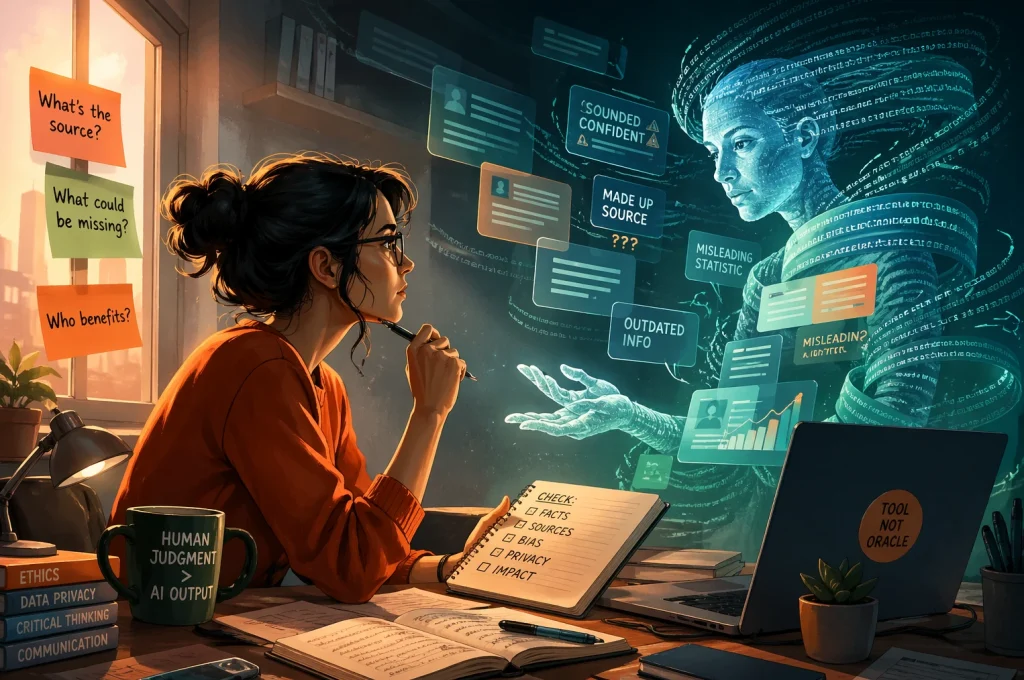
Table of contents:
AI Literacy: what it actually looks like in real life
It is bigger than "being good at prompts"
A lot of people think AI literacy means knowing a few clever prompt formulas and making ChatGPT write emails in the tone of a cheerful Victorian pirate. Fun party trick, sure. But the real skill is broader. It means understanding, in human terms, what these systems do well, what they fake well, and where they can go gloriously off the rails.
An AI-literate person knows that most generative AI systems do not "know" things the way people do. They predict patterns. They remix language, images, code, and structure based on training data. That can be wildly useful. It can also produce nonsense that sounds polished enough to fool a tired brain at 4:47 p.m. That bigger view is close to how organizations like UNESCO and NIST frame the issue: use the tool, yes, but understand limits, risk, and oversight too. Sensible. Slightly less glamorous than "the robots are here," but more useful.
It starts with asking for the right thing
AI literacy also shows up in how a person asks. Weak users throw in vague mush like, "Write something about leadership," then complain that the result tastes like warm cardboard. Stronger users give context. Who is this for? What is the goal? What should be included, avoided, shortened, explained, checked? What tone fits? What output format would actually help? The same habit helps in human conversations too: clarity, context, and timing are part of what gets easier when you stop treating disagreement like a catastrophe, and vague pressure rarely produces a better response from people than it does from machines.
That skill matters because AI often mirrors the quality of the request. If your instruction is foggy, the answer will usually come back neat-looking and oddly hollow, like a hotel apple. A person with AI literacy learns to work in rounds: first get a rough direction, then tighten, then test, then revise. Not because they worship process. Because it gets better results with less muttering.
It keeps one eyebrow raised
This might be the heart of it, honestly. AI literacy includes healthy skepticism. Not paranoia. Not dramatic "technology is evil" theater. Just the calm habit of asking, "How do we know this is right?" AI can invent sources, flatten nuance, miss recent changes, botch math, misread tone, and state uncertain things with the confidence of a man explaining barbecue to a Texan.
So a literate user checks the parts that matter. Facts. Dates. Legal wording. Medical claims. Numbers. Citations. The existence of the book, article, person, or court case the model just mentioned so breezily. They notice warning signs too: generic phrasing, fake precision, suspiciously perfect confidence, or answers that avoid the exact question and glide past it with suspicious grace.
It includes boundaries, not just skills
And then there is the grown-up part: judgment. AI literacy means knowing when AI is useful and when it should stay in the back seat. Brainstorming, summarizing, outlining, translation support, coding assistance, meeting-note cleanup - often great. Uploading private client data, outsourcing hiring decisions, trusting it with sensitive health details, or letting it draft something you do not truly understand? Much shakier ground. In practice, this is one more reason setting boundaries matters more than it seems, because convenience gets persuasive the moment a deadline starts breathing down your neck.
It also means knowing that AI is not just chatbots. It is recommendation systems shaping what you see, image generators making fake photos look plausible, voice cloning, search tools, screening tools, and all sorts of invisible plumbing in daily life. So this skill is partly technical, yes, but also social and ethical. Who benefits? Who gets overlooked? Who is still responsible when the tool makes a mess? Hint: not the tool. Still you. Annoying maybe, but true.
What gets better when AI literacy becomes part of your toolkit
You stop feeling either intimidated or hypnotized
One of the first changes is emotional, not technical. AI stops feeling like a giant shiny thing happening to you. You are less likely to freeze because everybody else seems ahead, and less likely to get dazzled by a fluent answer that should have been interrogated before anyone copied it into a report.
That shift gives you something very practical: steadier footing. Instead of bouncing between "I should use AI for everything" and "I hate this and refuse," you start seeing where it genuinely helps. Drafting an outline. Summarizing a long document. Creating first-pass options. Translating jargon into plain English. Cleaning up repetitive admin sludge. Suddenly the tool becomes more like a power drill and less like a cult object. Useful, strong, not something you hand to a toddler or let decide your kitchen remodel.
Your learning gets faster, but not lazier
Used well, AI can make learning more interactive. You can ask it to explain a concept at three different levels, quiz you, generate examples, compare opposing views, or turn a messy topic into something you can actually hold in your head. That is powerful. Especially for people who learn by dialogue rather than by staring at a PDF until their soul leaves their body. It is also handy if you need to explain ideas out loud, because public speaking is the skill of getting your idea to land, and AI can be a decent rehearsal partner as long as it does not become your substitute brain.
But here is the key: AI literacy keeps the learning active. You are not just swallowing output whole. You are probing it. Asking what it left out. Testing whether it can explain the same idea another way. Catching contradictions. That active stance helps the material stick better, because your brain is doing something with it instead of just receiving it like damp mail.
You become harder to fool
This matters more every month, really. AI-generated text, images, and audio are getting smoother. So AI literacy becomes a kind of modern street-smarts. You get better at spotting when something is polished but flimsy, emotionally manipulative, weirdly source-free, or tailored to trigger a quick reaction instead of a careful thought.
That helps in obvious places - scams, fake experts, overhyped products, sensational posts - but also in smaller daily moments. A manager forwards an AI summary. A coworker pastes AI-written strategy notes. A student submits a suspiciously bloodless essay. A brand promises "AI-powered" everything as if the phrase itself were vitamins. You do not have to become cynical. You just become less easy to steer by shine alone. Very useful skill. Your wallet, your reputation, and your nervous system all appreciate it.
Your work becomes more valuable, not more generic
There is a career upside too, and it is not only for tech people. In many jobs now, the valuable person is not the one who merely touches AI. It is the one who can use it without lowering quality, leaking private information, or flooding the room with bland machine fluff. Someone has to bring taste, context, accountability, and actual judgment. That someone can be you.
And there is a quieter benefit beneath that. When you know how to use AI without leaning on it like a crutch, you feel less replaceable. Less flimsy. You can say, "Here is what the tool can do, here is where it helps, here is where I stepped in and why." That is a calmer kind of confidence. Not techno-bragging. More like, I know what I'm doing, and I know what I am not delegating. Lovely feeling, that.
When AI literacy is weak, the problems are usually sneakier than people expect
You swing between avoidance and overreliance
Most people do not lack AI literacy in a dramatic, movie-scene way. They just fall into one of two grooves. Groove one: avoidance. "This whole thing is annoying, overhyped, probably cheating, I'll ignore it." Groove two: surrender. "The AI said it, so that's probably fine." Neither groove is especially safe.
If you avoid it completely, you may miss useful tools and end up slower on tasks that no longer need to be done the hard way every single time. If you overrely on it, your work can start sounding generic, your judgment gets blurry, and you begin trusting outputs you did not really examine. Strange little trap, that. You either stay outside the room or hand the keys to the intern who sounds confident and has never once felt shame.
Confident nonsense slips into real decisions
This is one of the nastier costs. AI is often wrong in a very well-dressed way. It can invent facts, cite papers that do not exist, suggest broken code, flatten a complex situation into bland advice, or quietly miss the one clause that actually matters. If your AI literacy is weak, those mistakes can drift straight into emails, reports, schoolwork, proposals, client materials, even decisions about people.
Then the social damage starts. A boss catches the made-up reference. A customer notices the answer does not quite answer. A teacher recognizes the synthetic glaze. A colleague has to clean up after your "helpful" AI draft. Over time, that changes how people experience you. Not as innovative. As someone who needs checking. Oof. That is not a reputation most adults are trying to collect.
Your own thinking can get soft around the edges
There is also a more personal cost. If you reach for AI before you have formed even a rough thought of your own, your mind can get a little passive. Not stupid. Just underused. You stop practicing how to frame a problem, how to wrestle with ambiguity, how to write something in your own voice before a machine sands all the rough edges off it. If that disconnection starts spreading beyond work and into the rest of life, it can resemble how numbness quietly starts running your life, where things still happen on the outside but your sense of contact with them gets strangely thin.
This shows up a lot in students and knowledge workers. The person technically "produces" more, yet feels less connected to what they made. The work is there, but authorship feels slippery. So does confidence. Because deep down, you are not fully sure what was yours. That can create a weird, hollow dependence: faster output on the surface, weaker ownership underneath. And yes, people feel that, even when they cannot quite name it.
You become easier to manipulate, and easier to expose
Weak AI literacy also creates risk around privacy, bias, and persuasion. People paste in sensitive notes, customer data, internal documents, student records, performance reviews, private health details - all because the tool felt convenient in the moment. Later, maybe much later, they realize they treated a system like a private notebook when it was not one.
Then there is the manipulation side. If you do not understand how AI-generated content can mimic trust, scale emotional messaging, or flood your feed with synthetic certainty, you are easier to nudge. Easier to panic. Easier to believe the fake voice note, the edited image, the authoritative summary that skipped half the truth. That is the deeper pain here: not just making mistakes, but slowly losing your sense of what deserves trust. A tiring way to live, honestly.
How to build AI literacy without becoming one of those people who says "prompt engineering" at parties
Take one real task and ask for it three different ways
This is a great first drill because it makes the skill visible fast. Pick one ordinary task - a summary, a lesson plan, a meeting recap, a product description, whatever fits your life. Then ask for it three ways: once vaguely, once with clear context, once with context plus constraints and a target audience. Compare the outputs.
You will feel the lesson in your bones. Same tool, wildly different result. That teaches you that prompting is not magic wording. It is structured thinking. The more clearly you know what you need, the more useful the system becomes. Handy little mirror, really.
Run a "show me the weak spots" round
After AI gives you an answer, do not stop there. Ask a second question: "What might be wrong, missing, oversimplified, or risky in this answer?" Then ask it to name assumptions, edge cases, and places where a human should verify before using it. This is one of the easiest ways to train skepticism without turning the whole interaction into a courtroom drama.
Why does it help? Because it breaks the spell of fluency. You stop treating the first output as the final word. You start seeing it as draft material - useful, maybe even impressive, but still draft material. That is a major shift.
Practice factual spot-checking on purpose
Once or twice a week, take an AI answer with factual claims in it and verify several pieces manually. Check whether the source exists. Whether the statistic is real. Whether the quote is accurate. Whether the law, article, or person named is actually what the model says it is. Boring? A bit. Eye-opening? Oh yes.
After a while, you begin noticing patterns. Some tools are stronger in structure than in facts. Some are decent at summarizing a document you provide, but shakier when freewheeling from memory. Some sound spectacularly sure while standing on thin ice. This is how trust becomes calibrated instead of random.
Make a private "do not paste" list
AI literacy is not only about better output. It is also about better restraint. Write down what you do not feed into public or semi-public AI tools: client names, confidential documents, unreleased strategy, legal drafts you barely understand, medical details, HR notes, student records, passwords - yes, people really do that, and yes, it is as alarming as it sounds.
Having your own red lines matters because convenience is persuasive. In the moment, anything feels tempting if the deadline is loud enough. A pre-made boundary saves you from making ethics decisions while stressed and under-caffeinated.
Keep one zone of work stubbornly human-first
Pick one kind of task where you always think before you prompt. Maybe it is a personal reflection, a strategy memo, the opening of an essay, feedback to a colleague, or the first outline of a big decision. Give yourself ten or fifteen minutes to form your own view before AI enters the chat. After that, use the tool as a critic, challenger, explainer, or editor - not the author of your brain.
This protects two things at once: your judgment and your voice. And those are exactly the things that become more valuable, not less, in an AI-heavy world. So yes, use the tool. Absolutely. Just do not quietly hand over the steering wheel and then act surprised when you no longer enjoy where the car is going.
Should AI literacy be your next development focus?
Not for everyone, not this minute. Some people first need stronger focus, better digital boundaries, or basic relief from overload. If your life already feels like twenty browser tabs arguing with each other, piling one more skill on top may not be the wisest first move.
Still, if AI keeps showing up in your work, your study, your industry, or even your family chats - and you notice that you either trust it too quickly or avoid it with a kind of cranky suspicion - then this skill is probably timely. It helps to choose one growth priority on purpose, otherwise effort goes everywhere and lands nowhere. You know the feeling. If part of the hesitation is that you keep postponing your own development until some imaginary calmer season, it may help to look at how to be more ambitious, because a useful skill rarely grows while it is treated like a someday project.
If you want a cleaner way to sort that out, AI Coach can help you figure out what matters most right now and give you a simple plan for the first three days. Sometimes that is far more useful than vaguely promising yourself to "get better with AI" and then, well, never actually defining what that means.
Frequently Asked Questions (FAQ)
What is AI literacy in plain English?
It is the ability to use AI tools with understanding and judgment. You know what they are good at, where they are unreliable, what should be checked, what should stay private, and when a human should stay firmly in charge. In short: you use the tool without getting duped by the tool.
Why is AI literacy important now?
Because AI is no longer sitting off in some distant tech lab wearing futuristic sunglasses. It is in writing tools, search, hiring systems, customer support, education, design, coding, social feeds, and plenty of ordinary work. If you cannot evaluate it, you are more likely to be misled by it, underuse it, or hand it too much authority.
Do I need to learn coding to become AI-literate?
No. Coding can help in some contexts, but AI literacy is not the same as software engineering. Most people need practical judgment more than programming: how to ask clearly, how to verify, how to spot risk, how to protect data, and how to decide whether AI should be involved at all.
Is AI literacy only for people in tech jobs?
Not even close. Teachers, marketers, managers, students, freelancers, recruiters, writers, customer support teams, healthcare staff, small-business owners - all of them are already bumping into AI in one form or another. If your work includes information, decisions, communication, or digital tools, this skill matters.
What is the difference between AI literacy and just knowing how to use ChatGPT?
Knowing how to use one tool is only a slice of the picture. AI literacy is wider. It includes understanding limitations, bias, privacy, accountability, deepfakes, automated recommendations, and the social effects of AI systems. A person can be fast with ChatGPT and still be pretty shaky on judgment. Happens all the time.
How can I tell when an AI answer is probably unreliable?
Look for a few red flags: it sounds very sure without showing where the information came from, it dodges the exact question, it gives suspiciously generic advice, it names sources you cannot verify, or it handles a complex issue with cartoon-level neatness. Another clue: the answer is polished, but oddly thin once you poke it.
What should I never share with AI tools?
As a rule, do not paste in anything confidential, identifying, legally sensitive, medically private, or professionally protected unless you fully understand the tool, the setting, and the data policy involved. Client files, HR notes, internal strategy, passwords, private health details, student records - those should make you pause immediately.
Can using AI make me worse at thinking?
Yes, if you use it as a substitute for forming your own view. If AI becomes your first move every time, your reasoning, writing, and problem-framing can get a bit flabby. Used well, though, AI can sharpen thinking by helping you compare, challenge, test, and refine ideas. The difference is whether you stay mentally present.
Is AI literacy the same as digital literacy?
No. Digital literacy is the broader skill of navigating digital tools, media, and information. AI literacy is a more specific layer inside that world: understanding how AI systems behave, where they create risk, and how to use them critically. UNESCO treats AI literacy as a distinct area within modern education and citizenship, which is a pretty sensible frame. Their work on AI and education is here.
What is one small habit that improves AI literacy fast?
After every useful AI interaction, ask one extra question: "What in this answer should I verify, and what should I not delegate next time?" That tiny pause builds the core of the skill surprisingly fast. You stop being a passive receiver and become an active editor. Which, in this whole AI era, is a much better place to stand.