
You know that weirdly exhausting thing where you smile, nod, say "It's all good," and then spend the next three hours arguing with the person in your head? That's often what conflict avoidance looks like in adult life. Not peace, exactly. More like emotional traffic hidden under a polite face.
You keep things smooth, skip the awkward sentence, tell yourself it is too small to mention. Meanwhile the irritation stays, your body stays tense, and people keep crossing lines you never actually named. If that lands a bit too neatly... yeah, this one may be yours.
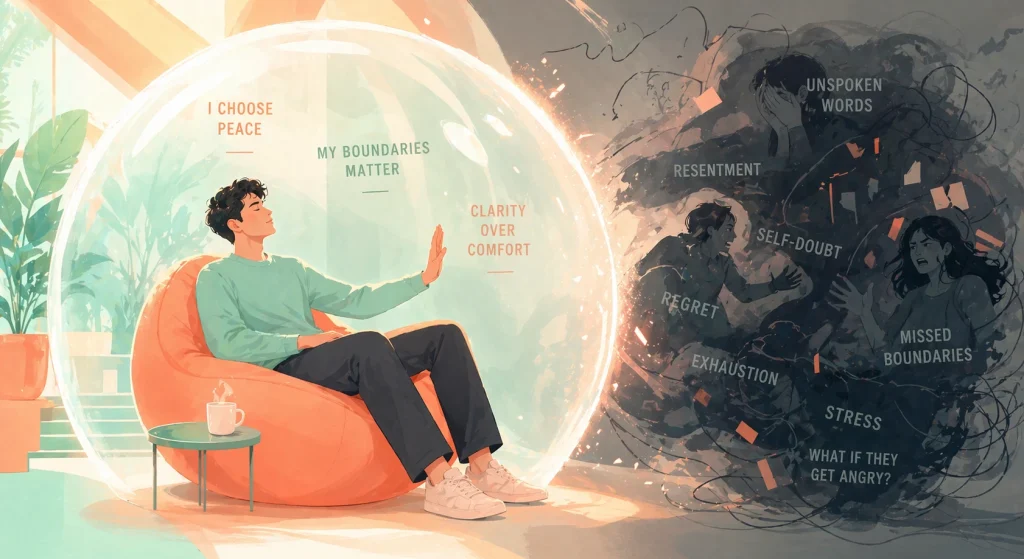
Table of contents:
Conflict Avoidance: neat on the surface, expensive underneath
It often passes for being easygoing
Conflict avoidance is the habit of dodging tension even when honesty would help. On the outside, it can look almost admirable. You are flexible. Pleasant. "Low drama." The person who says, "Whatever works for everyone." Lovely, in theory. But the real pattern is not calm strength. It is fear of friction. So instead of saying, "That doesn't work for me," you soften, postpone, hint, joke, disappear, or quietly rearrange yourself. You tell yourself you are keeping the peace. Sometimes you are. A lot of the time, you are just paying for short-term comfort with long-term mess.
Your nervous system may treat disagreement like danger
This is why smart, kind, capable people still avoid hard conversations. In the moment, conflict does not feel like a normal social skill. It feels like risk. Your chest tightens. Your throat goes dry. Your brain starts throwing out emergency ideas: smooth it over, backpedal, make them happy, leave the room. That reaction is not random. For many people, disagreement carries an old emotional charge. Raised voices, disapproval, icy silence, disappointment, being called selfish, being mocked for having needs - the body remembers faster than the mind explains. So even a perfectly ordinary conversation about chores, deadlines, money, or respect can feel much bigger inside than it looks from the outside.
It shows up in tiny everyday edits of yourself
Conflict avoidance is rarely only about huge confrontations. More often, it lives in tiny moments. You say "fine" when you are annoyed. You laugh when something actually stings. You agree to plans you do not want. You send the extra-nice email instead of the clear one. You let the friend keep interrupting. You let the coworker dump work on you again because pushing back feels weirdly harder than doing the task. This is where the pattern gets sneaky. The issue is not one dramatic blowup. It is steady self-erasure in miniature. One little swallowed objection at a time.
For a lot of people, the pattern was learned early
Many conflict-avoidant adults were not born that way. They adapted. Maybe home was unpredictable, so staying agreeable felt safer. Maybe one parent exploded and the other tiptoed, and you learned that honesty was expensive. Maybe your culture, school, or workplace praised niceness but punished directness, especially if you were expected to be "pleasant" no matter what. So you learned to monitor moods, prevent discomfort, and keep the room stable. Fair enough. That strategy can be brilliant in the short term. But over time, it can start resembling what reactive living quietly costs, because your decisions get shaped by other people's moods long before they are shaped by your own priorities. It just ages badly. In adult life, the same habit that once kept you safe can make relationships blurry, work frustrating, and self-respect oddly flimsy. The problem is not that you care about harmony. It is that harmony without truth has a shelf life, and usually not a long one.
What changes when you stop treating every disagreement like a small catastrophe
Relationships get clearer, not colder
One of the biggest surprises here is that healthy conflict does not ruin closeness. It usually improves it. When you start saying what bothers you sooner and more cleanly, people have a real chance to respond to the actual issue instead of your hints, weird mood shifts, or sudden withdrawal. That makes relationships feel less foggy. Less guesswork, fewer emotional scavenger hunts. And yes, some conversations will be awkward for a minute. So what. Awkwardness is cheap compared with months of silent resentment. This is also where honesty starts paying you back: less performance, more reality, fewer strange little fractures hidden under "I'm fine."
Boundaries stop feeling like an act of cruelty
People who avoid conflict often treat boundaries like a social crime. "If I say no, they'll be hurt." "If I correct this, I'll look difficult." But once this pattern loosens, a boundary starts feeling less like rejection and more like useful information. You say what you can do. You say what you cannot. You ask for a different tone, a clearer plan, more notice, less sarcasm, whatever the thing is. The whole exchange gets simpler. This is close to what shifts when personal boundaries stop leaking everywhere: your kindness no longer requires self-abandonment as an entrance fee.
Your work life gets less political and more real
At work, conflict avoidance can quietly make other people's preferences look like objective truth. The loud colleague gets their way. The vague manager keeps being vague. The bad process survives because nobody wants to be the one who says, "This is not working. In teams like that, weak organizational skills make the problem worse, because unclear roles and fuzzy ownership give avoidance even more places to hide." When you get better with conflict, you do not become combative. You become usable. You can give feedback before a project goes sideways. You can disagree in a meeting without sounding like you want to duel at dawn. You can negotiate deadlines, challenge assumptions, and say, calmly, "I don't think that's the best move." That matters. A lot. Careers stall less when your voice actually shows up in the room.
You leave conversations with more self-respect
There is also a quieter gain, and honestly it may be the best one. You stop walking away from interactions feeling like you abandoned yourself again. That sour little after-feeling gets smaller. You said the thing. Maybe not perfectly, maybe with a slightly shaky voice, maybe while your pulse was doing jazz hands - still, you said it. Over time, that builds trust in yourself. And that trust overlaps with self-awareness, because you begin noticing your real reactions sooner and responding to them before they curdle into resentment. You still care about people. You just stop vanishing to prove it.
How this pattern starts running the week when it gets too strong
Resentment comes out through side doors
People who avoid conflict are not less angry. They are often just less direct with anger. So instead of a clear sentence, the feeling leaks out sideways. You get sarcastic. Slow to reply. Weirdly tired whenever that person texts. You "forget" the favor. You become overly formal, then tell yourself you are simply being professional. Ahem. The problem is that unspoken irritation rarely stays elegant. It changes the tone anyway. So the conflict you were trying to avoid still happens, just in a messier costume.
You keep agreeing to things your actual self did not approve
This is where the pattern becomes expensive. You say yes in the moment because no feels too sharp. Then later, your calendar fills with obligations you resent, your budget gets stretched, your energy drops, and you feel trapped inside promises made by your panic, not your values. Want a small but brutal example? "Sure, I can take that on" in a meeting, followed by quiet fury at 10:30 p.m. while fixing someone else's sloppy work. Conflict avoidance often looks like overcommitment wearing a nice smile. And the person who pays first is usually you.
Important issues stay alive far too long
When nobody names the thing, the thing does not disappear. It settles in. A partner keeps making jokes that sting. A friend keeps arriving forty minutes late. A boss keeps taking your silence as agreement. A roommate keeps treating the sink like modern art. Small issues become patterns because there is no interruption. Then one day you finally speak, but now you are not discussing one incident. You are dragging six months of collected evidence behind you like a rattling cart. No wonder it comes out hotter than you intended.
Your body stays braced even when your mouth stays polite
This pattern is not only social. It is physical. If you avoid conflict a lot, you may spend absurd amounts of energy scanning tone, predicting reactions, rehearsing what to say, then not saying it. That is exhausting. Left unchecked, this pattern can slide toward when burnout starts running your system, and then even small moments of tension start eating far more energy than they should. You can look calm and still feel tightly wound inside. Sleep gets noisier. Rumination gets longer. A simple text like "Can we talk?" feels like your organs have opinions. In many cases, what needs strengthening here is not aggression but emotional regulation, so your system learns that tension is uncomfortable, yes, but not automatically catastrophic. Until that shifts, even ordinary disagreement can keep feeling like a fire alarm in a very small apartment.
How to loosen conflict avoidance without turning into a bulldozer
Notice your polite escape phrases
Start embarrassingly small. For one week, listen for the phrases you use when you are abandoning your real position. "Whatever." "It's okay." "No big deal." "I'm good with anything." Maybe you truly mean them sometimes. Maybe. But not always. Each time one slips out and your body says otherwise, make a quick note on your phone. Not a giant journal entry, just the line and the situation. This gives you a map of where avoidance actually lives: money, dating, family plans, workload, feedback, maybe all of the above on a festive Tuesday.
Train preference before you train confrontation
A lot of conflict-avoidant people jump from silence straight to imagining some huge brave speech. No wonder they avoid it. Start earlier. Practice stating preferences in low-stakes moments: "I'd rather sit outside." "Thursday doesn't work for me." "Can we start at two instead?" Preference is the baby muscle under direct communication. If that muscle is weak, stronger conflict skills will feel theatrical and fake. These little reps matter because they teach your system that having a point of view does not, in fact, cause civilization to collapse.
Use a smaller doorway into the hard topic
You do not need to kick every door open. Try a softer entry that is still clear: "There's something a bit awkward I want to bring up." Or, "Can I check something with you before it grows in my head?" That kind of opening helps because it names the discomfort without surrendering to it. Then keep the message plain: what happened, what landed badly, what you need now. Not a legal brief. Not a character assassination. Just enough truth to make the conversation real. Short is your friend here. If you keep waiting for the flawless wording, it may help to look at how to train perfectionism without becoming unbearable, because clarity usually works better than a polished speech you never actually say. Rambling is often fear in a cardigan.
Do not wait until the issue becomes emotionally expensive
Pick one live issue and rate it privately from one to ten. One is mild irritation. Ten is "I am naming my future memoir after this betrayal." Start with a three or a four. Not the family volcano. Not the boss who scares everybody. Just one manageable issue that matters enough to be worth your effort. The goal is to interrupt the old pattern before your nervous system is fully hijacked. Conflict skills grow faster in smaller weather. That is not cowardice. It is training.
Expect the body wobble, and stay with yourself through it
After you speak up, your body may act like you just wrestled a bear in a parking lot. Adrenaline, shaky hands, second-guessing, the urge to send a follow-up text saying, "Ignore everything, I'm actually a cloud." Do not treat that reaction as proof you did it wrong. Treat it as practice. Breathe slower than you want to. Keep your shoulders down. Let the wave pass before rewriting the whole interaction into a disaster movie. The point is not to feel fearless. The point is to stop obeying fear quite so automatically. That's a different thing, and a much more useful one.
Does this need to be your main growth project right now?
Not always. Some people really do need to work on conflict avoidance. Others are mostly dealing with burnout, grief, chronic stress, depression, or a relationship where speaking up is genuinely unsafe. If your system is in survival mode, forcing yourself into "better confrontation" may be the wrong first move.
It helps to ask what keeps costing you most. Are you swallowing too much, agreeing too fast, resenting people in silence, and losing ground in work or love because nothing gets named? That slow drift can look a lot like the quiet damage feeling stuck can do, because life keeps moving on the calendar while the real issues stay frozen underneath. Then yes, this probably deserves attention. If the bigger issue is safety, exhaustion, or old trauma getting lit up, start there too, or your effort will scatter.
If you want a cleaner read on what to focus on first, AI Coach can help you sort the priority and give you a simple plan for the first three days. Sometimes that is more useful than declaring yourself "more assertive now" and then folding the next time someone says, "Where do you want to eat?"
Frequently Asked Questions (FAQ)
What is conflict avoidance in simple terms?
It is the habit of dodging disagreement, tension, or uncomfortable honesty even when speaking up would help. In real life, that can look like saying yes too quickly, staying vague, delaying feedback, hinting instead of asking directly, or going quiet to keep the atmosphere pleasant. The key detail is this: the peace looks calm from the outside, but it usually costs you something on the inside.
Why do I avoid conflict even when I know I'm right?
Because being right and feeling safe are not the same thing. Many people avoid conflict not from weakness or lack of logic, but because their nervous system has learned that disagreement leads to rejection, anger, shame, or chaos. So the body steps in before your principles do. You may know the conversation is necessary, yet still feel a strong pull to smooth, delay, or disappear. Very common. Very trainable too.
Is conflict avoidance the same as being nice?
No. Niceness can be generous, thoughtful, and socially useful. Conflict avoidance is more fearful and costly. A nice person can still say, "That doesn't work for me," without making a theatrical mess. A conflict-avoidant person often struggles to do that, because they are trying to prevent discomfort rather than communicate clearly. Kindness includes honesty. Avoidance usually waters honesty down until it barely has a pulse.
Can conflict avoidance damage a relationship even if we rarely fight?
Absolutely. A relationship with very little open conflict is not automatically healthy. Sometimes it means one or both people are editing themselves constantly. When issues go unnamed, they do not disappear. They turn into distance, resentment, passive-aggressive behavior, less desire, less trust, or that odd feeling of "we're fine, but something feels off." Real closeness needs room for disagreement, not just politeness.
How does conflict avoidance affect work?
It can make you easier to overrule, overload, or overlook. You may agree to unrealistic deadlines, stay silent in meetings when you actually see the flaw, avoid giving corrective feedback, or let unclear expectations keep repeating because asking for clarity feels awkward. That can hurt performance, leadership, and credibility. Work usually gets better when you can disagree without drama and ask direct questions before the mess multiplies.
Why do I freeze, cry, or go blank during confrontation?
Because your body may be going into a threat response. Some people get loud when stressed. Others shut down, tear up, lose their words, or mentally float three feet above the meeting. That does not mean you are manipulative, weak, or "too sensitive." It usually means your system is overloaded. This is why practicing with smaller issues helps. You are not only learning sentences. You are teaching your body that disagreement can be survived.
How can I bring something up without sounding aggressive?
Keep it narrower than your emotions want to make it. Name the specific moment, say how it landed, and state what you want now. For example: "When the plan changed at the last minute, I got stuck with the extra work. Next time, I need more notice." That lands better than a history lecture beginning with "you always." A calm tone helps, sure, but clarity matters more than performing saintliness. You do not need to sound perfect. You need to sound understandable.
Can avoiding conflict make me passive-aggressive?
Yes, very easily. When direct expression feels unsafe, emotion looks for side exits. Sarcasm, withdrawal, procrastinating on purpose, "forgetting," cool politeness, loaded jokes, vague replies - all of that can become a substitute for clean disagreement. Passive aggression is often conflict avoidance in a fake moustache. Not always malicious, but still confusing and hard on relationships.
What if the other person really is explosive, manipulative, or unsafe?
Then the issue is not simply "learn to be more direct." Safety comes first. If someone regularly punishes honesty with rage, intimidation, humiliation, or retaliation, your caution makes sense. In those situations, the useful question becomes strategic: what needs documenting, what belongs in writing, what requires support, what boundaries are realistic, and whether this relationship or environment is healthy at all. Not every conflict should be handled with cheerful openness. Some need distance, structure, and protection.
How do I know I'm getting better at this?
Look for behavior, not bravado. You speak up sooner. You state preferences before resentment builds. Your no gets a little cleaner. You recover faster after a tense conversation instead of replaying it for two days like a cursed podcast. You stop treating every raised eyebrow as a social extinction event. And, quietly, people around you start getting a more accurate version of you. That is a strong sign things are moving in the right direction.