
You know that weird, overheated half-second when a completely ordinary comment lands like a slap, and suddenly your jaw locks, your chest starts fizzing, and the room feels about three sizes smaller? Yeah. That is often what anger issues look like in real life.
Not movie-villain rage. More like snapping. Simmering. Sending that text with a little too much edge. Slamming a cupboard harder than the cupboard deserved. Driving as if every other car has personally offended your ancestors. Or going dead cold and saying, "I'm fine," in a voice that could make houseplants wilt. Then comes the aftertaste: shame, exhaustion, that low-key dread once your nervous system finally stops tap-dancing on the ceiling. If your reactions keep outrunning your actual values, it is probably worth getting curious about that.
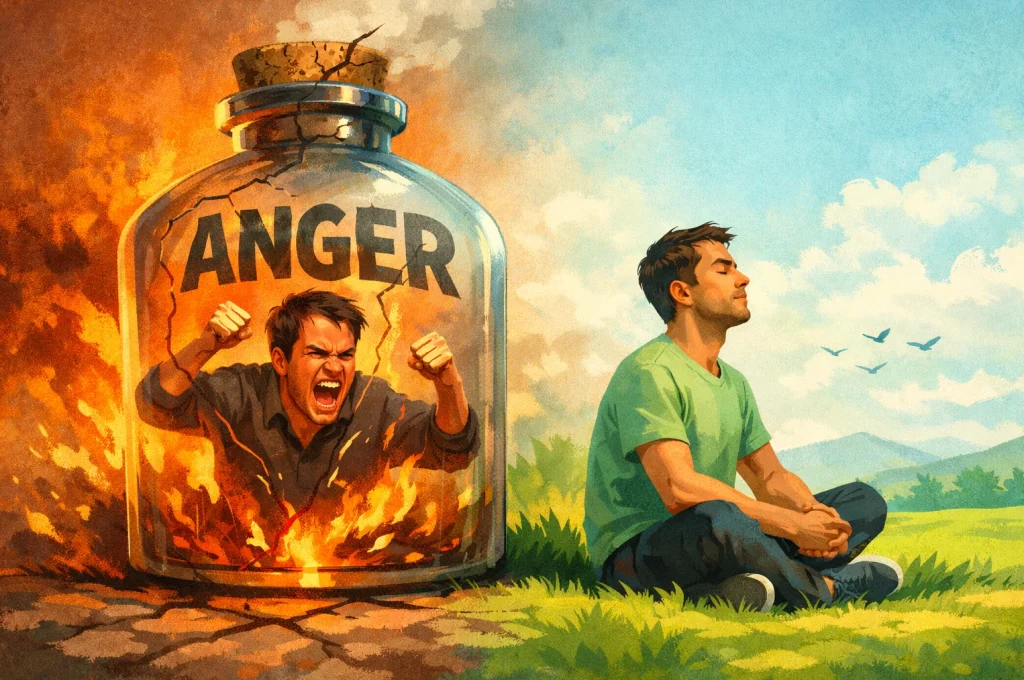
Table of contents:
When Anger Stops Being Just Anger
It is not the feeling itself that is the problem
Anger, on its own, is not some character defect. It is a human signal. Sometimes a boundary got crossed. Sometimes something felt unfair. Sometimes you are hungry, overbooked, embarrassed, underslept, quietly hurt, and your system grabs anger because it is quicker than saying, "Actually, that stung." The trouble starts when anger shows up too often, hits too hard, sticks around too long, or keeps costing you more than the original moment ever should have. So no, the issue is not that you feel angry. The issue is that anger keeps grabbing the steering wheel before the wiser part of you even gets a hand on it. That is when everyday frustration turns into a pattern, and patterns leave dents - in work, intimacy, trust, even your health.
The body usually floors it before the mind has a speech ready
One reason anger feels so convincing is that it starts in the body, not in some tidy little courtroom of logic. Your heart kicks up. Your shoulders tense. Breathing gets shallow. Heat rises. Vision narrows a bit. And then, almost instantly, your brain rushes in like an overconfident intern with a clipboard, building a case for why your reaction is absolutely justified, obviously, thank you very much. That order matters. A lot of people think they are calmly choosing anger. Usually... not really. The body has already hit the alarm button, and the mind is just trying to keep up. Miss that first surge, and the rest can feel inevitable when it actually is not.
It can be loud, sure, but it can also wear a nice sweater
When people hear "anger issues," they often picture shouting, threats, doors, broken plates - the full kitchen opera. That version exists, yes. But anger can also go cold and polished. Sarcasm. Eye-rolls. Little cutting jokes that somehow manage to be "just kidding" and still hit like a slap. Punishing silence. Icy politeness. Withholding warmth on purpose. Some people do not explode, they frost over the whole room instead. Others become so measured and calm that it feels more hostile than if they had just sworn and gotten it over with. Same fire, different outfit. So if you never raise your voice, that does not automatically mean anger is under control. Sometimes it has simply learned better manners.
The aftermath tells the truth pretty fast
A very useful clue is what happens afterward. Do you feel relief for thirty seconds, then regret? Do people get careful around you? Do you replay conversations in the shower and think, well, that was not exactly my finest hour. Do tiny incidents somehow turn into a three-hour emotional weather system complete with thunder? Anger issues usually leave a trail: strained talks, apologizing for your tone again, tension headaches, defensive spirals, awkward dinners, lost focus at work, that quiet fear that one more bad day and you might say something hard to unsay. When the damage keeps getting bigger than the trigger, it is no longer "just how I am." It is a growth problem. Annoying, yes. Fixable too.
What Changes When Anger Is No Longer Driving
Hard conversations stop turning into little disasters
Once anger is handled better, conflict gets a lot more useful and a lot less theatrical. You can stay with the actual issue instead of wandering off into tone wars, character attacks, or a dramatic side trip to something from eight months ago that nobody expected to see again. A disagreement about dishes can remain about dishes. Feedback from your manager can stay feedback, instead of becoming a private courtroom drama about respect, competence, and your entire life story. Calm is not weakness, by the way. It is accuracy. You hear more. You say what you mean more cleanly. People stop bracing before they speak. And in practice, this is part of how charisma actually works in a real person: people relax around steady energy. Safety is magnetic. Volatility, not so much.
People feel safer telling you the truth
This one sounds small until you notice how much it changes. If your reactions are sharp, unpredictable, or just a bit too intense, people start editing themselves around you. They soften feedback. They postpone hard talks. They hide irritation. Maybe your partner waits until you seem "in a good mood" before saying anything real. Maybe coworkers compare notes with each other first and only then approach you. Maybe your kids scan your face before asking a totally ordinary question. That is not closeness. That is emotional weather forecasting. But when anger loosens its grip, people stop tiptoeing. They trust that discomfort will not automatically become fallout. That is also where honesty starts paying you back, because people are far more open when they do not expect truth to trigger a blast radius. And that kind of safety - honestly - is gold. Better information, fewer weird silences, deeper relationships.
Your energy stops leaking into recovery mode
Anger is expensive. Socially, yes, but also physically. If you flare up a lot, you burn energy gearing up, reacting, replaying, justifying, crashing, then trying to patch things back together later. It is like paying emotional taxes all day for no especially good reason. In practical terms, this overlaps with what gets better when efficiency stops leaking out of your day: less time spent recovering from reactions, and more attention left for work, rest, and actual problem-solving. With better regulation, more of that fuel stays available for work, humor, sleep, patience, concentration, even enjoyment. Imagine not losing half an afternoon because somebody wrote a sloppy email and your body responded like war had been declared. Nice upgrade, frankly. Less cleanup. Less inner static. More room for an actual life.
You get choice back, and that feels a lot like dignity
This might be the deepest change of all. When anger is not running the controls, you do not become bland, passive, or weirdly saintly. You just get your options back. You can still be firm. Still say no. Still call nonsense what it is, because nonsense remains annoyingly abundant. But you do it without instantly dumping the whole situation on someone else, which is a big part of how to take responsibility for your actions when emotions are running hot. But now there is space between trigger and action. In that space, self-respect grows. You trust yourself more because you know a bad mood is not automatically about to become someone else's problem. There is something deeply grounding in being able to think, "I can be upset without becoming destructive." Very adult. Very solid. And, not to be dramatic, but it is easier to like yourself when your strongest emotions are no longer stomping around your relationships in muddy boots.
How This Pattern Starts Warping Daily Life
Your fuse gets shorter than the moment deserves
One of the clearest signs is simple disproportion. A delayed reply feels insulting. Someone chewing loudly feels like a moral failure. A harmless suggestion lands like criticism. The dog barks, the Wi-Fi dies, the milk spills, and suddenly it feels as if the universe held a secret meeting and chose you for special irritation. From the inside, it can feel righteous - almost noble. From the outside, it often looks baffling. This is why everyday life starts feeling tense around chronic anger. The trigger may be tiny. The charge behind it is not. And if it happens a lot, people around you begin living in anticipation of your next flare-up. That is hard on them... and, really, not exactly restful for you either.
Your version of the story gets very certain, very fast
Anger loves instant meaning. "They disrespected me." "She did that on purpose." "He never listens." "Nobody hears me unless I make it loud." In the moment, those thoughts do not feel like interpretations. They feel like facts carved into stone tablets. The problem is, anger narrows perception. That is almost the opposite of how to train strategic thinking in real life, where you slow interpretation down long enough to notice alternatives, missing context, and consequences before reacting. It grabs certain details, drops context, and turns ambiguity into accusation at record speed. So you are not just reacting to what happened. You are reacting to your immediate story about what happened. That is why angry people often sound so sure - and then later, when the body calms down, quietly admit, "Okay... maybe I read that wrong." The threatened mind is not famous for nuance. It wants a villain, and it would like one immediately.
The behavior starts deciding before you do
Then the habits settle in. Interrupting. Raising your voice. Hitting send too fast. Driving like every other person on the road has made it their personal mission to ruin your day. Pacing the kitchen. Slamming drawers. Dragging old grievances into new arguments because, well, if we are here already, why not light up the whole attic. That is how anger becomes a shortcut. Your system learns that intensity creates release, control, distance, leverage. So it keeps reaching for intensity. And the sneaky part? It can start to feel efficient. "At least people listen when I get mad." Maybe they do. But they also withdraw, resent you, edit themselves, avoid you - and remember.
The crash afterward can hurt almost as much as the blow-up
People talk a lot about the eruption and much less about the comedown, but the comedown matters. After the heat there is often guilt, embarrassment, exhaustion, and that odd emotional hangover where even your own skin feels tired. Some people cry. Some go numb. Some become instantly defensive because shame is already tapping at the window. Others retreat to another room and tell themselves everyone else is too sensitive, which, well, usually does not help much. Over time the cycle gets bleak: anger, damage, regret, promise to do better, then the next trigger shows up and there you are again. One bad moment is one thing. The painful part is realizing the pattern has become familiar. Familiar patterns shape whole lives, if you let them.
Ways to Loosen Anger's Grip Without Pretending You're Zen
Start with a trigger map, not a personality label
Skip the big dramatic identity statements for now. You do not need to declare, "I am an angry person," like you are narrating a gritty indie film. Much more useful: map the pattern. For a week, after each flare-up - or almost flare-up - jot down four things. What happened. What you told yourself it meant. What your body did. What you wanted in that moment. You will probably notice repeats pretty quickly. Maybe disrespect is your hot button. Maybe feeling controlled. Maybe being interrupted. Maybe noise when you are already fried. If the pattern gets worse when you are rushed, late, or always trying to catch up, it may help to learn how to get better at punctuality without turning into a clock zealot, because a nervous system that feels behind schedule is much quicker to snap. A trigger map turns vague shame into usable information. And information is kinder than self-condemnation, while also being a lot more practical. It helps you catch the pattern earlier, which is where change actually becomes possible.
Calm the body before trying to win the argument
Anger management is not mainly a lecture problem. It is a nervous-system problem first. So use a body move simple enough to remember when you are heated. Unclench your hands. Drop your shoulders. Let your tongue fall away from the roof of your mouth. Exhale longer than you inhale for five rounds. Plant both feet on the floor. If you can, splash cool water on your face or step outside for ninety seconds and look at something far away - a tree, a roofline, a boring parked car, whatever. Sounds too basic to matter, I know. Still works. The goal is not instant enlightenment. Come on. The goal is to lower the internal temperature enough that your words stop arriving with teeth on them.
Put a gate between anger and action
Most of the damage happens in the first impulsive move. The text. The comeback. The sarcastic little dagger you almost admire for being clever. So build some friction right there. Make one rule: when you are above a seven out of ten, you do not send, post, decide, or keep arguing in real time. You say one clean sentence instead: "I'm too activated to talk well. I need twenty minutes. I will come back." That last part matters more than people think. Leaving without return feels punishing. Leaving with a clear return time feels regulated. If your anger tends to spill through your phone, physically move the phone away from your body during conflict. Primitive? Maybe a little. Effective? Also yes.
Practice repair while the problem is still small
Even with better tools, you will still get it wrong sometimes. Humans are terribly inconvenient that way. So learn repair early, and keep it plain. Not a grand speech. Not "I'm sorry you felt that way," which is basically an apology wearing fake glasses. Try something more real: what I did, how it probably landed, what I should have done instead, what I will do next time. Short. Specific. Then look under the outburst too. Was it poor sleep? Too much alcohol? Overcommitment? Feeling cornered? Resentment you never voiced? Anger often rides on top of neglected stuff. Work there as well. Otherwise you are mopping the floor while the tap is still running, and that gets old fast.
Should This Be Your Main Growth Focus Right Now?
Maybe. Maybe not. Not everybody needs to start with anger. Some people are actually running on empty and need sleep, boundaries, grief support, less overload, or treatment for anxiety that keeps their whole system humming like a faulty fridge. If anger is mostly smoke from something deeper, that deeper thing deserves attention too.
It helps to be blunt with yourself, in a kind way. Are your reactions straining trust, wrecking conversations, or leaving you with regular regret afterward? Then yes, this probably deserves a front-row seat in your growth work. If your bigger struggle is emotional numbness, chronic exhaustion, or depression, start there - or at least work on both together. Otherwise you end up wrestling with the alarm instead of the actual fire.
If you want a clearer read on that, AI Coach can help you sort out what needs attention first and give you a simple plan for the next three days. Sometimes that kind of structure is more useful than making one more private promise to "just stay calmer next time."
Frequently Asked Questions (FAQ)
How do I know whether I have anger issues or I just get angry sometimes?
Look at four things: how often it happens, how intense it gets, how long it lasts, and what kind of mess it leaves behind. Normal anger fits the situation and settles. Anger issues tend to be bigger than the moment, harder to bring down, and more likely to leave relational wreckage in their wake. If people around you brace, if you regret your tone a lot, or if small triggers keep turning into major reactions, that is a pretty solid clue.
Why do tiny things set me off when I'm already stressed?
Because the tiny thing is usually just the spark. The real fuel was already there. When your system is under-slept, anxious, overstimulated, overloaded, or carrying around unspoken resentment like a heavy backpack, even small annoyances land harder. On a decent day, a misplaced comment feels manageable. On a brutal day, the same comment can feel outrageous. Same spark, different pile of dry wood.
Can anger issues show up without yelling?
Absolutely. Some people go loud. Others go cold. Sarcasm, contempt, hostile texting, punishing silence, glaring, slamming things, icy politeness, passive-aggressive behavior, little jokes with a blade hidden inside - all of that can be anger in disguise. Volume is not the only measure. The social damage matters too.
Why am I usually angrier with the people I love most?
Because closeness lowers the mask. With strangers, many people stay contained because the stakes are public. At home, history, old hurts, expectations, fatigue, and attachment all get tangled together. Loved ones matter more, so disappointment cuts deeper. That does not excuse harmful behavior, obviously. But it does explain why anger often spills out where attachment is strongest.
What should I do in the middle of an argument when I feel myself boiling over?
Go body first. Drop your shoulders. Unclench your jaw and hands. Lengthen your exhale. If needed, step away briefly. Then use one plain sentence: "I'm too activated to talk well. I need twenty minutes and I will come back." The key is not disappearing into a fog of silence. It is pausing before you say the thing that becomes tomorrow's regret.
Is it healthy to vent anger by hitting a pillow, screaming in the car, or breaking things?
Usually that creates short-term relief but teaches your system that intensity is the exit route. For some people, it actually keeps the body revved up. Safer, more useful outlets are movement, cooling the body, writing the unfiltered version privately, or talking once you are below full emotional boil. The goal is not to rehearse rage like it is a talent show. The goal is to regulate it.
Can anger be connected to anxiety, shame, or hurt?
Very often, yes. Anger is sometimes the top layer because it feels stronger and less exposed than fear, sadness, humiliation, or helplessness. A person may say, "I'm furious," when the deeper truth is more like, "I feel dismissed," or "I feel scared and out of control." Naming that deeper layer can soften the reaction without turning you into a doormat.
Why do I feel guilty right after I blow up, even if I was technically right?
Because being factually right and behaving well are not the same thing. A lot of anger regret comes from the gap between your point and your delivery. You may still believe the issue mattered, while also knowing your reaction was sharper, bigger, or crueler than it needed to be. That guilt can be useful, if it pushes you toward repair and change instead of defensiveness.
How long should I wait before coming back to a conversation?
Long enough for your body to settle, short enough that the other person does not feel abandoned. For many people that is somewhere around twenty to forty minutes, though sometimes longer is needed if the activation is strong. The important part is agreeing on the return, not storming off into mystery. If you say you will come back at 7:30, come back at 7:30. Boring advice, but really important.
When is this serious enough that I should get extra help?
If anger is leading to threats, intimidation, physical aggression, damage to property, frightening your kids, harming your relationship, hurting your work life, or making you feel genuinely out of control, treat it as urgent. Same goes if the anger feels constant, or if it flips on so fast you barely recognize yourself in it. At that point, this is not just a bad habit or "a rough patch." It is a pattern asking for real support.