
You know that oddly exhausting state where, objectively, nothing catastrophic is happening... and yet your mind is behaving like someone just pulled the fire alarm? One text sits unanswered. One decision stays open a little too long. One mildly awkward thing you said on Tuesday wanders back in at 11:48 p.m. and suddenly your brain has convened a full emergency committee. With subcommittees.
That is what anxiety and overthinking often look like in real life. Not melodrama. Not weakness. Just a nervous system that keeps gnawing on uncertainty long after there is anything useful left to chew. If your days seem mostly fine from the outside, but inside it feels crowded, buzzy, expensive somehow - this may be the knot worth tugging on first.
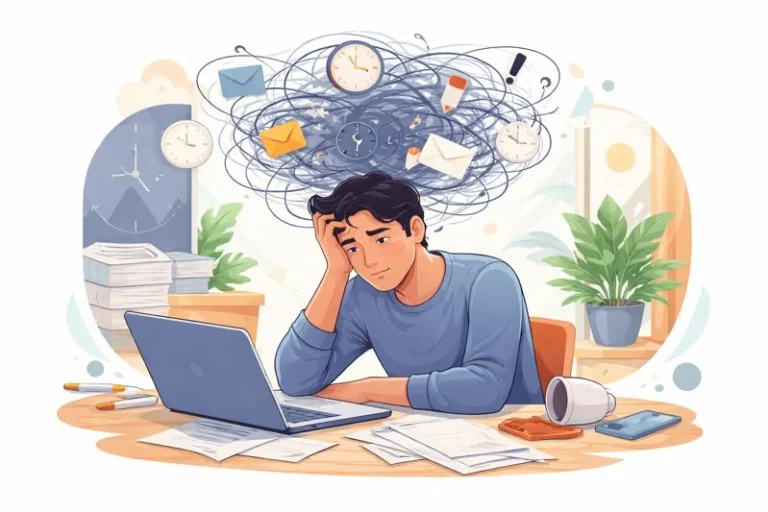
Table of contents:
When Your Mind Treats Every Maybe Like an Emergency
It is not the same as being thoughtful
A lot of smart people, genuinely smart people, mix up overthinking with depth. Fair enough. From the inside it can feel responsible, careful, even grown-up. "I'm just being thorough." Sometimes you are, sure. But healthy thinking usually moves somewhere. It heads toward clarity, or at least a decision. Anxiety-driven thinking just keeps doing laps in the same tiny pool. You do not come out wiser. You come out tired and a bit crispy round the edges.
Anxiety is the part of you that scans for danger. Overthinking is one of its favorite little side projects. Put them together and you get a very annoying loop: you feel uneasy, so you think more to try to feel safer, but all that extra thinking keeps the sense of threat alive, so your body stays uneasy. Brilliant system, really. Terrible for peace and quiet.
The brain starts rehearsing futures that have not happened
This often shows up as mental rehearsal. You pre-live conversations. You draft replies in the shower. You imagine the meeting going badly, then imagine how you will explain the bad meeting, then imagine what people will think about your explanation. It is like your brain keeps making tiny disaster trailers and insisting, with great confidence, that you watch every single one.
Sometimes the feared outcome is big, obviously. Losing the job. Wrecking the relationship. Being judged in some lasting way. But often? It is absurdly small and still weirdly sticky: sounding foolish on a call, choosing the wrong dentist, ordering the wrong thing, sending an email that lands a bit sideways. Anxiety does not always need a tiger. It can do a lot with a typo and a raised eyebrow.
The body joins in, whether you invited it or not
People talk about anxiety as if it lives only in thoughts. Not really. It lives in the body too. Tight chest. Shallow breathing. Jumpy shoulders. A stomach that, out of nowhere, has strong opinions. Trouble settling at night even when the day is very obviously over. That physical piece matters, because once the body feels on edge, the mind starts hunting for an explanation. And it usually finds one. Or twelve. It also helps to understand what emotionality actually means, because intense feelings are real body signals, not always reliable proof that something terrible is happening, and that distinction alone can take the panic down a notch.
This is why overthinking feels so convincing. Your body is sounding an alarm, so the brain assumes there must be danger nearby. It starts searching, predicting, explaining, connecting dots that maybe are not dots at all. You mistake activation for accuracy. Ever done that? Yes. A lot of us have.
It often hides inside "reasonable" habits
This is the sneaky bit. Anxiety and overthinking do not always look chaotic. Sometimes they look tidy. Responsible, even. Re-reading the message five times. Checking the calendar again. Googling symptoms again. Asking three friends if your reply sounded rude. Waiting to decide until you feel one hundred percent sure - which, awkwardly, never arrives.
Those habits can feel sensible in the moment, but they quietly teach your brain that uncertainty is dangerous and has to be fixed right now. And that makes the whole cycle stronger. So the issue is not just some vague "I think too much" problem. It is more specific, more annoying, more changeable too: your mind has learned to treat discomfort like something that must be mentally controlled. Over time, that can make life feel much smaller than it actually is.
What Starts Opening Up When the Spiral Loosens It can also spill into everyday reliability in ways people underestimate. If you keep checking, rechecking, hesitating, and mentally rehearsing before you leave, when punctuality is weak, the cost is bigger than it looks, because what seems like "just being a few minutes late" is often a sign that anxiety has started running the timetable.
Decisions stop eating half your day
One of the first changes is gloriously unglamorous: ordinary decisions become ordinary again. You pick the thing, send the text, book the appointment, choose the plan, and move on with your actual life. Not because you suddenly turn reckless. Just because you stop demanding impossible certainty before doing basic human tasks. Which is, honestly, a relief.
It saves more energy than people expect. Anxiety turns tiny choices into full-blown internal productions. Lighting, costumes, courtroom drama. When that eases, your attention comes back online. You are not burning an entire afternoon comparing ten versions of the same harmless option as if Congress will review your findings.
You get more of your actual life back
Overthinking is greedy. It steals moments that should belong to living. You are at dinner with your partner, but half your mind is replaying a meeting. You go for a walk, but internally you are arguing with someone who is not even there. It is Sunday afternoon and instead of resting, you are conducting a private audit of your future. Very efficient way to be exhausted. Not a great hobby, though.
When the spiral loosens, presence gets easier. You notice what is in front of you. Food tastes like food again. Conversations feel less foggy. Even rest becomes more real, which matters a lot if you have accidentally been calling "lying down while mentally sprinting" recovery. A lot of people do, no shame.
Your relationships get lighter
Anxiety rarely stays neatly contained. It leaks. You might ask for reassurance more often than you mean to. You might read a lot into a delayed reply. You might sound irritable when what you really are is flooded and tired and running out of bandwidth. Or maybe you do the opposite - keep everything inside, look calm, and quietly run a six-hour trial in your own head. Neither version feels wonderful. And if your mind keeps circling not only around fear, but around old slights, unfair moments, or things you still have not quite let go of, it may help to look at ways to work through resentment, because some mental loops are less about future danger and more about past hurt that never really settled.
As anxiety softens, other people stop having to absorb so much of the fallout. You ask clearer questions. You react less dramatically to ambiguity. You become less likely to assume distance, criticism, or rejection when the evidence is paper-thin. That makes closeness easier. So does a steadier kind of confidence, the kind that does not need constant proof just to get through a Tuesday.
Self-trust grows in a more adult way
This may be the biggest shift of all. When anxiety is in charge, you start feeling as if you cannot trust yourself unless everything is checked, explained, predicted, and emotionally approved in advance. That is such a shaky way to live. It makes the world feel sharp, and you feel flimsy in comparison. Part of the repair is learning how healthy pride changes your life: not vanity, not puffed-up nonsense, just a steadier respect for yourself that does not collapse the second something feels awkward or uncertain.
As you get better at acting with uncertainty still in the room, self-trust changes shape. You stop saying, "I can cope only if nothing goes wrong." You start sensing, "Even if this is messy, unclear, or mildly embarrassing, I can handle it." That is a very different feeling. Warmer. Stronger. And, wow, what a relief to stop treating every unknown like a personal insult from the universe.
How This Pattern Quietly Shrinks a Life
Small choices become sticky and weirdly heavy
When anxiety and overthinking get strong, daily life starts taking way too much effort. You can spend fifteen minutes rewriting a short text. You delay buying the ticket because what if the date is wrong. You research a simple purchase until the whole thing becomes faintly ridiculous. The task is rarely the real problem. It is the mental weight attached to getting it wrong.
That constant friction adds up. By evening, you are tired without anything dramatic having happened. Just ordinary life - made mentally overpriced.
Your nights become a bad time for philosophy
If you know, you know. The body is finally still, the room is dark, no one is asking anything from you, and suddenly your mind decides it is the ideal time to review every unresolved thread since 2009. Sleep gets delayed not only by screens or caffeine, but by unfinished mental loops that keep demanding one more pass, one more theory, one more ridiculous little internal hearing.
The maddening part is that night-thinking feels urgent and profound. At 1:17 a.m., everything seems loaded with meaning. By daylight, half of it looks flimsy. But once your brain has learned to solve discomfort by thinking harder, bedtime can turn into a private courtroom with terrible lighting. Not fun. Not remotely restful.
You start avoiding things that might stir the feeling
This is where anxiety gets especially sly. It does not always shove you into obvious panic. Sometimes it nudges you into a smaller life. You put off the conversation. You stay in the familiar role. You do not apply, ask, post, travel, speak up, or choose because every move wakes up too much inner noise. Avoidance brings relief, so the brain goes, "Excellent. More of that."
Over time this can look like low ambition, low confidence, even laziness from the outside. But often the real issue is fear of the internal aftermath. Not the event itself - the spiral after it. That is why it can help to look at what happens when ambition is missing or suppressed, because sometimes the problem is not lack of drive at all. It is a nervous system that has learned to treat action as emotionally expensive. Sometimes that same pattern is also tied to how fear of change shows up in real life, because the mind would rather stay stuck in familiar discomfort than risk the uncertainty that comes with doing something differently.
Self-criticism pours petrol on the whole mess
Then there is the second layer, which is just rude: shame about being anxious in the first place. You call yourself dramatic, weak, ridiculous, too sensitive. You get mad that other people seem able to decide, sleep, relax, and move on so much faster. That harshness does not calm the nervous system. It makes the whole system feel even less safe. If that voice sounds familiar, these inner critic traits and telltale patterns are often woven into anxiety more tightly than people realize, and spotting them can loosen some of the shame that keeps the cycle humming.
There is also a strange loneliness in this pattern. You can look functional, productive, pleasant enough, while inside you are constantly negotiating with your own mind. If that has been normal for a while, you may have forgotten how much space it takes up. That is one reason this matters. Not only because calm makes you nicer and more efficient - though, yes, sometimes it does. But because your inner life should not feel like a room where the smoke alarm is always quietly chirping in the background. You deserve better acoustics than that.
Ways to Loosen the Loop Without Pretending to Be Zen
Name the story your mind is selling
When the spiral starts, try giving it a blunt title. "The everyone-thinks-I'm-incompetent story." "The I-ruined-it story." "The if-I-choose-wrong-everything-collapses story." A little dry? Maybe. But useful. Naming the pattern creates a sliver of distance. You are no longer fully swallowed by the thought. You are noticing it happen, which is different.
That tiny shift matters more than it looks. Anxiety loves vagueness. The moment you label the script, it becomes less mystical and more... familiar. Still annoying. Still dramatic. But ordinary enough that you do not have to obey it on sight.
Separate facts from forecasts
Take a sheet of paper and write three short lines: what I know, what I am predicting, and what I need to do next. Keep it brutally simple. "I know she has not replied in four hours. I am predicting she is upset with me. My next move is to wait until tomorrow and not invent a breakup from one silence." You get the idea.
This helps because overthinking blends evidence and imagination into one sticky lump. Pull them apart, and your brain stops treating guesses like hard data. It is also one practical way of becoming more open-minded without becoming gullible, because you start holding more than one possible explanation instead of automatically marrying the scariest one. If you want to take that further, these 7 ways to enhance strategic thinking skills can help you shift from spiraling over possibilities to evaluating them more calmly, which makes decisions feel less like emotional roulette and more like something you can actually handle. And if your thoughts get tangled around standards and getting things exactly right, this is also where loosening perfectionism can quietly help. A lot, actually.
Give worry a container, not the whole house
Set aside a short daily slot for worry. Ten or fifteen minutes will do. During the day, when the loop starts up, tell yourself, "Not now. Tonight at 6:30." Then, at worry time, write the concern out quickly and ask just one question: is there an action here, or not?
If yes, choose one next step. If not, let the page hold it for a while. Strange little practice, I know. But it teaches your mind that worry does not get unlimited access to the calendar, the kitchen, your shower, your lunch break, and the five minutes right before sleep. Boundaries. Even your anxious thoughts need them.
Cut reassurance and checking by one notch
You do not need to become some serene mountain person by Friday. Just reduce the habit slightly. If you normally reread the email six times, try four. If you text a friend for reassurance immediately, wait twenty minutes first. If you google symptoms every night, skip one search and sit with the discomfort a little.
Not forever. Just enough to show your brain that uncertainty can be survived without ritual. This is exposure, really, just wearing very ordinary clothes. Boring. Effective. Kind of annoying, yes, but effective.
Calm the body before arguing with the mind
When your whole system is revved up, logic alone can feel like trying to fold laundry in a wind tunnel. Start with the body. Lengthen the exhale. Drop your shoulders. Press your feet into the floor. Look around and name a few neutral things you can see: mug, lamp, window, sock on chair, whatever is there. The point is to tell the nervous system, here, now, in this room, I am not under immediate attack.
Then do one concrete thing in the real world. Wash the cup. Send the short reply. Step outside. Open the form and fill in the first line. Anxiety hates grounded movement because grounded movement keeps life moving while certainty is still incomplete. And that, with practice, is exactly the lesson: you do not have to feel fully safe to take one sane next step.
Should This Be Your Main Focus Right Now?
Maybe. Maybe not. Not every restless mind needs the same answer. If your life is genuinely unstable right now - grief, unsafe relationships, financial shock, serious burnout, medical trouble - then constant worry may be less a personal flaw and more a nervous system reacting to real strain. In that season, safety, rest, support, and structure may need to come first. No point yelling "calm down" at a system that is carrying bricks.
It helps to choose your growth focus carefully. Otherwise you end up trying to work on calm, discipline, confidence, sleep, boundaries, and your inbox all at once, which is a fantastic way to achieve one tired eyebrow twitch and not much else. If the real pattern is mental spiraling, reassurance-seeking, and life getting smaller around uncertainty, then yes, this probably deserves real attention.
If you want a clearer read on where to start, AI Coach can help you sort your priorities and give you a simple three-day starting plan. Sometimes that is far more useful than spending another month asking yourself what the real problem is while, well... overthinking it.
Frequently Asked Questions (FAQ)
Is overthinking basically the same thing as anxiety?
Not exactly, but they are very close roommates. Anxiety is the alarm state - the feeling that something might go wrong and you need to prepare. Overthinking is one of the main ways the mind tries to manage that alarm. You can overthink without full-blown anxiety, sure. But when the two start feeding each other, life gets a lot louder than it needs to be.
Why does my brain get louder at night?
Because nighttime removes distractions, unfinished worries drift back up, and a tired brain is worse at perspective. Also, if you have trained yourself to deal with discomfort by thinking harder, bedtime becomes prime overthinking territory. That is why basic boundaries help more than people expect: lower input, a place to park worries on paper, and less treating midnight thoughts like sacred truth.
What can I do in the moment when my thoughts start spiraling?
Keep it small. Name the story. Separate facts from predictions. Calm the body a little. Then do one real-world action. Just one. Not ten, not a dramatic life overhaul, not a complete personality renovation before dinner. Anxiety gets stronger when you stay trapped in your head. It loosens a bit when attention returns to the room, the body, and the next concrete step.
Why does reassurance help for five minutes and then stop working?
Because reassurance soothes the feeling briefly without teaching your brain how to tolerate uncertainty. So the nervous system learns, "Ah, I need outside proof again." Then the doubt comes back, often wearing a slightly different hat. That is why reducing reassurance by one notch matters. The goal is not to become cold or stubborn. It is to stop outsourcing all your safety to other people's replies.
Why do I replay conversations for hours afterward?
Usually because your brain is scanning for social danger: Did I sound rude? Weird? Needy? Dumb? Humans are wired to care about belonging, so post-conversation replay is common. Anxiety just turns the volume up until it sounds like a full investigation. Most of the time, what feels like a forensic social review is simply a nervous system trying too hard to keep you acceptable.
How do I tell the difference between intuition and anxiety?
Intuition is usually quieter and cleaner. It often shows up as a simple sense: this feels off, this is not for me, slow down here. Anxiety is noisier. It floods you with urgency, repetition, branching scenarios, all the extra fireworks. Intuition tends to clarify. Anxiety tends to multiply. Not a perfect rule, no - but a useful one. If the message gets more frantic the longer you think, anxiety is probably driving the car.
Can caffeine and poor sleep make overthinking worse?
Yes, very often. Caffeine can amplify physical alertness, and a revved-up body gives the mind more material to interpret as danger. Poor sleep does the rest: weaker emotional regulation, more reactivity, less perspective, more drama from very little evidence. It does not mean coffee is evil or one rough night ruins you. It just means the mind is a lot less wise when the nervous system is under-rested and over-caffeinated.
Is overthinking connected to perfectionism?
All the time. If your mind believes mistakes are costly, embarrassing, or somehow revealing of your worth, it will keep trying to think its way to the flawless move. That is how simple tasks turn into mental marathons. Perfectionism adds pressure; anxiety adds urgency. Together they can make action feel oddly dangerous. Not fixed forever, though. Very changeable once you actually spot the pattern.
Can anxiety make my body feel unwell even if medical tests are fine?
Yes. Anxiety can show up as nausea, muscle tension, dizziness, chest tightness, shaky hands, digestive trouble, a racing heart - all sorts of things. The body is not pretending. It is activated. What matters is not mocking the sensation or worshipping it, but learning to notice it, regulate it, and respond without instantly turning every feeling into proof of catastrophe.
How do I know whether this is just a rough patch or a pattern I should work on?
Look at repetition and cost. If worry and overthinking keep stealing sleep, delaying decisions, shrinking your world, straining relationships, or making ordinary days feel mentally overpriced, then yes, it is a pattern worth working on. If it spikes around one hard season and eases as life stabilizes, it may be more situational. Either way, the question is pretty simple: is this helping you live - or mostly helping you brace?