
Cynicism is what happens when disappointment stops being a thing that happened and turns into the way you look at everything. You stop asking, "What's actually true here?" and slide into, "Mm-hm, sure, I've seen this movie before." The trouble is, that stance can feel clever almost sophisticated while it quietly leaches the color out of work, relationships, ambition, the whole messy business of being alive.
If you tend to assume hidden motives, roll your eyes before someone even lands their point, or treat hope like something only amateurs can afford, this may hit a little close. And when cynicism starts to loosen, life usually does not become sugary or gullible. It just gets more open. More accurate, oddly enough. And a lot less heavy in the chest.
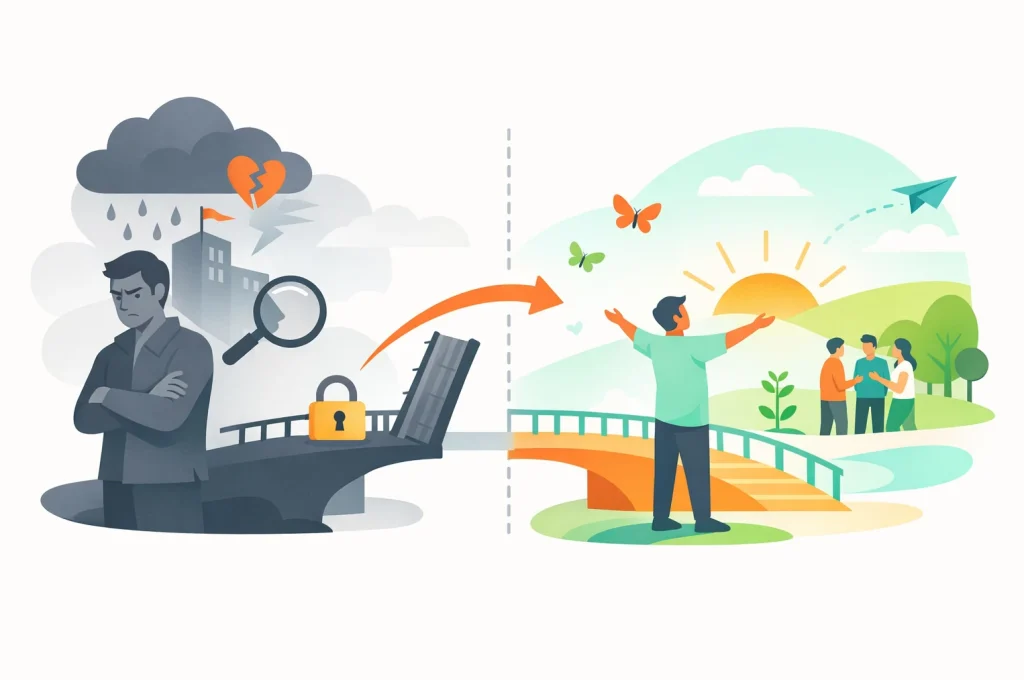
Table of contents:
When Cynicism Stops Being a Mood and Becomes a Habit
It is not the same thing as healthy skepticism
Skepticism asks for evidence. Cynicism kind of can't be bothered it skips the checking part and jumps straight to the verdict. A skeptical person says, "Let's see what's really going on." A cynical person says, "Please. I already know. Someone wants something, and it's probably shady." That difference matters. One keeps your mind awake. The other locks the door and pockets the key. That first posture is much closer to what curiosity is and how it shows up, because real openness asks a few annoying but useful questions before it settles on a conclusion.
And this is why cynicism is sneaky. It often sounds smart. Dry, sharp, worldly. It can put on a little blazer and call itself realism. But realism leaves room for good outcomes, bad outcomes, and the far more common middle bit where humans are confused and inconsistent. Cynicism leans hard in one direction. It gives extra weight to manipulation, selfishness, disappointment, and letdowns before the facts have even put their shoes on.
It often begins as protection
Most cynical people did not just wake up one Tuesday and decide to become the human version of a weary group chat. Usually something came first. Betrayal. Office nonsense on repeat. Big speeches, tiny follow-through. A family where warmth was treated like weakness and trust was for suckers. Enough of that, and the mind starts drafting rules: expect less, trust less, need less. Safer. Or at least it feels safer.
And, honestly, there is logic in it. If you expect the worst, then when the worst shows up your nervous system gets to mutter, "Called it." Less shock. Less sting. But that strategy does not only block pain. It blocks closeness too. Cooperation. Surprise. Gratitude. Momentum. Protective habits are like that they rarely know when to stop guarding the door, even when the house is empty and the party's already outside.
How it shows up in everyday behavior
Cynicism lives in little reactions, not just grand speeches. Your manager starts talking about "new opportunities," and your brain is already translating that into layoffs and corporate confetti. A friend takes a while to reply, and you instantly read it as indifference. Someone is kind, and part of you narrows its eyes like, alright then, what's the angle? Psychologists sometimes connect this to hostile attribution bias a clunky phrase, yes, but a useful one which basically means you assign darker motives faster than the situation really earns.
It also leaks into language. Sarcasm as the default setting. Compliments with a tiny blade tucked inside. A habit of treating enthusiasm like it's embarrassing, like someone showed up to dinner wearing a cape. You may even hear yourself do it after the words are already out, which is... a delight, obviously.
Why it sticks so hard
Cynicism survives because it pays out in the short term. It makes you feel prepared. Sharp. Harder to fool. Sometimes a bit superior too, if we're being honest. And when people do disappoint you, your brain gets to sit back with folded arms and go, "Exactly." That smug little reward is not free, though. It turns a handful of accurate observations into a full-blown worldview.
Over time, cynicism can start wearing your name tag. "I'm just not naive." "I've seen too much." "People are people." Maybe. Sure. But if those lines keep you armored all the time, then the issue is not wisdom anymore. It's habit. And habits, even the ones that sound clever at dinner, can be unlearned.
What Opens Up When Cynicism Relaxes Its Grip
People feel less exhausting
One of the first changes is relational, and it's almost embarrassingly practical. When you are not scanning every interaction for hypocrisy, manipulation, or some hidden agenda tucked under the table, people become easier to be around. Not because everyone suddenly turns into a saint they will absolutely not but because you stop spending so much energy bracing. A delayed reply can just be a delayed reply. A compliment can land without a private interrogation. A clumsy comment does not have to become a thesis on the decline of humanity.
That softening makes room for better conversations. Less testing, less pre-emptive distance, less invisible courtroom drama in your head. More actual contact. Which, frankly, is a nicer way to live. A bit quieter inside, too.
Your effort starts making sense again
Cynicism tells you that trying is for people who still believe the brochure. So goals go flat. Why pitch the idea, ask for the raise, invest in the relationship, care about the neighborhood, join the project? It'll all turn into politics, disappointment, spin, or some beige little version of failure anyway. That story kills momentum fast. It also gets in the way of what changes when you become more goal-oriented, because effort only starts to feel worth it when you stop assuming every attempt is doomed before it leaves the driveway.
When cynicism eases, action starts feeling rational again. Not guaranteed just rational. You can take a step without demanding a signed promise from the universe. You can work on something because it matters, not because success is certain. That is a huge shift, bigger than it sounds. A person does not need blind optimism to move. They just need to stop treating futility like the default wallpaper.
Your judgment gets cleaner, not softer
This part catches people off guard. Letting go of cynicism does not make you worse at reading situations. In a lot of cases, it makes you better. Why? Because you stop forcing everything through the same gloomy template. You can tell the difference between one flaky person and a real pattern. Between a weak idea and an evil motive. Between caution and contempt. Those are not tiny distinctions. They change decisions.
That kind of judgment is more useful than either gullibility or constant suspicion. Clean judgment sees what's there. Cynicism often sees what confirms its mood. Big difference. And you usually feel it pretty quickly less noise, less projection, more reality.
You get some emotional bandwidth back
Being cynical is tiring in a sneaky, low-voltage way. It keeps this faint electrical hum going in the background: annoyance, guardedness, contempt, the little private eye-roll every fifteen minutes. Once that quiet hostility drops, even a notch, there is more room for curiosity, humor, patience, interest. Not fireworks. More like opening a window in a stuffy room.
And yes, hope comes back too but the grown-up kind, not the glittery motivational-poster kind. The kind that says, "Some things are still worth showing up for, even if the outcome is mixed and imperfect and mildly inconvenient." That kind of hope has bones. It does not need to be loud to change a life.
What Cynicism Does When It Starts Running Too Much of Your Life
You assume bad faith too fast
When cynicism gets strong, your mind stops leaving much room for neutral explanations. The coworker is not disorganized, they are playing games. The friend is not distracted, they are self-absorbed. The partner is not clumsy with words, they are secretly careless. Sometimes those readings are right. Of course. But very often they are not. And if you keep reaching for the darkest interpretation first, you create strain that didn't need to exist. This is one of those places where where ethics actually lives becomes practical, because fair judgment means not assigning motives you cannot honestly verify.
That habit can damage trust before anything concrete has even happened. People feel accused by tone long before they argue with the actual words. You know that tight little feeling in a conversation, where everything suddenly sounds like cross-examination? Yeah. That.
Good advice bounces off you
Cynicism makes people hard to help. Not because they are foolish usually quite the opposite. They can dismantle every suggestion in seconds. Therapy? Trendy nonsense. Team-building? Corporate theatre. Gratitude journal? Please, be serious. New relationship? That'll age badly. It can all sound very witty, very defended, very... bulletproof.
The problem becomes obvious once you see it. If every tool looks fake, shallow, compromised, or doomed, then nothing gets a fair try. You do not protect yourself from disappointment that way. You just sentence yourself to the same loop, with better one-liners.
Connection dries out from the inside
Cynicism is rough on intimacy. People generally do not open up around someone who meets tenderness with irony, hope with mockery, or mistakes with instant character analysis. Even if you are not openly harsh, others can feel the recoil. The little flinch. They start editing themselves around you. Safer topics. Less sincerity. Polite distance. Surface-level weather chat. Lovely.
Then the cynical person often reads that distance as proof. "See? People are shallow." Maybe, sometimes. Or maybe they learned not to bring anything soft into a room that treats softness like target practice.
The future gets smaller
Too much cynicism can make growth feel faintly ridiculous. Why improve the skill if promotions are just politics? Why date if everyone is selfish? Why care about your community if people only act decent when there is a reward attached? This is the point where cynicism stops being a style and starts becoming a cage. Left alone, it can begin to resemble what low ambition quietly does to a life, where smaller expectations slowly turn into smaller choices, and then into a smaller future.
It can also overlap with burnout, chronic stress, and low mood. When a person is worn thin, cynicism can feel like the cheapest form of self-protection on the shelf: cheaper than hope, less exposing than caring. But a worldview built only to avoid hurt will, eventually, starve the parts of you that still want meaning, trust, movement. Quietly, yes. Thoroughly too. That is also why it helps to understand how to build emotional regulation without turning into a robot, because when your inner state is less reactive, it becomes easier to read people more fairly instead of treating disappointment as proof that everything is broken.
How to Loosen Cynicism Without Becoming Naive
Catch the private line you keep repeating
Cynicism usually runs on a little stash of repeat sentences. "People only help when they want credit." "Nothing really changes." "Kindness is strategy in a nicer outfit." Start there. For a week, notice the line that pops up when you feel yourself harden. Write it down exactly as it appears, even if it looks dramatic or slightly ridiculous on paper. Especially then.
You are not doing this to shame yourself. You are trying to hear the script clearly. Most habits lose a bit of power the moment they stop operating like background software and step out into daylight.
Split pattern from prophecy
Here's a very handy move: when you catch a cynical thought, ask yourself, "Is this a pattern I've seen, or a prediction I'm making?" Those are not the same thing. "My last boss overpromised" is a pattern from the past. "Every leader is lying" is a prophecy dressed up as certainty.
That tiny distinction matters more than it looks. It lets you keep your intelligence without handing it a megaphone and a trench coat. You can learn from experience without turning every old bruise into a universal law. That's the trick, really.
Give yourself more than one motive story
When someone annoys or disappoints you, make your brain come up with at least two non-sinister explanations before settling on the worst one. Maybe they are defensive. Maybe they are rushed. Maybe they are socially awkward and landed badly. Maybe, yes, they are being selfish. The point is not to excuse bad behavior or become weirdly saintly overnight. It is to stop acting like you have X-ray vision into motive every time somebody behaves oddly.
This feels awkward at first. Fine. A lot of useful mental habits do. The first few times, it may feel like trying to write with your non-dominant hand clumsy, slow, mildly irritating. Still worth doing.
Make one small trust experiment
Do not try to become a radiant believer in humanity by Friday. That is too theatrical, and also exhausting. Pick one low-risk situation and lower your guard by five percent. Delegate a small task without hovering over it like a nervous hawk. Accept a compliment with a simple "thank you" instead of swatting it away. Ask for help once, rather than doing the noble martyr routine. If even that feels oddly exposing, it can help to notice what low confidence quietly costs, because cynicism and self-doubt often keep each other in business. Share one honest opinion without wrapping it in three layers of sarcasm. Small experiments like that have a lot in common with how to build extroversion without turning into a performing seal, because social ease grows through repeated practice, not by putting on a whole new personality.
Then watch what happens. Carefully, fairly. Cynicism often stays in place because it is rarely tested in small, honest ways. It either rules everything, or it only gets challenged during giant emotional moments when no one is thinking clearly. No wonder it starts to feel immovable.
Change your informational diet a bit
If most of what you consume is outrage, takedowns, scandal, snark, and people performing contempt like it's an Olympic event, your mind will start treating that as reality's default soundtrack. So tweak the feed. Not toward fake positivity spare us all but toward fuller data. More real conversations. More examples of competence, repair, generosity, decent work done quietly when no one is handing out medals.
And one more thing: reduce contempt where you can. Sarcasm can be funny, absolutely. It can also become emotional nicotine. Quick hit, long cost. If you notice your sharpest tone appears whenever sincerity is nearby, that is not just humor. That is armor with excellent timing.
Do You Actually Need to Work on Cynicism Right Now?
Not always. Some people are not mainly cynical; they are exhausted, freshly hurt, stretched too thin, or surrounded by genuinely unhealthy people. In that case, the first move may not be "be more open." It may be rest. Boundaries. Grief. Leaving a bad environment. Fair enough, honestly.
It helps to figure out what is actually clogging the system. Otherwise you end up trying to become trusting, disciplined, calm, decisive, and emotionally radiant all in the same week which is a very efficient way to go nowhere and feel bad about it. If your main pattern is chronic suspicion, reflexive contempt, and treating hope like it's faintly embarrassing, then cynicism is probably worth your attention.
If you want a cleaner read on that, AI Coach can help you sort out your next growth priority and give you a simple plan for the first three days. Sometimes a bit of structure saves a lot of circling, and a lot of second-guessing too. I hope you get a little more room inside your own head. Really.
Frequently Asked Questions (FAQ)
Is cynicism the same as healthy skepticism?
No. Healthy skepticism checks claims and waits for evidence. Cynicism assumes bad motives or bad outcomes before the evidence is even in the room. One stays curious. The other becomes prematurely convinced. That is why cynicism can sound smart while quietly making your judgment less accurate.
What usually causes cynicism?
Repeated disappointment is a big one. Betrayal, burnout, manipulative workplaces, family environments where trust was not safe, or years of nice words followed by lousy follow-through can all push a person in that direction. Cynicism often starts as protection, not personality.
How do I know if I am cynical or just realistic?
Watch what you assume first. If you regularly jump to hidden motives, treat sincerity as suspicious, or predict disappointment before much has actually happened, that is probably more than realism. Realism leaves room for several explanations. Cynicism keeps lunging for the bleakest one.
Can cynicism ruin relationships?
Yes, and often very quietly. It tends to make people feel judged, tested, or emotionally unwelcome. When someone keeps meeting warmth with irony or mistakes with instant suspicion, others usually pull back. Then the cynical person may read that distance as proof that closeness is pointless. Rough loop, that one.
Does cynicism protect you from getting hurt?
Only partly, and the price is steep. It may reduce surprise because you expect disappointment anyway. But it also blocks trust, support, joy, and honest connection. It protects against some pain by shrinking the whole field, not by making you truly safer.
Can burnout make a person more cynical?
Absolutely. Burned-out people often lose patience, warmth, and the sense that effort matters. Cynicism can become the cheapest available defense: "If nothing is real, I do not have to care so much." If your cynicism got louder during a period of exhaustion, the issue may be bigger than attitude alone.
Why does cynicism sometimes sound intelligent?
Because it is fast, sharp, and often partly right. It notices flaws, contradictions, and spin quickly. The problem is not that it sees problems. The problem is that it starts treating those problems as the whole picture. Smart tone, distorted lens.
Is sarcasm always a sign of cynicism?
No. Some sarcasm is just play, timing, style. But if sarcasm shows up mostly when something sincere, hopeful, or vulnerable enters the room, it may be doing defensive work. A good question is this: does your humor connect people, or keep them at arm's length?
Can cynicism affect career growth?
Yes. Cynical people may dismiss useful feedback, mistrust collaboration, assume every change is manipulative, or stop investing effort because they expect politics to decide everything anyway. Over time that can make them look sharp but closed, perceptive but hard to build with. Not exactly a dream combination.
Can a cynical person really change later in life?
Yes. Cynicism is often a learned stance, and learned stances can soften. Usually not through one giant revelation life is rarely that cinematic. More through repeated correction: spotting your scripts, testing assumptions, allowing low-risk trust, and noticing that not every situation deserves the same dark interpretation. Slow change still counts. Quite a lot, actually.