
Depression is what happens when life stops feeling merely hard and starts feeling dim, heavy, weirdly far away. The little things you used to do almost on autopilot - answer a text, take a shower, make toast, care that it's Friday - can begin to feel like someone quietly stuffed your coat pockets with wet sand.
If you've been telling yourself, "I'm just tired," while your days keep losing color... well, it may be more than a rough patch. And when that heaviness starts to ease, people don't suddenly turn into shiny, fake-grinning superheroes. Usually they just become available to their own life again. Which, honestly, is huge.
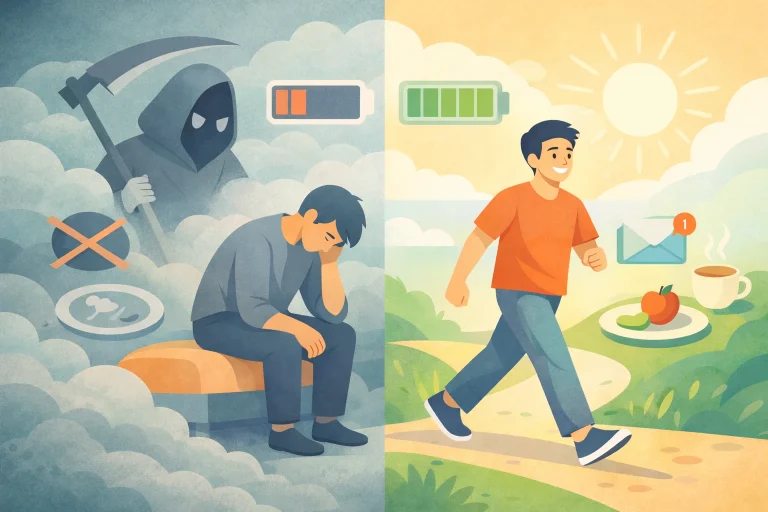
Table of contents:
Depression in Real Life: What It Is and How It Shows Up
It is more than sadness with better PR
A lot of people still imagine depression as dramatic crying, sad playlists, and someone staring out of a rainy window like they're in an indie film. Real life is less cinematic and much more annoying. Depression is not just sadness. It often comes with low mood, loss of interest, fatigue, brain fog, sleep changes, appetite changes, guilt, and that bleak little whisper of "What's the point anyway?" The WHO and the NIMH both describe it as something that affects how you feel, think, and function - not just your mood for a gloomy afternoon.
That difference matters. Sadness usually still leaves some movement in you. Depression often steals the movement first, and only then the hope. Nasty bit of work, really.
Motivation gets weird, and the body joins in
One of the most confusing things about depression is how much it can resemble laziness from the outside. The dishes are right there. The email is sitting there, judging you softly. You know a short walk might help a little. And still your system reacts as if those tasks belong to a different person - a better person, with functioning batteries and perhaps a decent breakfast. That is not a character flaw. Depression messes with drive, reward, and energy, so even tiny actions can feel absurdly far away.
The body usually gets dragged into it too. Some people sleep for ages and still wake up feeling like a wrung-out towel. Others sleep badly and spend the day with that wired, brittle exhaustion that makes everything feel faintly impossible. Appetite can vanish, or swing wildly. Shoulders creep up around the ears. Your face goes a bit blank. Even chatting can feel like hauling furniture up the stairs. Very elegant, obviously.
Your thoughts shrink around the worst story
Depression has a rotten habit of narrowing the mind. The future starts looking smaller, the past starts looking like a case file against you, and the present feels useless. You may notice more self-blame, harsher interpretations, and a kind of tunnel vision: "I always ruin things," "Nothing will change," "Other people can handle life; I clearly can't." That loop often overlaps with anxiety and overthinking, which can make every thought louder and every decision heavier even when nothing obvious has happened. In some people, that same defensive logic hardens into cynicism, so distrust starts to feel smarter than hope and asking for help feels, I don't know, a bit embarrassing and pointless. The annoying part? In the moment, these thoughts can feel downright sensible. Depression is very good at dressing distortion up as realism.
It can also flatten pleasure. Not necessarily dramatic anguish - sometimes just a dull, eerie flatness. Music sounds like noise with structure. Food is... fine, probably. A joke lands and you understand that it's funny, but the inner click never arrives. That numbness throws people off, because they think depression should feel intensely emotional. Quite often it feels emotionally underpowered instead.
It does not always look "serious enough" from the outside
Some people keep working, parenting, going to dinner, even pulling off decent small talk while privately feeling hollowed out. So yes, a person can look functional and still be depressed. They may be running on duty, habit, caffeine, fear of disappointing people, sheer embarrassment - pick your fuel. This is one reason depression gets missed for so long. It doesn't always make a grand entrance; sometimes it just quietly swaps a person's usual spark for endurance.
If any of this sounds familiar, pay attention to the pattern rather than waiting for one dramatic breakdown scene. A bad day is one thing. A few weeks of heaviness, detachment, exhaustion, and not caring about things you normally care about - that's something else. And that "something else" deserves more than a pep talk and a fresh planner.
What Starts Returning When Depression Loosens Its Grip
Ordinary tasks stop feeling absurdly expensive
One of the first signs of improvement is not joy, actually. It's usability. You wake up and the day doesn't instantly feel like a badly designed obstacle course. Brushing your teeth doesn't require a committee meeting. Replying to one message doesn't feel like opening a legal dispute. You start doing small things without spending an hour dreading them first, and that changes the whole rhythm of the day.
This matters because depression doesn't just create pain. It creates friction. Everything catches. Everything drags. When that friction eases, life feels less clogged up, less sticky. Energy stops leaking out through every tiny task, which means you have a little more left for work, family, rest - and for choices that actually matter.
You can feel interest again, not only obligation
When depression starts to lift, people often talk about mood. Fair enough. But interest may be even more important. You notice a song again. Food has texture, not just calories. A conversation feels engaging instead of like waiting politely for your turn to nod. You may not be ecstatic - no confetti cannons here - but the world stops feeling made of cardboard.
That return of interest is a big deal for growth. You can learn when your brain isn't permanently shrugging at everything. You can build habits when effort brings even a tiny emotional return. You can care about your future without feeling like you're writing fan fiction about somebody else's life. Motivation grows much better in that kind of soil, doesn't it?
Relationships get less foggy and less defensive
Depression often makes people pull back, misread tone, or feel like a burden long before anyone has actually said so. When it starts easing, connection becomes more reachable. You reply to a friend because you want contact, not because guilt finally pinned you to the wall. You can listen without half your attention getting trapped in your own inner weather. You may even ask for comfort without feeling ridiculous. Lovely change, that.
For some people, this also means learning how to build trustfulness without losing discernment, so reaching out feels safer and more grounded instead of like one more emotional gamble.
Other people usually feel the shift too. Not because you become endlessly cheerful, but because you become easier to reach. There's more warmth, more response, more back-and-forth. And when connection feels possible again, recovery often gets stronger. Humans are inconveniently social creatures like that. Even the ones who swear they're "fine on their own."
Self-trust begins to grow back
Depression chips away at confidence in a very quiet, sneaky way. You stop trusting your energy, your judgment, your follow-through, even your personality. Improvement restores something steadier than hype: evidence. That's often how confidence comes back in real life - not as swagger, but as repeated proof that you can rely on yourself again. "I said I'd do this one small thing, and I did." Then again. Then maybe you make a plan for next week and, surprisingly, it doesn't feel like a joke.
There's also a deeper shift. Hope starts feeling less embarrassing. And that's actually pretty close to optimism, though not the glittery kind. Not forced positivity, not pretending everything is magical - just the quiet sense that the future is still open to influence. Your current state is real, yes. But it's not the whole story. That matters more than it sounds. It makes treatment easier to stick with, routines easier to rebuild, and change easier to imagine. Depression makes the future feel sealed shut. Recovery cracks a window.
When Depression Gets Heavier Than You Realize
The day starts flattening into one long blur
When depression deepens, time often loses shape. Monday, Thursday, Sunday - same socks, different label. You may still be technically busy, but nothing really lands. Work gets done in bits. Meals become random. The week goes by and you can't point to anything you truly felt inside it. That flattening is part of why depression is so disorienting. It isn't only pain. It's the absence of aliveness, which is a strange and lonely thing.
People miss this all the time because they're waiting for dramatic collapse. Instead, they get a creeping dullness that makes everything feel equally unimportant. Birthdays, deadlines, hobbies, messages from people they love. It all lands with the same muted thud. Not ideal. Understatement of the year, maybe.
Your body may slow down, or go wired and restless
Depression doesn't always look sleepy and slow. For some people, yes - there's heaviness, long naps, moving through the house like gravity has developed a personal grudge. For others, it shows up as agitation: pacing, irritability, snapping at people, not being able to settle, a mind that keeps chewing on the same bleak thought like a dog with an old shoe. Both can happen. Both count. If your inner state keeps swinging between numbness, irritability, and shutdown, it may also help to understand emotional regulation in plain English, because managing overwhelming feelings is not the same as pretending not to have them, and that distinction matters when depression and stress start blurring together.
That's one reason depression gets confused with stress, burnout, or "just being in a mood." The surface behavior varies a lot. If you're trying to tell the difference, it helps to understand what happens when stress resistance is too low, because chronic overload and depression can look surprisingly similar from the outside while needing somewhat different support. Underneath, though, the pattern is often the same: depletion, disconnection, and a shrinking ability to enjoy or initiate life.
Isolation starts feeding the whole cycle
The more depressed someone feels, the more likely they are to pull back. They cancel plans. Stop replying. Tell themselves other people are better off without their weird, low-energy presence. Then, because they're now cut off, the depression gets more room to mutter its nonsense without interruption. "See? Nobody notices." "See? You don't belong anywhere." It's a rigged little loop, and a cruel one.
Shame usually makes it worse. A lot of people with depression aren't just hurting - they're also judging themselves for hurting badly. They compare themselves to their old self, to a sibling, to that one coworker who somehow meal-preps, runs 10Ks, and remembers everyone's birthday. Delightful. Very motivating. Except not really. Self-criticism rarely creates real momentum here; it just makes the whole inner climate more hostile.
Some signs mean the issue needs fast attention
If depression brings thoughts like "People would be better off without me," "I need this to stop no matter what," or any urge to harm yourself, treat that as urgent, not poetic. Same goes for being unable to function for days, barely eating, barely sleeping, or feeling so slowed down or desperate that ordinary decision-making is starting to slip. At that point, the goal is not elegant self-awareness. The goal is support, quickly.
The NHS and 988 Lifeline guidance is very clear about this: suicidal thoughts, plans, or an inability to stay safe need immediate help. Depression can lie with shocking confidence. That is exactly why it should not be left alone to narrate reality when things get that dark.
Ways to Work With Depression, Not Just Grit Your Teeth at It
Lower the bar until action is possible again
When depression is active, giant self-improvement plans usually collapse under the weight of their own optimism. Go smaller. Then smaller than that. If a full shower feels impossible, wash your face. If a workout is not happening, stand outside for three minutes and stretch your back a bit. If cooking is beyond you, eat something basic with protein instead of waiting to become the sort of person who sautes kale while glowing with inner radiance.
This isn't "letting yourself off the hook." It's rebuilding motion. Depression loves all-or-nothing thinking. Tiny completed actions interrupt that story better than dramatic promises ever do.
Create a few body anchors and stop negotiating them daily
Depression scrambles rhythm, so it helps to give the body a few fixed points: a regular wake-up time, daylight in the morning, actual food at roughly normal intervals, medication if prescribed, a short walk, dimmer lights at night. Not a perfect routine. Please, no. Just anchors. The point is to reduce chaos in the nervous system a little, because mood often gets worse when sleep, movement, and meals slide all over the place.
If you can only keep two anchors for now, that still counts. Two is a structure. The nervous system tends to like repetition even when your feelings are late to the party.
Track patterns, not only feelings
Try a simple note for one week: what time you woke up, how your energy felt, whether you talked to anyone, whether you left the house, and one line about what slightly helped or worsened the day. That's enough. No soulful essay required. After a few days, patterns often start peeking out. Maybe mornings are worse when you stay in bed scrolling. Maybe your mood lifts a notch after a shower and fifteen minutes outdoors. Maybe isolation bites harder than you admitted.
This helps because depression can make every day feel equally bad, even when they aren't. A little tracking gives you something firmer than mood alone - and sometimes that little bit of evidence is what gets you moving.
Use contact before you "feel social"
Waiting until you want connection can keep you alone for ages. Better to use low-pressure contact on purpose. Send the boring text. Sit with a friend while each of you does your own thing. Call someone and say upfront that you've got low battery and don't need a big conversation. Even brief, ordinary contact can interrupt the isolation loop.
And no, this does not mean forcing yourself into loud group dinners when you already feel peeled open. Choose gentler forms of contact. Smaller ones. Recovery likes dignity; it doesn't need performance.
Bring in proper treatment when the fog sticks around
If symptoms last more than a couple of weeks, keep coming back, or start messing with work, sleep, eating, or safety, bring treatment into the picture. Depression is treatable. Common options include therapy, medication, or both. Evidence-based guidance from NICE supports approaches such as cognitive behavioral therapy, behavioral activation, interpersonal therapy, and antidepressant medication when appropriate.
The key point, maybe the kindest one, is this: you do not have to earn help by getting worse first. A lot of people wait because they think they should be able to "snap out of it" if they were stricter, tougher, more grateful, more disciplined - pick your flavor of self-blame. But depression is not improved by being scolded like a lazy intern. It usually responds much better to treatment, structure, support, and some patience with the very human creature you actually are.
Does Depression Need to Be Your Main Focus Right Now?
Not always. Sometimes the bigger issue is grief, burnout, chronic stress, loneliness, thyroid problems, or a life setup that would flatten almost anybody. Still, if low mood, numbness, fatigue, withdrawal, and loss of interest have been hanging around for weeks, depression may be the thing quietly draining your ability to work on anything else.
It helps to identify the real bottleneck. If what you're noticing is less obvious sadness and more that unsettling sense that nothing in your life is moving, it may help to look at when life feels jammed in neutral, because feeling stuck and depression can overlap from the inside while still needing slightly different kinds of support. Otherwise you end up trying to fix confidence, discipline, sleep, relationships, purpose, and your email backlog all at once, which is really just a fancier way of going nowhere while exhausted. If part of the heaviness comes with a constant "what is the point of any of this?" feeling, it may help to look at how a purpose void starts showing up everywhere, because low meaning and low mood can overlap in real life even when they are not exactly the same problem. If the heaviness keeps cutting power to the rest of your life, this may need to move to the front of the line.
If you want a cleaner read on what to work on first, AI Coach can help you sort priorities and build a simple three-day starting plan. Sometimes that tiny bit of structure is enough to turn vague dread into an actual next step. I hope it gives you a bit of breathing room - truly.
Frequently Asked Questions (FAQ)
How is depression different from ordinary sadness?
Sadness usually still has some movement in it. You can want things, enjoy something for a moment, or feel the mood shift depending on what's happening around you. Depression tends to be broader and stickier. It affects energy, sleep, concentration, motivation, appetite, and your ability to feel interest or pleasure. It starts shaping daily functioning, not just feelings.
Can depression make you feel numb instead of sad?
Yes, absolutely. A lot of people expect depression to feel intensely emotional, but many describe it as flatness, emptiness, or disconnection. You know something should matter, and yet the internal response barely shows up. That numbness is one reason depression can hide in plain sight for so long.
Can someone be depressed and still go to work every day?
Absolutely. Plenty of people keep functioning on the outside for quite a while. They work, parent, answer messages, crack jokes, show up. Underneath, they may be running on habit, duty, caffeine, and sheer stubborn will. Functioning does not cancel depression; it can just camouflage it.
Why do tiny tasks feel so hard when I'm depressed?
Because depression interferes with motivation, energy, and the brain's reward system. The task may be objectively small, but your system registers it as heavy, distant, or not worth the effort. That's why "just do it" advice lands so badly. The problem isn't simple unwillingness.
Does depression always have a clear cause?
No. Sometimes there's an obvious trigger: loss, trauma, burnout, a breakup, chronic stress, illness. Sometimes the picture is mixed, messy, or unclear. Genetics, biology, environment, and life events can all play a part. Not having a neat explanation does not make the depression any less real.
What is the difference between burnout and depression?
Burnout is often tied more directly to prolonged stress, especially around work or caregiving, and it may ease when the pressure changes. Depression tends to spread wider. It can flatten pleasure, hope, energy, and self-worth across different areas of life, not just the stressful one. They can overlap, though, which is why the line isn't always neat.
Can exercise, sleep, and routine really help, or is that too basic?
They really can help, though they are not always enough on their own. Depression often gets worse when sleep, food, movement, and daylight become chaotic, so body anchors matter. The trick is to make them small and repeatable. A ten-minute walk done regularly beats a heroic plan you abandon by Wednesday. You know the type.
What if I know I need help but cannot make myself start?
Shrink the first step until it's almost boring. Ask one person to help you book an appointment. Save one clinic number. Fill out half the form. Put the medication bottle by the kettle. Depression is excellent at making treatment feel huge and strangely impossible. Smaller entry points usually work better than waiting to "feel ready."
Can depression come back after it improves?
Yes, it can. That does not mean recovery failed. It means depression can be recurrent for some people. That's why noticing early signs matters: sleeping too much, withdrawing, losing interest, harsher self-talk, that familiar heavy slowdown. Catching a slide early usually gives you more room to respond.
When does depression become an emergency?
If you are thinking about suicide, making plans to harm yourself, feel unable to stay safe, or are becoming unable to eat, sleep, or function in a basic way, treat it as urgent. Contact emergency services or a crisis line right away. In the US and Canada, 988 is the Suicide and Crisis Lifeline. If you are elsewhere, use your local emergency number or immediate crisis support.