
Emotional regulation is the skill of feeling what you feel without letting every emotion grab the steering wheel and aim the car at the nearest ditch. When that skill is shaky, a normal day can turn oddly expensive: one blunt email ruins your afternoon, one awkward comment sits in your chest for hours, one small disagreement suddenly feels like a referendum on your whole existence. A bit much for a Tuesday, really.
And the trouble is not only the big reactions. Sometimes it looks quieter than that. You go numb, swallow what you feel, act "fine," then leak irritation all over the wrong person later. If any of that sounds painfully familiar, stay with me. There may be less chaos available to you than your nervous system has been advertising.
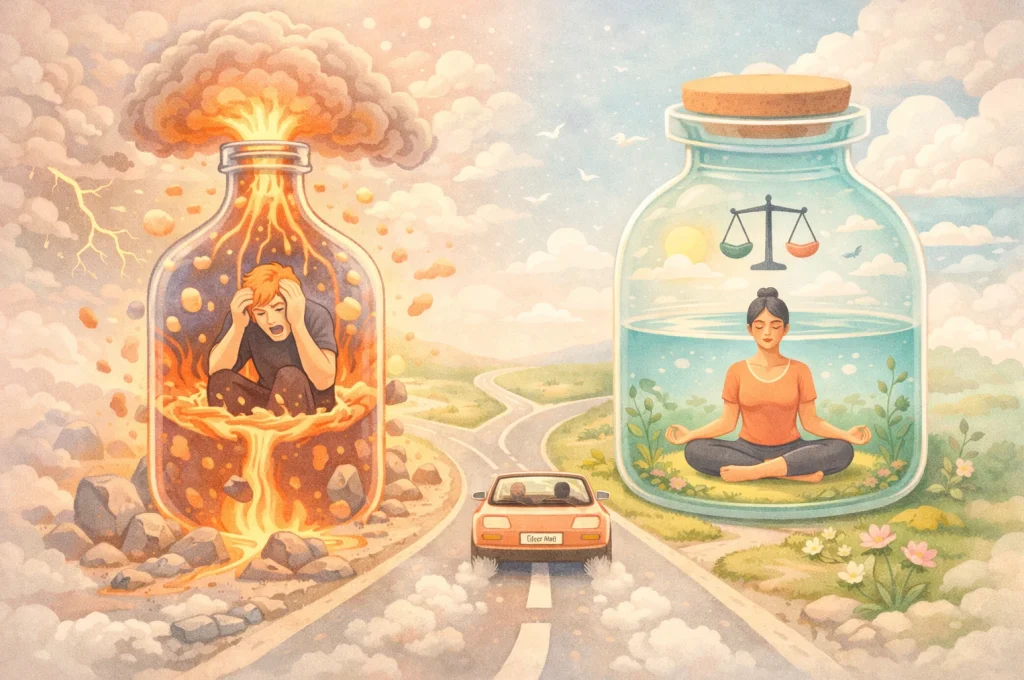
Table of contents:
Emotional regulation, in plain English
It is not about being calm all the time
In psychology, emotion regulation means how we influence what we feel, when we feel it, and how we express it. Important difference: it does not mean becoming some serene little statue who never gets annoyed in traffic or jealous at 11:40 p.m. while scrolling through somebody else's suspiciously perfect holiday photos. Real emotional regulation is much more practical than that. It means your feelings show up, but they do not instantly become behavior. There is a gap. Small, maybe. Still enough to choose. You can feel anger without starting a war. Feel sadness without vanishing from your own life. Feel fear without obeying every scary thought like it has legal authority.
Your body usually notices first
A lot of people think emotions begin as ideas. Often they begin as body signals. Tight throat. Hot face. Faster heartbeat. Heavy stomach. Shoulders up by your ears for no obvious reason. By the time your mind says, "I am getting upset," your nervous system may already be halfway through the fireworks setup. That is why emotional regulation is not just a mindset skill. It is a body skill too. If you only try to argue with your feelings using logic while your system is flooded, good luck. The thinking part of the brain goes a bit wobbly under threat. Not broken, just less available. Which explains a lot of text messages people wish they had not sent.
It can look loud, or it can look invisible
Weak emotional regulation does not always look dramatic. Yes, sometimes it is snapping, spiraling, slamming cupboards a touch harder than necessary, crying in the office bathroom, or turning one criticism into a three-hour internal courtroom drama. But sometimes it looks like emotional lockdown. You smile. You say, "No worries." You tell people you're just tired. Meanwhile your body is storing the whole thing like a warehouse with bad lighting. This is why the skill matters so much: dysregulation can be explosive, or it can be tidy-looking and still costly. And it is worth separating regulation from emotionality when feelings stop being a blurry background hum, because noticing your feelings clearly is one skill while steering them well is another. A person may seem composed while quietly living in constant overcontrol, which often overlaps with an inner critic that never really clocks out.
Triggers are not random, even when they feel random
Most reactions have a pattern. Maybe disrespect hits you hard. Maybe uncertainty does. Maybe being ignored, rushed, corrected in public, left on read, or asked for "a quick favor" when you are already hanging on by a thread. Emotional regulation includes learning that pattern language. Not to blame yourself. Just to stop being ambushed by the same plot twist every week. Once you notice what reliably hooks you, your reactions stop feeling mystical. They become more workable. Less "Why am I like this?" and more "Ah. This is one of my pressure points." That is a much kinder place to start from. Also, frankly, a more useful one.
What starts changing when your emotions stop running payroll
Conflict gets shorter, cleaner, and less weird
When emotional regulation improves, arguments stop multiplying like wet laundry. You still get frustrated. You still disagree. But the disagreement stays closer to the actual issue instead of dragging in six old grievances, one wounded tone, and that thing from February nobody had planned to mention. You become more able to say, "I need ten minutes," or, "That landed badly, let me try again," instead of reacting at full volume and sorting out the rubble later. In relationships, that shift is huge. People feel safer talking to you when every hard conversation does not risk turning into emotional weather with lightning. Not perfect safety. Human safety. Much better.
Your workday stops being held hostage by every feeling spike
This skill matters at work more than people think. Without it, feedback can wreck your concentration, stress can turn a normal task into sludge, and one rude meeting can poison the next four hours. With better emotional regulation, you recover faster. You can separate "I feel embarrassed" from "my career is obviously over." Handy distinction. It is also one reason logical thinking gets stronger under pressure, because you are less likely to treat a feeling spike as objective reality. You also make fewer impulse decisions, fewer defensive replies, fewer dramatic interpretations of neutral Slack messages. Which helps because half of modern working life is people trying to decode punctuation while under-caffeinated. Emotional steadiness does not make work fun, no miracle here. It just makes your inner system less easy to derail.
The body spends less time in emergency mode
There is a physical payoff too. If your nervous system is constantly spiking, crashing, bracing, swallowing, or replaying, the body pays rent for that. Better emotional regulation often means less lingering tension, fewer extended stress hangovers, better sleep, and a bit more room to breathe in your own skin. Not because life gets suddenly gentle, but because your system stops treating every difficult moment like a five-alarm crisis. This is one reason the skill helps protect against burnout. Chronic emotional whiplash is tiring. Deeply, quietly tiring. A steadier inner response gives your body fewer unnecessary battles to fight.
You trust yourself more after hard moments
Maybe the nicest change is self-trust. When you know you can handle a strong feeling without instantly obeying it, life feels less fragile. You are less afraid of your own anger, sadness, panic, shame, excitement too. That matters. Some people do not chase control because they love control; they chase it because they do not trust themselves once emotions get loud. As regulation grows, confidence becomes less performative and more grounded. You stop needing to be endlessly "fine." You just get better at riding the wave without becoming the wave. Bit cheesy, yes. Still true. And if your confidence has been tangled up with overreactions, shutdowns, or emotional regret, that steadiness can do more for your self-respect than another round of motivational slogans ever will.
When this skill is weak, life gets expensive fast
Small things get amplified beyond their pay grade
One of the clearest signs of poor emotional regulation is scale distortion. A tiny delay feels insulting. Mild criticism feels crushing. Someone's neutral tone sounds hostile. A change of plan feels like betrayal, not inconvenience. The emotion itself may make sense, but the size and duration of the reaction start causing collateral damage. You spend an hour replaying a five-second moment. You treat one irritating hiccup like proof that the day is ruined. It is exhausting. Also confusing, because part of you knows the reaction is oversized while another part is absolutely certain the situation deserves a full orchestra of distress.
You either spill everywhere or disappear inward
Some people dysregulate outward. They interrupt, snap, rant, send the message, make the face, slam the door, buy the thing, quit in their head before lunch. Other people go in the opposite direction. They freeze, people-please, go blank, say "It doesn't matter," then carry the feeling around like a hidden brick. Both patterns are costly. One burns bridges in public. The other erodes you in private. Over time, either style can start shaping identity. "I'm just too sensitive." "I'm just cold." "I always overreact." Maybe. Or maybe your system learned a rough survival method and kept using it long after the original moment passed.
The aftermath often hurts more than the spike
This part is sneaky. The emotion surges, something messy happens, then comes the second wave: guilt, shame, overexplaining, rumination, self-criticism, withdrawal. You think, "Why did I do that again?" or, "Why couldn't I say anything?" That aftermath is often where low self-respect gets fed. If this cycle keeps repeating, it can start blending with low self-esteem, because every reaction becomes fresh "evidence" that you are unstable, difficult, weak, too much, not enough. The story gets harsher than the fact. What happened was a regulation miss. Your brain, very helpfully, turns it into a character biography.
Quick relief starts replacing real coping
When emotions feel hard to manage, quick relief becomes very attractive. Doomscrolling. Stress eating. Drinking more than planned. Picking a fight. Ghosting people. Shopping to change your mood. Staying busy so you never have to feel the thing properly. None of this makes you broken. It makes you human and under-equipped in that moment. In fact, a little planning without turning into a spreadsheet person can remove some of the chaos that makes last-minute soothing habits feel like your only option. But if those habits become your main regulation system, the original emotions do not actually get processed; they just get pushed around the room wearing different outfits. Then your life gets shaped by reaction rather than intention. Days feel choppier. Relationships get harder to read. And your nervous system learns the wrong lesson over and over: big feeling equals immediate escape. Understandable. Not exactly a dream setup for growth, though.
How to build emotional regulation without turning into a robot
Catch the body before the story gets dramatic
Start earlier than your usual blowup point. Not when you are already composing a furious paragraph in your head. Earlier. Notice your first body cues: heat, pressure, buzzing, nausea, clenched hands, urge to flee, urge to fix everything right now. Then give the body something concrete. Plant both feet on the floor. Unclench your jaw. Exhale longer than you inhale for five rounds. Look around and name three ordinary objects you can see. A lamp. A mug. A terrible little cable nest behind the desk. This sounds almost too simple. It works because regulation is easier when the nervous system gets a signal that the current moment is not, in fact, a tiger.
Translate the feeling instead of arguing with it
After a charged moment, use one short sentence frame: "I felt ___ because I read the situation as ___, and what I needed was ___." That middle part matters. Emotions are often tied not only to what happened, but to what you made it mean. "She interrupted me, so I felt dismissed." "He went quiet, so I read it as rejection." "They changed the plan, so I read it as losing control." Once the meaning becomes visible, the feeling gets less foggy. From there, you can ask a more adult question: what is the next honest move? A request? A boundary? A walk? A delayed reply? Better than venting into the void and calling it processing.
Train in low-stakes irritation, not only in major crises
A very practical way to build this skill is to practice during mild annoyance. Slow line at the grocery store. A website that keeps logging you out. A neighbor with a leaf blower and terrible timing. Tiny moments, yes. Perfect training ground. Notice the rise. Relax one muscle group on purpose. Loosen the tongue from the roof of your mouth. Drop the urge to narrate the inconvenience like a courtroom speech. These reps matter because the brain learns from repetition, not from one heroic performance during a huge fight. That is also why ways to train diligence without becoming miserable matter here, because emotional regulation improves through small, unglamorous repetitions far more than through dramatic breakthroughs. Emotional regulation grows in the ordinary, irritating little corners of life. Glamorous? Not even slightly.
Create exit lines before you need them
A lot of emotional damage happens because people stay in conversations past the point where they can think straight. So write two or three plain sentences in advance. "I want to continue this, but not while I'm flooded." "Give me twenty minutes and I'll come back." "I'm getting reactive. Let me reset." These are not magic words. They just give you a bridge between feeling and behavior. If you tend to freeze instead of explode, script that too: "I need a minute to find words, but I do want to respond." Prepared language is underrated. In the hot moment, your best vocabulary often goes missing like socks in a dryer.
Review the miss without turning it into a trial
When you do react badly, and you will, skip the moral theatre. Do a five-line reset instead. What happened right before? What did I feel in my body? What story did my mind tell? What did I do next? What would help one notch earlier next time? That is enough. The point is pattern learning, not self-punishment. If you repair with another person, keep it clean: name the behavior, own the impact, say what you will try differently. Done. No ten-minute speech about being a terrible person. Emotional regulation gets stronger when mistakes become information. Not when every stumble gets dragged onto an inner stage and interrogated under bright lights.
Should this be your next growth focus?
Maybe. Maybe not. Not everyone needs to start with emotional regulation. Sometimes the real problem is sleep debt, chronic stress, grief, an unsafe relationship, ADHD, or plain old overload. And if what looks like "poor regulation" is really emotional flatness, exhaustion, or the feeling that life has quietly narrowed, it is worth reading about depression in everyday life, not just in definitions, because not every shutdown is a self-control problem. If your system is constantly overstretched, asking yourself to become perfectly regulated can get a bit ridiculous, fast.
It helps to choose the right bottleneck. If your main struggle is not emotional flooding but drift, passivity, or never really moving toward what matters, then it may be smarter to look at whether ambition should be your priority right now, because that kind of clarity can save a lot of fake self-improvement effort. Otherwise you end up trying to fix your confidence, focus, boundaries, productivity, and emotional life all at once, which is a lovely way to get nowhere in five directions. If your clearest pattern is overreacting, shutting down, regretting your responses, or feeling hijacked by moods, then yes, this probably deserves attention.
If you want help sorting that out, AI Coach can help you figure out what actually needs priority right now and give you a simple plan for the first three days. Sometimes that is the real relief. Not "be better immediately," but "oh, this is the knot. I can start here."
Frequently Asked Questions (FAQ)
What is emotional regulation in simple terms?
It is the ability to notice, handle, and express emotions without getting completely hijacked by them. You still feel anger, sadness, anxiety, embarrassment, all of it. The difference is that the feeling does not instantly become your behavior. There is enough space to respond with some choice instead of pure reflex.
What are common signs of poor emotional regulation?
Big reactions to small triggers. Going from calm to flooded very fast. Shutting down when feelings get intense. Saying things you regret, then replaying them for hours. Using food, scrolling, spending, alcohol, or avoidance to get quick relief. Also: feeling "fine" on the surface while your body is quietly tense all day. Dysregulation is not always loud.
Is emotional regulation the same as suppressing emotions?
No. Suppression is pushing feelings down or hiding them without really dealing with them. Emotional regulation is staying in contact with the feeling while choosing what to do with it. One says, "I must not feel this." The other says, "I do feel this, and I still get to decide my next move." Big difference. The first often leaks out later in stranger places.
How do I regulate emotions in the moment when I feel myself tipping over?
Go body first. Put both feet on the floor. Lengthen the exhale. Unclench something. Name a few neutral things you can see. Then reduce action. Do not send the message, make the accusation, or force the big conversation while your system is still blazing. If words are needed, use a prepared line like, "I need a short reset before I answer well."
Can adults really learn emotional regulation, or is it mostly childhood wiring?
Adults can absolutely learn it. Childhood shapes a lot, yes. People often copy the emotional style they grew up around: exploding, freezing, smoothing things over, pretending everything is fine. But the brain stays trainable. Repetition matters. Body cues matter. Better language matters. Repair matters. You are not stuck with the first emotional operating system you were handed.
Why do I shut down instead of expressing what I feel?
Usually because your system learned that open emotion was risky, useless, or likely to backfire. Shutdown is still a regulation strategy, just not a very comfortable one. Some people go hot and loud. Others go quiet and disappear inside. If you freeze, start with naming the body state first and using short bridge phrases. Full emotional honesty is hard when your brain has already hit the internal dimmer switch.
Why do I cry when I'm angry, or get angry when I'm actually hurt?
Because emotions often travel in groups. Anger can sit on top of hurt. Tears can show up when your system feels overwhelmed, not only sad. A lot of people were taught that some emotions are more acceptable than others, so the body learns a workaround. The goal is not to force the "correct" emotion. It is to get curious enough to ask what is underneath the first visible one.
What makes emotional regulation harder?
Sleep loss, chronic stress, hunger, sensory overload, unresolved resentment, alcohol, burnout, trauma history, ADHD, and relationships where you never feel fully safe. Not very glamorous answers, I know. But they matter. A tired nervous system has fewer brakes. A constantly threatened one has fewer reasons to stay calm. Sometimes improving regulation starts with better conditions, not better pep talks.
How does emotional regulation affect relationships?
It shapes everything from conflict to closeness. If you react fast, withdraw hard, or turn every hard feeling into blame, people become cautious around you. If you suppress everything, they may feel shut out or forced to guess. Better regulation helps you say what is true without making the whole room pay for your current state. That makes trust much easier to build and keep.
How long does it take to get better at emotional regulation?
Usually faster than people expect to notice, slower than they want to finish. Many people feel a difference within a couple of weeks if they practice one or two skills consistently, especially body-based ones. The deeper shift takes longer because you are not just calming down in moments. You are changing patterns: what triggers you, how fast you notice, what you do next, and how you repair afterward. That is real work. Worthy work too.