
There's a particular kind of tiredness that comes from doing all the normal adult things and still feeling like your life is slightly... off-center. You answer messages, show up, pay bills, maybe even look "fine" from the outside, and yet some part of you keeps whispering, "Wait, what am I actually doing with myself?" Feeling lost is often exactly that: not chaos, not failure, just a slow, unnerving drift away from your own inner coordinates.
If your days feel full but strangely unclaimed, this deserves a closer look. Because when that fog starts to lift, decisions get cleaner, energy stops leaking everywhere, and your life begins to sound like your own voice again.
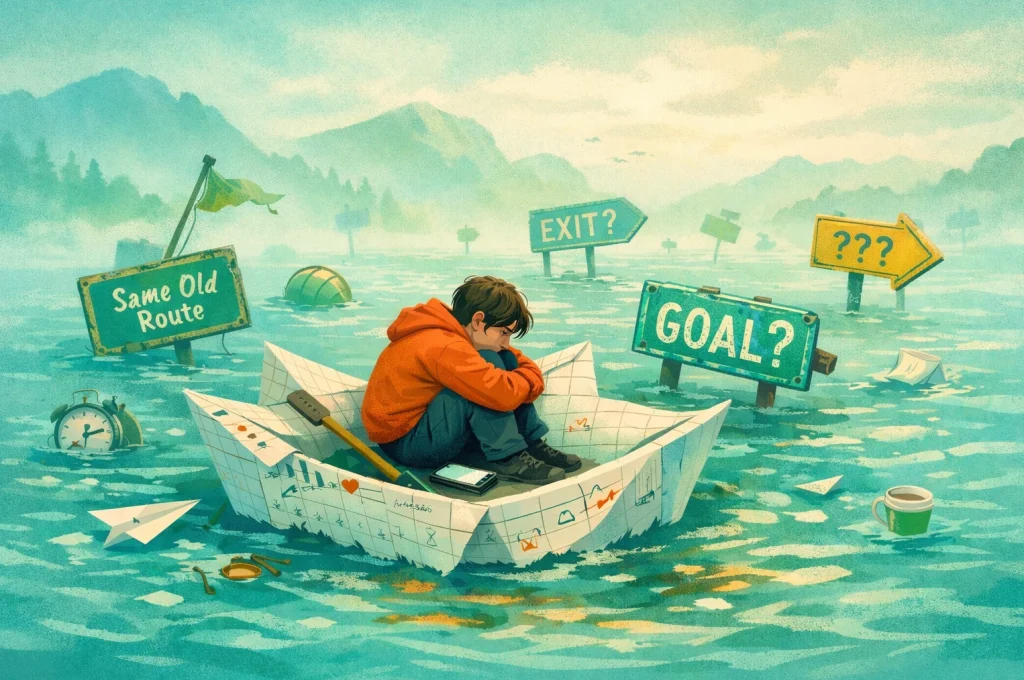
Table of contents:
When Life Stops Feeling Like It Belongs to You
It is not always a dramatic crisis
Feeling lost does not always arrive with a breakup, a layoff, or a thunderstorm over your soul. Sometimes it shows up in a much less cinematic way. You keep moving through your routine, but your choices feel mechanical. You say yes because it seems sensible. You keep a goal because you picked it three years ago and, well, it would be awkward to admit it no longer fits. On paper, your life may even look decent. Inside, though, there is fog. Not laziness. Not weakness. More like your inner map has gone faint, and now every road feels a bit arbitrary.
It often begins when your direction gets outsourced
A lot of people feel lost after years of following borrowed instructions. Family expectations. Workplace culture. Social media's weird little parade of "morning routine, side hustle, six-figure clarity" people. You absorb enough outside signals and start mistaking them for your own voice. This is one reason feeling lost can hit even high-functioning people pretty hard. They have been achieving, but not always choosing. Psychologists sometimes talk about identity in terms of exploration and commitment: first you try, then you decide. Trouble starts when the commitment happens before the honest exploration. You build a life, then one day realize you never really asked whether it felt like yours.
The signs are often small, repetitive, and annoying
In ordinary life, feeling lost can look like chronic second-guessing, sudden envy of people with clear paths, compulsive career daydreaming, or a strange inability to answer simple questions like "What do you want next?" You might keep consuming advice without acting on any of it. Or you change direction every few weeks, not because you are wildly adventurous, but because nothing settles. Another common clue: your energy perks up when imagining escape, but drops when dealing with your actual life. That does not automatically mean you need to burn everything down and become a surf instructor in Portugal. Relax. It usually means your current direction and your inner reality are no longer in good conversation.
At its core, this is a loss of orientation
That is the important part. Feeling lost is not just "I lack motivation." It is deeper than that. Motivation struggles when the mind cannot see where effort is supposed to go or why it matters. When people reconnect with values, identity, and self-concordant goals, motivation often returns in a less dramatic, much more useful form. In many cases, this is also an issue of integrity, because it is hard to feel energized by a life that keeps pushing your real values into the back seat. So this problem is partly emotional, partly cognitive, and partly existential, yes, a big word, but it fits. You are trying to move without a felt sense of direction. No wonder it is exhausting. A person can tolerate hard work surprisingly well. What drains them is hard work in a direction that no longer feels alive.
What You Get Back When the Fog Starts Clearing
Decisions stop feeling weirdly expensive
When you are no longer so lost, small and medium choices become less draining. Not because life suddenly turns easy, but because you have a clearer filter. You know what fits, what does not, what is merely shiny, and what is actually yours. That cuts down a lot of mental static. You spend less time doing emotional archaeology over every invitation, offer, or possible next step. "Do I want this?" stops feeling like a philosophical trap and starts becoming a workable question. That is a huge relief, honestly. So much adult misery is just prolonged confusion wearing decent shoes.
Your effort starts landing somewhere real
One of the best things about regaining direction is that your energy stops scattering. You are still tired sometimes, obviously. You are a person, not a rechargeable lantern. But the tiredness changes flavor. It becomes the fatigue of using yourself, not losing yourself. Work feels more coherent. Rest feels less guilty. Even boring tasks make more sense when they belong to a path you have actually chosen. That is also where responsibility starts carrying weight, because commitments feel very different when they come from a real decision rather than borrowed momentum. This is also why clearer direction often strengthens confidence. Not the loud, performative kind. The steadier version. The one that comes from knowing what you are building and why.
You become less easy to pull off course
People who feel lost are often highly influenceable, even when they seem independent. Every confident friend, charismatic boss, trendy video, or polished success story starts tugging at their steering wheel. Once your own bearings return, that tug loses some power. You can still learn from other people, of course. You should. But you stop treating every external opinion like a divine weather report. That makes boundaries easier. It also makes comparison less poisonous. Someone else's path can stay theirs. You do not have to keep trying it on like a jacket that looks fantastic online and ridiculous in your hallway mirror.
The future becomes less threatening and more interesting
Feeling lost can make the future seem like a giant, judgmental hallway. Too many doors. Too much pressure. Too little certainty. When orientation improves, the future shrinks to a more human size. You do not need a perfect five-year plan. You just need enough inner alignment to take the next honest step. That shift matters emotionally. Hope becomes practical. Curiosity comes back. You stop waiting for one grand revelation to save you and begin trusting smaller evidence from real life. Strange thing, too: once people stop demanding total certainty, they usually move better. The future does not need worship. It needs relationship.
How Feeling Lost Starts Warping Everyday Life
You live in permanent maybe-mode
One of the clearest signs is that everything stays half-open. You are maybe changing careers, maybe moving, maybe ending the relationship, maybe starting the project, maybe "taking time to think" for the ninth month in a row. This does not always look inactive from the outside. Lost people can be very busy. They research. They compare. They make mood boards, notes, playlists for the new self. Lovely. But actual commitment keeps slipping. Sometimes that is less careful reflection and more self-sabotage in real life, where fear keeps disguising itself as more research, better timing, or the need to be absolutely sure before doing anything. Life turns into a waiting room full of possible versions of you, while the current version gets more and more restless.
Other people's certainty starts feeling louder than your own mind
When your inner signal gets weak, outside noise gets oddly persuasive. Someone tells you their industry is booming, and now you wonder if you should go into it. A cousin gets engaged, and suddenly your single life feels like an emergency. A creator online posts about quitting everything to "follow alignment," and now your Tuesday office job feels like moral failure. If that pattern keeps pulling you around, FOMO may be adding fuel to the confusion. The result is a jittery life. Not truly chosen, just constantly adjusted in response to other people's momentum.
Numbness and overthinking start taking turns
This part is sneaky. Feeling lost is not always intense emotion. Sometimes it is the absence of clean feeling. Things that should matter barely register. Then, at 11:40 p.m., your brain suddenly decides to stage a full internal panel discussion about your purpose, your career, your relationships, and whether you should flee to another city. Very efficient timing, the brain, really. People in this state often swing between numb autopilot and exhausting mental spirals. Because clarity is missing, the mind compensates with analysis. And if that analysis is being narrated by an inner critic that confuses attack with guidance, the whole process gets louder without becoming wiser. Lots of it. Not always useful analysis, either. More like a hamster with a philosophy podcast.
Even progress can feel oddly hollow
This is the part many people miss. You can still achieve while lost. Promotions happen. Deadlines get met. Apartments get furnished. You can be competent, admired, organized enough. Yet when a win arrives, it does not fully land. There is no satisfying click. Just a brief "good, I guess," followed by a return to that quiet emptiness. Over time, this can slide toward feeling stuck in life, because motion without orientation eventually starts to feel like its own kind of trap. The danger is not only external underperformance. It is internal estrangement. A life can keep functioning while the person inside it feels less and less present.
Ways to Find Your Bearings Again
Put your real life on paper, not your ideal one
Take one sheet of paper and divide it into three plain columns: what fills my week, what gives me energy, what leaves me flat. Then fill it in honestly. Not aspirationally. Honestly. The point is to see whether your calendar and your aliveness still know each other. A lot of lostness becomes clearer once the mismatch is visible. You may notice that the parts of life taking the most space are not the parts making you feel most like yourself. Harsh little discovery sometimes. Useful one too.
Interrogate the goals that came pre-installed
Pick one goal you keep dragging around and ask three blunt questions. Would I still want this if nobody admired it? Would I still want it if it took longer than I hoped? Would I want it if it made me feel calmer but less impressive? These questions are excellent at exposing borrowed ambition. Some goals survive the test and grow sturdier. Others collapse like cheap patio furniture. Good. Better a wobble now than another three years spent proving something to an audience that is mostly busy microwaving leftovers and not thinking about you.
Choose a season, not a destiny
People get stuck because they think they need a life purpose by Thursday. You do not. What helps more is choosing a direction for the next ninety days. A theme. Recovery. Stability. Exploration. Contribution. Craft. Belonging. Let that theme guide your choices for one season of life. Even a loose structure like this can help planning stop being an afterthought, which makes the next step feel less mystical and much more doable in ordinary life. This keeps you moving without demanding a grand identity conclusion. It also gives your nervous system something kinder than "figure yourself out forever." If your lostness has a lot of emotional heaviness in it, and not just confusion, it may help to check whether burnout or depression is sitting underneath the fog.
Run small experiments with the real world
Clarity rarely arrives from pure thinking. It shows up in contact. So test things. Take the Saturday ceramics class. Join the local running group even if you suspect you'll hate it. Shadow a friend for a day in their field. Volunteer at the food bank once this month. Publish one essay instead of fantasizing about becoming "someone who writes." You are not auditioning for a new identity all at once. You are gathering data. What energizes you after doing, not just imagining? That difference matters more than people think.
Keep one weekly appointment with your own attention
Once a week, sit down for twenty minutes and ask yourself three questions: Where did I feel most like myself this week? Where did I abandon myself to keep things smooth? What am I pretending not to know? That last one bites, fair warning. Still, it is gold. Over time, this little ritual rebuilds inner contact. And that is the whole game, really. Feeling lost eases when you stop treating yourself like a blurry concept and start treating yourself like someone worth listening to, regularly, even when the answer is inconvenient or annoyingly unglamorous.
Should This Be Your Main Growth Focus Right Now?
Not always. Some people really are dealing with feeling lost. Others are mostly dealing with exhaustion, grief, depression, financial stress, or a life setup so overloaded that no one would feel clear inside it. In those cases, trying to "find your purpose" too early can turn into another exhausting project, which... nobody needs.
It helps to look at the actual pattern. If your main struggle is drifting, borrowed goals, constant inner wobble, and the sense that your life no longer feels properly yours, then yes, this deserves attention. If the bigger issue is that you are simply depleted or emotionally hurting, start there, or at least alongside this, otherwise your effort scatters.
If you want a cleaner way to sort that out, AI Coach can help you see what deserves priority right now and give you a simple plan for the first three days. Sometimes that is more useful than trying to decode your entire soul between laundry loads.
Frequently Asked Questions (FAQ)
What does it actually mean to feel lost in life?
Usually it means you have lost a clear sense of direction, fit, or inner ownership. You may still function, work, and make plans, but your life feels oddly disconnected from what matters to you. It is less "my life is a disaster" and more "my life no longer feels like mine."
Why do I feel lost even though things look good on paper?
Because external success and inner alignment are not the same thing. You can meet expectations, hit milestones, and still feel flat if the path was built from borrowed goals or outdated versions of yourself. "Good on paper" does not automatically mean "alive in the body."
Is feeling lost the same as depression?
No. They can overlap, but they are not identical. Feeling lost is mainly about direction and identity. Depression usually brings a broader drop in mood, energy, pleasure, and mental movement. If your fog comes with deep heaviness, persistent emptiness, or a hard time functioning at all, something more than simple disorientation may be going on.
Can major life changes trigger this?
Very often, yes. Graduation, divorce, parenthood, burnout, relocation, losing a job, even success can shake your old identity loose. Big transitions remove familiar structure. Then the question becomes, "Who am I now, and what actually fits this next version of me?"
Why do I keep changing my mind about what I want?
Because when your inner compass is weak, every new option can feel strangely convincing. You are not necessarily flaky. You may just be trying to create direction from the outside in. That is why real-world experiments help more than endless fantasy-planning. Action sorts faster than rumination.
Should I make a huge life decision while I feel lost?
Usually, make smaller decisions first. You do not need to blow up your life just because you feel disconnected from it. Start by gathering better information: what drains you, what wakes you up, what goals are truly yours, what themes matter now. Big moves go better when they grow from clearer ground.
Can social media make feeling lost worse?
Absolutely. It floods you with polished identities, simplified success stories, and enough comparison bait to make anyone question their own path. When you already feel uncertain, other people's certainty can sound much louder than your own quieter truth.
How long does this phase usually last?
It depends on what is feeding it. A short transitional wobble may ease in weeks. Deeper identity drift can last much longer if a person keeps avoiding honest reflection or keeps living by default. The encouraging part is this: lostness tends to shrink once you combine reflection with real-life testing, not just more thinking.
What helps more: journaling or taking action?
Both, but in the right order. Reflection helps you notice what is true. Action helps you test whether it stays true in real life. Journaling without action becomes fog with nice handwriting. Action without reflection can turn into random thrashing. Put the two together and things get clearer, faster.
How can I help a friend who says they feel lost?
Do less fixing, more listening. Ask what no longer fits, what they miss, what has started feeling empty, what still gives them a spark. Encourage small experiments instead of grand speeches. A lost person usually does not need more pressure to "figure it out." They need room, honesty, and a little help hearing themselves again.