
You can be busy all week and still end up with that weird, flat thought: nothing is actually changing. You answer emails, pay bills, maybe even do a decent Pilates class, and yet your real life feels parked somewhere with the hazard lights on. That is often what feeling stuck looks like in adult life. Not laziness. Not failure. More like inner traffic that never fully clears.
And the maddening part? From the outside you may look fine. From the inside, though, everything starts to feel delayed, foggy, half-lived. If that lands a little too hard, good. We may have found the knot, not just the noise.
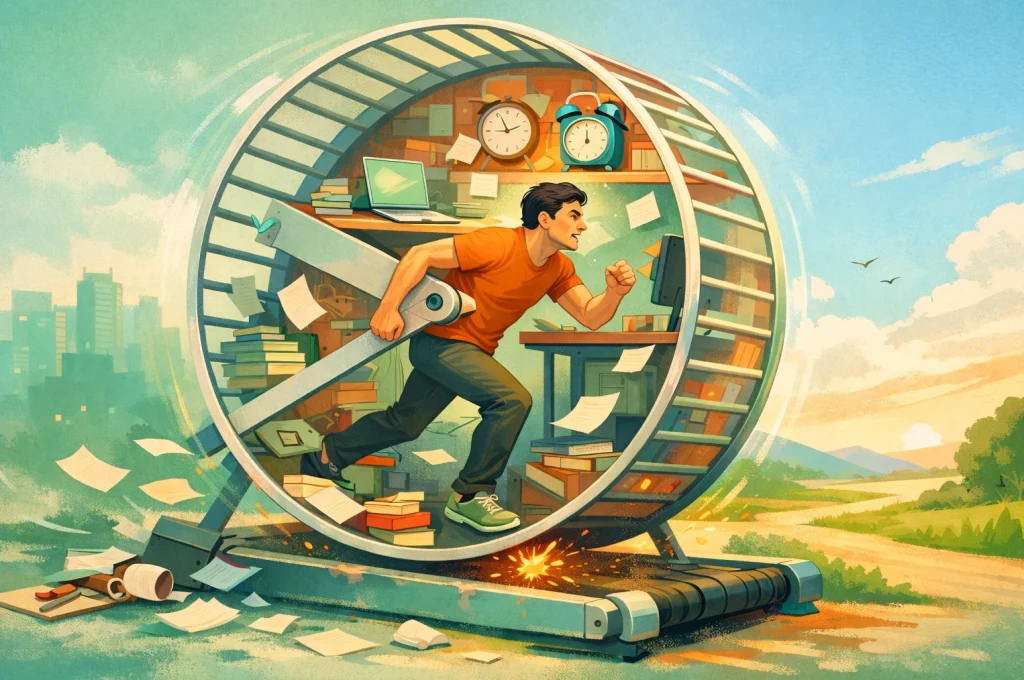
Table of contents:
When Life Feels Jammed in Neutral
It is not always stillness
Feeling stuck does not always mean doing nothing. Very often it looks like movement that goes nowhere. You research, compare, think, rethink, maybe have twelve sincere conversations about "what to do next," and still the core thing stays untouched. A career question hangs there for months. A relationship conversation keeps getting postponed. A creative project lives in your notes app like an extremely well-dressed ghost.
That is why stuckness confuses people. They assume, "But I'm trying." Usually they are. The issue is not zero effort. It is scattered effort without a clean shift in direction.
Your mind wants two opposite things at once
A lot of stuckness is really an internal tug-of-war. One part of you wants change. Another part wants safety, predictability, and no embarrassment whatsoever, thank you. So you end up in a strange compromise: enough longing to feel restless, enough fear to stay put.
This is common when a decision threatens identity. If you have always been "the reliable one," changing careers may feel like betrayal. If you have built your whole personality around being useful, asking what you want can feel oddly illegal. The problem is not lack of desire. It is conflicting desire. The psyche is trying to protect you and move you at the same time, which... lovely design flaw.
Vagueness makes the whole thing heavier
Another big feature of feeling stuck is blur. People often know they do not like how things are, but they cannot name what exactly needs to change. They say things like, "I just need something different," or, "I don't know, I feel off." True, maybe. Also not very usable.
When the mind cannot picture the shape of the next chapter, it clings to the current one, even if the current one is making it quietly miserable. Unclear goals, half-formed preferences, borrowed ambitions from family or social media, all of that thickens the fog. You cannot walk toward what you cannot describe.
Your body usually joins the protest
Feeling stuck is not only a thought problem. It often shows up physically. Low energy. Tight shoulders. Random irritability. Trouble starting simple tasks. That dull Sunday-evening dread appearing on a Wednesday morning because apparently time has lost all manners. The nervous system reads unresolved tension too. It knows when life has become a waiting room.
Sometimes this stuck feeling is a mix of fear, fatigue, grief, boredom, and unspoken anger all piled together in one trench coat. Which is why people misread it. They call it a motivation problem when it may be a deeper misalignment between how they live and what they actually need. Hard truth, yes. Useful truth too. If the heaviness feels less like indecision and more like depletion, it may help to look at when burnout starts running your system, because exhaustion often disguises itself as a lack of drive and keeps people blaming themselves for being tired.
What Changes Once You Start Loosening the Gridlock
Decisions stop feeling so dramatic
When stuckness begins to ease, one of the first changes is surprisingly quiet. Choices stop feeling loaded with your entire future. You can send the message, update the resume, try the class, say no to the invitation, ask the uncomfortable question, without acting like each move is a moon landing. That matters.
People who feel stuck often spend ridiculous amounts of emotional energy on ordinary decisions because every choice seems to carry hidden meaning. Once that pressure drops, life gets lighter. Not easier in a cheesy movie way. Just lighter. More breathable.
You get traction instead of endless self-analysis
There is a huge relief in seeing proof that things can move. Even tiny proof. One honest conversation. One application sent. One boundary kept. One afternoon where you do not betray your own priorities out of habit. These moments rebuild trust in yourself faster than another forty-five minutes of overthinking ever will.
And that trust is gold. It changes the emotional climate. You stop staring at your life like it is a complicated customer-service issue and start participating in it again. A small shift, but a real one. This is often where confidence pays you back: not through louder self-talk, but through repeated proof that you can act before you feel perfectly ready, and that changes the way you carry yourself.
Your identity gets less cramped
People do not talk about this enough: feeling stuck can make the self feel narrow. You become the person who never leaves the job, never starts the thing, never says what they mean, never risks looking foolish. After a while, that story hardens. You stop noticing it as a story and start treating it as your nature.
When you begin moving again, identity softens. You remember you are not only your current routine, salary, city, relationship status, or inbox. You become more available to surprise. And honestly, that is one of the best parts of growth. Not becoming a brand-new person. Becoming less trapped inside the smallest version of yourself.
Other people feel the difference too
Stuckness is personal, but it rarely stays private. It affects work, friendships, dating, family dynamics, all of it. You hesitate more. You answer later. You bring fog into conversations because you are carrying fog inside. Once you start shifting, people often notice before they can name why. There is more clarity in your tone. More follow-through. Less apologetic drifting.
Work improves because you stop treating your important goals like vague background wallpaper. That is also a practical entry point for how to be more efficient at work, because once your attention is less divided, the same hour starts producing more of what actually matters. Relationships improve because you are easier to reach. Even your free time improves, weirdly enough, because rest feels better when it is not secretly avoidance in comfy pants.
The Quiet Damage Feeling Stuck Can Do
You start living in postponed versions of yourself
One nasty side effect of feeling stuck is the way it turns life into a string of future fantasies. I'll start when work calms down. I'll think properly after the holidays. I'll deal with it when I'm less tired, less scared, less busy, less whatever. Fair enough for a week or two. Not so charming when it becomes your default decade.
Postponement gives temporary relief. It also teaches your brain that your real life is always about to begin, never quite here. That does something sad to a person.
You become strangely loyal to what is not working
This part is sneaky. Humans get attached to familiar discomfort. A bad fit that is predictable can feel safer than a better fit that is unknown. So people stay in roles, routines, cities, relationships, even self-images, long after the thing has gone stale. Not because they adore the pain. Because they know its furniture.
Then the mind invents elegant reasons to stay. Timing. Practicality. Responsibility. More research needed. Sometimes those reasons are partly true. But if you keep using logic to avoid contact with your own restlessness, stuckness starts dressing up as wisdom.
Your confidence wears down in tiny bites
Feeling stuck rarely crushes self-respect all at once. It nibbles. You promise yourself you will make a move, then you don't. You tell yourself this month will be different, then the same week repeats with better snacks. After enough rounds, your own promises stop carrying much weight with your nervous system.
That is why stuckness can quietly feed low self-esteem. Not because you are incapable, but because you keep watching yourself step away from what matters. The mind notices. It keeps score, annoyingly. And soon even small actions feel emotionally expensive because they are rubbing against months of built-up disappointment. Over time, this becomes part of what low confidence quietly costs, since your own promises stop feeling solid and even ordinary decisions begin to carry more emotional weight than they should.
The world gets smaller without announcing it
Here is the bit I find most sobering. When you feel stuck for too long, you adapt. You stop bringing up your real wishes. You avoid places, people, and questions that might wake you up. You scroll more. Numb out more. Settle faster. The life around you becomes narrower, not always visibly, but definitely emotionally.
That shrinking can look respectable from the outside. Stable job. Sensible schedule. No dramatic disasters. Meanwhile inside, there is a low hum of unlived life that does not fully go away. If you know that feeling, I hope you take it seriously. Not theatrically. Seriously. It is often a signal that something in you wants contact with a more honest way of living.
How to Start Moving Again When You Feel Stuck
Figure out what kind of stuck this is
Not all stuckness is the same animal. Sometimes it is fear. Sometimes grief. Sometimes burnout with a tidy haircut. Sometimes you are trying to want a life that was never really yours. Before you rush into action, spend a few days noticing the flavor of the freeze. Ask yourself, "What exactly feels blocked here?" and "What does this stuckness protect me from?"
Those questions can be annoyingly revealing. Good. You are not looking for poetry. You are looking for the real friction. Learning to notice that friction is close to intuition, what it is really made of - not mystical certainty, but a cleaner read on what your mind and body have been trying to tell you under all the noise.
Stop asking for a whole new life plan
One reason people stay stuck is that they keep demanding a complete answer. Should I leave the job? Move cities? End the relationship? Go back to school? Start the business? That is a lot to ask from one tired brain on a Tuesday.
Try a smaller frame: not "What is the right life?" but "What is one honest experiment?" Shadow someone in the field. Spend one weekend offline and notice your mind. Take one class. Update one portfolio piece. Have one direct conversation instead of fourteen internal rehearsals. Experiments create information. Grand declarations mostly create adrenaline. This is also one practical way to make adaptability less of a theory and more of a habit, because small experiments teach your system that change can be survivable, informative, and far less dramatic than your fear predicted.
Change the conditions, not just the pep talk
If your life keeps locking you into the same loop, motivation speeches will not save you. Change something concrete. Work from a different place. Put distance between yourself and the app, person, or routine that keeps sedating you. Join a room where other people are actually making things. Rearranging your environment is not cheating. It is common sense.
A lot of stuck people are trying to think their way out while living inside the exact setup that keeps them numb. Different input, different rhythm, different physical cues, these matter more than people like to admit.
Use discomfort as data, not a stop sign
When you begin to move, discomfort will show up. Of course it will. That does not automatically mean you are making the wrong choice. Sometimes it means you have touched something alive. Learn to ask, "Is this pain from misalignment, or from growth?" Different feeling. Different message.
Growth discomfort often has energy in it, even if it is messy. Misalignment feels deadening. Flat. Draining in a dull, beige kind of way. The distinction is not perfect, but it helps. Your job is not to avoid all discomfort. That game is unwinnable. Your job is to get better at reading which kind you are dealing with.
Give the change a witness
Private intentions are lovely and flimsy. If stuckness has lasted a while, tell one grounded person what you are testing over the next week or two. Not ten people. One. Ask them to check in on the date you choose. Not to judge you. Just to keep the thing real.
Why does this help so much? Because stuckness thrives in vague solitude. The moment another human can say, "Hey, did you do the thing you said mattered?" the fog loses some of its magic. Borrowed steadiness counts. Plenty of changes begin that way, a little awkwardly, with someone else holding the thread while you find your footing.
Is This the Right Knot to Work on First?
Maybe. Maybe not. Not everyone who feels stuck needs to begin with "getting unstuck" as the main project. Sometimes the real issue is exhaustion, grief, depression, chronic stress, or a life structure that would make almost anyone feel pinned to the floor. In that case, forcing movement can turn into self-bullying with a planner.
It helps to ask what is most central right now. If your pattern is circling, delaying, second-guessing, and quietly abandoning what matters, then yes, this deserves attention. But if the deeper problem is emotional depletion or a situation that genuinely limits your choices, start there, or at least alongside this. Otherwise you spend a lot of energy solving the wrong puzzle. People do that all the time. Very industrious, very unhelpful.
If you want a clearer read on where to begin, AI Coach can help you sort your priority and build a simple plan for the first three days. Sometimes that is exactly what a foggy season needs: not a reinvention, just a sane starting point.
Frequently Asked Questions (FAQ)
Why do I feel stuck in life even when everything looks fine on paper?
Because external stability and inner alignment are not the same thing. A person can have a decent job, functioning relationships, and a calendar full of normal adult activity, yet still feel disconnected from what actually matters to them. That gap often creates the strange experience of being "fine" and unhappy at the same time. Feeling stuck usually grows in that gap.
Is feeling stuck the same as being lazy?
No. Laziness gets blamed for far too much. Feeling stuck is often a mix of conflicting desires, fear of change, fatigue, unclear direction, or a nervous system that does not feel safe enough to move. Plenty of stuck people are trying very hard. They are just spending their energy in loops instead of in movement.
Can feeling stuck be a sign of depression or burnout?
Yes, sometimes. If the stuck feeling comes with deep exhaustion, numbness, loss of pleasure, hopelessness, or trouble functioning across most areas of life, there may be something heavier going on. Burnout can make every next step feel expensive. Depression can flatten desire itself. In those cases, the answer is not more pressure. It is better understanding of what is actually happening.
Why do I stay stuck even when I know what I want?
Because wanting something and feeling ready for the consequences are two different things. You may know what you want while still fearing loss, judgment, instability, conflict, or disappointment. That inner split is one of the most common engines of stuckness. The issue is often not clarity alone. It is the cost your mind expects movement to bring.
How do I know whether I need a big change or just a small adjustment?
Look at what happens when you make small honest changes. If a few clear adjustments bring relief and fresh energy, you may not need to blow up your whole life. If you keep tweaking around the edges and the deadness stays the same, the deeper structure may be the issue. Small experiments are useful because they give you data before you make dramatic decisions with too little evidence.
Do life transitions make people feel stuck more often?
Absolutely. Finishing school, becoming a parent, changing careers, moving, divorce, empty-nest seasons, even success can trigger stuckness. Why? Because old roles stop fitting before new ones fully form. You are between identities for a while. That in-between phase can feel messy, slow, and very unflattering. Still normal.
Does social media make feeling stuck worse?
For many people, yes. It floods the mind with borrowed goals, polished timelines, and constant proof that everyone else is apparently launching a business, training for a half marathon, and making sourdough with suspiciously good lighting. That can blur your own signals. It becomes harder to hear what you actually want when ten other people's aspirations are shouting in your ear.
Should I wait until I feel motivated before trying to get unstuck?
Usually not. Motivation is lovely when it appears, but it is not a reliable landlord. Movement often creates motivation, not the other way around. That is why small experiments work better than waiting for a grand internal green light. Action gives the mind evidence. Evidence tends to wake energy up.
What if I feel stuck only in one area, like work or dating?
That is still worth taking seriously. Stuckness can be very specific. A person may feel lively in friendships and completely frozen in career decisions, or confident at work and lost in relationships. Often the stuck area touches a deeper fear, old wound, or identity rule. The good news is that specific stuckness is often easier to work with because the pattern is easier to observe.
How can I support a friend who feels stuck without becoming pushy?
Do less fixing, more helping them see clearly. Ask concrete questions. Reflect what you notice. Encourage one small experiment instead of giving them a full life script. And try not to confuse pressure with support. People usually move better when they feel understood, not managed. A little warmth and one honest question can do more than a motivational speech with excellent posture.