
The inner critic is that voice in your head that treats ordinary human imperfection like a legal offense. It comments on the email before you send it, the joke after you tell it, the body in the mirror, the idea you were almost excited about five minutes ago. If simple things leave you oddly tense, embarrassed, or tired, even when nobody else has said a word... this little tyrant may be doing laps in your mind.
And no, losing that voice does not turn you into a careless chaos goblin. It usually does the opposite. You get clearer, steadier, easier to live with - especially for yourself.
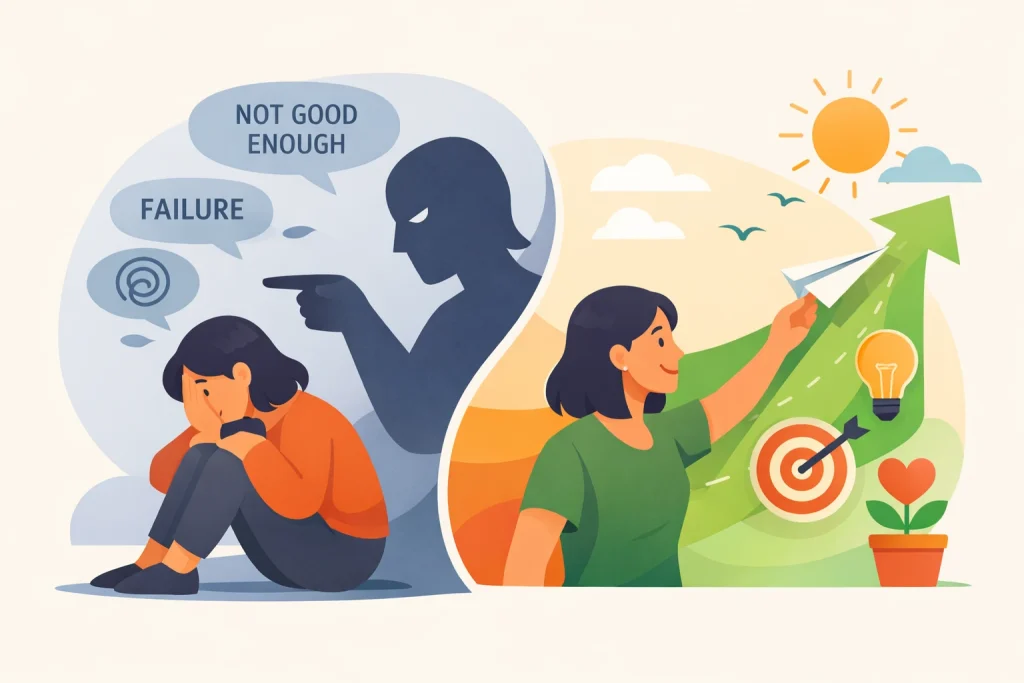
Table of contents:
The inner critic: the voice that confuses attack with guidance
It jumps in before real life even has a chance
The inner critic is not the same thing as healthy self-reflection. Healthy self-reflection waits for facts. It says, "That meeting went off track - maybe next time prepare the opening better." The inner critic does not wait. It barges in early and goes for the throat. "Don't say that." "You'll sound stupid." "Why are you wearing that?" "Other people can do this. You, apparently, cannot." Charming roommate, truly.
It often shows up in tiny moments, which is why people miss how much power it has. You hesitate before raising your hand. You rewrite a message six times. You feel a weird drop in your stomach after posting something harmless online. The critic works fast. So fast, in fact, that many people assume its voice is just "reality" or "being honest with myself." It usually isn't.
It speaks in verdicts, not in useful details
Another giveaway is the language. The inner critic loves sweeping conclusions. Always. Never. Everyone. No one. It turns one awkward moment into a personality diagnosis. Miss one deadline? "You're unreliable." Freeze in one conversation? "You're pathetic under pressure." Need rest? "Lazy." That style matters, because broad, identity-based attacks are much harder to learn from than concrete observations.
Constructive inner guidance is specific and boring. A harsh critic is dramatic, absolute, and weirdly theatrical. It acts as if every stumble reveals your final form as a human being. Which, come on. Most stumbles reveal that you were tired, underprepared, distracted, scared, or simply alive on a Tuesday.
It often sounds like you, but it was not born with you
A lot of this voice is borrowed. It can be stitched together from childhood criticism, perfectionistic families, snarky classrooms, high-pressure jobs, social media comparison, or a culture that treats relentless self-improvement like a religion with expensive stationery. Over time, those messages move in-house. Then they stop sounding like "something I absorbed" and start sounding like "me."
That is one reason the inner critic can feel so convincing. Familiarity creates authority. If you grew up around sharp judgment, your nervous system may mistake harshness for seriousness. This is also why it often overlaps with perfectionism and the old "not enough" loop of low self-esteem. If that overlap feels familiar, it helps to understand perfectionism as more than "having high standards," because the pressure to be flawless often gives the inner critic even more material to work with. Different patterns, same family resemblance.
It pretends to protect you, then keeps you small
Here is the sneaky part. The inner critic usually claims it is helping. It says, in effect, "If I shame you first, maybe nobody else will." Or, "If I push hard enough, you'll finally get it right." So the voice does have a kind of protective job. Bent, clumsy, exhausting - but protective. It tries to prevent rejection, failure, embarrassment, loss of status. The trouble is that its method is terrible.
Shame can produce short bursts of effort, sure. It can also produce avoidance, hiding, indecision, burnout, and that brittle sort of fake competence people wear when they are scared of being seen in progress. The inner critic does not make growth spacious. It makes growth cramped. You may still achieve things with it barking in your ear, but the whole journey feels like running with a stone in your shoe. Possible, yes. Nice? Not remotely.
What changes when that voice stops running the place
You start acting before you feel flawless
One of the first shifts is wonderfully unglamorous: you begin doing things with fewer ceremonies of self-doubt. You send the draft. You ask the question. You apply for the role even though your brain is muttering about the one bullet point you do not match. You stop waiting to feel sparkling, polished, blessed by the productivity gods. That is often the moment healthy ambition starts to look different too - less like constant self-pressure, more like the willingness to move toward something meaningful before you feel fully ready.
That matters because progress usually belongs to people who can tolerate being unfinished. When the inner critic softens, you become more willing to learn in public a little. That strengthens everyday courage and even supports learnability, because being teachable gets much easier once "not perfect yet" stops feeling like a character defect.
Feedback stops feeling like a knife fight
A harsh inner critic makes outside feedback sting twice. First from the other person, then from the chorus in your own head that turns one note into a funeral march. When that internal layer eases up, something very practical happens: you can hear useful information without collapsing into self-defense or fake cheerfulness. "Good note, I need to tighten that section," lands differently from, "Ah yes, proof that I am fundamentally embarrassing."
This does not mean feedback becomes fun. Let's not get silly. But it becomes usable. And that is a big deal at work, in relationships, in creative life, anywhere reality needs a say. A quieter critic leaves more room for discernment. You can sort what is true, what is noise, and what simply reflects another person's taste or mood.
Your energy comes back from strange little leaks
People often underestimate how tiring self-attack is because it happens inside. No bruises, no sirens, no dramatic soundtrack. Yet constant inner correction drains a shocking amount of fuel. Replaying conversations. Anticipating judgment. Mentally editing your face, your body, your tone, your competence, your future. It's a lot. Enough to make ordinary tasks feel heavier than they really are.
When the critic loosens its grip, energy returns in small but real ways. You recover faster after awkward moments. You waste less time spiraling after minor mistakes. Rest feels less suspicious. Even pleasure gets simpler, because you are not spending half the nice moment observing yourself from the ceiling and grading the performance.
Your relationships get less armored
Inner climate spills outward. When you are brutal with yourself, you often become more guarded with other people too. Maybe you over-explain. Maybe you hide needs. Maybe you hear neutral comments as criticism and get prickly fast. Sometimes you become too easy to please, because disapproval feels bigger than it should. Sometimes the opposite - you go sharp first so nobody can catch you soft. Humans are inventive like that. When that defensive edge softens, friendliness often becomes easier to access too - not as fake sweetness, but as a more natural way of meeting people without bracing for danger first. If that braced state goes on for long enough, it can also quietly turn into resentment, because when you expect hurt everywhere, even small frictions can start collecting emotional weight.
With a less dominant inner critic, relationships tend to lose some static. You can apologize without groveling. You can disagree without hearing it as rejection. You can accept praise without instantly swatting it away like a mosquito. That change also supports steadier confidence: not the loud, polished kind, but the quiet sense that you do not have to keep prosecuting yourself to stay decent.
When the inner critic gets overgrown, life starts bending around it
You reject yourself before anyone else gets the chance
This is one of the most expensive effects, and it hides well. You do not only fear judgment from outside. You start doing the rejecting in advance. You do not pitch the idea. You do not flirt back. You do not post the work. You keep the question to yourself. It can look like modesty, caution, even "being realistic." Sometimes it is just pre-emptive surrender wearing a sensible cardigan.
The inner critic loves this move because it feels safe. If you never fully show up, nobody can fully reject you. Neat trick. Rotten outcome. A person can lose years this way, not in one dramatic collapse but in dozens of tiny self-cancellations that seemed sensible at the time.
Nothing you achieve ever quite sticks
When the critic is strong, success has the lifespan of cheap flowers. You do the thing, get the praise, survive the presentation, finish the project - and the mind moves the goalpost before the emotional evidence has even landed. "That was luck." "Anyone could've done that." "You should have done it sooner." "Yes, but look at the one clumsy part." So the nervous system never really gets to update.
This is one reason people with a loud inner critic can look accomplished and still feel oddly fraudulent. That experience often overlaps with imposter syndrome, where evidence of competence never seems to feel as convincing as the fear of being exposed, and the inner critic keeps narrating the gap. The win goes in through the front door and gets shoved out the back. Fast. Then they keep chasing proof that never settles because the issue is not lack of achievement. It is lack of permission to let achievement count.
Mistakes become identity emergencies
Another sign: the punishment does not fit the event. You forget a detail and suddenly you are not "someone who missed a detail." You are incompetent, hopeless, unserious, not to be trusted with adult life, apparently. The reaction is global. Total. Weirdly medieval. And because the brain hates that level of pain, it starts avoiding situations where mistakes are possible.
That is where the critic starts feeding other struggles. Procrastination. Overpreparing. People-pleasing. Overthinking. From the outside, that can start to look a lot like lack of self-discipline in ordinary life, even when the real driver is fear of getting things wrong rather than some deep moral flaw. Sometimes even touchiness, because when your own inner tone is harsh, outside comments can land on skin that is already sunburned. No wonder it hurts more.
You become hard to soothe, even with evidence
Friends reassure you. Partners compliment you. Your boss says the work is solid. Still, some part of you stays unconvinced. The critic has usually built an entire case by then, and it does not like witnesses for the defense. Evidence gets minimized. Warmth gets mistrusted. Praise sounds like politeness, pity, or a setup. Not because you are impossible. Because the system has learned that danger lives in imperfection, so safety must live in vigilance.
The trouble is, chronic vigilance makes a person brittle. You can become hyper-aware of tone, slower to rest, less spontaneous, oddly suspicious of your own joy. If that sounds familiar, it is worth pausing. Not to scold yourself some more - heaven forbid - but to notice the pattern clearly. A loud inner critic does not only hurt feelings. It distorts behavior, choice, and what kind of life starts to feel available to you.
How to loosen the inner critic without becoming careless
Catch the exact sentence, not just the mood
The critic gets power from vagueness. You just feel bad, small, wrong, off. So the first useful move is surprisingly plain: write down the exact line your mind is using. Not "I felt insecure." The actual sentence. "Everyone will see I have no idea what I'm doing." "I look ridiculous." "If I rest now, I'm lazy." Once the wording is visible, the spell weakens a bit. This is also where analytical thinking becomes surprisingly useful: instead of treating the thought like a verdict, you start testing it like a claim, and that creates a little room to breathe.
Why? Because precision lets you examine the thing instead of merging with it. You can hear the exaggeration, the cruelty, the mind-reading, the drama. A thought on paper is much easier to challenge than a cloud of dread floating through your chest.
Ask two annoying questions: whose voice, and what is it trying to prevent?
After you catch the sentence, ask where it seems to come from. A parent? A coach? School? An old partner? The internet on a bad day? You do not need a grand detective board with red string everywhere. Just notice the flavor. Many people realise, with a bit of a jolt, that the critic sounds suspiciously like somebody they would never willingly hire to run their inner life.
Then ask what the voice is trying to prevent. Shame? Rejection? Looking needy? Failing publicly? This matters because it shifts the conversation. Instead of, "How do I destroy this part of me?" the question becomes, "What safer, saner protection do I actually need here?" Boundaries, preparation, rest, practice, clearer standards - these are far better bodyguards than insult.
Turn verdicts into instructions
This is one of the quickest day-to-day tools. When the critic gives you a verdict, translate it into an action. "I'm terrible at presentations" becomes "I need to rehearse the first two minutes out loud." "I'm a mess with money" becomes "I need to look at my bank app before lunch and name the numbers honestly." "I'm so awkward" becomes "I want one slower breath before answering." Crude? A little. Effective? Often, yes.
Instructions calm the nervous system because they create movement. Verdicts freeze it. A brain stuck in identity attack is rarely good at problem solving. A brain given one concrete next move can usually work with that. Even on low battery.
Practice repair right after a wobble
The inner critic loves the vulnerable few minutes after you mess up. So build a replacement ritual for that exact window. Not later, not when you have become a perfectly healed woodland creature - right then. Try three lines: what happened, what matters, what is next. "I blanked in that meeting. It was uncomfortable, not fatal. I'll send the follow-up note this afternoon." Keep it plain. No poetry competition.
And one more thing: let positive evidence land, even if only for five seconds. If someone thanks you, do not rush to erase it. If you finish something well, pause before your mind starts lawyering against your own competence. This is not ego inflation. It is accuracy training. In a quiet way, that is also part of integrity: seeing yourself truthfully rather than through either vanity or contempt, and letting the facts matter. Over time, these little corrections teach the brain that self-respect and self-deception are not the same thing. Very important distinction, that one.
Should this be the thing you work on right now?
Not always. Some people really do need to soften the inner critic. Others are dealing with something more basic first: exhaustion, grief, a chaotic environment, constant stress, old trauma, maybe a life structure that would make almost anyone feel raw and self-doubting. In those cases, attacking the critic head-on can turn into yet another project for the critic to weaponize. Irritating, but true.
It helps to choose one development priority at a time. Otherwise you end up trying to become calmer, kinder to yourself, more focused, more disciplined, less perfectionistic, more confident, and somehow spiritually radiant by next Wednesday. That plan has... flaws. If your main pattern is self-attack, shrinking, overediting yourself, and never letting your own wins count, then yes, this may be the right place to begin.
If you want a cleaner way to sort that out, AI Coach can be a useful mirror. It helps you see what deserves attention first and gives you a simple plan for the first three days, which is often more helpful than circling your habits and calling it insight.
Frequently Asked Questions (FAQ)
What is the difference between an inner critic and a conscience?
A conscience helps you notice when your behavior is off and points you back toward repair. It is specific. The inner critic is broader and crueler. It does not say, "That comment was unfair." It says, "You are awful." One guides behavior. The other attacks identity.
Is the inner critic always a bad thing?
No. The part underneath it usually has a protective intention. It may be trying to stop embarrassment, rejection, failure, or social pain. The problem is not that it wants safety. The problem is its method. Shame, contempt, and constant inner pressure are lousy teachers.
Where does the inner critic usually come from?
Often from repeated outside messages that got absorbed over time. Family criticism, perfectionistic environments, bullying, conditional praise, rigid schools, harsh workplaces, comparison-heavy culture - any of these can help build it. Then the voice moves inside and starts sounding like "just me." Sneaky little process.
Why does my inner critic get louder when I am tired or stressed?
Because stress shrinks mental flexibility. When you are depleted, your brain is more likely to fall back on old threat patterns, black-and-white thinking, and habitual self-attack. Also, tired people make more ordinary mistakes, and the critic adores fresh material. Rest does not solve everything, but it often lowers the volume.
Can confident people still have a strong inner critic?
Absolutely. Some people look confident because they have learned to perform well, speak smoothly, or stay productive under pressure. Inside, the tone can still be brutal. In fact, high achievement sometimes grows right next to a loud critic, which is why outsiders get confused and think, "But you seem fine." Surface polish tells you very little about inner gentleness.
Is the inner critic connected to perfectionism?
Very often, yes. Perfectionism gives the critic a polished vocabulary: standards, excellence, discipline, self-improvement. But underneath, the emotional engine is often fear. Fear of being seen as messy, average, behind, needy, or not enough. That is why perfectionism can look impressive while feeling miserable from the inside.
How do I respond to harsh self-talk in the moment?
Do three things fast. Catch the exact sentence. Name it as a thought, not a fact. Then translate it into one concrete instruction. For example: "I'm going to embarrass myself" becomes "I need one note card and one slow breath before I start." The goal is not to become instantly serene. The goal is to stop the spiral from driving the car.
Can the inner critic affect romantic relationships?
Very much. It can make you over-apologize, hide needs, expect rejection, distrust praise, or hear neutral comments as criticism. Some people become clingy. Others become distant and sharp. Either way, the relationship ends up carrying stress that was partly created inside. A quieter inner critic often makes intimacy feel safer, because you are not constantly bracing.
What is the difference between being humble and having a strong inner critic?
Humility is accurate. It lets you be good at some things, weak at others, and still remain human-sized. The inner critic is not accurate. It distorts, dismisses strengths, magnifies flaws, and acts as if self-attack is morally superior to self-respect. Humility has room in it. The critic has a chokehold.
How can I help someone I love who is hard on themselves?
Do not try to out-argue every negative thought with shiny positivity. That usually bounces off. Reflect the pattern gently instead. Name what you notice: the harsh language, the way they erase wins, the speed of the self-blame. Offer specific counter-evidence and calmer language. And when they do something well, keep it concrete. "You handled that conversation with real steadiness" lands better than "You're amazing," which some inner critics swat away on sight.