
You can be doing everything "right" and still feel weirdly missing from your own life. The meetings happen. The groceries get bought. You reply to emails, maybe even with suspicious efficiency. People look at you and think, Oh, they're doing well. And meanwhile, somewhere under all that competence, a quiet question keeps tapping you on the shoulder: Is this... really it?
That's usually what a lack of purpose feels like. Not some dramatic collapse. Not a movie-scene crisis with rain on the window. More like living in a nice, fully furnished room that never quite feels like home. If that hits a little too close, yeah, stay with me.
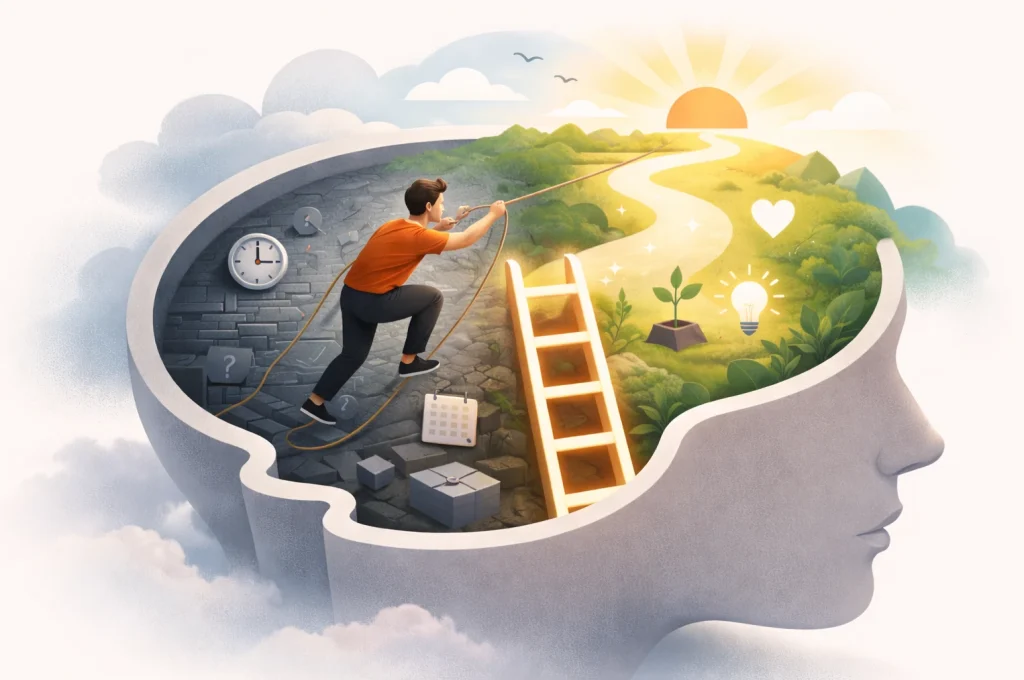
Table of contents:
When Life Has Motion but Not Meaning
It is not the same as having no goals
A lack of purpose is not just "I need better goals." Plenty of people have goals coming out of their ears. They want the promotion, the cleaner diet, the prettier apartment, the relationship, the side hustle with the tasteful logo and very serious beige branding. The problem is, those goals don't feel tied to anything deep enough to hold your weight. They sit there like errands. Important errands, maybe. But still errands.
So yes, you can be productive and still feel hollow. You can be admired and still think, Hm. I'm not buying my own life. Purpose has less to do with stuffing your planner and more to do with knowing why this effort deserves your actual life force in the first place. Bit of a big question, sure. But it matters.
Borrowed ambition is a very expensive hobby
One of the clearest signs? Your direction feels imported. You chase what sounds respectable, what your family approves of, what your industry rewards, what looks good when someone from high school checks your LinkedIn eleven years later after one glass of wine and a mild identity crisis. From the outside, it all looks sensible. Inside, though, it feels like wearing someone else's coat. It fits well enough to leave the house, fine, but you never really relax in it.
Sometimes the next step is learning to be honest but not harsh with yourself about whose goals you're actually living. Borrowed ambition survives best when nobody says the quiet part out loud. That's why people with a purpose gap often say things like, "I should be happy," and somehow it lands like a line from a script their heart never approved.
Motivation gets moody, flaky, almost suspicious
When there's no felt reason under your actions, motivation starts acting strange. Small tasks feel heavier than they should. Progress gives you a quick little hit, then vanishes like cheap perfume. Weekends become recovery time from a life you technically chose. Which is... not ideal.
You may tell yourself the answer is more discipline, better habits, a stricter calendar, a morning routine involving lemon water and moral superiority. And sure, structure helps. Sometimes it really does help to look at how to strengthen organizational skills in real life, because better structure reduces friction. But structure alone can't answer the deeper question: why does any of this matter to you? Without that, even good systems can feel like elegant storage for emptiness. The brain isn't always resisting because you're lazy. Sometimes it's asking, very reasonably, "Remind me why we care?"
Purpose is usually quieter than people expect
This problem hides well because people imagine purpose as a thunderbolt. Choir music. Destiny descending from the heavens with excellent lighting. Real life is rarely that theatrical. Purpose is often much quieter than that, almost annoyingly so.
You care about a certain kind of problem. You feel more like yourself in some roles than others. You can tolerate difficulty better when it serves something that matters to you. Time feels different there - not always fun, not always easy, but alive. So a lack of purpose often doesn't feel like daily catastrophe. It feels like the absence of that steady pull. A thin, persistent sense that life has become all mechanism and not enough meaning. Subtle, yes. But not small.
What Starts to Shift When You Know What Matters
Decisions stop chewing through so much mental energy
When your sense of purpose gets clearer, everyday choices stop turning into tiny courtroom dramas. Not because life becomes easy in some magical, soft-focus way. Just... easier. You spend less time circling the same questions: Should I say yes to this? Take this opportunity? Keep pushing this project? Stay in this role? You finally have something to measure those choices against.
Does this move me toward a life that feels true, or just toward a life that looks impressive from the outside? That one filter saves an absurd amount of energy. It also makes saying no feel less like betrayal. You're not rejecting life. You're protecting direction. Big difference, honestly.
Effort stops feeling like self-betrayal
A strong sense of purpose doesn't remove hard work. I wish. It changes the flavor of it. You can handle boredom, uncertainty, even setbacks better when they belong to something you actually care about. The work still tires you, of course. But it doesn't hollow you out in quite the same way.
That matters more than people think. A lot of exhaustion is not just about volume. It's about disconnection. When your actions line up with your values, your strengths, or the kind of impact you want to have, effort starts feeling cleaner. Less like being dragged behind your own life. More like being used well.
Your self-respect gets a backbone
There's a quiet psychological payoff here. When you move in a direction that feels genuinely yours, you stop needing quite so much outside applause to keep going. Praise is still nice. Money still matters. Rent, stubbornly, remains real. But your entire identity isn't hanging from whether other people clap for your choices.
That creates a steadier kind of confidence. Not the loud kind, not chest-out, look-at-me certainty. Something calmer. More grounded. You know what you're trying to build, serve, learn, fix, or contribute, and that makes you harder to knock sideways by trends, comparisons, or random opinions from people who would be spectacularly unhelpful in an actual crisis.
Joy becomes less random
Purpose changes the emotional texture of life. Good moments stop feeling like accidents. You notice satisfaction more often - after helping someone properly, finishing meaningful work, learning a skill that matters to you, making something honest, being useful in a way that actually fits your nature.
For many people, that feeling deepens when their effort becomes more generous and outward-facing, which is part of what gets better when you build benevolence, especially when usefulness turns into a real sense of connection with other humans. According to Self-Determination Theory, people function better when life includes autonomy, competence, and connection. It's a helpful lens here. Purpose tends to braid those things together: you're choosing, growing, and relating in ways that make sense to you. That's why life feels less flat when meaning comes back. Not perfect. Just more inhabited. And that's already a lot.
How a Purpose Void Starts Showing Up Everywhere
You keep changing your life, but the emptiness packs first
One classic sign is serial reinvention. New city, new routine, new app, new haircut, new productivity system, new identity phase, fresh notebook, noble intentions. For a minute, it works. You feel lighter. Hopeful, even. Then, annoyingly, the same dull dissatisfaction walks in carrying your name tag.
That's because a lack of purpose is not always a logistics problem. Sometimes people keep rearranging the furniture of life while the deeper question sits there untouched in the corner. At some point, you have to test direction through action, because what changes when you stop living on incoming is that your choices start coming from intention instead of the next external cue, trend, or panic-driven reset. What do I care about enough to organize myself around? If that answer stays blurry, novelty gives relief - not resolution. Fun for a weekend. Pretty bad as a life strategy.
Busy days still end with a weird kind of emptiness
Another pattern: you're not inactive at all. If anything, you're dependable, responsive, useful. People may rely on you heavily. Your calendar has things in it. Your inbox certainly does. And yet by the end of the day, your effort doesn't seem to land anywhere inside you. You feel spent, but not fulfilled. Full schedule, empty center. Brutal combo.
This is where people often confuse a purpose problem with plain fatigue. The difference is subtle, but it's real. Fatigue says, "I need rest." A purpose gap says, "Even when I rest, I still don't feel connected to anything that matters." That can create a low-grade numbness where entertainment replaces nourishment and productivity replaces direction. Life gets full, but somehow not fed. You ever have that feeling? It's sneaky.
Comparison gets louder because your own compass is faint
When your inner direction is weak, other people's lives start looking weirdly authoritative. Their career path, their relationship timeline, their move to Lisbon, their sourdough era, their nonprofit, their six-figure pivot, their suspiciously photogenic morning routine - suddenly all of it feels like evidence that everyone else got a map and yours got lost in the mail.
So you compare more. Copy more. Second-guess more. Not because you're shallow, not necessarily. Because unclear purpose makes outside signals feel like instructions. And that quietly feeds anxiety, envy, and that brittle little feeling of "I'm falling behind," even when the thing you're supposedly behind on doesn't actually fit you at all. That part stings.
Resentment and cynicism start creeping in through the cracks
Leave a lack of purpose alone long enough, and it can harden. People become sarcastic about ambition, dismissive about hope, irritated by questions they used to find interesting. Sometimes they overwork to outrun the emptiness. Sometimes they drift. Sometimes they do both in alternating weeks, which, let's be honest, is its own chaotic little circus.
Relationships can suffer too. When you feel disconnected from your own direction, other people's needs start feeling either intrusive or weirdly magnetic. You may cling to them for meaning, or push them away because you've got nothing left to give. That's one of the hidden costs here. Purpose isn't some luxury add-on for people with candles and free evenings. It helps hold a person together.
How to Rebuild Purpose Without Pretending You Heard a Cosmic Voice
Drop the fantasy of one perfect calling
The first useful move is almost boring, which is exactly why it works: stop waiting for one grand answer. That myth wastes years. Purpose is not always one job, one passion, one dazzling sentence you discover while staring at a lake in emotional high definition.
More often, it's built from patterns - what you care about, what kind of contribution feels honest, what pain or difficulty you're willing to tolerate, what kind of life makes you respect yourself. So lower the drama a notch. You are not trying to identify your destiny by Tuesday. You're trying to notice where meaning already shows up in small, repeatable ways. Much more doable. Slightly less cinematic, yes, but life usually is.
Keep an "alive moments" record
For ten days, write down three moments each day that felt mentally or emotionally alive. Not just pleasant. Alive. There's a difference. Maybe you explained something clearly to a coworker and felt that satisfying click. Maybe you calmed a messy situation. Maybe you wrote, taught, repaired, organized, made, listened, built, encouraged. Maybe you were outside for ten whole minutes and your nervous system stopped arguing with reality. Lovely when that happens.
After ten days, look for patterns. Purpose often leaves breadcrumbs in attention, not in abstract overthinking. What keeps pulling you in? What kind of usefulness energizes you instead of draining you dry? That little record can tell you more than another hour of staring at the ceiling asking what your life means. Ceiling-staring has its place, but still.
Use envy and irritation as clues, not verdicts
This one is sneaky, and surprisingly helpful. Notice who you envy and what exactly hurts. Not "she has a better life." Too blurry. Is it her creative freedom? His calm authority? Their community work? Their courage to choose less money for more meaning? Envy often points toward neglected desire. It's rude, but informative.
Irritation can do the same thing. What repeatedly frustrates you in the world may reveal what you care enough to improve, protect, challenge, or repair. The trick is to turn the feeling into information. Otherwise envy just becomes social-media heartburn, and that helps absolutely no one.
Run purpose experiments in real life
Then test, don't just think. Try small experiments for two weeks at a time. Mentor someone. Volunteer nearby. Take on a project that helps real people, not just your resume. Join a community effort. Learn a skill tied to a value you actually care about. Spend one Saturday making something instead of consuming nineteen opinions about making things. That one bites, I know.
Purpose grows through contact with reality. Action gives you emotional data that reflection alone can't. After each experiment, ask yourself: Did this make me feel more present? More useful? More like myself? If yes, stay near it. If no, good - that's still real information. I genuinely hope you get a few honest surprises here. Those can change more than people expect.
Should You Work on This Right Now?
Maybe. Maybe not, actually. Not every flat season means purpose is the main issue. Sometimes the real problem is burnout, grief, depression, financial stress, or a life structure so cramped that even meaningful things have nowhere to breathe. If you're not sure whether you're dealing with a meaning problem or an energy collapse, asking should burnout be your next growth focus can save you from mislabeling exhaustion as a life-purpose crisis. People do that all the time. If the emptiness feels heavier than a motivational slump, it may help to read how depression quietly takes over a life, because sometimes what looks like a purpose problem is really a deeper loss of energy, interest, and emotional traction.
It helps to name the real bottleneck. If your main pattern is "I function, but none of this feels like mine," then yes, this probably deserves serious attention. If you already know what matters but can't act on it because you're exhausted, scared, overwhelmed, or scattered in six directions, then another growth area may need to come first.
If you want a cleaner way to sort that out, AI Coach can help you figure out which area deserves priority right now and give you a simple plan for the first three days. Sometimes that kind of clarity is more useful than trying to reinvent your entire existence during one slightly emotional Tuesday night.
Frequently Asked Questions (FAQ)
What does a lack of purpose actually feel like day to day?
Usually not like a dramatic breakdown. More like a steady inner shrug. You do what needs doing, you show up, you keep things moving, but your effort feels disconnected from meaning. Days can be full and still feel oddly vacant, like your life is running but not really landing anywhere inside you.
Is it normal to not know your purpose in your 20s, 30s, or even later?
Yes. Extremely normal. Purpose is not something everyone discovers at 19 and then carries around forever in a neat little folder. For most adults, it shifts with age, work, health, family, grief, freedom, values - life, basically. The bigger problem isn't always "I don't know yet." It's when you stop paying attention and start living entirely by default.
How do I know whether I lack purpose or I'm just tired?
Tiredness usually improves, at least somewhat, with rest and a lighter load. A purpose gap feels different. You can rest and still feel disconnected, underfed, or strangely unconvinced by your own life. The two can overlap, of course. Burnout can blur purpose badly, which is why timing matters more than people think.
Does purpose have to be one big mission?
No, and thank goodness. That idea has wasted a frankly impressive number of human years. Purpose can be made of smaller threads: raising decent humans, building useful things, making hard topics easier to understand, caring for a community, creating beauty, solving practical problems well. It needs to feel meaningful. It does not need fireworks.
Why do successful people still feel empty?
Because success and purpose are not the same thing. Achievement can bring money, status, relief, even pride, and still fail to answer the deeper question: why does this matter to me? If your goals were borrowed, performative, or disconnected from your values, reaching them may feel more confusing than satisfying. Awkward, but true.
What is the difference between values and purpose?
Values are the qualities or principles that matter to you - honesty, growth, contribution, freedom, care, craftsmanship, things like that. Purpose is what happens when those values start shaping how you live and what you move toward. You could say values are the ingredients, and purpose is the meal. Slightly clumsy metaphor, yes, but it gets the job done.
Can anxiety or depression make purpose harder to feel?
Yes. Anxiety can crowd purpose out by making every choice feel loaded and risky. Depression can flatten interest, hope, and emotional access to meaning altogether. In those states, purpose may not disappear exactly, but your connection to it gets muffled. Which is one very good reason not to turn this into some moral lecture about "trying harder."
Do I need to quit my job to find purpose?
Not necessarily. Sometimes purpose grows by changing how you relate to your work, what you contribute, what you do outside work, or which role you stop forcing yourself to play. Sometimes, yes, the job really is part of the problem. But making a huge life move before you understand what you're moving toward can create expensive confusion. And nobody needs more of that.
How long does it take to find a sense of purpose?
Usually longer than one inspired weekend and shorter than your mind's most dramatic predictions. Many people start feeling more direction within weeks once they begin noticing patterns, trying real-world experiments, and loosening their grip on borrowed goals. Full clarity may take longer. Useful movement does not have to wait for perfect certainty.
What is one practical habit that helps purpose grow?
Keep a short record of alive moments. Just note when you felt engaged, useful, curious, moved, quietly proud, or deeply present. Over time, those moments reveal patterns your thinking brain tends to miss while it's busy narrating everything. If you want a research-friendly frame for why this works, Self-Determination Theory is a solid place to look at autonomy, competence, and connection
Can purpose change over time?
Absolutely. Honestly, it should. The purpose that fit you at 24 may feel too narrow at 39, and the one that carries you through a parenting season may differ from the one that wakes up later when life opens again. Purpose is not ruined by change. Sometimes change is the evidence that you're finally listening. If you're in that season now, I hope you give yourself a little grace - and enough curiosity to see what's trying to grow.