
Low self-esteem is what happens when your brain keeps ranking you last in some weird little competition nobody actually signed up for. You replay what you said, downplay what you did well, and turn one slightly awkward moment into a full evening trial in your head. Not always dramatic. Not always obvious. Just... exhausting, in that low-grade, daily way. Like a mosquito in the room that somehow survives every clap.
And the sneakiest part? Life starts to feel like one long audition where you're forever "almost right" but never quite picked. If that lands a bit too neatly, stay with me. This can shift. You do not need to become loud, wildly self-obsessed, or one of those people who posts "living my best life" while clearly being held together by caffeine and unanswered emails.
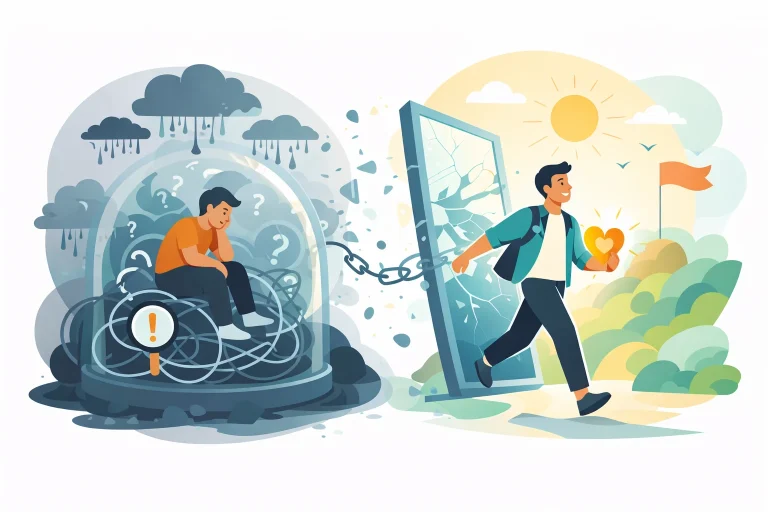
Table of contents:
Low self-esteem: when the picture you have of yourself keeps coming out warped
It is not just "feeling insecure sometimes"
Everybody has off days. Bad sleep, weird hair, one oddly sharp message from a coworker, and suddenly your whole mood is wearing a crumpled supermarket bag. Sure, that happens. Low self-esteem goes deeper than a rough Tuesday. It is a stubborn, repeated habit of seeing yourself as less capable, less worthy, less likable, or less important than you really are. Not because the evidence clearly says so, but because your mind has got a little too talented at editing reality in one direction only.
It highlights your mistakes in bright red and files your strengths under "probably luck." Helpful? Not exactly.
You assume you are the problem before the facts have even shown up
One of the clearest signs is how quickly blame finds you and settles in like it pays rent. A friend takes ages to reply, and your brain goes, "Ah. I must have said something weird." A meeting feels a bit awkward, and now obviously everyone noticed that one clunky sentence you said. Someone gives neutral feedback - not cruel, not glowing, just normal human feedback - and somehow it lands like a verdict on your whole character.
That is the trick low self-esteem pulls. It turns ordinary uncertainty into self-accusation. You do not wait for proof. You volunteer as tribute. Which, honestly, is a brutal way to move through adult life.
You shrink in places where you should be allowed to take up space
From the outside this can look pleasant. Flexible. Easygoing. "Anything is fine, I don't mind." But under that softness there is often fear - fear of being too much, asking for too much, needing too much, wanting too much. People with low self-esteem often struggle to say what they actually want, set a boundary, or let their preferences count for anything at all.
So they over-explain simple needs. They apologize before making a perfectly reasonable request. They talk as if their existence comes with a small inconvenience fee attached. If that feels a bit familiar... yeah. That is not just modesty. That is self-erasure dressed up in good manners. In a lot of cases, this pattern overlaps with people pleasing when being "nice" starts editing you out, because constantly trimming yourself down to stay acceptable can feel safe in the moment while quietly teaching you that your needs should always come second.
Praise bounces off, criticism moves in and starts redecorating
There is usually a strange filter problem too. Compliments feel suspicious, overblown, maybe even awkward. Criticism, though? Oh, that gets the penthouse suite. You can hear ten kind things and one slightly sharp remark, and guess which one your brain drags into the shower, the car, the supermarket queue, while you pretend to watch Netflix. Yeah. That one.
Low self-esteem makes good information feel flimsy and bad information feel carved into marble. If that pattern gets powered by emotions that hit hard and fast, it helps to understand what emotionality actually means, because strong feelings are not the enemy here - letting them decide your worth is. Over time, this builds a self-image that feels solid only because it has been repeated so often, not because it is true. Big difference. And comparison, of course, loves to throw petrol on the whole thing. That spiral often overlaps with perfectionism minus the flattering mythology, where the standard keeps floating upward while your sense of adequacy keeps shrinking. Other people start to look polished and complete, while you feel like the unfinished draft in the room.
What changes when you stop talking to yourself like an enemy
Decisions get cleaner
When self-esteem gets healthier, every decision stops feeling like a referendum on your worth as a human being. You can choose something without adding ten extra layers of "But what if I look stupid?" or "What if they think I'm overreaching?" That does not make you reckless. It just means your brain stops adding shame tax to ordinary action.
You apply for the role. You send the draft. You suggest the restaurant you actually want instead of saying "I'm easy" and then chewing through a sad salad you never wanted in the first place. Small things? Maybe. But life is mostly made of small things, isn't it. A steadier sense of self makes movement less sticky.
Relationships become less one-sided and more real
Low self-esteem often turns connection into performance. You try to be useful, pleasant, low-maintenance, easy to keep around. You become the person who says "No worries!" while privately having, in fact, many worries. The problem is that people do not really get to know you that way. They get the edited version. The safe cut. Not the full film.
As self-respect grows, relationships usually get simpler and warmer at the same time. You ask for clarification instead of assuming rejection. You stop chasing crumbs of attention like they are luxury goods. You can hear "no" without translating it into "I am not enough." That shift also leaves room for benevolence without becoming a doormat, so kindness stops meaning self-abandonment and starts including you too. In dating, friendship, family - all of it - closeness gets sturdier when it is not built on you disappearing.
Work stops feeling like one long exposure risk
At work, healthier self-esteem changes the emotional weather. Feedback becomes information, not humiliation. A mistake becomes something to fix, not proof that you were hired by accident and someone is about to notice. People with stronger self-esteem are usually more willing to speak up, negotiate, learn in public, and try things before they feel one hundred percent ready.
That overlaps a lot with what changes when learning stops feeling like a threat, because correction stops feeling like a public trial and starts becoming usable material. You can see more of that shift in what starts shifting when you become easier to teach, where feedback becomes something you can use instead of something you have to survive. The same shift often becomes part of how strong leadership transforms your life and work, because it is much easier to take initiative when your value does not collapse every time you are challenged. Pretty useful, really. Promotions, visibility, leadership, even salary conversations often go to people who can stand behind their value without internally folding like a camping chair. And if your work includes supporting newer colleagues, stronger self-worth also supports what gets better when you build mentorship skills, because it is far easier to guide someone when you are not spending half your energy dismissing your own value. Not because these people are always the smartest in the room, either. Often they are just not busy hiding.
You recover faster when life gets embarrassing, messy, or just very human
This might be one of the nicest changes. Resilience gets easier. When your worth is not hanging by a thread, you bounce back faster. An awkward date is just an awkward date. A clumsy presentation is a clumsy presentation. It is not your soul's permanent Yelp review.
You laugh sooner. Adjust sooner. Learn sooner. And with that comes a quieter kind of confidence - not "I'm amazing at everything," because, please, spare us - more like, "I can survive being imperfect and still belong here." That feeling is gold. It makes growth less scary because failure stops feeling like exile.
When low self-esteem gets too much power, it starts choosing for you
You can become wildly productive for all the wrong reasons
Low self-esteem does not always look like hiding, doubting yourself, and avoiding mirrors. Sometimes it looks impressive. Efficient. High-functioning as hell. You overprepare, say yes too quickly, work harder than necessary, and keep trying to earn a basic sense of legitimacy through output.
From the outside, people may call you driven. Inside, it often feels more like panic wearing decent shoes. Rest becomes oddly uncomfortable because the old voice gets louder the second things go quiet. Achievement helps for about six minutes, and then the bar slides away again. That cycle burns people out fast, because no amount of doing can heal a wound that keeps whispering, "Still not enough." If that kind of polished panic feels familiar, it is worth reading burnout explained without the buzzwords, because overworking for approval can look admirable long after it has started draining you dry.
You accept treatment that should bother you much more than it does
This is one of the rougher effects. If some part of you already believes you are lucky to be chosen, included, dated, hired, or merely tolerated, your standards start slipping in ways you barely notice at first. You excuse disrespect. You stay too long in lopsided situations. You explain away behavior that would make you furious if it happened to someone you love.
Why? Because low self-esteem makes deprivation feel normal. It lowers the price at which you hand yourself over. That shows up in relationships, sure, but also with bosses, clients, relatives, friends - the whole circus. The inner script becomes, "Maybe this is just what I should expect." Small sentence. Dangerous sentence.
Ordinary moments start carrying way too much threat
When self-esteem is shaky, everyday life can feel oddly exposing. Introducing yourself. Posting something online. Asking a question in class. Wearing clothes you actually like instead of the social camouflage outfit. Saying, "That doesn't work for me." None of these things are objectively catastrophic, and yet your whole system reacts as if social ruin is one wrong move away. There is a difference between healthy awareness and fear dressed up as wisdom, and if you want a clearer framework for that, how entrepreneurs can balance caution and risk shows how caution can stay useful without taking over, which is why it helps to learn how to become more cautious without turning into a coward when your brain treats every small risk like a five-alarm social emergency.
That can blend with anxiety and overthinking until the day fills with these tiny private alarms. You rehearse. Delay. Soften. Retreat. Then later, you get annoyed with yourself - which, naturally, feeds the whole loop. Mean little machine, that one.
Your identity starts depending too much on other people's weather
Maybe the deepest cost is this: you stop being the main source of your own evaluation. Your sense of self leans too hard on approval, reassurance, signs, replies, reactions, warmth. If people are warm, you feel okay for a bit. If they are distracted, blunt, tired, or simply busy dealing with their own lives, your self-worth drops through the floor.
That is exhausting because people are inconsistent. They have deadlines, headaches, unread texts, family drama, odd moods, all the usual human clutter. If your worth rises and falls with every social signal, stability becomes nearly impossible. Over time, this can feed isolation, resentment, and sometimes the heavy flatness people associate with depression in everyday life. Not every confidence issue is depression, obviously. But if the heaviness feels broader than self-doubt, it helps to understand depression in real life, because low mood, numbness, and shame can blur together more than people expect. The overlap is real enough to take seriously.
How to start rebuilding self-esteem without pretending to be confident all day
Name the voice, then fact-check its favorite lines
The first step is not positive thinking. For a lot of people, that stuff slides right off like a sticky note on a wet wall. Start smaller, and sharper. Notice the lines your mind repeats most often: "I'm awkward," "I always ruin things," "People only keep me around out of politeness." Write one down exactly as it shows up.
Then ask two plain questions: what is the actual evidence, and what evidence does this sentence keep conveniently skipping? You are not trying to become your own motivational speaker. You are trying to catch distortion in the act. That alone creates breathing room - and breathing room matters a lot more than fake confidence ever will. And if you want a more practical next step, learning how to build confidence gives that fact-checking process somewhere to go, so you are not just arguing with the inner critic but slowly collecting better evidence about yourself.
Practice preference reps in low-stakes situations
People with low self-esteem often lose touch with basic preference. Not some giant life mission. Just ordinary choice. Tea or coffee. Window seat or aisle. This film or that one. So train that muscle on purpose. Pick the place for lunch. Say what time works for you. Send the food back if the order is wrong - politely, no dramatic violin music needed.
These tiny acts teach your nervous system something surprisingly important: having a preference does not make you difficult, selfish, or unsafe to love. Sounds obvious on paper. Feels much less obvious when your whole body has learned to disappear first.
Build self-trust through kept promises, not big speeches
Self-esteem grows when you experience yourself as someone you can rely on. That does not come from staring into a mirror and declaring greatness like a game-show host. It comes from follow-through. Quiet, boring, almost annoyingly unglamorous follow-through.
Pick one very small promise for the week and keep it. A ten-minute walk after dinner. Sending one email you have been dodging. Going to bed when you said you would - twice, even, that counts. The point is not productivity. The point is evidence. Every kept promise says, softly but clearly, "I matter enough to be looked after by me." That tends to sink in deeper than hype.
Change the company your inner critic keeps
Low self-esteem is rarely built in a vacuum, and it almost never heals in one either. Pay attention to the places that make you feel chronically smaller. Maybe it is a group chat built entirely on status games and subtle little digs. Maybe your social feed is one endless parade of filtered perfection and humblebragging. Maybe one person in your life treats teasing like a personality trait, and you keep calling it banter because calling it what it is would be... inconvenient.
Reducing those inputs is not weakness. It is sane housekeeping. Then add better inputs on purpose: people who are clear without being cruel, honest without performing superiority, warm without making you earn basic dignity first. Your self-image is shaped in relationships. Always has been. So yes, it makes sense to choose surroundings that do not keep poking the bruise.
Should this be your next growth focus?
Not always. Some people really do need to work on low self-esteem. Others are dealing with something close to it, but not quite the same thing - grief, burnout, depression, old trauma, an environment that keeps shaming them, plain exhaustion. If the ground under you is shaky for those reasons, "just build confidence" can turn into one more irritating assignment instead of actual help.
It is usually smarter to ask where life keeps getting blocked. Are you holding back because you feel fundamentally lesser, or because your nervous system is fried, your relationships are unsafe, or your workload is absurd? Sometimes it also helps to ask is adaptability even the right thing to work on first, because if change keeps knocking you sideways, the issue may be less about self-worth and more about how hard it is for you to adjust under pressure. Pick the right door first. Otherwise your effort scatters everywhere and you end up doing self-improvement cosplay, which... not exactly the dream.
If you want help sorting that out, AI Coach can be genuinely useful. It helps you figure out what deserves attention first and gives you a simple plan for the first three days. And honestly, that kind of clarity can be worth more than another month of vaguely promising yourself you'll "work on you."
Frequently Asked Questions (FAQ)
What are the most common signs of low self-esteem?
The usual signs are harsh self-talk, constant comparison, difficulty accepting praise, fear of disappointing people, over-apologizing, and treating small mistakes like proof of personal failure. Some people become chronic people-pleasers. Others turn into overachievers who look polished on the outside and completely wrung out on the inside. It does not always look shy, which can throw people off.
What causes low self-esteem in the first place?
Often it grows out of repeated criticism, neglect, bullying, unstable caregiving, humiliation, or growing up in places where love felt conditional. Later, it can be reinforced by toxic relationships, perfectionistic work cultures, relentless online comparison, or long stretches of stress and failure. Usually it is not one giant dramatic event. It is repetition. Little cuts count too - maybe especially those.
How is low self-esteem different from low confidence?
Confidence is usually more specific. You might feel shaky about public speaking, dating, money, or your new job. Self-esteem is broader. It is the underlying sense of worth you carry into all those situations. You can be confident at work and still have low self-esteem in relationships. Plenty of people do, and yes, it is a deeply confusing combo.
Can low self-esteem affect relationships?
Very much. It can make you cling, withdraw, over-give, accept poor treatment, or see rejection in moments that are actually neutral. It also makes real intimacy harder, because you may keep offering the "safe" version of yourself instead of the true one. People can get close to your performance and still not really know you. That hurts in a very specific, lonely way.
Does social media make low self-esteem worse?
For many people, yes. Social media compresses thousands of edited moments into a fake standard your nervous system still reacts to as if it were real life. If you already lean toward comparison, that stream can quietly confirm your worst fears: everyone else is prettier, calmer, richer, more wanted, more sorted. None of that is a fair comparison, but your body may not care much about fairness in the moment.
Can successful people still have low self-esteem?
Absolutely. Success can hide low self-esteem extremely well. Some people become impressive precisely because they are trying to outrun the feeling of not being enough. The outside may look strong, capable, even enviable. Inside, they can still be ruled by fear, self-doubt, and the need to keep proving something. Achievement is not the same as peace. Not even close.
Is low self-esteem linked to anxiety or depression?
Yes, often. Low self-esteem can feed anxiety by making ordinary situations feel more threatening and socially expensive. It can also overlap with depression, especially when someone feels hopeless, withdrawn, numb, or deeply self-critical for long stretches. They are not the same thing, but they do travel together pretty often - like two awful houseguests who keep saying they are "just here for one more night."
Can low self-esteem come from childhood even if life looks fine now?
Yes. Old beliefs do not magically update just because your adult life improved on paper. You can have a decent job, good friends, a caring partner, and still carry a nervous system shaped by shame or conditional approval. The mind tends to keep living by old rules until those rules are questioned, felt through, and replaced in real day-to-day life.
How long does it take to improve self-esteem?
It depends on how long the pattern has been there, what keeps feeding it, and whether you are working only on thoughts or also on behavior, boundaries, relationships, and self-trust. Small shifts can happen fairly quickly. Deeper change usually takes repetition. Annoying answer, I know. Still true. The encouraging bit is that progress often shows up before you feel fully "healed."
What helps more than empty affirmations when self-esteem is really low?
Three things usually help more: catching distorted self-talk, building evidence through kept promises, and practicing visible self-respect in ordinary moments. That means saying what you prefer, asking for what is reasonable, and spending less time in environments that keep reinforcing shame. Warmth matters, yes. But warmth without evidence can feel flimsy. You need both.
When should someone get extra support for low self-esteem?
If low self-esteem is affecting your work, relationships, eating, sleep, daily choices, or basic sense of safety, it deserves real attention. Same if it is tied to trauma, abuse, self-harm thoughts, or long periods of hopelessness. When the pattern is running your life instead of merely bothering you now and then, that is a strong signal. Your life should not feel like one long apology. And if this is where you are - genuinely, I hope you get solid support. You deserve that.