
Procrastination is that odd little split where one part of you genuinely cares about the thing, and another part suddenly develops a burning interest in wiping the kitchen counter, checking one harmless email, or researching the entire history of cast-iron pans. Ridiculous? A bit. Familiar? Probably. And if your days keep sliding by while the important task just sits there, quietly bulking up into some dark emotional kettlebell in the corner, this is not a tiny inconvenience. It chips away at your confidence in such a plain, sneaky way that you may not even notice the bill you are paying.
And no, it is not always laziness in sweatpants. A lot of the time it is avoidance wearing glasses and speaking in complete sentences. If that stings a little, stay with me.
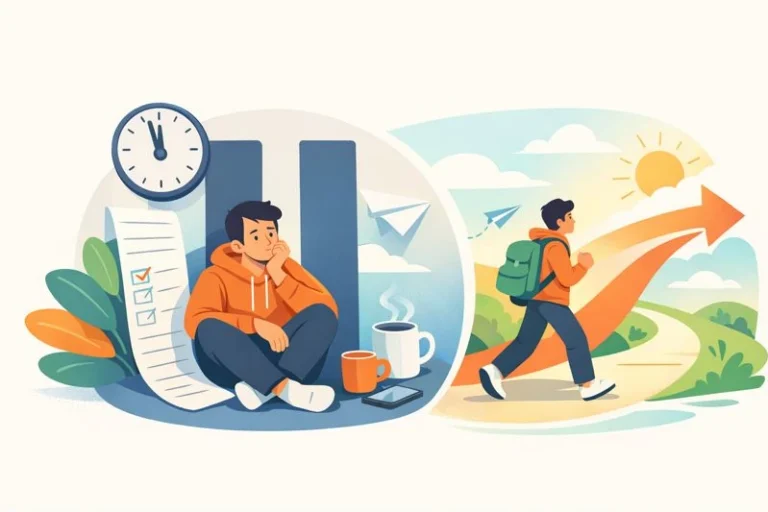
Table of contents:
Procrastination: why the task gets heavier before you even touch it
It is rarely just "bad time management"
People love to talk about procrastination like it is a calendar problem. Buy a better planner. Download a shinier app. Wake up at 5:12 a.m. and become one of those glowing people who stretches in a sunbeam and drinks lemon water on purpose. Cute fantasy. Real procrastination is usually messier than that.
You may know exactly what matters. You may even have the time blocked off, color-coded, blessed by productivity YouTube. And still... you drift. That is also why planning helps only up to a point: structure can reduce friction and make the next step easier to see, sure, but it cannot magically calm the fear, boredom, resentment, or pressure wrapped around the task. That is where time management skills are useful but limited: they can reduce clutter and make action easier to start, but they cannot do the emotional part of the job for you. Sometimes the drift is not only about fear or boredom, either. It is also about FOMO quietly bending your behavior out of shape, because the thing in front of you has to compete with the suspiciously thrilling idea that something more exciting, more rewarding, or more validating might be happening somewhere else.
That is why procrastination often starts before the schedule even matters. It begins in the moment your mind bumps into resistance: uncertainty, boredom, pressure, fear of doing it badly, fear of discovering you are not as brilliant as you hoped. At that point the task is no longer just a task. It becomes a feeling problem. And feelings, inconveniently, do not care how tidy your calendar looks.
Delay is often a form of emotional self-protection
This is the bit people miss all the time. Procrastination can look irrational from the outside, but from the inside it often makes short-term sense. You avoid the report, the phone call, the application, the horrible little login portal for your taxes, because not doing it gives you a quick hit of relief. Briefly, deliciously, you do not have to feel exposed, confused, trapped, stupid, behind, not-ready-yet. Ahh. Sweet temporary escape.
So your brain learns a rather dumb but efficient lesson: delay now, feel better now. Let future-you deal with the crater. Researchers have been pointing for years to procrastination as a self-regulation issue, especially an emotion-regulation one, and honestly, everyday life backs that up pretty well. People do not only postpone tasks. They postpone discomfort. Big difference.
Your future self keeps getting volunteered for unpaid labor
Procrastination also carries a very specific fantasy: tomorrow-you will be clearer, calmer, sharper, less distractible, weirdly noble. Tomorrow-you will open the laptop with quiet purpose, not stare at the blinking cursor like it has personally insulted the family. Tomorrow-you, apparently, is built from oak, magnesium, and excellent sleep hygiene.
Meanwhile, today-you quietly hands that poor person another stack of leftovers. This is why procrastination is not passive, not really. It actively shoves pressure forward. The deadline creeps closer. Your options shrink. The emotional price goes up. And by the time you finally begin, you are no longer starting fresh. You are starting under a damp little cloud of catch-up, guilt, and mild self-disgust. Lovely atmosphere. Very inspiring.
It hides behind surprisingly respectable behavior
Procrastination is not always couch-scrolling in pajama pants. Sometimes it looks polished enough to get compliments. You color-code your notes instead of writing the draft. You read one more article, then another, then maybe a "deep dive" because you are being thorough, obviously. You answer easy messages. You rename files. You decide the desk should really be cleaner before serious work can begin. Ah yes, the ancient religion of Productive Avoidance.
Real organizational skills are supposed to move the work forward, not put a tasteful frame around the delay. If your system keeps getting prettier while the actual task remains untouched, avoidance may simply be wearing a respectable jacket.
And that is why smart, capable, ambitious people procrastinate all the time. Intelligence does not cancel avoidance. If anything, clever people can invent world-class reasons not to start. They do not say, "I am scared." They say, "I am still refining the approach." Which does sound much better over brunch, to be fair. But if you keep preparing, circling, tidying, researching, and optimizing without actually touching the thing, then... well, the pattern is still the pattern.
What becomes possible when you stop living in "later"
Work stops carrying so much emotional drag
One of the nicest shifts, when procrastination eases up, is not even higher output. Though yes, that is nice too. It is the drop in emotional friction. Tasks stop feeling like cursed objects in the corner of the room, quietly radiating accusation. You think of a task, you begin the task, and your whole nervous system does not have to stage a courtroom drama first.
That matters because so much misery around work is not the work itself. It is the dread before it. The circling. The bargaining. The weird little rituals of not-beginning. Once that load gets lighter, ordinary responsibilities stop eating so much mental space. You get more of your day back, not by becoming some productivity superhero, but by wasting less energy wrestling the first step.
Momentum starts feeling natural, not theatrical
When procrastination loosens its grip, progress gets less dramatic. You no longer need panic, guilt, or a heroic last-minute sprint to get moving. And that is huge. Panic is a terrible manager. It gets results sometimes, sure, but it leaves muddy footprints all over everything.
Steadier action lets effort build in a calmer, almost boring way. A draft grows page by page. The taxes get handled before they become a full-blown identity crisis. You book the doctor's appointment before your body has to send follow-up letters in bold. Small moves start mattering again. Life becomes less about rescue missions and more about rhythm. Boring? Maybe a little. Effective? Almost annoyingly so.
You recover a quieter kind of self-respect
There is a dignity piece here too, and not the glamorous kind. Not movie-trailer dignity, with wind in your hair and orchestral music swelling in the background. I mean the plain, useful kind that shows up when you tell yourself, "I'll handle this," and then, more often than not, you actually do. It changes the sound of your own inner voice.
People often chase confidence as if it were some mood they need to summon out of thin air. But confidence grows much better from evidence than from pep talks. When you procrastinate less, you give yourself that evidence. That is why confidence often looks less like bravado and more like quiet follow-through, because every completed promise teaches your brain that your word to yourself can be trusted. Not perfect consistency. Nobody needs another fake productivity saint. Just enough proof, repeated often enough, that your intentions and your actions are no longer living in separate apartments.
Rest becomes cleaner and relationships get easier
Another benefit people underestimate: rest starts feeling like actual rest. Not fake rest with dread smeared over it like cheap frosting. Real rest. You watch the movie, go to dinner, play with your kid, take Saturday off, and your brain is not muttering in the background about The Thing You Keep Avoiding. That alone is a small miracle, honestly.
Other people feel this shift too. You reply earlier. You miss fewer deadlines. You stop bringing frantic 11:48 p.m. energy into shared projects. You are easier to trust, easier to collaborate with, and frankly easier to live with. Chronic delay does not stay private. It splashes. So does follow-through, in a much nicer way. In team settings, this is often part of what changes when leadership gets stronger, because people trust you more when you deal with discomfort early instead of exporting stress to everyone else at the last minute.
When delay becomes a lifestyle, not an exception
The task expands in your imagination
Leave something untouched long enough and your brain starts dressing it up like a monster in a hallway. The email becomes delicate and dangerous. The proposal turns into a referendum on your talent. The simple conversation somehow requires ideal wording, perfect timing, and maybe the correct moon phase. Meanwhile, half the misery is homemade.
This is one of the nastier parts of procrastination. Delay makes the task feel bigger than the task. Not always objectively bigger, though sometimes yes, consequences do pile up. But bigger emotionally. Bigger symbolically. Bigger in the body. So you avoid it more, which makes it loom larger, which makes the avoidance feel even more reasonable. Round and round. Efficient little trap, really.
Urgency takes over where intention should have been
When procrastination gets chronic, life starts running on countdown energy. You do things because the consequences are finally hot enough, not because the timing makes sense. The deadline is tonight. The fridge is empty. The fee jumps tomorrow. Your boss follows up again, with that very polite but very pointed email. Only then does the engine sputter to life.
Some people get so used to this that they mistake panic for focus. They say they "work best under pressure." Sometimes what they mean is they work only under pressure because early action feels emotionally flat, and flat feels weirdly harder to start. But living like that keeps the nervous system jumpy and overcaffeinated even if you are not drinking caffeine. You are not really choosing your effort. You are waiting to be cornered into it. If that pattern keeps showing up across work, health, money, and relationships, it may help to look at what low self-discipline looks like in ordinary life, because sometimes procrastination is not only about one avoided task but about follow-through quietly breaking down in several parts of life at once.
Shame starts talking louder than information
At first procrastination creates inconvenience. Then, if it hangs around long enough, it starts spinning identity stories. "Why am I like this?" "What is wrong with me?" "Other adults can do basic things, why can't I?" That voice can get nasty very quickly. And once it does, coming back to the task feels heavier than ever.
This matters because shame is not useful information. It does not tell you why you stalled. It does not tell you what kind of task trips you up, what feeling was underneath it, what support would help, what system broke down. It just makes you smaller. A lot of procrastination gets maintained not by the task itself, but by the self-attack that grows around it afterward. Grim little bonus feature, that.
Your work, money, and trust take quiet hits
Chronic procrastination also leaks into practical life in unpoetic ways. Late fees. Rushed work. Missed chances. A reputation for being "really talented but hard to pin down." People may not sit you down and lecture you about it. Usually they just adjust. They stop counting on the polished promise and start waiting for proof.
Then there is the private cost. When you postpone health admin, relationship conversations, or financial decisions, life gets more expensive. Not always in money, though yes, sometimes painfully in money. Often in tension, avoidable conflict, and doors that close before you get there. And that is the real sting. Procrastination does not only steal hours. It steals timing. Which is sometimes the same thing as opportunity.
How to break the stall without turning your life into a boot camp
Use a doorway move, not a full heroic start
When a task feels too big, stop demanding a complete beginning. Give yourself a doorway move. Open the document and write the title. Put on the running shoes and step outside for four minutes. Open the billing portal and log in, that is it for now. A doorway move is smaller than a whole work session and much more concrete than "I should really get to it."
This works because starting is often the steepest part. Once your body crosses the threshold, resistance usually drops a notch. Not always. Let us not get mystical about it. But often enough that it is worth using on purpose.
Make a "bad first pass" your official policy
Perfectionism feeds procrastination the way birdseed feeds pigeons. Scatter enough of it around, and suddenly the whole place is full of flapping nonsense. If the first attempt has to be elegant, insightful, organized, and somehow evidence of your worth as a human being, your brain will keep finding reasons to wait.
So change the deal. Your first pass is allowed to be clumsy, half-baked, and a little embarrassing. For writing, that might mean a rough paragraph full of brackets and blunt notes. For admin, maybe it is a scrappy list of missing pieces. For a difficult conversation, maybe it is just the three points you actually need to say, instead of rehearsing a TED Talk in the shower. The point is not quality first. The point is contact first.
Name the feeling before you negotiate with the task
A surprisingly useful question is this: "What am I unwilling to feel right now?" Not what task am I avoiding. What feeling. Boredom? Confusion? Fear of doing it badly? Resentment, because you never wanted the task in the first place? If that feeling keeps showing up, it may help to notice how too much resentment shows itself, because procrastination is sometimes less about laziness and more about quietly resisting what has started to feel heavy, unfair, or imposed. Name it plainly. The delay often softens once the hidden emotion is sitting out in the open instead of driving the car from the back seat.
Then try one clean sentence: "I can feel reluctant and still do ten minutes." That sentence is far more useful than waiting to feel inspired. Inspiration is lovely, yes, but wildly unreliable, like a friend who texts "five minutes away" while still in the shower.
Shorten the distance between action and visibility
Procrastination loves private vagueness. Fog is its favorite weather. So make progress visible sooner. If you are working on something solo, send a midpoint snippet to a colleague, classmate, or friend. Not for applause. Just for contact. "Here is the outline." "Here is the first graph." "Here is what I have by 3 p.m." That small act interrupts the fantasy that the task is still abstract and can be dealt with later, in some magical cleaner future.
Another version is physical. Leave evidence for yourself. A stack on the table. The form printed and clipped. The instrument already out of its case. Running shoes by the door where they can silently judge you. Out of sight is not always out of mind, but it is very often out of hand.
Do a nightly de-fog, not a guilt review
At the end of the day, do not ask, "Why was I useless?" Charming question. Terrible results. Ask instead, "Where did I stall, and what snagged me?" Keep it factual. Maybe the task was vague. Maybe it required a decision you had not made. If every next step keeps turning into another internal debate, it may help to notice when choice starts draining more than it gives, because procrastination often grows faster when even small decisions start feeling oddly expensive. Maybe your energy was toast by 4 p.m. Maybe you kept pretending a forty-minute job was a five-minute one, which, come on, we have all done it.
A little critical thinking helps here, because separating the real obstacle from the dramatic story wrapped around it makes the next move much easier to spot.
Then choose one adjustment for tomorrow. Not a total personality overhaul. One adjustment. Move the task earlier. Shrink the scope. Ask for the missing info. Delete the fake optional step that somehow keeps eating thirty minutes. Procrastination tends to shrink faster when you study its mechanics than when you build a moral case against yourself. Strange, but true.
Is procrastination actually the knot to untie first?
Not always. Sometimes procrastination is the main pattern. Sometimes it is only smoke. The fire underneath may be burnout, grief, depression, ADHD, perfectionism, a goal you do not truly want, or a life setup that leaves you wrung out before the important work even starts. Which is why barking "be more disciplined" at yourself can miss the point by a mile.
It helps to choose your next area of work carefully. If you try to fix everything at once, effort gets scattered and you end up with six half-started self-improvement projects, which is... well, painfully on-brand for this topic. If what is really going on is exhaustion or emotional overload, starting with pure discipline may just create a neater-looking struggle.
If you want a clearer read on what deserves attention first, AI Coach can help sort the priorities. It is a simple way to see which skill or pattern matters most right now and get a practical plan for the first three days, without turning your whole life into a self-improvement side hustle.
Frequently Asked Questions (FAQ)
What is procrastination in simple terms?
It is the habit of delaying an important task even when you know the delay will probably make life harder. The key part is this: it is not simple forgetfulness. You know the thing matters, and still you push it away.
Is procrastination the same as laziness?
No. Laziness suggests you do not want to make effort at all. Procrastination usually looks more like conflict than indifference: you do want to do the task, you feel bad about not doing it, and yet somehow you still avoid it.
Why do I procrastinate even on things I genuinely care about?
Because caring raises the stakes. If the task matters, it can wake up fear of failure, fear of not being good enough, or pressure to do it perfectly. The more meaningful the thing is, the easier it is for avoidance to sneak in wearing a clever little disguise.
Can procrastination be connected to perfectionism?
Very often, yes. If your brain treats the first attempt like a verdict on your worth, starting feels risky. That is why a deliberately rough first pass helps so much. It lowers the emotional entry fee.
Is procrastination a sign of ADHD?
Sometimes, but not automatically. ADHD can make task initiation, attention control, and follow-through much harder, so procrastination may show up as part of that picture. But plenty of people procrastinate without ADHD. The patterns overlap. They are not the same thing.
Why do I do random chores instead of the one important thing?
Because the brain often reaches for tasks that offer quick completion, visible progress, or low emotional risk. Washing dishes is gentler on the nerves than sending a vulnerable email or starting a report with fuzzy expectations. Productive avoidance is still avoidance, even if the sink looks amazing.
Does stress make procrastination worse?
Yes, very often. Stress narrows attention and increases the urge for quick relief. When your system already feels overloaded, the brain becomes more likely to dodge the task that feels most uncomfortable, even if the dodge creates bigger stress later. Which, annoyingly, it usually does.
Can procrastination hurt self-esteem?
Absolutely. Repeated delay creates a gap between what you intend and what you actually do. Over time, that gap can make you doubt your own promises, judgment, and ability. The damage is often gradual, almost quiet, but it is real.
What should I do when a deadline is close and I have already procrastinated?
Strip the task down fast. Drop nonessential polish. Define the minimum acceptable version and finish that first. Do not spend your last hours on shame, elaborate planning, or a dramatic personal reckoning. Right now you need completion, not philosophy.
Can procrastination ever be useful?
Occasionally, yes. A short pause can reveal that the task is poorly defined, unnecessary, or emotionally loaded in a way that needs attention first. But that is not the same as chronic procrastination. Useful delay brings clarity. Destructive delay mostly brings consequences and a weird amount of browser tabs.
Why do I sometimes procrastinate more after I have already failed once?
Because the task is no longer just the task. Now it is carrying embarrassment, guilt, and fear of repeating the same pattern. That extra emotional weight makes re-entry harder. Which is exactly why a factual review works better than self-attack. You need traction, not a trial.