
You know that weirdly lonely feeling when you explain something twice, maybe three times, and the other person still answers a question you never asked? That is often what poor active listening feels like in real life. Not dramatic betrayal, just the slow irritation of not landing anywhere.
Active listening is the skill of hearing the words, the meaning, and the feeling under them. If people often misunderstand you, interrupt you, or rush in with advice while you're still mid-sentence, this topic may hit a nerve. Good. Nerves are useful. They tell us where the live wire is.
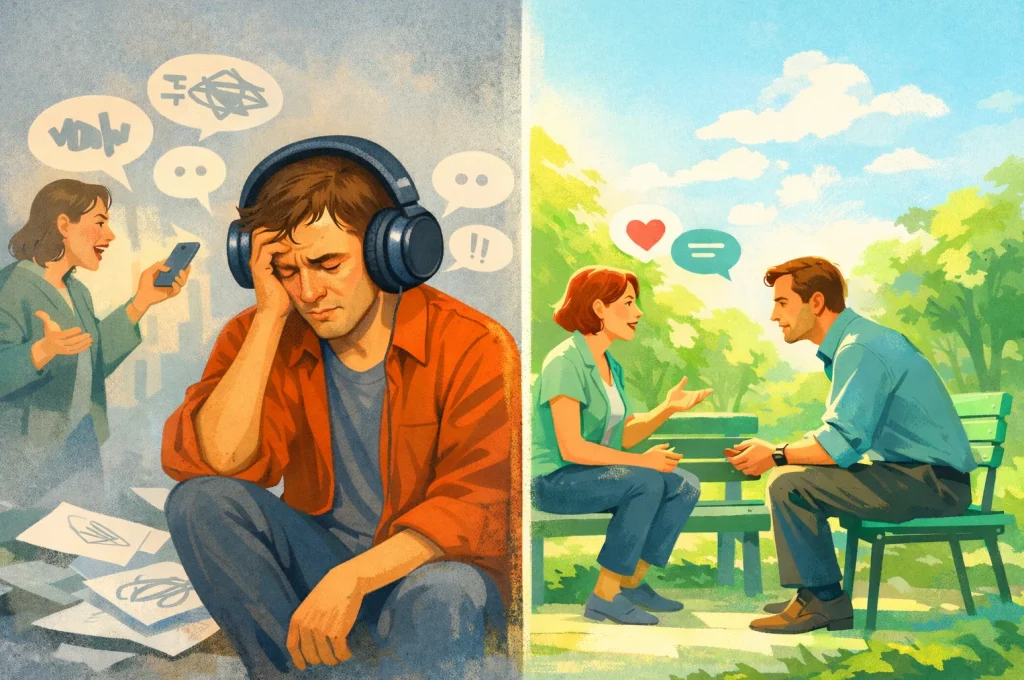
Table of contents:
Active Listening Is Not Just "Being Quiet While Someone Else Talks"
It starts with full attention, not decorative nodding
Active listening looks simple from across the room. A person is quiet, maybe nods, maybe says "right" at the correct intervals, everybody acts civilized. But real listening is not a furniture pose. It is attention with muscle in it. Your mind is with the speaker instead of drafting your comeback, checking your inner notifications, or waiting for your favorite part, which is of course your own opinion.
That means you are tracking more than vocabulary. You notice emphasis. Hesitation. The part they speed through. The part they repeat. The sentence that sounds factual but is clearly carrying emotion like a kid dragging an overstuffed backpack. In ordinary life, this is the difference between hearing "I'm fine" and hearing "I really don't want to talk in this exact way, right now, with you standing there holding a sponge." Big difference.
It includes checking that you understood correctly
A strong listener does not assume understanding too fast. They test it. They might say, "So the main issue isn't the deadline, it's that nobody warned you it had changed?" or "You're not asking me to fix it yet, you just want me to hear how frustrating it was?" That little check is gold. It also overlaps with justice in ordinary life, because giving someone a fair reading before you react often prevents a lot of unnecessary damage. It saves whole arguments, whole weird resentments, whole Monday mornings.
This is one of the most useful parts of the skill because people are messy communicators. We skip context. We soften what matters. We talk around the thing because the actual thing feels sharp in the mouth. Active listening helps you gather the real message instead of the first draft version. Which, honestly, is what most conversations are: first drafts with eyebrows.
It makes room for feelings without drowning in them
Another core piece is emotional recognition. Not amateur mind reading. Not "I know exactly what your inner child is doing." Calm down. Just the ability to notice, and sometimes name, the emotional tone under the words. "Sounds like you felt dismissed." "That seems disappointing." "You sound more tired than angry."
Why does that matter? Because people relax when they feel accurately received. Their nervous system stops fighting to prove the experience was real. And once that fight settles, actual thinking gets easier. The conversation becomes less about defending reality and more about dealing with it.
It has brakes on your urge to fix, judge, or hijack
Plenty of smart people are weak listeners because they are too fast. They hear a problem and leap into solutions. They hear a familiar story and grab the mic with "That happened to me too." They hear one awkward sentence and start cross-examining like a budget lawyer in a bad mood. None of that is listening. That is conversational impatience wearing useful clothes.
Active listening adds a pause between hearing and reacting. In that pause, you get curious. You let the person finish. You ask instead of assume. You resist turning their story into your TED Talk. So in daily life, this skill shows up as presence, reflective responses, clarifying questions, tolerance for silence, and a steady effort to understand before responding. It sounds modest. It changes a lot.
What Opens Up When You Learn to Listen Properly
People start telling you the truth sooner
One of the first benefits is surprisingly practical: people become more honest around you. Not because you become magical. Because you stop punishing honesty with interruption, instant advice, or subtle little performances of "yes yes, I get it" when you very much do not. When people feel heard, they usually give better information. More complete information. The useful stuff.
That matters at work, at home, everywhere. A colleague tells you the project risk before it becomes a mess. A partner says what is actually bothering them instead of sending out passive-aggressive weather reports. A friend admits they are not "busy," they are hurt. If you've ever wondered why some people seem to hear the important part early, this is often why. Others trust them with the unscripted version.
Conflict cools down faster
Most arguments get uglier when neither person feels understood. Then both start repeating themselves with worse tone, which is such a charming human tradition. Active listening interrupts that spiral. Once someone hears, "Okay, you felt sidelined in the meeting, and what upset you most was that I joked about it after," the temperature usually drops a notch. Maybe two.
Not because the problem vanishes. Because accurate reflection reduces the need to fight for basic reality. That is part of what changes when your sense of justice gets stronger, because people stay more open when they feel the situation is being represented fairly. That is huge. It gives both sides somewhere firmer to stand. You can disagree after that, sure. You can even set limits. But the conversation is less likely to turn into verbal bumper cars.
Your decisions get better because your data gets better
Weak listening creates bad decisions in a boring, expensive way. You miss key details. You solve the wrong problem. You walk out of a meeting feeling confident and slightly doomed. Strong listening improves judgment because you collect reality more accurately. That is one reason planning stops being an afterthought when this skill gets stronger, because plans built on distorted information usually fail in very predictable ways. You catch nuance. You hear objections before they harden. You notice when the "small concern" is actually the whole iceberg waving from the water.
Managers need this. Parents need this. Salespeople need this. So do friends, teachers, nurses, designers, anybody who interacts with actual humans, which is inconveniently most of us. Better listening means less guessing. Less guessing means fewer preventable messes. Lovely chain reaction.
Relationships feel less lonely from the inside
There is also the emotional payoff, and I don't think it's minor. Being listened to well is regulating. It settles the body. It softens that clenched little feeling of having to push your words uphill. When you become a better listener, you give people that experience more often. And, interestingly, you usually receive it more too. Good listening tends to invite better listening back. Not always. Humans remain chaotic. Still, often enough.
This changes the texture of a relationship. More warmth. Less defensive static. More sense that two people are in the same room, not just taking turns broadcasting. For many people, that is part of what starts to change when loneliness stops running the room, because being heard properly makes connection feel safer, more real, and less like social small talk with better lighting. That is not a small upgrade. It is one of those quiet qualities that makes life feel less like a customer service queue and more like connection.
When This Skill Is Weak, Conversations Start Leaking in All Directions
People repeat themselves, then stop trying
When active listening is underdeveloped, others often feel it before you do. They repeat the same point. You answer the side issue instead of the real one. They add more detail. You jump to a conclusion anyway. After a while, many people give up and start giving you the short version, the bland version, or no version at all.
That can quietly damage closeness. People do not always announce, "I no longer feel heard by you." Much ruder than that. They just become less open. Less spontaneous. More careful. You think conversation is fine. They feel alone in it. Awkward gap, that.
You become a fixer when understanding was the job
A very common listening failure is solution-hunger. Somebody says, "I'm overwhelmed," and within three seconds you're offering apps, vitamins, calendar systems, a podcast, and maybe a laminated spreadsheet if things get really wild. The problem? They might have needed empathy, not logistics. Or clarity, not instruction.
Premature fixing often lands as dismissal. Part of solving that is training discipline without becoming your own prison warden, since listening well often means holding back an impulse rather than showing off a solution. It tells the speaker, "Your discomfort is making me itchy, so let's wrap this up." Even when the intention is kind, the impact can be cold. And yes, people notice. Especially children, partners, and employees. The ones who depend on you most usually feel this fastest.
You miss what was really being said
Weak listening also produces plain old misunderstanding. You hear "I'm not sure about this plan" as lack of commitment, when it was a warning about real risk. You hear "I need space" as rejection, when it was overload. You hear "Can we talk later?" as avoidance, when the person was trying not to explode in the pasta aisle at Tesco. Context matters. Timing matters. Tone matters. Listening badly flattens all of that.
Then people start having fights about the interpretation instead of the issue itself. Exhausting. Also very preventable, at least sometimes.
Your presence feels thinner than you mean it to
There is a personal cost too. If you interrupt a lot, drift off, compare everything to your own experience, or keep checking your phone while someone talks, other people may read you as self-involved, impatient, or emotionally unavailable. Maybe you are none of those things in your heart. Fine. But relationships run on experienced behavior, not private intentions.
Over time, weak listening can hurt your credibility, your leadership, your dating life, your friendships, even your self-respect. Because somewhere inside, you usually know when you were only half there. And half-presence has a stale little aftertaste. You leave the conversation thinking, "I should've caught that." Often, you're right.
How to Build Active Listening Without Becoming Weirdly Scripted
Practice the two-second landing
Most poor listening happens in the gap between hearing and reacting. So train that gap. This is also where training determination without turning into a robot helps, because a tiny pause becomes a real skill only when you practice it consistently enough for it to survive stressful moments. In one conversation a day, wait two full seconds after the other person finishes before you answer. Not forever. You are not auditioning for the role of haunted owl. Just two seconds.
That tiny pause does a lot. It stops interruption. It gives meaning time to settle. It lets the speaker add the sentence they were about to tack on, which is often the important one. And it helps your reply come from understanding instead of reflex. Feels small. Works big.
Use the "mirror, then move" habit
Before you give your opinion, reflect back one piece of what you heard. Not every sentence, or you'll sound like a hostage negotiator in a training video. One piece is enough. "So you're frustrated because the goal kept changing." "Sounds like you wanted support, not advice." Then, and only then, say what you think.
This trains your brain to earn the right to respond. It also gives the other person a chance to correct you early. Which is useful, because active listening is not silent guesswork. It is collaborative accuracy. A bit clunky at first, yes. Then it starts feeling natural.
Listen for the hinge word
In many conversations, there is one small word that signals where the real meaning turns: "actually," "except," "but," "honestly," "the hardest part," "what bothered me most." Start catching those. They are like little conversational trapdoors. People often circle safely until one of those words opens the floor.
When you hear it, slow down and explore there. "What made that the hardest part?" "When you say 'actually,' what changed for you?" This is an excellent way to stop having shallow chats that somehow last twenty minutes and say absolutely nothing. You know the kind.
Do one no-fixing conversation each day
Pick one conversation, brief is fine, where your only job is to understand and stay with the person. No advice unless they ask directly. No story about your cousin, your manager, your back pain, your cat. Just questions, reflection, and attention. If they ask, "What do you think I should do?" then sure, step in. But not before.
Another helpful drill: at the end of an important conversation, write down in one sentence what the person wanted, what they felt, and what mattered most to them. Later, check whether you were right. This sharpens recall and teaches you to hear for meaning, not just content. Over time, active listening stops being a communication trick and becomes part of how you relate. Quieter. Kinder. Much more effective.
Should This Be Your Next Growth Focus?
Maybe. Maybe not. Not everyone needs to start with active listening right now. Some people are already listening plenty and actually need stronger boundaries, clearer speech, or more courage to say the uncomfortable thing instead of understanding everybody to death.
It helps to look at the real pattern. Do people often tell you, "That's not what I meant," "You're not hearing me," or "Can I finish?" Do you leave conversations realizing you solved a problem nobody had asked you to solve? Then yes, this skill is probably worth your attention. If the real issue is that you keep noticing the habit but still repeat it under pressure, ask yourself do you need to build determination right now, because insight without follow-through rarely changes how you listen when it counts. If your bigger issue is emotional overload, chronic distraction, or fear of conflict, start there too, or this will stay harder than it needs to be.
If you want a cleaner way to sort that out, AI Coach can help you see which skill deserves attention first and give you a simple plan for the first three days. Sometimes that kind of direction is more useful than vaguely promising yourself to "communicate better" and then, well, hoping your personality updates overnight.
Frequently Asked Questions (FAQ)
What is active listening in simple terms?
It is listening to understand, not just waiting for your turn to talk. You pay attention, notice the meaning and emotion under the words, and check that you understood the person correctly before jumping in with your own view.
Is active listening the same as empathy?
No. They overlap, but they are not identical. Empathy is the ability to sense or understand another person's emotional experience. Active listening is the behavior that helps you show that understanding in real time: attention, reflection, clarifying, staying present. You can feel empathy and still listen badly. Happens all the time.
Does active listening mean I have to agree with everything someone says?
Not at all. Understanding is not surrender. You can listen accurately and still disagree, set a boundary, decline a request, or challenge an idea. In fact, disagreement usually goes better after the other person feels understood, because then you are arguing with less static in the room.
Can active listening actually help during conflict?
Yes, often a lot. Conflict escalates when people feel unheard or misread. Reflecting the core point - and especially the emotional core - can lower defensiveness and make the conversation more workable. It does not erase the issue, but it reduces the scramble to prove basic reality.
Why do I keep interrupting even when I genuinely care?
Usually because your mind is moving faster than your listening. Sometimes it is excitement. Sometimes anxiety. Sometimes the urge to be useful. Sometimes plain impatience, let's be honest. The fix is behavioral first: slow the response, leave a short pause, and train yourself to reflect before reacting. Caring helps, but technique matters too.
How do I listen without rushing into advice mode?
Give yourself one rule: no advice until you can say the person's main point back in one clean sentence and they confirm you got it. Another useful question is, "Do you want me to just hear you, help you think it through, or suggest something practical?" That one question saves a shocking amount of friction.
What are the signs that someone is not really listening to me?
They interrupt to tell their own version. They answer too quickly. They miss your main point and latch onto a detail. They give solutions before understanding the problem. They keep dragging the conversation back to themselves. Or they say "I get it" while clearly not getting it at all. Your body usually notices before your mind does.
Can active listening be learned, or is it mostly personality?
It can absolutely be learned. Some people are naturally more patient or observant, sure. But active listening is a trainable skill. Pausing, paraphrasing, asking cleaner questions, tolerating silence, noticing emotional cues - all of that improves with practice. You do not need a new personality. You need reps.
How is active listening useful at work?
It improves meetings, feedback, leadership, customer conversations, hiring, teamwork, and conflict repair. At work, poor listening causes expensive confusion because people act on partial understanding. Strong listening gives you better information, which leads to better decisions and fewer awkward "that's not what we agreed" moments. Nobody misses those.
Do I need strong eye contact to be a good listener?
No. Eye contact can help in some cultures and situations, but it is not the whole skill, and for some people it can feel intense or distracting. Active listening is more about attention and response than about performing a face. You can be an excellent listener while looking away briefly, taking notes, or thinking quietly, as long as your behavior still shows real engagement.
Can you practice active listening over text or video calls?
Yes, though you lose some cues. On video, active listening means not multitasking, summarizing clearly, and checking understanding more often because lag and half-heard phrases can scramble meaning. Over text, it means slowing down, not assuming tone too quickly, reflecting the key point, and asking clarifying questions before reacting. Less elegant than face to face, still very possible.
What is one small thing I can do today to get better at this?
In your next meaningful conversation, do just one thing differently: reflect the other person's main point before sharing yours. One sentence. That's it. Small move, big signal. It tells the other person, "I'm with you," and it tells your own brain, "Understanding comes first." Solid place to begin.