
Arrogance is that sharp inner stance of "I know better" that slowly pushes people away. On the outside you may look confident and successful; on the inside you feel constantly forced to prove you are right, smarter, or more important. Conversations turn into silent contests, feedback feels like an attack, and over time colleagues, partners, or friends stop being fully honest with you. If you notice tension after your comments, people "walking on eggshells" around you, or relationships cooling for reasons you do not understand, it may be a sign that arrogance is running the show.
At the same time, the energy behind arrogance is not evil by itself - it is often wounded self-respect that never learned a kinder way to stand tall. If this description stings a little, stay with it: below we will explore how arrogance actually works, what it costs you, and how to turn it into grounded confidence that lifts you and others instead of pushing them down.
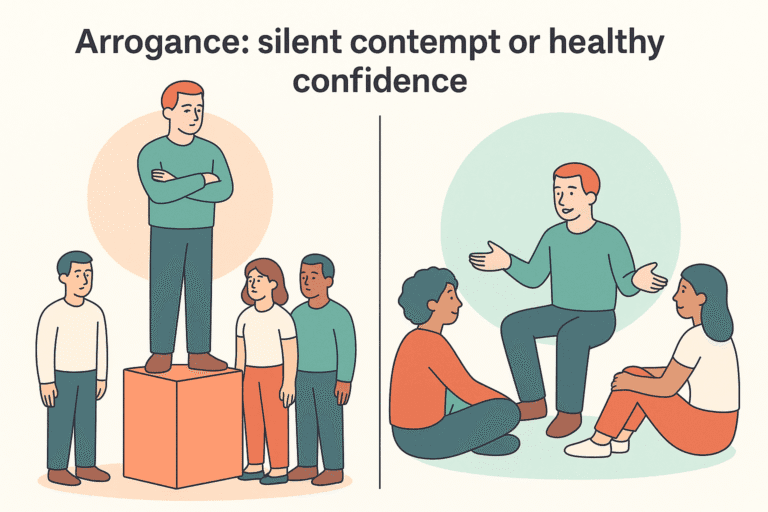
Table of contents:
What is Arrogance? Main traits and how it shows up
The inner story behind arrogance
Arrogance is more than big talk or a raised eyebrow. At its core it is a way of relating to others from an imaginary upper floor: "I am above you; therefore, I do not have to adjust, listen or rethink." This stance can be loud and theatrical, or very quiet and polite. You may never openly insult anyone, yet inside you constantly rank people, silently grading their ideas, backgrounds or careers. What makes arrogance a soft skill topic is that it is a learned pattern, not a fixed character flaw. You can observe it, question it and gradually replace it.
Typical thinking patterns
Inside an arrogant mindset, the world is split into "those who get it" and "the rest." You automatically look for proof that you are right and others are mistaken, less competent or less refined. Sometimes this "filter" is really just low empathy in disguise - not cruelty, but a habit of not modeling other people's inner world, especially under stress. When something goes well, you attribute it to your special qualities; when it fails, you blame circumstances or other people. Criticism feels unfair by default, even when it is gentle and accurate. You may silently think, "they just do not understand my level," instead of asking what you could improve. Over time this selective filter becomes invisible, so arrogance starts to feel like simple realism.
How arrogance sounds in everyday talk
Arrogance often reveals itself in language before anything else. It sounds like frequent generalisations ("people here are so unprofessional"), constant corrections of small details, or telling others what they "should" do without being asked. You may interrupt, finish sentences for people, or answer questions that were not addressed to you. In meetings you speak longer than others and rarely ask clarifying questions. When someone shares an achievement, you immediately respond with a bigger story of your own. None of these behaviours is dramatic once, but together they create an atmosphere where others feel talked over rather than met.
Body language and micro-behaviours
Even when you say little, arrogance can be visible in small physical cues. One way to rebalance this is to treat attention as a deliberate skill - the same muscle you use when you practice honesty: you notice what's true in the moment (your boredom, your irritation, your impatience) without acting it out as superiority. A fixed half-smile, avoiding eye contact when others speak, or checking your phone while someone is presenting all send the same message: "you are not worth my full attention." You might sigh, roll your eyes, or slightly tilt your head back when you disagree. In online settings, arrogance appears as delayed replies to people you perceive as "less important," or as abrupt one-line answers with no greeting or context. These signals are often unconscious, but people around you still feel their weight and protect themselves by withdrawing.
Arrogance, confidence and self-worth
From the outside arrogance can resemble strong confidence, but on the inside they feel very different. Healthy confidence knows its strengths and limits; it can say "I am good at this" without needing others to be small. Arrogance, by contrast, quietly depends on comparison and hierarchy: "I know more than these people, therefore I am safe." Research suggests it often grows where personal power and narcissistic traits combine, especially when self-awareness is low. This is why arrogant behaviour may collapse when someone receives firm feedback or loses status. Under the surface there is usually sensitive self-esteem trying hard not to feel exposed. That matters.
How working with arrogance changes your life
Easier, more honest relationships
When arrogance softens, relationships stop feeling like ongoing performance reviews. As you learn to genuinely listen, people relax and start sharing real concerns and ideas instead of only what they think you want to hear. This makes conversations warmer and also more useful: you get access to information that was previously hidden behind politeness. Friends and partners feel safer to disagree without fearing your reaction. At work, teammates no longer avoid you or edit themselves heavily. The practical result is more trust, fewer passive-aggressive comments and less guesswork about what others actually think or need from you.
Stronger leadership and influence
As your arrogance loosens its grip, your ability to influence people usually grows. That's the paradox: real influence is less about "being the smartest" and more about making better decisions together - which is why strong problem-solving skills often look like calm collaboration, not domination. Instead of pushing your ideas through sheer volume or status, you start winning support because others feel seen and respected. People follow leaders who combine clarity with humility: they know where they are going, yet are willing to adjust plans when new information appears. When you show that you can change your mind, colleagues feel more comfortable bringing early warnings and creative suggestions. That makes projects more robust and reduces costly late surprises. Influence built on mutual respect is slower at first but more stable over time.
Faster learning and growth
Arrogance quietly blocks growth because it tells you that you already know enough. The moment you allow yourself to be a learner again, your development accelerates. You start asking questions in meetings instead of pretending, and you pick up techniques from people you once dismissed. Feedback feels less like a personal attack and more like free consulting. This shift saves enormous energy: you no longer waste hours defending every decision in your head. Instead, you can quickly update your approach and move on. Over months and years, this willingness to learn compounds into better skills, better decisions and better results.
More emotional calm
Working on arrogance also changes your emotional climate. If you're used to "winning" every interaction, your nervous system starts treating disagreement like danger; building genuine confidence helps you stay steady when you're not the top voice in the room, and you can still remain effective. When you constantly need to be the most competent person in the room, every interaction carries hidden pressure. You scan for threats: who might outshine you, who might criticise, who might reveal a gap in your knowledge. As you relax this internal competition, your nervous system finally gets to breathe. You can say "I don't know" without shame and ask for help before a situation becomes critical. This reduces chronic tension, anger and defensiveness. There is more space for humour, curiosity and even self-irony instead of permanent inner battle.
A healthier sense of self-worth
Perhaps the most surprising change is a deeper, quieter self-worth. Arrogance tries to protect shaky value by inflating it; the more you boast, the less solid you actually feel. When you stop measuring yourself against everyone around you, you can notice your strengths without exaggeration and your limits without shame. You are allowed to be talented and still learning, successful and still human. This integrated self-respect is more durable than any status symbol. It does not disappear when someone else shines. You can genuinely celebrate other people's wins because they no longer threaten your place in the world. From the outside that may look like arrogance; inside, it feels calm, grounded and open.
What happens when arrogance runs the show
Invisible distance in relationships
When arrogance is left unchecked, the first casualty is closeness. People may still smile, reply to your messages and show up to meetings, but inside they gradually close the door. They share less about their struggles, stop asking for your opinion, or avoid giving you honest reactions. Instead of saying "that hurt" or "I disagree," they change the subject, distance themselves or quietly update their view of you. You may feel confused: "Why does everyone seem so sensitive?" In reality, they are protecting themselves from feeling belittled. Over time you can end up surrounded by people who are present but not truly with you.
Teamwork that quietly falls apart
In teams, unchecked arrogance slowly poisons collaboration. Others hesitate to propose ideas because they expect to be overridden or mocked. Meetings become one-directional: you speak, they nod, and then they do something different afterwards or disengage entirely. Talented colleagues may quietly move to other projects or companies where their contribution is valued. You might interpret their departure as proof that "no one can handle high standards," instead of seeing your own role in the dynamic. Over time the team becomes less diverse in perspectives, more dependent on you personally and more fragile when you are unavailable or make a mistake.
Stalled career and missed chances
For your career, arrogance can create a ceiling that is hard to see but very real. You may be technically brilliant yet repeatedly passed over for promotions that involve managing people. Decision-makers look for leaders who can handle feedback, negotiate and build trust across different groups. If your reputation is "smart but difficult," opportunities quietly go to someone else. In client-facing roles, a single arrogant comment can damage long-built relationships. People rarely explain this directly; they simply stop choosing you. From your perspective it may feel like unfair politics, when in fact it is a natural consequence of how others experience you.
Inner loneliness and constant defence
Outwardly arrogant people often suffer more than they show. Constantly defending your superiority is exhausting. You must stay alert so that nobody discovers your doubts or weaknesses. Any sign that someone might be "better" easily triggers irritation, sarcasm or withdrawal. Instead of asking for support, you push through alone and then resent others for not helping. Inside, there may be a quiet loneliness: few people feel close enough to see the real you. Even compliments do not land, because you suspect they are fake or insufficient. This inner isolation can fuel burnout, anxiety and even depression over time.
Blind spots and painful crashes
Another consequence of unexamined arrogance is a dangerous lack of self-correction. Because you filter out uncomfortable feedback, problems have to become very large before you notice them. A project may fail publicly, a relationship may end abruptly, or a team may revolt after months of silent frustration. From your standpoint, these events seem sudden and unfair, but for others they have been building for a long time. Without people who feel safe to challenge you, your decisions become increasingly risky. The crash that finally breaks through your defences often feels dramatic, yet it could have been avoided with earlier humility.
How to work with arrogance and grow healthier confidence
Step 1: Catch your superiority thoughts in real time
Start by noticing, not fighting, the inner voice that says "I'm above this." For one week, carry a small notebook or open note on your phone. Each time you catch yourself mentally judging someone as "stupid," "slow" or "clueless," briefly write what triggered it and how strong the reaction was. Do not analyse yet; just collect data. In the evening, read your notes and ask: what patterns do I see - certain people, roles, topics?
Step 2: Practise curiosity about other perspectives
Next, deliberately expose yourself to views you normally dismiss. Think of it as training adaptability: the ability to stay flexible when reality doesn't match your preferred story, and to update your position without turning it into a status fight. Once a day, choose one opinion you disagree with and try to reconstruct its logic. You might read an article from a competing company, listen to a podcast by someone with very different politics, or ask a colleague you often judge, "What is your take on this?" Your task is not to convert but to understand. Write down at least one point that is reasonable, even if you still disagree overall. This exercise stretches your ability to respect intelligence that does not look like yours.
Step 3: Train the courage to admit you were wrong
Arrogance hates being wrong, so consciously practise the opposite. Think of a recent situation where you overruled someone or reacted sharply. Go back to that person and say clearly, "I realised I was wrong about X," or "I see now that I did not consider your perspective." Do not wrap it in excuses. Then pause and let their reaction land. This simple act rebuilds trust and teaches your nervous system that admitting mistakes does not destroy you. To make it a habit, aim to acknowledge at least one mistake out loud every week.
Step 4: Deliberately highlight others' strengths
To balance your inner scoreboard, intentionally look for what others do well. Each day, write down three qualities or actions you genuinely admire in people around you: a teammate's patience with clients, a friend's humour, a junior colleague's fresh ideas. Then, choose one person and tell them specifically what you appreciate, without adding anything about yourself. For example: "Your presentation was clear and engaging; it helped me understand the risks." This trains your attention to notice value outside your own performance and makes appreciation a normal, comfortable part of how you relate.
Step 5: Ask for feedback and just listen
Feedback is a powerful antidote to arrogance when you learn to receive it. Choose three people who see you in different contexts - for example, a colleague, a friend and a family member. Ask each of them two questions: "What is it like to work or live with me when I am stressed?" and "What do you wish I did differently in conversations?" While they answer, do not interrupt, explain or defend. Your only responses are clarifying questions and "thank you." Later, review what you heard and look for repeating themes; pick one small behaviour to adjust this week.
Step 6: Let others lead and back their ideas
Finally, practise stepping back so others can step forward. In your next meeting or group decision, consciously choose one moment to say, "Let's go with your idea," and then actively support it: help refine it, share credit, defend it if criticised. Notice any discomfort or urge to take control again; treat it as training, not a signal to stop. You are teaching yourself that your value is not limited to being the star of every scene. Over time, these small acts build a more collaborative identity that leaves little space for old arrogant reflexes.
Do you need to work on arrogance?
Not everyone needs to start their growth journey with arrogance. For some people, the urgent task is learning to say no, rebuilding basic energy or finding any confidence at all. If you rarely speak up and constantly doubt yourself, softening arrogance is probably not your top priority right now.
On the other hand, if you often feel irritated by "incompetent" people, notice that conflicts follow you from job to job, or hear feedback about being harsh, this area is worth attention. Choosing one or two key qualities to focus on at a time protects you from burnout. Otherwise you may start ten improvements at once, get overwhelmed and decide that personal development "doesn't work" for you.
If you are unsure where to begin, you do not have to guess. Our AI Coach can help you explore your current situation, highlight your most important growth point and suggest a simple three-day experiment to start with. You can then decide calmly whether working with arrogance is the right next step for you now or something to return to later.
Frequently asked questions (FAQ)
How do I know if I come across as arrogant?
Look less at your intentions and more at the effects you create. Do people often go quiet after you speak, avoid disagreeing with you, or say you sound harsh even when you "only stated facts"? Do you interrupt, correct small details or give advice that no one asked for? Ask three people who know you in different contexts how they experience you in discussions, especially during conflict. If you hear words like "intimidating," "dismissing," or "hard to talk to," treat that as useful data, not a verdict on your character. It shows where to start adjusting your behaviour.
What is the difference between confidence and arrogance?
Confidence is a grounded belief in your abilities while recognising the abilities of others. Arrogance puts you above other people in your own mind. A confident person can say, "I can handle this task, and I'm open to input." An arrogant person leans toward, "I know better than the rest of you; just do what I say." Research and coaching practice highlight humility and openness to feedback as key markers of confidence, while arrogance is linked to lack of perspective and poor self-awareness. Ask yourself: do I feel stronger when others shine, or are threatened?
Can arrogance be a sign of insecurity?
Very often, yes. Many people use arrogance as armour to cover fears of being insignificant, replaceable or "not enough." If you secretly worry that others are more talented, you may attack or minimize them to feel safer. This does not mean your achievements are fake; it means your self-worth is fragile and needs constant external proof. Working directly with your insecurity - for example, by building real competence, practising self-compassion and seeking honest feedback - usually reduces arrogant reactions more effectively than trying to "behave nicely" on the surface.
How can I stop sounding arrogant at work?
Start with two simple habits. First, slow down and ask at least one clarifying question before giving your opinion: "How do you see this?" or "What am I missing?" That shows you take others seriously. Second, shorten your interventions and end with an invitation, such as, "That's my view - what do you think?" Watch your tone in emails and chats: add context instead of one-word commands, and replace "Obviously..." with "My understanding is...". Over time, combine these habits with deeper work: listening practice, learning to admit mistakes and giving honest praise.
How should I deal with an arrogant coworker or manager?
Protect your dignity first. You do not have to accept insults or constant put-downs, but direct confrontation is not always the safest or most effective move. Many workplace guides recommend staying calm, setting clear boundaries and addressing behaviour, not personality. For example: "When you interrupt me, I find it hard to contribute. Can we agree to let each other finish?" Document patterns if the behaviour is severe and involve HR or a trusted leader when needed. Outside of formal steps, limit personal disclosure to this person and invest more energy in supportive relationships.
Is arrogance always bad, or can it be useful?
The raw energy behind arrogance - strong self-belief and ambition - is not bad. It becomes harmful when it rests on putting others down or refusing to learn. In some competitive environments, a slightly exaggerated self-presentation can open doors, but if you lean on it too heavily, people quickly stop trusting you. Instead of trying to preserve a "useful amount of arrogance," aim to develop solid confidence plus clear boundaries. You can be bold, ambitious and proud of your work without treating others as props or competitors in every interaction.
Is arrogance the same as narcissism?
They overlap but are not identical. Narcissism is a clinical personality pattern that includes a grandiose self-image, lack of empathy and a deep need for admiration. Arrogance is a visible style of thinking and behaving that anyone can show at times. Some narcissistic people are consistently arrogant, but many otherwise caring people also slip into arrogance in certain roles or under stress. If you notice rigid patterns across many areas of life, intense anger at criticism and long-term relationship problems, it may be worth discussing with a mental health professional.
Why do some successful people become arrogant?
Success brings power, status and praise - all things that can distort self-perception if not balanced with honest feedback. Studies suggest that when power combines with narcissistic traits and low self-awareness, arrogance becomes more likely. People may start to believe their own press, forget how much help they received, or stop hearing "no" from anyone. At the same time, the higher you climb, the more mistakes cost, which can make it scarier to admit them. Deliberately keeping mentors, critics and diverse voices around is one of the best protections against this drift into arrogance.
Can therapy or coaching help me change arrogant behaviour?
Yes, especially if you are willing to look at what arrogance protects. A good therapist or coach will not simply tell you to "be nicer." They will help you explore the fears, stories and past experiences that shaped your current style of relating. Together you can practise new behaviours: asking for feedback, naming insecurity instead of hiding it, expressing disagreement respectfully. External accountability matters: it is easier to stay on track when someone regularly reflects your progress and blind spots. Change usually happens step by step, starting in one area of life and then spreading to others.
Can someone who has been arrogant for years really change?
Yes - if they choose to. Long-standing habits are stubborn, but they are still habits, not destiny. Many people become more considerate and humble after a major crisis: a failed project, a divorce, a team rebellion. You do not have to wait for such a crash. The same mechanisms that built arrogance - repetition, reinforcement and environment - can build healthier patterns. Honest feedback, daily micro-practices, new role models and sometimes professional support gradually rewire how you relate to others. Change will probably be uncomfortable, but the payoff in relationships, opportunities and inner peace is significant.