
Arrogance is what happens when self-belief puffs itself up a little too much, then asks for a taller chair and better lighting. From the inside, it can feel like strength. From the outside, though, it often feels like being cornered by someone who has already decided everyone else in the room is running on half-battery.
If people keep stepping back from you, if feedback annoys you more than it helps you, if some part of you quietly assumes most people don't have much to teach you... well, it might be worth looking at. And here's the annoying twist: arrogance does not just bruise other people. It quietly blocks your own development too, then acts shocked when life stops applauding. Rude little trait, honestly.
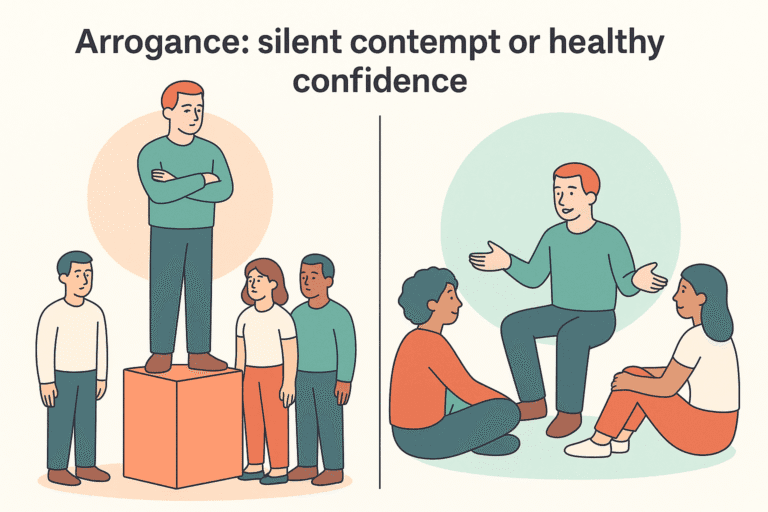
Table of contents:
Arrogance, without the dramatic costume
It is not the same as confidence
A confident person can walk into a room, know what they bring, and still leave enough oxygen for other people to exist. An arrogant person usually struggles with that bit. That is the cleanest difference. Confidence says, "I have something valuable here." Arrogance says, "I am the value here, the rest is kind of wallpaper." Same posture, maybe. Totally different energy.
This is why arrogance gets mistaken for strength all the time. It can look decisive. Clear. Untouchable. Sometimes even magnetic, in that shiny "wow, they really back themselves" kind of way. But unlike confidence, arrogance needs comparison to stay alive. It does not just stand tall; it needs to stand taller than. And if that line still feels fuzzy, it helps to look at what confidence is and how it shows up. Healthy self-belief can be solid without turning everyone else into background scenery. Big difference.
It ranks people fast and listens badly
One of the most obvious signs of arrogance is this quick little mental sorting habit. Smart. Not smart. Useful. Not useful. Worth my time. Probably not. The arrogant mind is fast like that - too fast, usually. It decides what shelf to put someone on before the other person has even finished the sentence. Sometimes before they've started, let's be honest.
You can spot it in small moments. Interrupting. Correcting too early. Brushing off an idea because it came from a junior colleague, a quieter friend, a parent who's still typing in all caps on Facebook. And no, arrogance does not always arrive wearing a villain cape. Sometimes it hides inside phrases like "I'm just being honest," "I have standards," or "I don't suffer fools." Ah yes. Very convenient costume.
It quietly shrinks what other people bring
Arrogance has this weird appetite: it wants your strengths to look bigger, so it trims everybody else's down. Another person's success becomes luck. Timing. Politics. Low standards. A fluke. Their idea was "obvious." Their skill is "fine, but..." You know the move. Most of us do, if we're being a little uncomfortable and honest.
The trouble is not only social. It messes with your thinking. The moment you start assuming other people have little to offer, your ability to learn narrows. You stop borrowing good ideas. You stop noticing nuance. You stop getting corrected by reality while the mistake is still small and fixable. Then the invoice shows up later - bigger, uglier, and with less sympathy attached. Not ideal.
Under the shine, there is often a fragile center
Not always, no. But often, arrogance is less sturdy than it looks. Plenty of arrogant people are not standing on deep self-respect. They are standing on a wobbly platform built from defensiveness, status anxiety, or a fear of feeling ordinary. In some cases, that inner tension has a lot in common with why anxiety keeps coming back even when you are smart and self-aware, because insight by itself does not always dissolve the need to protect yourself through superiority. If they admit someone else was right, or better, or wiser in one area, something inside them flinches. So they push back. Hard.
That is why arrogance and insecurity can absolutely live in the same house, share a fridge, and bicker in the kitchen at midnight. One performs superiority. The other panics at vulnerability. Put them together and you get someone who has a very hard time saying, "I was wrong," "I don't know," or "That was your idea, not mine." Which, unsurprisingly, makes real closeness harder and real growth slower.
So yes, arrogance is about superiority, condescension, and dismissiveness. But it is also a relationship pattern, a learning problem, and sometimes a very expensive form of self-protection. Looks strong from a distance. Up close? Not nearly as useful as it pretends to be.
What gets better when arrogance loosens its grip
People stop shrinking around you
When arrogance softens, conversations change almost immediately. Other people stop bracing for correction before they've even finished a thought. They share more. They relax more. They stop offering that carefully edited, safest-possible version of themselves. And that is not some fluffy social bonus - that is useful information finally coming back into the room.
At work, this matters a lot. Teams tell the truth earlier when they do not expect ridicule. Friends get more honest. Partners stop feeling like every disagreement is a courtroom drama in three acts. The whole atmosphere becomes less brittle. Less "brace for impact," more actual exchange. Funny, isn't it, how much smarter people seem when they are not busy defending their dignity? This is exactly where empathy shifts the whole dynamic, because people open up when they feel understood instead of silently ranked.
You learn faster, because reality can finally get through
Arrogance slows learning in a sneaky, almost sneering way. It makes you overrate what you already know and underrate what other people can teach you. So when that layer starts to peel back, even a little, your mind gets more open in the best possible sense. You ask better questions. You catch blind spots sooner. You hear correction without turning it into a duel at sunrise.
This naturally strengthens learnability. Not because you become timid or unsure of yourself, but because you stop treating every challenge to your view like a personal insult. Suddenly the world is full of material again. A younger colleague may know the tool better. A quieter friend may spot the pattern first. Even someone you dislike may still have one very solid point. Annoying? Sometimes. Useful? Oh, absolutely.
Your leadership becomes much easier to trust
Arrogant leadership can look impressive for a while. It often sounds crisp, fast, certain. But people tend to trust it only up to a point, because they can feel the ego-tax involved in bringing bad news or disagreeing. Once that cost gets too high, truth starts arriving late. And late truth is dangerous truth.
When arrogance eases up, leadership gets steadier. You become easier to approach. More coachable yourself, which is a strangely underrated strength. Better at giving credit without behaving like someone is asking for one of your kidneys. And that strengthens other qualities too, especially mentorship. Helping people grow is very hard if you still need to be the smartest person in every single frame. Exhausting, really.
Self-respect gets quieter and a whole lot steadier
This may be the best part. Without arrogance, your self-worth no longer needs constant staging. You do not have to win every conversation, know every answer, or subtly establish rank every six minutes like some overcaffeinated peacock. You can simply be good at what you're good at, limited where you're limited, and still feel completely intact.
That kind of inner steadiness is oddly peaceful. You spend less energy performing superiority and more energy building real substance. You can admire somebody without feeling reduced by it. You can be corrected without collapsing inside. You can say, "That was better than my idea," and - surprise - the sky does not split open. There is real relief in that. Lightness, even.
So the upside is not only warmer relationships, though yes, definitely that. It is sharper judgment, faster learning, stronger trust, and a form of dignity that does not depend on keeping everybody else one notch below you. Much lighter way to live. Much less noisy.
When arrogance goes unchecked, the damage is rarely glamorous
Feedback keeps bouncing off until life says it louder
One of the nastiest costs of arrogance is delayed correction. If you dismiss criticism too fast, if you keep assuming the problem is other people being slow, sensitive, jealous, or underqualified, then the early signals never really land. So reality has to escalate. A client leaves. A partner gets worn out. A team stops speaking up. You miss the lesson in pencil and end up getting it in permanent marker. Oof.
That is the thing about arrogance: it can protect your ego in the short term while making the consequences much harsher later on. You get to feel right now, and blindsided later. Not a brilliant trade, when you put it that way.
Relationships become thinner than they appear
Plenty of arrogant people still have friends, partners, followers, admirers - sure. But the quality of closeness often changes. People stay, yet share less. They avoid disagreement. They stop bringing you the messy truth and offer the polished version instead, because the raw version will just get stepped on, corrected, or explained away.
In romantic relationships, arrogance can turn every conflict into a weird hierarchy contest. Who is smarter. Who is more rational. Who gets to decide what "really happened." Very tiring. In friendships, it creates that lopsided dynamic where one person is permanently the lecturer and the other person becomes a very patient audience member. After a while, even loyal people get tired of being cast as supporting characters in somebody else's brilliance story.
Your talent starts working against you
This is the sneaky bit. Arrogance often grows in people who really are capable. They may be bright, accomplished, quick-thinking, highly skilled. And because some of their self-belief is backed by real evidence, the arrogance hides well. They tell themselves they are "just being accurate." Sometimes that's true. Sometimes... not so much.
Once arrogance latches onto talent, growth can stall hard. You stop stretching. You stop checking assumptions. You stop turning your critical thinking inward, which is exactly where it becomes most useful - and yes, most uncomfortable. You keep applying old strengths to new situations as if the world owes them permanent relevance. It does not. This is where strong problem-solving matters more than ego, because real progress comes from testing your assumptions, not protecting them like family heirlooms.
People start adapting around you
Here is how arrogance quietly edits a life: not always through dramatic fights, but through silent adjustments. Colleagues stop challenging you. Smart people leave the room - emotionally or literally. Opportunities that depend on collaboration drift somewhere else. You still get information, but not the best information. You still get agreement, but not honest agreement.
That is expensive. Especially in leadership, parenting, partnership, and any role where judgment improves through multiple perspectives. Arrogance creates an invisible tax on truth. Other people start asking themselves, "Is it worth the friction to tell them?" If the answer keeps being no, your world gets more flattering and less accurate. Lovely for the ego. Terrible for the future.
And emotionally? There is often more loneliness in arrogance than people like to admit. Not dramatic, movie-scene loneliness. The quieter kind. It often looks a lot like loneliness is not about empty rooms, because a person can be surrounded by others and still feel cut off from anything real or mutual. The kind where you're surrounded by people and still oddly untouched by them, because superiority is a poor bridge. It can lift your chin, sure. It cannot build intimacy.
How to work on arrogance without turning into a doormat
Train your mind to find value where it doesn't want to
Pick one opinion you strongly disagree with and study it like a grown-up, not like a prosecutor preparing a dramatic closing argument. Your job is not to abandon your position. Your job is to find three parts of the other side that are logically solid, even if the conclusion still makes you roll your eyes a bit. This is excellent medicine for the arrogant habit of assuming disagreement equals stupidity.
Do the same with people. Listen to one person you usually dismiss too quickly - the quiet colleague, the junior hire, the relative whose communication style makes you want to fake a bad signal. Ask yourself, "What might they be seeing that I'm missing?" Not because they are always right. Because you are not always right either. Irritating truth, weirdly freeing.
Practice saying the correction out loud, not just revising it in your head
Arrogance weakens when humility becomes visible. Once a week, name a mistake out loud to the person it affected. Keep it short. No orchestra, no dramatic monologue. "You were right, I rushed that." "I dismissed your point too quickly." "I missed something important in what you said." That does more than private self-awareness ever will, because it trains your nervous system to survive the social discomfort of not being on top. And that kind of repair gets very close to what honesty really is: saying what is true clearly, without burying it under twelve layers of explanation.
Also, notice the urge to explain yourself to death afterward. Resist it. A clean repair is enough. If every admission comes wrapped in a TED Talk about how you were technically under pressure, sleep-deprived, misunderstood, and still sort of impressive... well, the arrogance is still doing push-ups in the background.
Get used to lifting other people up without comparing yourself
For a week, give one clean compliment each day for someone else's result, behavior, or skill. No self-reference. No subtle ranking. No "you're great at this, unlike me, obviously I'm trash," because that is just ego wearing a sad little hat. Keep it simple and honest: "Your presentation was sharp." "You handled that customer with real patience." "You make people feel included quickly." Tiny habit, big shift. If that sounds obvious but oddly hard to do consistently, it may be worth looking at how to strengthen self-discipline without becoming a joyless robot, because noticing a pattern is one thing and repeating a better response often takes a steadier kind of follow-through.
Then take it a step further. Think of someone you have underestimated and offer support without performing generosity like a Victorian landlord. Just be useful. Just help. Arrogance feeds on distance; respect grows through contact. Funny how that works.
Ask for feedback and let someone else lead for a change
Ask three people one uncomfortable question: "What makes me hard to work with or talk to sometimes?" Then listen without defending yourself, correcting details, or clenching your jaw hard enough to crack a walnut. Write down what repeats. Repetition matters more than your first emotional reaction - which, let's be real, may be "Well, they're wrong." Sit with it anyway.
For one day, also let someone else's idea lead even if yours seems cleaner. Use their meeting structure. Back their solution. Follow the expert you usually half-ignore and pull out one useful insight. This builds a very specific muscle: the ability to cooperate without needing your fingerprints on every good outcome.
That, by the way, is the healthier alternative to arrogance. Not shrinking. Not pretending you have no strengths. Just becoming secure enough that other people's value no longer feels like a threat. Nice upgrade. Peaceful, too.
Is arrogance really the thing you need to work on right now?
Not for everyone. Some people are not arrogant at all; they are simply direct, competent, or tired of acting smaller than they really are. Others worry they have an arrogance problem when the real issue is stress, blunt communication, or shaky confidence that flips into defensiveness under pressure. If that defensiveness also comes with a short fuse, it may help to look at irritability up close, because what reads as superiority from the outside is sometimes a person who is already emotionally overloaded and reacts by snapping, dismissing, or hardening too fast. And sometimes what looks like superiority is actually closer to when cynicism stops being a mood and becomes a habit, where distrust and emotional distance start dressing themselves up as intelligence.
It helps to choose the right growth target instead of grabbing the one that sounds the most morally impressive. If your pattern is dismissing feedback, underestimating people, needing to be right too often, or losing trust because others feel talked down to, then yes - this deserves your attention. If your real struggle is people-pleasing, self-doubt, or fear of taking up space, start there instead. And if your defensiveness mostly spikes when plans change, roles shift, or new information lands quickly, it may make more sense to work on adaptability first. Flexibility often lowers the need to posture in the first place. Handy little truth.
If you want a clearer read on what actually matters right now, AI Coach can help you sort your priorities and build a simple three-day starting plan. Sometimes the most useful move is not "I need to work harder on myself." It is "I need to work on the right thing, finally." Big difference. I hope you give yourself that chance.
Frequently Asked Questions (FAQ)
What is arrogance in simple terms?
Arrogance is the habit of seeing yourself as above other people and acting from that position. It usually shows up as condescension, dismissiveness, poor listening, and a strong need to be the one who knows best.
How is arrogance different from confidence?
Confidence does not need to push anyone else down. It can be strong and calm at the same time. Arrogance leans on comparison. It says, directly or indirectly, "I matter more, I know better, I rank higher." That is the part that poisons the room.
Can arrogant people actually be insecure underneath?
Yes, often. Not always - but often. Some arrogance is basically insecurity in expensive sunglasses. Superiority becomes a shield against feeling ordinary, wrong, behind, or exposed. Looks tough, feels shaky.
What are subtle signs that I may come across as arrogant?
Interrupting too much, explaining things nobody asked you to explain, reacting badly to correction, giving backhanded compliments, dismissing ideas too fast, or getting strangely irritated when someone else gets credit. Those are all useful clues, even if they sting a little.
Does success make people arrogant?
It can, if success starts convincing someone they no longer need feedback, perspective, or humility. But success does not automatically create arrogance. Some people become more grounded as they grow, because reality keeps reminding them how much they still do not know. Lucky them, honestly.
Can arrogance hurt a career even if someone is very talented?
Absolutely. In the short run, talent can cover for arrogance. In the long run, arrogance makes collaboration harder, feedback weaker, and trust thinner. People may still respect your skill while quietly deciding you are not worth the friction. That sentence alone has ended a lot of careers, by the way.
Is arrogance the same as narcissism?
No. Arrogance is a trait or behavior pattern. Narcissism is broader and usually involves a deeper pattern of grandiosity, entitlement, and lack of empathy. A person can be arrogant without fitting anything close to narcissistic patterns.
How do I respond to an arrogant person without starting a pointless fight?
Stay concrete. Ask specific questions. Bring the conversation back to facts, outcomes, or decisions instead of wrestling over status. If needed, use direct boundaries: "I'm happy to discuss the idea, not be talked down to." Clean usually works better than dramatic.
Can arrogance damage romantic relationships too, or is it mostly a work problem?
It damages both. In relationships, arrogance can make one person the permanent judge of what is reasonable, intelligent, or valid. That erodes emotional safety fast. People need respect to stay close - not just attraction, logistics, and shared groceries.
How can I become less arrogant without becoming weak or overly modest?
Keep your strengths; drop the superiority. You do not need to pretend you are average at everything. You need to stop treating your abilities as proof that other people matter less. Healthy humility is not self-erasure. It is accurate self-respect with room for other minds.
What is one daily habit that helps most with arrogance?
Once a day, notice where you instinctively discount someone and ask yourself, "What might this person understand that I don't?" Then actually listen for the answer. Tiny habit. Big consequences. And if you do it consistently, it changes more than you'd think.