
Some people go through the whole day saying, "I'm fine," while their jaw is clenched hard enough to crack a walnut, their chest is humming like a dodgy fridge, and then somehow they end up snapping over a dishwasher door or a text that took twenty minutes too long. That, very often, is weak emotionality in ordinary clothes. Not some cinematic breakdown. Just a quiet, stubborn gap between what you feel and what you know how to do with it.
Healthy emotionality is much less dramatic than people think. It is the ability to notice your feelings, call them by their actual names, and let them have a say without handing them the steering wheel and a road map. If your inner world often feels foggy, delayed, or weirdly explosive at the worst possible moment... well, this may be the knot you keep tripping over.
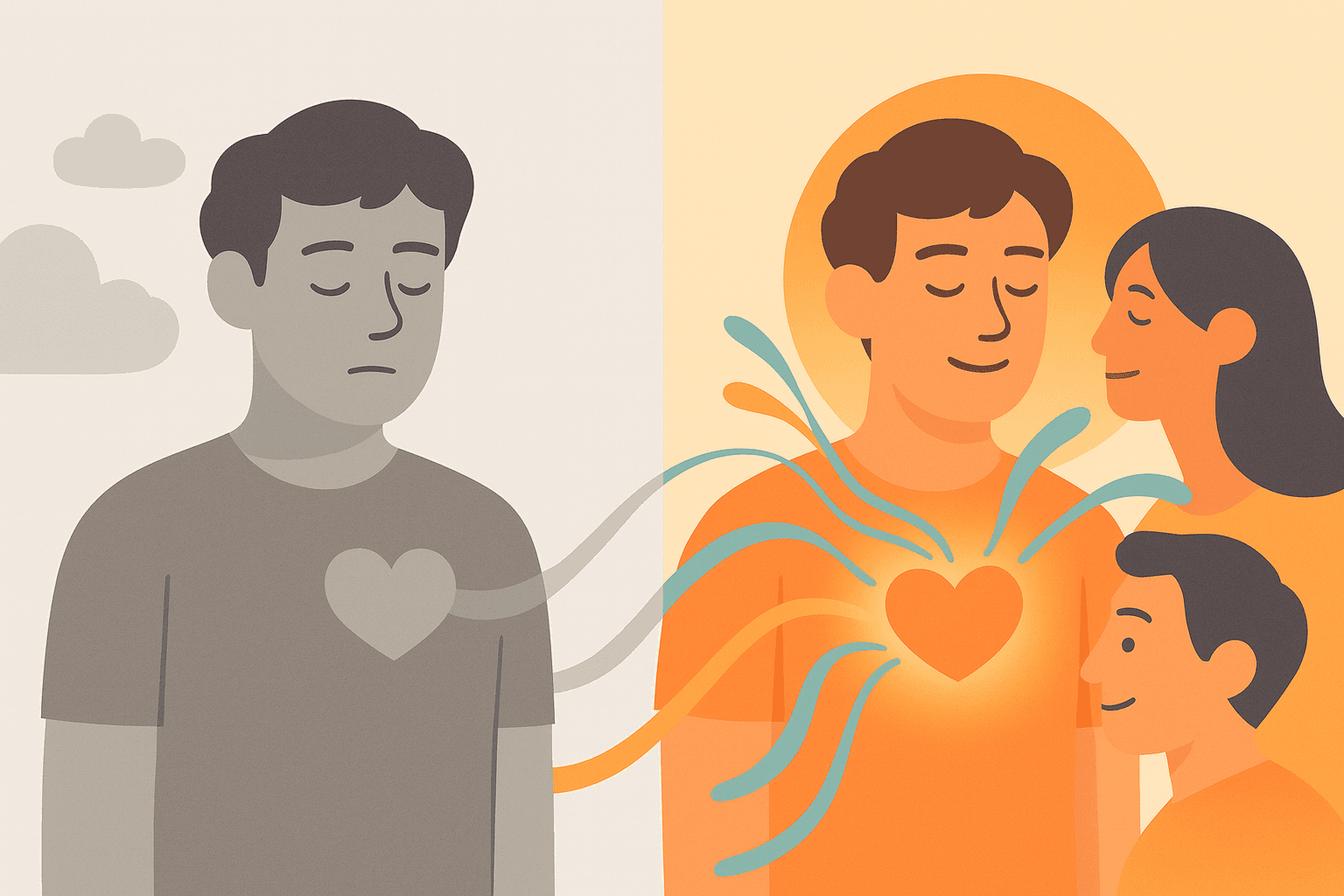
Table of contents:
Emotionality: when feelings stop being a blurry background hum
It is not "being dramatic," despite what the internet suggests
Say the word emotionality and some people instantly picture tears in aisle seven, midnight voice notes, or that one family member who can turn Sunday lunch into a one-person stage production. But that is not the useful version of the trait. Healthy emotionality is simpler, steadier, more grown-up than that. It means you can notice what you feel, stay in touch with it, and express it without turning every mood into a public emergency. Honesty, basically, with a bit of steering.
Someone with decent emotionality usually does not need three working days and a minor argument to realise they are hurt, tense, relieved, jealous, proud, or quietly sad. They catch it earlier. And feelings caught early are much easier to handle than feelings that have been simmering in the basement all afternoon, banging pipes.
It begins with inner noticing
At the centre of emotionality is awareness. Real awareness, not the vague "I guess I'm just off today" kind. You can tell the difference between anger and embarrassment. Between tiredness and resentment. Between "I don't care" and "I care so much it's making me act bizarre." Small distinction? Maybe on paper. In real life, it changes everything.
Because once you know what the feeling actually is, you stop trying to fix the wrong problem. Maybe you keep calling yourself lazy, when the real issue is dread. Maybe you think you're irritated with your partner, but underneath it is loneliness. Or fear. Or the sting of not feeling chosen. Sometimes when loneliness starts running the show, irritation is just the costume it borrowed for the day, and misreading that feeling can quietly push people even further apart. Different feeling, different next move. Without emotionality, people tend to live in about three giant emotional buckets: good, bad, stressed. That's... not a lot of room, is it.
Then it becomes expression, not emotional dumping
Another part of emotionality is being able to say what you feel clearly. Not as a performance. Not as a weapon. Just clearly. "I feel shut out." "I'm excited about this." "I'm more anxious than I look." Those sentences are not fancy, but they save people an astonishing amount of confusion.
This is where a lot of us wobble. We either swallow feelings whole and go weirdly quiet, or we spray them across the room like a loose garden hose. Emotionality sits somewhere in the middle, which is a lovely place when you can find it. It lets you reveal something real without making the other person responsible for your entire nervous system. Huge difference.
It also sharpens your sense of other people
People with stronger emotionality often get better at reading the room, too. They notice the smile that lands a fraction too late. The "I'm good" that is clearly not good. The bright voice with stress hiding underneath it like a cat under a bed. Not because they are mystical beings with emotional radar beams. Because they know feelings from the inside, and that makes other people less mysterious.
That is one reason emotionality overlaps with empathy, closeness, and trust. If you understand your own inner weather, you usually become less clumsy with other people's storms. That is part of trustfulness from the inside out, too, because people relax faster when your reactions feel honest rather than baffling. Conversation gets deeper. Connection gets easier. You stop living only on the polite, shiny surface. Much nicer down there, honestly.
What starts changing when emotionality gets stronger
Relationships become less full of static
One of the first shifts is almost boring in the best way: people understand you better. You stop sending mixed signals all day and then feeling secretly wounded because nobody guessed what was wrong. Instead of going cold, sarcastic, distant, or "totally normal" in that very tense not-normal way, you can name what's happening while it's still manageable.
And that changes closeness fast. Friends trust you more. Partners no longer have to decode you like a moody crossword clue. Even work conversations get cleaner, because saying, "I'm frustrated because I think we're missing the real issue," lands a lot better than acting fine and silently resenting everyone by 4 p.m. You know that sour, brittle feeling? Exactly.
Your decisions get smarter, not softer
Feelings are information. Not perfect information good heavens, no but still information. Anxiety may point to risk. Excitement may point to desire. Shame may reveal an old bruise. Relief sometimes tells you which option your body already voted for before your brain finished its meeting.
When emotionality is stronger, you do not have to obey every feeling like it is the boss. You just stop ignoring it like an inconvenient intern. That is one reason why strategic thinking pays off: once you notice the feeling, you can sort whether it is a warning, a bias, an old story, or a useful clue. Then you choose with more intention. That is also where how to develop problem-solving skills becomes surprisingly relevant, because it is much easier to solve the right problem when you can tell the difference between a practical obstacle and an emotional signal that needs attention first.
Which means fewer strange decisions. Fewer "yes" answers when your whole body is yelling no. Fewer missed chances because ten minutes of vulnerability felt scary and you mistook that for danger. Emotionality gives emotion a seat at the table, not the whole parliament. That's usually enough.
Stress moves through you faster
People often assume emotionality makes life more intense. At first, sometimes it does. Mostly because you start noticing what was already there, and that can be a bit... loud. But over time, emotionality usually helps feelings move instead of getting stuck in storage.
A recognised emotion has somewhere to go. An ignored one tends to leak sideways into irritability, doom-scrolling, overeating, numbness, mysterious headaches, or that classic "I'm not upset" voice that convinces exactly no one. Not your partner. Not your colleagues. Not even the dog, probably.
When you can admit, "I'm sad," or "I'm ashamed," or "I'm overloaded," the feeling often softens sooner. Not in a magical, candlelit, soundtrack-swelling way. Just because your mind and body are no longer doing the exhausting work of pretending nothing is happening. Which, let's be honest, is a terrible long-term strategy.
You come across as more human, and oddly, more solid
This bit surprises people. Emotionality does not make you flimsy. Used well, it makes you believable. People tend to feel safer around someone who can be real without collapsing, defensive without turning cruel, moved without becoming chaotic. That reads as maturity, not weakness.
There is a quiet confidence in it, too. You stop acting as if every tender reaction must be hidden in a locked drawer so you can look competent. You can be angry, touched, nervous, relieved, joyful and still grounded. Warmth plus steadiness. That combination has weight. It sticks.
When emotionality is underfed, life gets oddly cramped
Your feelings come out sideways
When emotionality is weak, feelings do not disappear. They just put on disguises and find more annoying exits. Instead of saying, "I felt dismissed," you get short and icy. Instead of admitting fear, you become suspiciously "logical" in a way that feels less like reason and more like armour. Instead of noticing sadness, you decide you are just tired and then start a fight over something microscopic, like whose turn it was to buy oat milk. Very noble. Very efficient. Obviously not.
This sideways expression confuses other people and wears you out. The emotion still gets out, only now it arrives dressed as sarcasm, defensiveness, passive aggression, shutdown, or random tears in the car park. Inconvenient little system, that.
You lose useful information about yourself
If you cannot read your own emotional state, life starts to blur at the edges. You say yes too often. You stay in situations that drain you and call it "being easygoing." Sometimes that blur slides straight into what people-pleasing quietly does while everyone else thinks you're just nice. Your preferences get edited out before you even hear them.
And sometimes the whole mess tangles itself up with self-doubt. Then imposter syndrome explained without the hype can help you spot when insecurity is dressing up as realism, which makes your own feelings even harder to trust. You keep assuming the problem is discipline, motivation, other people, bad timing something out there when part of the problem is that your inner dashboard is barely lighting up at all. That is also how emotional blind spots can feed self-sabotage in real life, because you keep working against your own needs while calling it practicality or common sense.
That creates a strange kind of distance from yourself. You can look perfectly functional on paper and still have no real idea what you feel about your work, your relationship, your direction, your actual life. And that distance costs you. Choices become flatter. Slower. Less honest.
Closeness gets harder than it needs to be
Relationships are not especially good at emotional guesswork. If naming your feelings is hard, people around you end up trying to decode them from tone, timing, facial expressions, or the mysterious meaning of "It's fine." Sometimes they guess right. Often they don't. Then both sides feel misunderstood, and nobody can quite pinpoint why the conversation suddenly went sideways.
Low emotionality can also make you seem colder than you really are. Not because you lack depth usually the opposite. It's just that your depth stays locked in the cellar while your surface handles public relations. And people cannot connect deeply with what they never get to see. Bit of a problem, if closeness matters to you. Does it? Probably, more than most people admit.
Your body starts filing complaints
Unnoticed emotion often lands somewhere. Tight shoulders. A knotted stomach before completely ordinary conversations. Restless sleep. Sudden exhaustion after social situations you kept insisting were "fine." The body is not being dramatic here, it's just carrying what the mind has not sorted out.
No, not every ache is a hidden feeling in a trench coat. Life is less poetic than that. But when emotionality is underdeveloped, the nervous system often ends up doing the emotional admin and frankly, it did not apply for that job. If you often feel wound up, flat, buzzy, or internally noisy for reasons you cannot name, this skill is worth a closer look.
How to build emotionality without becoming a walking monologue
Use tiny check-in anchors, not giant self-analysis sessions
Do not wait for a crisis to ask how you feel. Pick three ordinary moments that already exist in your day first coffee, lunch break, brushing your teeth at night, standing in the kitchen staring into the fridge for no clear reason. Pause for ten seconds. Ask, "What am I feeling right now?" Then add, "What seems to have triggered it?"
That's enough. Really. You are not writing your memoir in the cereal aisle. You're just building contact in small, repeatable doses. Tiny moments count more than the occasional grand emotional summit.
Upgrade your emotional vocabulary
A surprising amount of emotional confusion comes from lazy labels. People say "bad," "off," "stressed," or "annoyed" when the real feeling is disappointment, envy, dread, grief, embarrassment, relief, tenderness. Different words open different doors. If you use one giant word for everything, your inner life stays muddy. Hard to work with mud.
A more curious mindset helps here too, and the benefits of cultivating curiosity show up quickly once you stop judging the feeling and start examining it. For a week, try replacing vague labels with more exact ones. Not "I feel weird." More like, "I feel left out." Or "I feel pressure." Or "I feel weirdly hopeful, which is unsettling but nice." Precision sounds a bit nerdy, yes. It also works.
Practice saying one feeling out loud, cleanly
Once a day, in a safe conversation, name an emotion without wrapping it in blame. "I'm frustrated because I feel unheard." "I'm happy about this and I want to say it." "I'm more nervous than I expected." Short. Clear. No dramatic soundtrack, no courtroom speech.
This matters because emotionality is not only private awareness. It is also expression. If feelings stay trapped inside your head forever, you may understand yourself better, sure but the people around you still won't know where they stand. And that gap creates all sorts of silly, avoidable tension.
Leave yourself an evening record
At the end of the day, write a few lines to yourself or record a one-minute voice memo. Which feelings showed up most strongly today? When did your mood shift? What set it off a comment, a meeting, a memory, a message, a look, some tiny moment that seemed harmless until it wasn't?
Over a few days, patterns start showing their little faces. Ah, right. That meeting always spikes anxiety. That call with your sister leaves you warm but oddly drained. That walk after work changes the whole emotional weather. This is less about documenting every mood like a Victorian diarist and more about learning your own map. Hard to navigate a place you refuse to look at.
Let at least one emotion move all the way through
If sadness shows up, sit with it for a few minutes before lunging for distraction. If joy shows up, let yourself actually feel it instead of shrinking it into a neat little polite smile. If anger shows up, give it a safe exit: write furiously in a notebook, move your body, speak into a voice note, sing badly in the kitchen honestly, underrated. Very effective.
And in conversation, try gently checking your read of someone else's mood now and then: "You seem tense. Am I reading that right?" That combination matters. Emotionality grows through fuller contact with your own feelings and better attunement to other people's. You get more alive on the inside, and less clumsy on the outside. Nice trade, if you ask me.
Should emotionality be your main growth focus right now?
Maybe. Maybe not.
Not everyone needs more emotionality this month. Some people are already flooded by feelings and would benefit more from steadiness, boundaries, or better regulation first. If your inner world already feels like six radio stations playing at once, the first task may not be "feel more." It may be, very plainly, "learn how to hold what I feel without drowning in it."
That is why it helps to choose one growth priority at a time. Otherwise you end up trying to become emotionally open, calm, confident, disciplined, deeply self-aware, and magically well-rested by next Tuesday. Charming idea. Catastrophic plan.
What matters is the pattern. Are you disconnected from your feelings? Confused in relationships? Reacting late instead of understanding early? If yes, emotionality may deserve your attention now, not someday when life gets less busy because, let's be real, that mythical calmer future rarely arrives on its own.
If you want a cleaner answer, AI Coach can help sort what deserves attention first and give you a simple three-day starting plan. Sometimes that is far more useful than vaguely deciding to "be more in touch with yourself" and then, well, doing absolutely nothing with that thought.
Frequently Asked Questions (FAQ)
What does emotionality mean in simple terms?
Emotionality is the ability to notice, feel, and express emotions in a way that is real and usable. In everyday life, it means you know what is happening inside you and can show it without either stuffing everything down or flooding the room.
Is emotionality a strength or a weakness?
It can be either, depending on balance. Healthy emotionality helps with honesty, empathy, stress processing, and closer relationships. Unbalanced emotionality can slide into impulsiveness, oversharing, or emotional chaos. The useful version has openness and regulation. One without the other gets messy fast.
What is the difference between emotionality and emotional intelligence?
Emotionality is more about contact with feeling: sensing it, naming it, expressing it. Emotional intelligence is broader. It includes understanding emotions, managing them, and responding well to other people's states too. You can be emotional without being especially skilled, and you can be emotionally intelligent without being highly expressive. Annoying but true.
Can emotionality be learned if I grew up hiding my feelings?
Yes. Slowly, often awkwardly, but yes. Many people were taught to minimise feelings, mock them, or translate them into "being strong." Emotionality can still be built through small check-ins, better emotional vocabulary, honest but simple self-expression, and regular reflection on your triggers and patterns. You are not stuck with the emotional habits you inherited.
Why do I sometimes react strongly before I even understand what I feel?
Because the nervous system often notices emotion before the thinking mind labels it. If emotionality is underdeveloped, your body may react first tension, tears, anger, shutdown while your mind catches up later like someone running after a bus. Building awareness shortens that delay. You start recognising the feeling earlier, before it has to shout.
Is emotionality the same as being sensitive?
Not quite. Sensitivity usually means you are strongly affected by stimuli, tone, energy, or emotional cues. Emotionality is the ability to stay in contact with those feelings and express them clearly. Plenty of sensitive people are not emotionally articulate, and some emotionally expressive people are not especially sensitive. Similar neighbourhood, different houses.
Can emotional people still be good leaders or professionals?
Absolutely. Often they are easier to trust when their emotionality is grounded. A leader who can say, "This is difficult," "I'm concerned," or "I appreciate the effort here" without becoming erratic tends to feel more human and more believable. The key is not emotional absence. It is emotional steadiness.
How do I express emotion without overwhelming other people?
Keep it specific and own it. Say what you feel, what seems to be causing it, and, if needed, what would help. That is very different from blaming, unloading, or expecting the other person to become your emergency support team on the spot. Clear usually beats intense.
What are signs that my emotionality is weaker than I thought?
A few common clues: you often say "I'm fine" when you are clearly not, feelings come out as sarcasm or shutdown, you struggle to name what you feel beyond "stressed," people say you are hard to read, or you only understand your emotions after the argument, not during it. That pattern usually points to weak emotional contact, not lack of depth. And yes, that distinction matters.
Can too much emotionality become a problem?
Yes. If every feeling becomes urgent, public, or impossible to regulate, emotionality stops helping and starts running the household. That does not mean the answer is suppression. It means openness needs structure. Feel deeply, sure. Just don't hand every passing emotion the microphone and the event budget.