
Empathy is the thing that keeps people from feeling like background furniture in your life. Without it, conversations get oddly bleak. You explain, advise, reply, maybe you even mean every word kindly - and the person in front of you still has that look, like your sentences bounced off the glass and slid to the floor. If you hear, "You don't really get it," more often than you'd like, or closeness keeps evaporating the minute life gets messy, there may be an empathy gap sitting there in plain daylight.
The good news is, empathy is not some rare angelic trait handed out to a lucky few at birth. It's a skill. A very human one. You can train yourself to notice more, understand better, and respond in a way that makes another person feel genuinely met. And when that starts happening, a lot changes. More than just "being nice," honestly - quite a bit more.
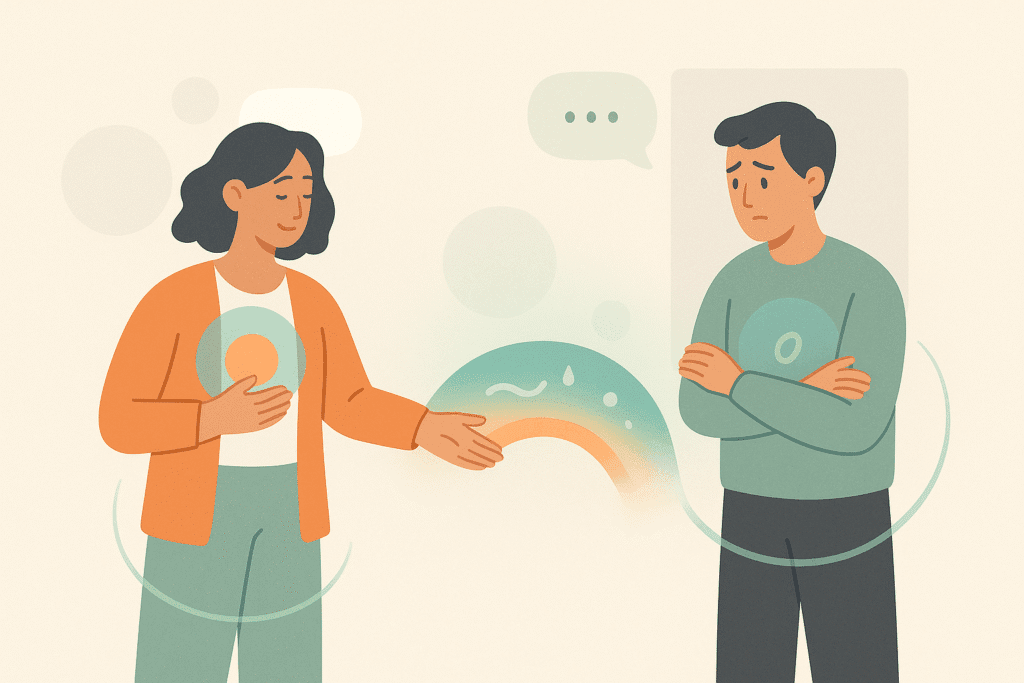
Table of contents:
Empathy: what it really is when it shows up in a real human
Not mind-reading, not sainthood
A lot of people hear empathy and picture someone endlessly soft, endlessly available, basically an emotional hotel lobby with warm lamps, herbal tea, and zero closing hours. Lovely image. Not accurate. Empathy is not agreeing with everyone, soaking up every mood in the room, or becoming so understanding that your own backbone quietly leaves the building. It's the ability to sense what another person may be feeling, make an honest effort to understand their inner world, and respond in a way that shows, "Yeah, I'm here with you." That's already plenty. No halo, no harp music.
You hear more than the sentence
One of the clearest signs of empathy is that you don't only react to the words themselves. You catch the feeling underneath them. Someone says, "I'm fine," but their jaw is clenched, their shoulders are halfway to their ears, and their smile looks like it was borrowed for the evening. An empathetic person notices the mismatch. They might say, "You sound wiped out, not fine," or "Oof, that seemed to hit harder than you expected." Tiny moment, big effect. People exhale when they feel accurately read. Not dissected, not cornered. Just... seen.
That's why empathy has two moving parts. There's the emotional side - you register that someone is hurt, relieved, embarrassed, thrilled, ashamed, all of it. Then there's the thinking side - you try to understand why it feels that way from their position, not from your own comfy seat. You need both. Warmth without understanding turns into projection. Understanding without warmth can feel like being analyzed by a polite robot. Not ideal. If you sometimes confuse empathy with simply feeling things very intensely, it helps to look at what emotionality actually means, because strong feelings and accurate understanding are cousins, maybe, but they are not the same job.
It stays connected without drowning
Healthy empathy comes with edges. This part gets skipped all the time, for some reason. People act like empathy means taking on someone else's pain until now there are two miserable people and maybe a blanket involved. But real empathy lets you stay close without losing your footing. You can care without spiraling. You can understand someone's anger without catching fire yourself. You can sit beside grief without moving in permanently.
That balance matters more than it sounds. In families, friendships, management, healthcare, teaching, customer service - anywhere, really, that humans continue being inconveniently human. Empathy works best when it's warm but steady. Close, but not engulfed. That's also why it pairs so well with altruism - the skill of giving without losing yourself, especially if caring for people tends to drag you straight into overgiving, rescuing, or quietly vanishing from your own life.
It usually sounds like curiosity
Empathetic people tend to ask more than they announce. Instead of leaping in with "Here's what you need to do," they leave room. "What was the hardest part?" "How did that land for you?" "Do you want comfort, ideas, or just company right now?" Hear the difference? Empathy is less performance, more attention. Less spotlight, more lamp.
And in real life it often looks almost ridiculously ordinary, which is part of the magic. A manager notices a usually sharp employee getting quiet and checks in without turning it into a spectacle. A friend hears the joke, yes, but also hears the bruise hidden inside it. A partner doesn't argue with your feelings like they're disputing a parking ticket. They stay for a minute. They try to see the room from your side of the table. That's empathy. Not dramatic, not cinematic. Just deeply, stubbornly human.
What starts going better when empathy gets stronger
Conflict stops becoming a stupid contest
When empathy gets stronger, disagreement becomes less primitive. You still argue, obviously. Nobody turns into a serene woodland creature overnight. But the whole thing starts to shift. It becomes less about winning and more about understanding what's actually going on beneath the sharp words and crossed arms. Maybe the tone was fear. Maybe the defensiveness was shame. Maybe that "small thing" touched an old bruise nobody had named yet.
Once you can sense that, the conversation changes. You stop punching at smoke and start dealing with the fire. Does that make hard conversations pleasant? No, let's not get silly. But it does make them more useful. More honest. Less like two nervous systems flinging cutlery at each other in the dark.
People trust you with the real version of themselves
One of empathy's quiet superpowers is safety. Not the grand movie kind. The everyday kind. The kind where someone thinks, "If I tell them the truth, I probably won't get flattened, fixed, or laughed at." That matters more than most people admit. In relationships, it creates depth. In friendships, loyalty. In teams, it helps honesty show up before the problem gets expensive or embarrassing or both.
And if you want that trust to lead somewhere solid, it helps to learn how to develop honesty, because empathy without truthful communication can feel warm in the moment and foggy five minutes later.
Here's the interesting part: people open up faster around someone who makes them feel understood. So empathy improves communication not only because you understand more, but because other people become willing to tell you what's really going on. Less guessing. Less bizarre interpretation. Less emotional charades in the kitchen at 8:40 p.m. while somebody pretends they're "not upset."
Support becomes useful instead of annoying
Without empathy, help can land like a dropped toolbox. Loud. Heavy. Slightly painful. Someone shares pain and immediately gets advice, comparison, motivation, or a bright little speech they did not order. You know the vibe. It's not always cruel - sometimes it's just badly aimed care.
Empathy changes that. You stop matching your response to your discomfort with their feelings, and start matching it to the person in front of you. Sometimes that means listening longer than feels efficient. Sometimes it means saying, "That sounds brutal," and not adding a single clever thing after it. Sometimes it means practical help: picking up groceries, taking a shift, sending the text they don't have the energy to write. Empathy makes care more precise. And precise care feels so good, honestly. It tells the other person, "I wasn't just reacting. I was paying attention."
Work gets sharper, not just kinder
People talk about empathy as if it belongs only in therapy offices and heartfelt late-night conversations. Nope. It's useful at work - wildly useful. An empathetic manager notices morale dipping before it turns into resignations and awkward farewell cupcakes. A salesperson hears the hesitation behind the objection and stops pushing the wrong point. A teacher spots confusion before the student shuts down. A colleague knows when feedback needs more tact and when it actually needs more clarity. Same skill, different outfit.
There's a personal payoff too. Empathy tends to soften your inner world. When you understand people better, you take fewer things personally. You stop assuming every blunt message is an attack, every silence is rejection, every awkward pause is proof the relationship is doomed. Life gets less prickly. Not perfect, just - less full of unnecessary emotional splinters. Which is already a pretty lovely upgrade, if you ask me.
What low empathy quietly does to your relationships, work, and self-image
You answer the message and miss the person
When empathy is weak, people can become very efficient and very off-target at the same time. Someone shares distress, and you respond to the facts only. Someone says they're overwhelmed, and you hand them a plan. Someone hints they're hurt, and you defend your intention like a lawyer who's had one excellent coffee. From your side, it may feel sensible. From theirs, it often feels cold. Not because you don't care, necessarily. Sometimes you do care a lot. You're just not translating the emotional part.
And that gap hurts more than people expect. A person can be surrounded by words, texts, check-ins, practical support - all of that - and still feel intensely alone if no one seems to catch what those words actually mean emotionally. Have you ever had that happen to you? It stings in a very specific way.
Advice starts doing the job of connection
This one is sneaky. Low empathy often dresses up as helpfulness. You move fast. You solve. You explain. You tidy the mess. Very competent, very brisk, maybe even impressive. And yet people don't seem relieved. Sometimes they pull away. Why? Because being helped is not the same thing as being understood. If the feeling part gets skipped, support can feel like a patch slapped over a crack that's still widening underneath.
Over time, people may stop bringing you vulnerable things at all. Not because they dislike you. Because they don't expect to feel met there. That's a hard sentence, I know. Still worth sitting with for a minute.
Tension gets interpreted in the worst possible way
Without empathy, conflict fills up with bad guesses. You assume disrespect where there's stress. Weakness where there's fear. Hostility where there's pain. The other person does the same with you. Now you've got two frazzled nervous systems standing in the metaphorical kitchen, both inventing stories, and none of those stories are especially generous. Fantastic.
That's how small misunderstandings grow teeth. They turn into long sulks, brittle group dynamics, family distance, or that weird office mood where everyone is technically polite and somehow exhausted anyway. Empathy doesn't erase friction - humans will still human - but the lack of it adds static to everything. Suddenly ordinary tension feels sharper, more personal, more loaded than it really is.
Your own blind spots stay weirdly comfortable
Low empathy doesn't just strain relationships. It quietly blocks self-development too. If you struggle to imagine how your words or behavior land in other people, you keep repeating patterns without fully seeing them. You interrupt and call it passion. You go blunt and call it honesty. You withdraw and call it independence. Maybe those labels are true sometimes. Sometimes they're just prettier names for disconnection.
And sometimes the deeper issue isn't indifference at all - it's defensiveness. If feedback instantly turns into shame, panic, or self-attack, working on how to quiet the inner critic and reclaim agency can make empathy much easier, because you hear other people more clearly when you're not busy surviving your own internal prosecutor.
The emotional cost of all this can sneak up on you. You may start wondering why closeness feels fragile, why the same feedback keeps coming back in different outfits, why people warm up to you and then stay strangely cautious. That stings. Not because you're a bad person. Because some part of you probably wants deeper trust, easier communication, less recurring friction, fewer conversations that leave everyone feeling vaguely scraped. Empathy is one of the skills that makes that possible. Without it, life can become very factual and oddly touch-starved at the same time.
How to grow empathy without turning yourself into an emotional sponge
Reflect the feeling before you offer the fix
For one week, try a tiny rule in conversation: before you give advice, name what the other person may be feeling. No theatrical voice, please, nobody needs that. Just simple and real. "You sound disappointed." "That seems exhausting." "I get the sense you're carrying more than you're saying." Then stop. Pause. Let them correct you if you missed it.
That correction is useful, by the way. Empathy is not perfect guessing. It's a willingness to check. This one little exercise retrains your attention. You stop listening only for content and start listening for tone, pace, tension, relief, that wobble people get when they're trying very hard not to wobble. If this sounds easy and yet weirdly hard to do consistently, it helps to learn how to be disciplined, because empathy usually grows through repeated small acts of attention, not one dramatic breakthrough with background music. And if staying present with people feels harder than it should, it may be worth looking at what too much digital input quietly does to a person, because fractured attention does not only weaken focus - it can also make emotional attunement thinner, faster, and strangely less human.
Step into a life that is not yours
Pick one story each week from someone whose life conditions are very different from your own - an older adult living alone, a refugee, a parent caring for a disabled child, a person with chronic illness, a teenager trying not to fall apart at school. Read it or watch it slowly. No speed-skimming. Then ask yourself, quietly, "What might an ordinary Tuesday feel like in that life?"
The point is not pity. It's expansion. Empathy grows when your mind becomes less provincial, less convinced that your own experience is the center of the map. Most of us need that reminder now and then. Maybe more than now and then, if we're being honest.
Ask one feeling question and leave room for the answer
In daily conversation, ask at least one question that invites an inner answer rather than a status update. "How did that actually feel?" works. "What part of this is hitting you hardest?" works too. Then comes the tricky little miracle: don't interrupt. Don't rush in to rescue the silence just because you feel twitchy. Let the other person find their words. They may need a second. Or six.
If you live with someone or love someone, try asking, "When you're having a rough day, what kind of support helps most from me?" Then just listen. No self-defense speech. No historical review of all the times you were supportive, actually. You may discover that what feels helpful from your side isn't what lands as helpful from theirs. Humbling? Yes. Useful? Massively.
Train empathy in conflict and in action
When tension shows up, take ten minutes and write a short note from the other person's point of view. Not to excuse them. Not to declare them right. Just to understand the scene from inside their logic. What did they notice? What might have hurt? What story are they probably telling themselves about what happened? This exercise is excellent for cooling down moral drama. It reminds you that other people usually make sense to themselves, even when they are being completely maddening.
Then bring empathy down to earth. Offer one concrete act of care with no speech attached: make tea, take a task off someone's plate, send a warm message, sit beside them without turning into a motivational podcast. Presence is often more powerful than advice. If painful news hits - disaster, illness, war, someone's loss - let yourself feel it for a minute instead of speed-scrolling past. And if the feeling is real, let it move your behavior. Support someone. Give something. Show up. Empathy gets stronger when it leaves the head and enters the hands.
Should empathy be the next thing you work on?
Not always. Some people really do need stronger empathy. Others already feel too much, absorb everyone's moods, and reach Friday feeling emotionally wrung out like an old dishcloth. If that's you, your first priority may be boundaries, assertiveness, or nervous-system recovery - not "feel even more," thanks very much.
It helps to look at the actual friction in your life. Are you often told you come across as cold, dismissive, or hard to talk to? Do conflicts keep escalating because you miss what the other person is feeling underneath the words? Then yes, empathy probably deserves real attention. But if your main struggle is over-involvement, rescuing, or burnout, choose more carefully. Growth is not about collecting pretty traits like badges. It's about solving the right problem first.
If you want a clearer sense of what deserves focus right now, AI Coach can help you sort that out. It gives you a simple way to see which skill needs attention most and offers a three-day starting plan - which, frankly, is often far more useful than vaguely deciding to become "better with people" by Thursday.
Frequently Asked Questions (FAQ)
Why does empathy matter so much in everyday life?
Because people don't only need information from each other. They need to feel understood. Empathy improves conflict, trust, feedback, closeness, teamwork, customer conversations, parenting - all the messy little places where feelings shape behavior whether we like it or not. Without empathy, you can communicate constantly and still leave people feeling oddly alone.
What is the difference between empathy and sympathy?
Sympathy is more like, "I'm sorry this happened to you." Empathy is closer to, "I'm trying to understand what this feels like from inside your experience." Sympathy can stay at a polite distance. Empathy steps nearer. Both can be kind, sure, but empathy usually creates deeper connection because the other person feels met, not merely observed from across the room.
Can empathy actually be learned, or do you either have it or you don't?
It can absolutely be learned and strengthened. Some people may start with a natural head start, that's true. But empathy grows through habits: listening for emotion, asking better questions, checking your assumptions, imagining another point of view, practicing support that actually fits the person. It behaves much more like a muscle than a permanent label.
How do I become more empathetic without getting emotionally drained?
By pairing empathy with boundaries. You do not need to absorb another person's whole emotional weather system to understand them. Stay present. Name what you notice. Ask what helps. Remember that their feelings are real without making them your full-time responsibility. Warmth works best when it has a frame around it.
Can empathy improve romantic relationships and friendships?
Very much. Empathy helps people feel safe enough to be honest. It reduces defensive spirals, makes repair faster after conflict, and turns support into something that actually lands instead of something that merely looks supportive from a distance. A lot of relationship pain isn't lack of love. It's lack of feeling understood. Those are not the same problem - not even close.
Does empathy matter at work, or is it mostly a personal-life skill?
It matters at work a lot. Empathy helps managers spot strain early, salespeople hear the real concern behind objections, teachers notice confusion, and teams give feedback without unnecessary emotional shrapnel. It isn't just "being nice." It's practical people-reading, and that makes collaboration smarter, cleaner, and usually less exhausting.
Can you be empathetic and still disagree with someone?
Yes, and that's actually one of the healthiest forms of empathy. You can understand why someone feels what they feel without sharing their conclusion or approving their behavior. Empathy says, "I can see your experience." It does not automatically say, "Therefore you are right about everything." Big difference. Important difference.
How can I tell whether I lack empathy or I'm just socially awkward?
If you feel clumsy but genuinely try to understand people, you may be socially awkward more than low in empathy. If you regularly dismiss feelings, jump straight to fixing, get irritated by emotional nuance, or keep hearing that you come across cold or invalidating, that points more toward an empathy gap. The reassuring part? Both can improve with practice. Human beings are wonderfully trainable, even when we're a bit awkward about it.
What is one small daily habit that builds empathy fast?
In one conversation a day, reflect back the emotion before you say anything else. Something simple like, "That sounds frustrating," or "You seem relieved," is enough. It trains you to notice feeling, not just content. Small habit, surprisingly big effect. Sneaky, really.
Is empathy harder in texts, email, and online communication?
Usually, yes. Digital communication strips out tone, facial expression, pacing, and all the tiny cues humans rely on. Which means misunderstandings multiply fast. Online, empathy often requires extra effort: ask one clarifying question, assume less, and resist replying as if the shortest, harshest interpretation must be the correct one. The internet could use a little more of that, don't you think?