
You know that grim little feeling when you send something out, then spot the typo, the broken link, the missing slide, the one awkward sentence that now glows in your memory like a neon sign? That is often what weak perfectionism looks like in real life: not some dramatic personality flaw, just a steady drip of avoidable sloppiness that makes your effort look smaller than it really was.
Healthy perfectionism is the part of you that says, "Hang on, let me tighten this before it goes out into the world wearing one shoe." If you keep doing decent work that lands as merely "fine, I guess," this quality may be exactly where the leak is. And if that stings a bit... good, actually. Means we found something useful.
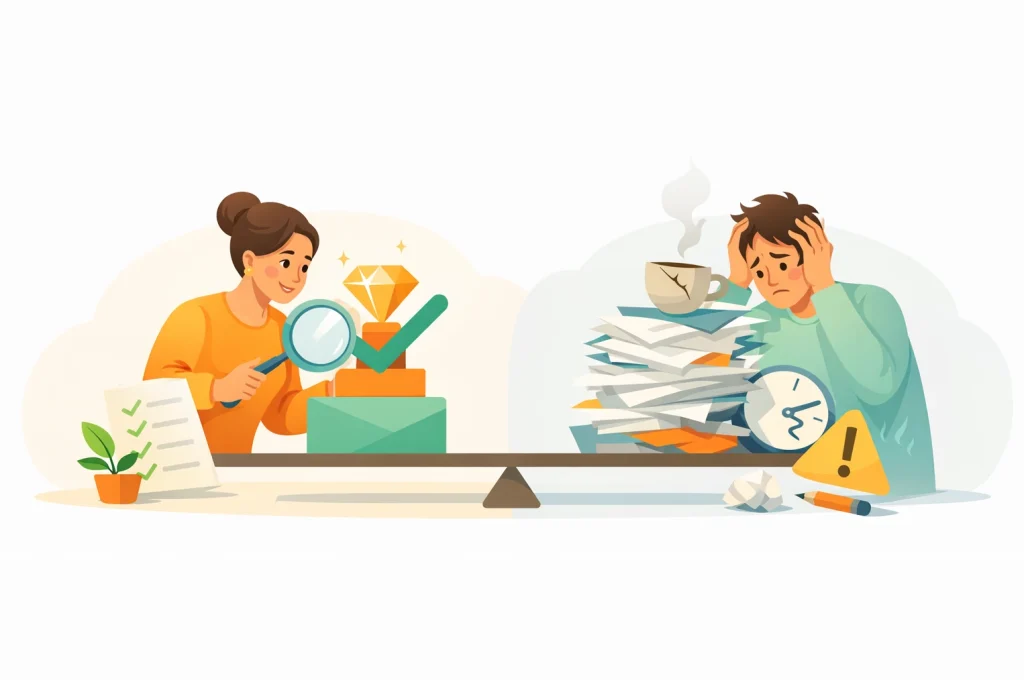
Table of contents:
Perfectionism Without the Weird Myths
It starts with a high bar
Perfectionism, in its healthy form, is the habit of aiming above the minimum. Not because you want applause for alphabetizing your soul, but because "good enough" often leaves value on the table. A person with developed perfectionism does not simply finish. They compare the result to a clear inner standard. Is this accurate? Is it clean? Is it strong enough to survive another pair of eyes? They want the work to hold up, not just exist.
That matters more than people admit. Plenty of adults have talent, knowledge, ideas, charm, all of it, and still undercut themselves by handing things over half-ready. Perfectionism is what closes that gap between potential and presentation.
Then there is the detail radar
This skill also shows up as unusual sensitivity to details. Tiny mismatches, vague wording, odd spacing, wrong numbers, clumsy transitions, missing context - a perfectionistic mind tends to catch them faster. Not because it is magically superior. More because? no, let's say it plainly: it has trained itself to look closely.
And close looking changes outcomes. In a spreadsheet, it catches the formula error before a meeting goes sideways. In an email, it removes the sentence that could sound rude. In a presentation, it fixes the order so the story makes sense instead of wobbling around like a shopping cart with one bad wheel. Details are not decorative. They affect trust.
It includes refinement, not just criticism
Another core part of perfectionism is the urge to improve what already works. That is a big difference. Some people are great at spotting flaws and terrible at making things better. Healthy perfectionism does both. It asks, "What would make this clearer, sharper, more elegant, more complete?"
This is why perfectionistic people often turn strengths into standout strengths. They do not stop at "pretty solid." They rewrite the title. They tighten the logic. They remove the extra slide. They change the file name from "final_v2_REALfinal" to something a sane person can find later. Small mercy, huge upgrade.
The useful version has brakes
Now, the important nuance. Healthy perfectionism is not endless reworking, panic, or self-punishment in expensive stationery. If there are no limits, perfectionism mutates into paralysis. The useful version knows the difference between polishing and fussing. That boundary is easier to keep when you understand what discipline really is and what it isn't, because real structure helps you improve the work without getting trapped inside it. It can say, "This is ready," without needing cosmic certainty.
So when we talk about perfectionism as a strength, we mean disciplined care. High standards, sharp attention, careful review, deliberate improvement. Not the miserable version where you spend four hours adjusting margins because your nervous system is looking for something to control. One builds quality. The other just eats your afternoon.
What Gets Better When This Quality Grows
Your work starts carrying more weight
When perfectionism gets stronger, people feel the difference before they can always explain it. Your work looks more finished. More considered. Less accidental. A report feels cleaner. A proposal reads smoother. A product page answers the question before the customer has to ask it. There is a quiet solidity to polished work, and that solidity creates trust.
It is a bit like walking into a well-kept home. You may not consciously list every detail, but your nervous system notices. Same with work. Quality has a texture.
You make fewer expensive little mistakes
Not all mistakes are dramatic. Most are small, boring, and weirdly costly. Wrong attachment. Old date. Missing source. Broken formatting. A number copied into the wrong cell. None of these sounds like a Greek tragedy. Still, enough of them and people begin to double-check you, which is not exactly a career enhancer.
Perfectionism lowers that tax. It reduces rework, embarrassment, and those maddening "why did nobody catch this?" moments. Better yet, you caught it. That changes how you feel about your own competence. You stop relying on luck and start relying a bit more on method.
Your strengths become harder to ignore
A lot of people are capable but blurry. Their ideas are good, yet the delivery leaks. Their thinking is sharp, yet the final output looks rushed. For many otherwise strong people, closing that gap also softens imposter syndrome, because the result finally starts matching the ability they have been doubting. Healthy perfectionism helps your real ability show up in full clothes, brushed hair, decent lighting. Not glamorous. Effective.
This is especially valuable in crowded environments. At work, polished output separates you from the sea of "basically done." In creative fields, it turns raw taste into actual craft. In leadership, it signals care. You are telling people, without giving a speech, "I take the outcome seriously." That message travels far.
Self-respect gets less fragile
There is also an emotional benefit here, and I think it matters. When you know you checked your work, improved it, and sent out something you can stand behind, you feel steadier. Less defensive. Less desperate for reassurance. You are not hoping nobody notices the cracks because you already handled what you could. Over time, that starts to resemble how confidence changes your life: not louder self-promotion, but a quieter belief that you can trust your own process under pressure.
That kind of confidence is different from performance swagger. It is quieter. More adult. More, "I did the job properly." And honestly, that feeling is deeply calming. Not because the world will reward you every single time - it won't, people are busy and occasionally blind - but because your own standard is no longer a random mood. It becomes part of your character.
What Life Looks Like When Perfectionism Is Too Weak
You keep leaking quality at the edges
Usually the problem is not total failure. It is unfinished edges. The idea is good, but the wording is muddy. The project is done, but the details are messy. The meeting goes fine, but you forgot the follow-up note. Weak perfectionism often hides inside otherwise capable people because the core work is there. It is the last ten percent that keeps betraying them.
And that last ten percent matters. It is often the part people remember.
Other people do the final check for you
When perfectionism is underdeveloped, somebody else usually has to carry the quality burden. A manager catches the mistake. A client points out the omission. A colleague cleans up the deck. A friend rewrites the email before you send it. Over time, this changes the social meaning of your work. It also affects what changes when your word starts carrying weight, because people rely more on those who finish carefully without needing rescue. Even if you are smart, even if you are fast, people start associating you with "needs another pass." Ouch.
That can quietly limit opportunity. Important tasks tend to go toward people who are trusted to finish well, not just start well. The same logic shows up in what gets better when punctuality becomes part of your character, because people usually experience timing and quality as one combined signal of reliability rather than two separate virtues.
Speed starts pretending to be competence
Here is a sneaky trap. If you lack perfectionism, you may begin identifying with being "quick," "flexible," or "not fussy," when part of the story is simply that you are not staying with the work long enough to improve it. Fast is useful, sure. But fast plus avoidable errors is just faster disappointment wearing a confidence badge.
This can become a habit. You rush, submit, get notes, fix, resend, explain, patch, and call the whole cycle productivity. Meanwhile the same amount of time, used with more care upfront, could have produced something cleaner and less stressful. Annoying little truth, that one.
Your confidence gets nicked in small, repetitive ways
Weak perfectionism does not only affect outcomes. It affects your inner climate. Every preventable mistake adds a tiny bit of friction between you and yourself. You start bracing for corrections. You feel embarrassed by work that was almost strong. You know, privately, that you could have done better if you had just slowed down and checked.
After enough repeats, the mind gets cynical. Not dramatic, just tired. "Apparently I always miss something." That story can lead to avoidance, defensiveness, or the opposite - pretending details do not matter anyway. But very often, they do matter. And deep down, you know it. Which is why this weakness feels so irritating. It is not lack of ability. It is lack of finish.
How to Train Perfectionism Without Becoming Unbearable
Pick one thing a week for a gold-standard finish
Do not try to perfect your entire life by Thursday. Choose one meaningful task each week and take it further than usual. One article, one client email, one presentation, one portfolio piece. Ask yourself, "If I wanted this to look unmistakably well made, what would I still improve?" Then do that, and only that.
This teaches your brain what real polish feels like. Not theoretical excellence. Actual, visible finish.
Separate making from correcting
A lot of people do messy work because they mix drafting and checking into one blurred struggle. Try splitting them. First pass: create the thing. Second pass: improve meaning and logic. Third pass: fix mechanics, tone, formatting, numbers, links, names, all the fiddly bits.
That separation sounds almost too simple, but it works. When your mind knows what kind of attention it is using, quality improves fast. You stop pretending one distracted skim counts as a review. It doesn't.
Borrow two brains before you call it done
Now and then, send a finished piece to two people and ask one narrow question: "What would you tighten?" Not "Do you like it?" That question usually produces polite fog. Ask for improvements. One person may spot clarity issues. Another may notice tone, design, or missing context. Use the comments, then revise.
This is excellent training because it teaches you what your own eyes still miss. It is also part of how to improve your learning ability, because the faster you absorb precise feedback without getting defensive, the faster your standards become skill instead of stress. Over time, you begin catching those patterns earlier without outside help. Lovely. Also slightly humbling, which is usually good for a person.
Build a closing ritual for repeat tasks
For any task you do often, create a tiny finishing routine. Not a giant life system, relax. Just a short sequence you always run before sending or publishing. For example: subject line, attachment, date, name spelling, link test, final read aloud. Or: headline, structure, numbers, visual consistency, callout quote, export settings. Whatever fits the job. If your work has any visual layer, even a simple one, this is also where aesthetic sense in ordinary life quietly helps, because people read care through spacing, order, rhythm, and presentation long before they consciously name it.
Perfectionism gets stronger when quality becomes repeatable, not mood-based. A checklist sounds boring because it is boring. That is part of its charm. Boring tools save glamorous disasters.
Do daily precision reps
Once a day, take a small routine task and do it with exaggerated care. Format a note neatly. Rename files properly. Clean up a calendar entry so future-you can understand it. Rehearse a key paragraph until the rhythm feels right. Review a simple document twice, once for content and once for accuracy. Tiny reps build sharpness.
And one more useful habit: after finishing something, write down three ways it could have been better. Not to shame yourself. To train your eye. When that eye gets better, perfectionism stops being a personality label and becomes what it actually is - practiced attention.
Is Perfectionism the Right Growth Focus for You Right Now?
Maybe. Maybe not. Not everyone needs more perfectionism this month. Some people first need courage to finish at all, or better boundaries, or relief from overload. If your attention keeps getting pulled outward because FOMO can quietly bend your behavior out of shape, then trying to polish your work may feel strangely hard because your focus never gets to settle in one place. If you are already stuck in endless tweaking, then more perfectionism is obviously not the medicine. Different problem, different fix.
It helps to look at the real pattern. Are you mostly suffering from preventable mistakes, messy handoffs, and work that lands weaker than it should? Then yes, this quality is probably worth attention. But if your main issue is fear, exhaustion, or chronic delay, start there, or you will just decorate the wrong problem.
If you want a cleaner read on that, AI Coach can help you sort which skill matters most right now and give you a simple three-day starting plan. Sometimes that is more useful than spending another month vaguely promising yourself to "do better next time."
Frequently Asked Questions (FAQ)
Is perfectionism a good thing or a bad thing?
Both versions exist. Healthy perfectionism means high standards, careful review, and pride in doing things well. Unhealthy perfectionism means fear, paralysis, and endless reworking because nothing ever feels safe enough to release. The first improves quality. The second mostly inflates stress.
What is the difference between perfectionism and being detail-oriented?
Being detail-oriented means you notice specifics and care about accuracy. Perfectionism goes a bit further: it adds a strong inner standard and a drive to refine the final result. You can be detail-oriented without obsessing. You can also call yourself a perfectionist while missing obvious details, which is awkward but common.
Can perfectionism actually make you slower?
Yes, if it loses its brakes. Healthy perfectionism saves time by reducing errors and rework. Unbalanced perfectionism wastes time on over-editing, second-guessing, and polishing parts that barely matter. The useful question is not "Am I slow?" but "Is this extra effort improving the outcome enough to justify the time?"
Why do some perfectionists procrastinate so much?
Because starting becomes emotionally loaded. If the mind expects flawless performance, even a normal task can feel like an exam with your worth attached to it. Then delay becomes a weird form of self-protection. This article focuses on building the practical side of perfectionism - attention, review, refinement - without feeding that fear-based version.
Is perfectionism connected to anxiety?
Often, yes. Especially the harsh kind. When mistakes feel dangerous or humiliating, the nervous system can turn standards into threat. That is why healthy perfectionism needs limits. A strong review habit is useful. A panic spiral over one imperfect sentence is not craftsmanship, it is anxiety wearing a blazer.
How do I know whether my standards are helping or hurting me?
Look at the results and the emotional cost together. Helpful standards make your work cleaner, more trusted, and more satisfying to finish. Harmful standards make you avoid, overwork, or keep "improving" without real gains. If your standards raise quality but still let you complete things, good sign. If they mostly create dread, something has tilted.
Can you build perfectionism if you have always been more of a "good enough" person?
Yes. It is trainable. Start with repeatable behaviors, not identity drama. Review before sending. Use a short checklist. Ask for targeted feedback. Choose one task to polish properly each week. Over time, your eye sharpens and your tolerance for sloppy output drops in a healthy way. That is usually how the shift happens.
Does perfectionism help in every job?
No. It helps most where accuracy, trust, presentation, and quality control matter - writing, design, finance, operations, law, medicine, product work, leadership, client communication, plenty more. But even there, it needs balance. Some roles need fast iteration more than museum-grade finish on every draft.
Can perfectionism affect relationships too, or is it mostly a work thing?
It affects relationships quite a bit. In healthy form, it can make you more thoughtful, reliable, and careful with your words. In unhealthy form, it can make you critical, rigid, hard to please, or exhausting to yourself and everyone nearby. So yes, it leaves the office and follows you home, like many habits do.
What is one small thing I can do today to strengthen healthy perfectionism?
Take one task you were about to send and give it a real final pass with one focus only: clarity, accuracy, tone, or formatting. Just one focus. Then send it. That gives you a quick taste of the skill without tipping into endless fiddling. Small, clean, useful. Good place to begin.