
Justice is the skill that keeps your values from turning into a private hobby you only remember when it is convenient. When it is weak, you may not look cruel at all. You may look pleasant, reasonable, even "nice" - while still giving more grace to people you like, more patience to people above you, and less room to the ones who are easy to overlook. That gap leaves a nasty aftertaste.
And yes, other people feel it. The quiet coworker feels it. The newer friend in the group feels it. Sometimes you feel it too, later, when the moment has passed and your conscience starts tapping the glass like, "Well... that was not your best work, was it?"
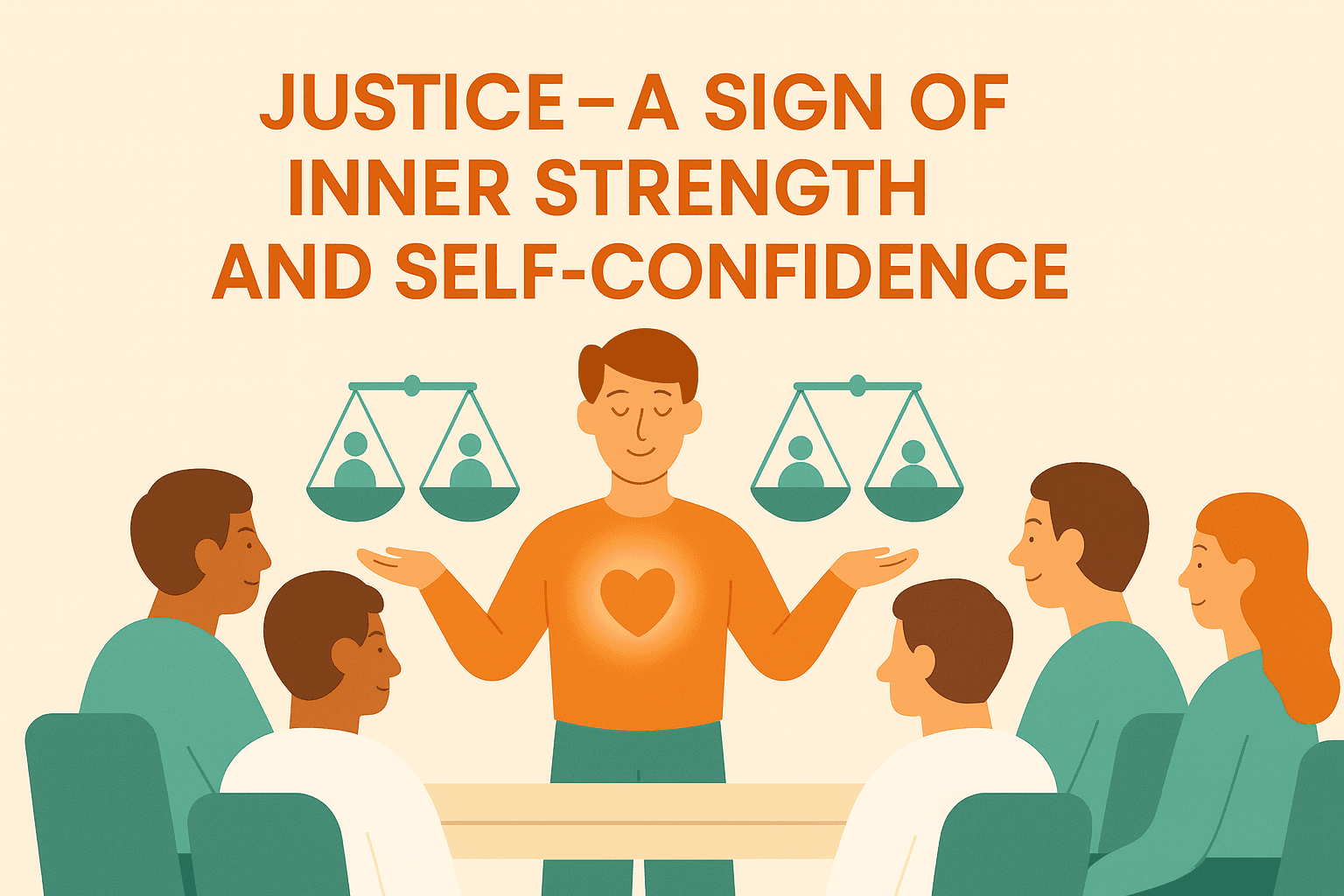
Table of contents:
Justice in ordinary life: what this skill actually looks like
It starts with giving people equal human weight
Justice, as a personal skill, is not about sounding noble at dinner or having loud opinions online. It is much more daily than that. It is the habit of treating people as if their dignity does not rise and fall with status, charm, usefulness, or how much they agree with you. A person with a strong sense of justice does not automatically hand extra softness to the confident ones and extra scrutiny to the awkward ones. They try to keep the scales steady. That steadiness gets harder when pride quietly suggests that some people deserve more grace simply because they seem more impressive, and noticing that reflex is part of becoming fairer.
That sounds obvious until real life shows up in wrinkled clothes. In meetings. In families. In group chats. In classrooms. In a hundred tiny moments where one person gets listened to and another gets politely stepped over. Justice notices those moments. And it does not shrug them off as "just how people are."
Fair does not always mean identical
This is where many people get tangled. Justice is not robotic sameness. It does not mean pretending everyone starts from the same place, needs the same thing, or has the same amount of power in the room. Sometimes fairness means giving equal rules. Sometimes it means adjusting for reality so that equal respect becomes possible at all.
Think of two employees. One already knows the culture, the jargon, the unwritten rules, all that invisible stuff. The other joined last week and is still decoding the office like it is an escape room. Treating them "exactly the same" can sound fair while quietly being lazy. Justice asks a better question: are people being given a real chance, or only the appearance of one?
It notices bias before bias becomes policy
Another part of justice is catching your own inconsistency. You are annoyed when one colleague interrupts, but amused when your favorite friend does it. You call one person "assertive" and another "difficult" for the same behavior. A manager misses a deadline and you explain it away. A junior misses one and suddenly standards matter. Funny how that happens.
People with this skill are not free from bias. Nobody is. The difference is that they are willing to look. They compare their reactions. They ask uncomfortable little questions. "Would I judge this the same way if a different person had done it?" That question alone can save you from a lot of polished unfairness. In practice, that is one reason learning how to improve your learning ability matters here, because fairer judgment depends on being able to revise your assumptions when reality gives you better information.
It has backbone, not only good intentions
Justice also requires some spine. Not theatrical courage. Just enough steadiness to say, "No, that is not right," even when the unfair version would be easier, smoother, more socially convenient. Maybe you name the contribution of the person who got skipped. Maybe you refuse to laugh at the joke that lands by punching down. Maybe you share credit properly instead of letting it drift toward the loudest person in the room. Small actions. Real consequences.
That is why justice overlaps with honesty and courage. You need truth to see what is happening, and nerve to respond to it. Otherwise "fairness" stays a lovely word and a fairly useless one.
What changes when your sense of justice gets stronger
People trust not only your decisions, but your process
One of the biggest gifts of justice is trust. Not the shiny, motivational kind. The practical kind. People feel safer with someone who does not play favorites, move the goalposts, or suddenly discover "principles" only when it benefits them. When your fairness is steady, others stop spending so much energy guessing where they stand with you.
That matters at work, in friendships, in families, everywhere humans compare notes - which they absolutely do, by the way. People can tolerate a disappointing outcome more easily when they believe the process was clean. If they feel the process was crooked, even a decent outcome tastes off.
Groups become less tense and less quietly bitter
Justice calms a room in a very specific way. It reduces the little poisons that build up when some people get extra chances and others get extra suspicion. Less whispering after meetings. Less "why does he get away with that?" Less private scorekeeping. A fair person or fair leader does not remove all conflict, obviously. Humans are still going to human. They also make more room for creativity, because people are far more likely to offer unusual ideas when they are not busy protecting themselves from lopsided treatment. But they lower the amount of resentment that comes from lopsided treatment.
And resentment is expensive. It drains motivation, cooperation, and goodwill faster than people admit. A just atmosphere gives people more room to contribute without constantly managing the emotional math of who gets protected and who gets exposed.
Your judgment gets cleaner under pressure
When justice grows, decisions stop swinging so wildly with mood, loyalty, irritation, or convenience. You become less likely to excuse bad behavior because you like the person, and less likely to punish someone harshly just because they are not "your kind of person." That steadiness improves critical thinking too, because fairness pushes you to examine evidence and standards instead of reacting from instinct wrapped in confidence.
There is a real emotional relief here. You do not need to keep rewriting your own values case by case. You know your line better. You can act from it faster. A surprisingly large amount of adult peace comes from not having to negotiate your conscience every afternoon.
You become safer to be around
This may be the most human benefit of all. When people sense justice in you, they bring you more truth. The shy person speaks up sooner. The newer person asks the basic question without bracing. The friend admits they felt overlooked instead of swallowing it for three months and then exploding over brunch. Fair people create that kind of room.
And it changes how you feel about yourself, too. Self-respect gets sturdier when you know you are not only decent in theory. You are decent when there is something to lose. That is a different flavor entirely. Less decorative. More solid.
When justice is weak, the damage spreads in sneaky ways
Double standards creep in wearing normal clothes
The trouble with weak justice is that it rarely arrives announcing itself. It slips in through preference. Through comfort. Through "I did not mean anything by it." You forgive lateness from the charming person and punish it in the person who already irritates you. You call one mistake human and another one unacceptable. You hear the same idea from two different mouths and only one of them sounds convincing to you. None of this feels dramatic in the moment. Together, though, it shapes a whole climate.
People notice patterns faster than excuses. They may not argue with you about it. They may simply file you under unsafe, biased, not worth risking honesty with. That file is hard to erase once opened.
The quieter people get pushed to the edge
When justice is missing, louder or more familiar people naturally take up more space. Their opinions get more airtime. Their mistakes get more context. Their needs get handled first. Meanwhile the ones who are newer, shyer, less polished, less connected - they start disappearing in plain sight.
This is one reason weak justice harms groups even when no one is openly nasty. Exclusion does not always look like open hostility. Sometimes it looks like being left out of decisions, interrupted a little more often, credited a little less, consulted only after the real choices were made. Death by a thousand tiny shrugs. Grim little system, that.
Resentment builds where fairness is thin
Unfairness creates a special kind of anger. Not only "I did not get what I wanted," but "I was not treated as if I mattered equally." That hits deeper. It can turn colleagues cynical, friends guarded, siblings competitive, partners touchy. The stated issue may be small. The emotional charge underneath usually is not. Over time, living in environments that feel persistently unjust can wear people down emotionally, and for some it overlaps with patterns described in depression, especially when helplessness and invisibility become chronic.
And if you are the one acting unfairly, even unintentionally, you may end up surrounded by people who nod in front of you and vent elsewhere. That is a rotten setup for any relationship. Warm on the surface, sour underneath. Like milk that looks fine until the tea goes in. Ugh.
You drift away from your own values
There is also an inner cost. Every time you look away from unfairness because the unfair version benefits you, protects your comfort, or keeps the peace, something in you registers it. Maybe not loudly. More like a quiet loss of sharpness. Your moral language stays polished, but your actual standards get mushier. You become selective about when fairness matters.
That split weakens self-trust. And without self-trust, even confidence can start feeling like costume jewelry. Nice from across the room. A bit flimsy up close. Justice, when it is missing, does not only harm other people. It leaves you less whole.
How to build justice without becoming rigid or self-righteous
Replay one moment a day through another person's eyes
At the end of the day, pick one interaction and run a short fairness replay. Nothing grand. Just ask: who had more power here, more familiarity, more room to recover from a mistake? Did I respond to the person, or to their position in my mind? This works especially well after meetings, family friction, feedback conversations, or any situation where one person went quiet and you only noticed later.
The point is not guilt. Guilt gets noisy fast and then becomes weirdly self-centered. A little optimism helps here, because if you believe people and systems can improve, you are more willing to correct unfair patterns instead of defending them. The point is pattern detection. Justice grows when you train yourself to see the slant in situations you once called neutral.
Use one standard on two different people
Choose one recurring issue this week - lateness, interruptions, quality of work, tone, sharing credit, whatever tends to trigger judgment in you. Then deliberately compare how you respond when different people do the same thing. A favorite person. A neutral person. A difficult person. Keep it honest. Slightly embarrassing is fine. Actually, it usually means you are getting somewhere.
This practice is simple and brutal in the best way. It separates principle from preference. And once you see where you bend, you can start correcting it in real time instead of calling your preferences "good judgment" and strolling off.
Deliberately widen the circle
Justice gets stronger when you interrupt social gravity. In a discussion, invite the person who keeps being cut off. In a shared project, mention the contribution no one sees because it happened backstage. When making a decision, ask whose perspective is missing from the table. That last question matters a lot. Decisions often look fair only because the people most affected were never really in the room.
You can do this quietly. No need to climb onto a moral soapbox. A sentence is enough sometimes: "I want to hear from someone who hasn't spoken yet." Or, "We should include the people who actually have to live with this outcome." Clean. Useful. Human.
Repair one old unfairness instead of only admiring fairness in theory
If someone comes to mind right away - the person you judged too fast, overlooked, dismissed, talked over, credited poorly - do not only make a private face about it. Repair what you can. An honest apology helps. A correction helps. Giving overdue credit helps. Even a brief message can matter more than people think: "I realized I was not fair to you in that situation."
And then build one small habit that keeps the repair from becoming a one-time performance. If that part is hard, learning how to master proactivity in 5 powerful ways can help, because justice becomes real when you act on what you notice instead of only agreeing with fairness in theory. Maybe you rotate who speaks first. Maybe you check task distribution before assigning more work. Maybe you pause before defending people you naturally like. Repetition is what turns fairness from an opinion into a trait.
Should justice be the next thing you work on?
Not always. Some people truly need to strengthen justice. Others are already very tuned in to fairness and are actually struggling more with boundaries, conflict avoidance, or exhaustion. If you are constantly over-carrying other people's burdens, "be more fair" may not be the missing piece. In that case, understanding the difference between justice and altruism, the skill of giving without losing yourself, can be more useful, because fairness should not require you to disappear. You may need clearer limits, not more moral weight on your shoulders. If you keep confusing fairness with keeping everyone happy, reading about how to stop being a people pleaser can help you separate real care from self-erasure, which makes your sense of justice steadier rather than more self-sacrificing.
It helps to choose one growth focus at a time. Otherwise self-development turns into that familiar little circus where you try to become wiser, calmer, braver, kinder, more focused, and mysteriously better at email by next Tuesday. Noble. Ridiculous. If your real pattern is favoritism, inconsistency, silent resentment around you, or a nagging sense that you are not living by your own standards, then justice is probably worth real attention.
If you want a cleaner read on that, AI Coach can help sort your priorities and offer a simple three-day starting plan. Sometimes the most useful move is not "work harder on yourself." It is "work on the right thing first."
Frequently Asked Questions (FAQ)
What is justice as a soft skill in simple terms?
It is the ability to treat people fairly, apply standards consistently, and resist favoritism even when your feelings pull the other way. In ordinary life, it means giving people equal respect, looking for bias in your own reactions, and making choices you could defend even if roles were reversed.
Is justice the same as fairness?
They are very close, but justice is a bit broader. Fairness is often about a specific situation: was this treatment balanced, was this outcome reasonable? Justice includes that, but also the deeper habit of protecting equal dignity, equal voice, and clean standards over time. Fairness is often the moment. Justice is the pattern.
Does justice mean treating everyone exactly the same?
No. That sounds neat, but life is not neat. Equal treatment and fair treatment are not always identical. If people have different starting points, different access, or different power in a situation, rigid sameness can actually become unfair. Justice asks whether people are getting a real chance, not only a technically identical one.
Why does justice matter so much in teams and workplaces?
Because people do not only judge results. They judge how results were reached. When standards are uneven, credit gets skewed, or certain people are always protected, trust drops fast. Motivation usually drops with it. A fair environment makes people more willing to contribute, speak honestly, and stay engaged instead of quietly checking out.
How can I stay fair when I naturally like some people more than others?
You do not need to like everyone equally. You do need to notice when liking starts bending your standards. A good practice is to compare your reactions across similar situations. Would you excuse this if your favorite person did it? Would you punish it if someone less charming did the same? That comparison reveals a lot, sometimes more than is comfortable.
Can justice make me seem cold or harsh?
It can, if you confuse justice with rigid rule-worship. Healthy justice is not icy. It includes context, humanity, and proportion. The goal is not to become a walking policy manual. The goal is to stay fair without dissolving into bias, pressure, or convenience. Warmth and fairness can live in the same person quite happily.
What are signs that my sense of justice may be weaker than I thought?
A few clues: you defend similar behavior differently depending on who did it, you often side with the more confident or higher-status person, quieter people rarely get your attention unless there is a problem, and people around you seem polite but not fully open. Another clue is private discomfort after a situation where you know, deep down, you were not even-handed.
Why do people stay silent when they witness unfair treatment?
Usually because speaking up has a cost. They may fear conflict, social friction, exclusion, or being seen as difficult. Sometimes they are also not sure whether what they noticed "counts" as unfairness, especially when it is subtle. That is why justice needs a bit of backbone. Seeing it is only half the job. Acting on it is the other half.
Can a strong sense of justice be learned later in life?
Yes. People do not arrive finished. Family culture, school, work, class, race, status, and past experiences shape how fairness feels and where blind spots show up. But awareness can be trained. So can consistency. So can the courage to correct yourself. Late is not ideal in some situations, sure, but late is still infinitely better than never.
How do I help a child develop a sense of justice?
Use daily moments, not only big lectures. Let them see that house rules apply consistently. Ask questions like, "How would that feel on the other side?" or "Did everyone get a fair turn?" Notice when one sibling is always interrupted, one child is always blamed faster, or one voice gets treated as more important. Children learn justice by watching how power works up close.