
There is a special kind of discomfort that shows up when the world keeps moving and you feel like your inner software did not get the update. A new tool at work, a different way of doing things, some younger colleague using terms you half-recognize, and suddenly your confidence starts wobbling like a cheap cafe table.
Lifelong learning is the skill of staying teachable as life changes around you. If you often feel stale, intimidated, weirdly defensive, or quietly left behind, this may be the muscle worth waking up. And when it gets stronger, life feels less like a test you missed and more like a game you can still join.
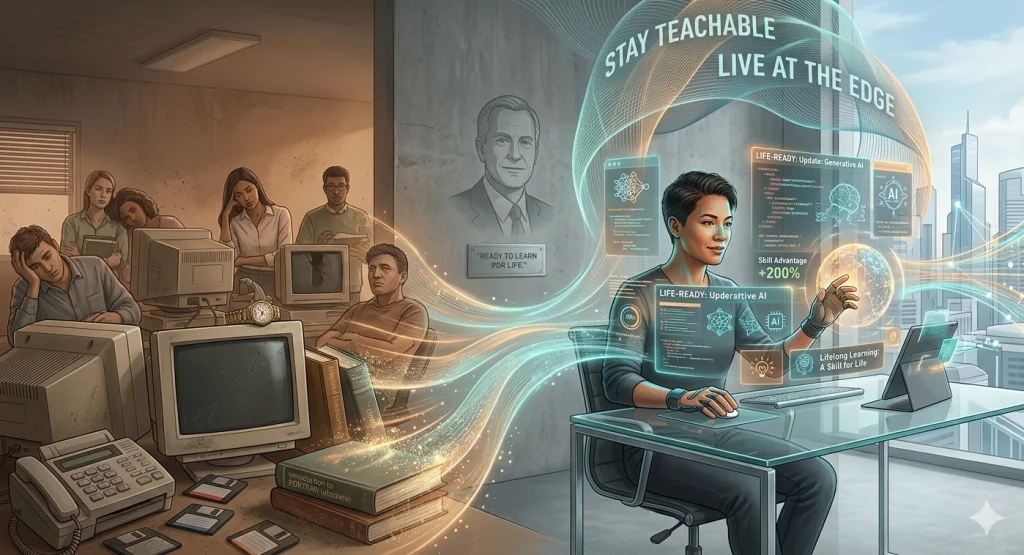
Table of contents:
Lifelong learning is not "being good at school forever"
It starts with staying teachable
Lifelong learning is the ability to keep learning across your whole life, not because someone is grading you, but because reality keeps changing and you would rather not fossilize in public. It is not about endless courses, smug book piles, or turning your Sunday into a punishment schedule. It is a mindset and a habit. A person with this skill stays open to new information, notices gaps in what they know, and does not treat "I don't know yet" like a personal insult. That last part matters more than people think.
Curiosity helps, but humility does a lot of the heavy lifting
People often imagine lifelong learners as naturally curious types who ask sparkling questions and wander around in intellectual delight. Lovely image. Not the whole picture. The deeper trait is humility: the willingness to admit your current map may be outdated. A lifelong learner can say, "Huh, I may need to rethink this," without collapsing into shame. They are less attached to looking informed and more attached to becoming informed. Which, honestly, is a much saner arrangement. In practice, this shows up as asking follow-up questions, seeking better explanations, listening without immediately defending yourself, and letting new evidence change your mind when it should.
It becomes visible in behavior, not in slogans
This skill has very ordinary-looking signs. You look things up instead of bluffing. You notice patterns. You ask for feedback and actually use some of it. You can connect ideas across different parts of life: something from parenting helps you manage a team, something from gardening helps you understand patience, something from a podcast about cities oddly helps your writing. Real learning leaks into action. You try a new approach, test it, adjust it, keep what works. Otherwise it is just information hoarding, and many smart adults are basically elegant hoarders with bookmarks.
It includes being a beginner without making it dramatic
Maybe the clearest sign of lifelong learning is this: you can tolerate being clumsy at first. You do not need instant mastery to keep going. That sounds simple, but it gets much harder when perfectionism starts running your days, because every messy first attempt feels like a referendum on your worth instead of a normal stage of learning. Adult learners often struggle here because being competent has become part of identity. We like knowing what we are doing. Fair. But a lifelong learner can survive the awkward stage where they ask basic questions, misunderstand a concept, or produce something mediocre on the first try. Not cheerfully every time, sure. Still, they stay in the room. That matters because the adult brain remains capable of change and adaptation throughout life. Not in some magical movie montage way, but in the very practical sense that repeated attention, practice, and feedback keep reshaping what you can do. Lifelong learning is, at heart, the skill of staying mentally alive.
What gets easier when this skill is alive in you
Change stops feeling like a personal attack
One of the biggest benefits is adaptability. In practice, lifelong learning and adaptability reinforce each other, because the more you trust yourself to learn, the less every change feels like an identity-level emergency. When you are used to learning, change still annoys you sometimes, but it does not immediately threaten your identity. A new system at work, a shift in your industry, a move to a different city, a new stage of family life - these become learnable situations, not proof that you are suddenly useless. That shift is emotional as much as practical. You feel less brittle. Less panicky. More able to say, "Alright, give me a minute, I can figure this out," which is a very different life posture from "Everything keeps changing and I hate it here."
Your career gets more durable
Let's be blunt: the workplace rewards people who can keep updating. Not always fairly, not always kindly, but it does. Lifelong learning helps you stay relevant because you are not relying only on what worked five years ago. You can learn new tools, understand new expectations, and translate your existing strengths into new conditions. That makes career changes less terrifying too. Not easy, no. But less like jumping into the ocean with office shoes on. Employers tend to trust people who can learn because specific technical skills expire faster than many people would like to admit. The person who keeps learning has a better chance of staying useful, employable, and less resentful.
Confidence becomes less fake
There is a sturdy kind of confidence that comes from knowing you can learn your way forward. Not that you already know everything. Quite the opposite. You trust your ability to catch up, improve, and recover from not knowing. That creates calmer self-respect. You do not have to perform expertise all the time or bluff your way through every unfamiliar moment. You can ask, read, practice, revise. Oddly enough, this often makes people seem more competent, not less. Because reality is kinder to teachable people than to rigid ones pretending they have no gaps.
Life gets bigger, not just more efficient
This skill is not only for promotions and polished LinkedIn updates, thank God. Lifelong learning also makes life more interesting. You become harder to bore because the world keeps offering material. A person, a craft, a neighborhood, a recipe, a historical period, a bit of science, the way moss grows on a wall - suddenly there is texture everywhere. You become better company too. Better questions, richer conversations, more nuance, less stale certainty. And there is something quietly joyful about remaining intellectually awake as you age. It protects against that sad narrowing some adults slip into, where everything new is dismissed and everything familiar gets worshipped like it personally built civilization.
What starts going wrong when you stop learning
Old competence turns into a hiding place
When lifelong learning is weak, people often cling to what they already know long after it stops serving them well. They keep using the same methods, the same opinions, the same social scripts, not because those are still the best ones, but because they feel safe there. Familiar competence becomes a bunker. Inside, they can still feel skilled. Outside, the world has moved on a bit. This is how people end up sounding oddly frozen: very sure, increasingly irritated, and less useful than they think. It is not always arrogance. Sometimes it is fear in a sensible jacket.
Feedback feels harsher than it is
If learning is not part of your identity, correction lands differently. A suggestion can feel like disrespect. A new idea can feel like criticism of your whole past. Somebody younger knowing more about one area can trigger a ridiculous amount of defensiveness. You may smile, nod, and then quietly reject the input because taking it in would require admitting you are still unfinished. For people carrying a lot of shame, even gentle feedback can land like a verdict, which makes curiosity feel risky when it should feel useful. Which, to be fair, nobody loves hearing on a random Tuesday. But resisting feedback this way makes growth expensive. The ego gets protected for five minutes. The person pays for it for years.
Boredom and insecurity start feeding each other
There is also a quieter cost. People who stop learning often become both bored and intimidated at the same time. They feel under-stimulated by their own routine, yet strangely reluctant to try anything new because being a beginner feels embarrassing. So life gets flatter. The same entertainment, the same conversations, the same thoughts about the same problems. And underneath that flatness sits a little anxiety: "What if I can't keep up anymore?" Not a fun combo. A bored mind with a bruised ego can get very cynical, very fast.
Your world gets smaller than it needs to be
Lack of lifelong learning does not only hurt your resume. It shrinks your world. You become more dependent on other people's interpretations, more likely to repeat half-understood opinions, more likely to avoid places where you are not instantly fluent. Over time, that limits choices. Career options narrow. Social circles narrow. Even your sense of self narrows, because you stop seeing yourself as someone who can stretch. The emotional sting here is real: you may feel behind, but tell yourself you are "just not the learning type." That story is convenient and miserable in equal measure. Most of the time, the issue is not inability. It is a relationship with discomfort that has gone a bit stale.
How to build lifelong learning without turning into a productivity goblin
Keep one live question in your life
Instead of vaguely promising yourself to "learn more," keep one active question for the week or month. Something real, not decorative. "How do I write clearer emails?" "What actually helps me sleep better?" "How does investing work without finance-bro nonsense?" A live question gives your attention somewhere to go. It also makes learning feel connected to life, which helps a lot. Human beings are much better at learning when the topic is tied to a real itch.
Use a short learn-then-use rhythm
Try this simple loop: spend twenty minutes taking in something new, then twenty minutes using it somehow, then two minutes noting what stuck. Read the article, then apply one idea. Watch the tutorial, then test the feature. Listen to the expert, then explain the concept in your own words. That middle part matters. Without use, knowledge evaporates into the wallpaper. With use, even imperfect use, the brain starts treating it as relevant. Which is the whole point really.
Schedule a beginner slot on purpose
Many adults only learn when forced. That keeps learning associated with stress, deadlines, and mild humiliation. Better move: create one regular slot where you are allowed to be new at something. Maybe one hour every other Saturday. Maybe Tuesday evenings. If you keep meaning to do this and never quite begin, a few ideas from how to get better at punctuality without turning into a clock zealot can help you protect that learning slot without making your calendar feel like a prison. Learn a language badly. Try digital illustration. Figure out basic home repair. Study bird calls if that is your thing, no judgment. The specific topic matters less than the repeated experience of being a beginner and surviving it with dignity mostly intact.
Turn private intake into shared language
A sneaky way to strengthen learning is to talk about what you are learning before it feels polished. Not in an annoying sermon way. Just naturally. Tell a friend one idea you are testing. Ask a coworker how they solved something. Bring a question into a meeting instead of waiting until you understand everything perfectly. That is often harder than it sounds when being "nice" starts editing you out, because you end up protecting the room from your uncertainty instead of using the room to learn. Learning gets stickier when it enters conversation, because now you have to organize it, compare it, and hear where your thinking is still fuzzy. Very useful, a little exposing, excellent for the ego.
Track revisions, not just achievements
Most people record what they completed. Lifelong learners also notice what they updated. Keep a small revision log: "I used to think this, now I think that." "I assumed this task required talent; turns out it mostly required reps." "I thought feedback meant failure; now I see it as direction." This practice trains your identity away from static certainty and toward growth in motion. And it makes progress visible in a less glamorous but more honest way. Not every week will produce some dramatic breakthrough. Often the win is smaller: you asked a better question, noticed an old assumption, or got less embarrassed not knowing. That counts. More than people think.
Is lifelong learning actually the thing to work on next?
Maybe yes. Maybe not right now. Not everyone needs to make lifelong learning the headline project this month, especially if the real issue is exhaustion, grief, financial stress, or a life so overcrowded that your brain is already living on crumbs.
It helps to look at the pattern honestly. If you mainly feel stagnant, outdated, overly defensive, or oddly scared of being a beginner, then this skill probably deserves attention. If your bigger problem is that you are just trying to get through the week without melting into the sofa, start with recovery or structure first, or at least alongside it. Otherwise even good intentions turn into decorative guilt.
If you want a clearer read on what deserves priority, AI Coach can help you sort your next growth focus and give you a simple plan for the first three days. Sometimes that kind of clarity is far more useful than buying another book you mean well about and then using as an expensive coaster.
Frequently Asked Questions (FAQ)
What is lifelong learning in simple words?
It is the habit of continuing to learn throughout life instead of treating education as something that ended with school or college. In plain English: you keep updating your knowledge, skills, and thinking as life changes.
Why is lifelong learning important for adults?
Because adult life does not stay still. Jobs change, technology changes, health needs change, relationships change, even your own values change. Lifelong learning helps you adapt instead of clinging to an outdated version of yourself and calling it stability.
Is lifelong learning only about career development?
No. Career is one part of it, and an important one. But lifelong learning also improves how you handle money, health, parenting, communication, creativity, decision-making, and plain old daily life. It makes you more capable, not just more employable.
Do I need formal courses to be a lifelong learner?
Not at all. Courses can help, sure. But lifelong learning also happens through books, conversations, observation, guided practice, experimentation, mentorship, reflection, and real-world problem solving. A lot of useful adult learning looks surprisingly ordinary.
What are signs that I may be bad at lifelong learning?
Some common signs are getting defensive when corrected, avoiding anything that makes you feel like a beginner, relying too heavily on old knowledge, feeling intimidated by change, or saying "I'm just not that kind of person" whenever growth gets uncomfortable. That pattern is usually less about ability and more about rigidity.
Can older adults still become good learners?
Yes. Learning may look different at different ages, and speed can vary by topic, energy, and health, but adults remain capable of building knowledge and skill throughout life. In many areas, older learners have advantages too: context, patience, pattern recognition, and a better sense of what actually matters.
How much time should I spend on lifelong learning each week?
Less than many self-improvement fanatics would like to claim. Consistency matters more than heroic bursts. Even a few focused sessions each week can change a lot if you actually use what you learn. Twenty useful minutes repeated is stronger than three hours of half-distracted "content."
What if I get excited about learning things and then drop them?
That is common. Usually the fix is to make learning more concrete and more visible. Choose one live question, use a short learn-then-use loop, and connect the topic to real life fast. Excitement is nice, but structure is what keeps the thing alive after the first shiny mood leaves the building.
How do I choose what to learn next?
Start where life is already poking you. What keeps frustrating you? What skill would make your week easier? What topic keeps returning to your mind? What are you currently avoiding because you feel behind? The best next subject is often the one that sits at the intersection of usefulness, curiosity, and a bit of healthy discomfort.
Can lifelong learning become unhealthy?
Yes, if learning turns into avoidance. Some people keep consuming information so they can feel productive without actually changing anything. Others collect courses to postpone the awkward part of trying, failing, and improving in public. Healthy lifelong learning makes life more engaged. Unhealthy lifelong learning becomes a very sophisticated hiding place.