
Some people are not buried by the amount of work. They are buried by the sprawl of it. The file is in one tab, the deadline is hiding in your calendar, the follow-up is rattling around in your brain, and somehow three people all think someone else has it covered. By evening, you are not really working anymore - you are scavenging.
That is where organizational skills earn their keep. They help you line up tasks, people, tools, and timing so life stops feeling like a kitchen drawer full of tangled chargers and one mysterious key nobody recognizes. If you are often busy, capable, and still oddly behind... well, this may be the missing piece.
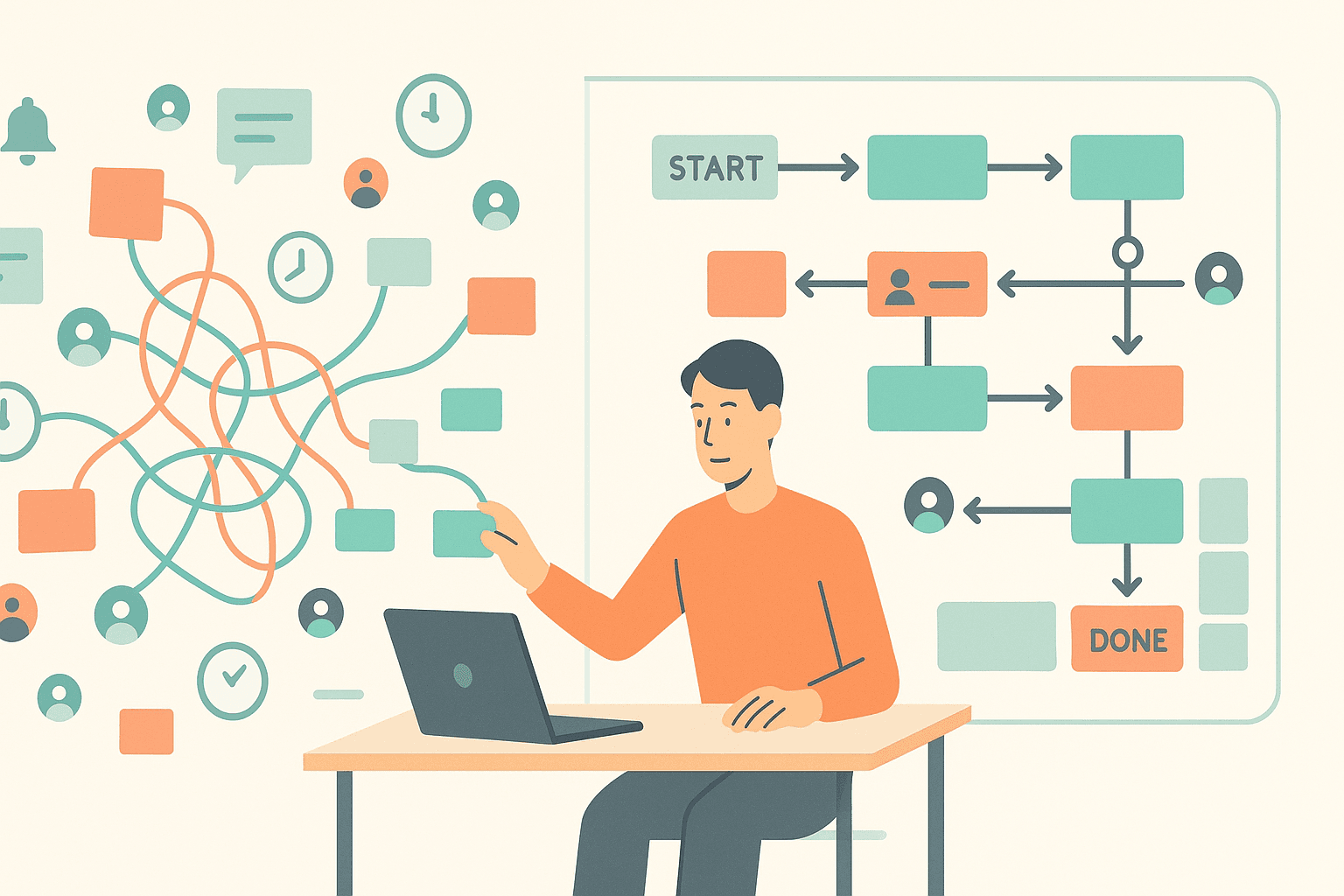
Table of contents:
Organizational skills: the ability to make moving parts cooperate
It is not the same as being neat
When people hear organizational skills, they often imagine someone with labelled folders, color-coded planners, matching pens, maybe a slightly alarming devotion to highlighters. Charming image. Not really the point.
Real organizational skill is less about looking tidy and more about making things work. It is the ability to look at a situation with lots of moving pieces - tasks, deadlines, people, tools, information, limitations - and arrange those pieces so the whole thing does not wobble like a cheap table. A well-organized person is not obsessed with order for the aesthetic. They understand what belongs where, what comes first, what can wait, what should be handed off, and what needs checking before it turns into a problem.
So yes, a clean desk can help. Lovely, even. But a clean process helps a lot more.
It builds an inner map before action starts
One of the clearest signs of strong organizational skills is this: a person does not charge into the day hoping everything will sort itself out by magic. They build a map first. Sometimes it is in a calendar, sometimes on a board, sometimes in a notebook, sometimes just in a brain that has been trained to stop and arrange things before sprinting off. But the map is there.
They can see the sequence. They notice which tasks depend on which other tasks. They can tell where effort is likely to pile up, where time will get squeezed, where things may jam. That is also why organization often sits close to strategic thinking. The moment you can see timing and dependencies before you act, you stop reacting to work like a cat chasing laser dots and start choosing a smarter route through it. If you want to strengthen that part directly, these ways to enhance strategic thinking skills can help you plan further ahead, so organization supports real progress instead of just helping you manage the next small fire.
This matters more than people think. A lot of daily stress does not come from lack of talent. It comes from bad sequencing, fuzzy ownership, and too many things arriving in the wrong order. You can be smart, fast, hardworking - and still waste huge chunks of energy if everything around you is arranged badly. Organizational skill gives work a shape before the rush begins. And honestly, that alone can feel like oxygen.
It puts the right thing in the right hands
This skill shows up in how a person handles resources too. And yes, people count here, even if the word resources makes everyone sound like office furniture. Still. Organized people are usually pretty good at asking the useful questions: who should handle this, when should it happen, what tool will make it easier, what does everyone need to know, what can be automated, what absolutely should not live only in someone's memory?
This is also where organization brushes up against responsibility. Once ownership, timing, and expectations are made clear, fewer things slip through the cracks and fewer people are left doing that awkward little dance of "Wait... was that me?"
And that, by the way, is a big deal. Weak organization turns your brain into a storage locker. Strong organization gets things out of your head and into systems that can hold them properly. It also helps prevent the classic mess where one person is drowning, another has barely anything to do, and the whole team acts shocked when the deadline shows up wearing steel-toe boots.
It stays flexible when reality barges in
The useful version of organization is not stiff. That part matters. A person with real organizational skill does not fall apart the minute a meeting moves, a client changes the scope, a child gets sick, or a train decides to become folklore instead of transportation. They adjust. They reshuffle. They keep hold of the thread.
In practice, that flexibility leans on problem-solving skills just as much as planning. Because, let's be honest, plans break. All the time. Someone still has to figure out the constraint, rebuild the sequence, and keep the end result in sight instead of spiraling into dramatic uselessness.
So this quality includes planning, sure, but also prioritizing, tracking, simplifying, delegating, and adapting without losing the plot. It is structure with a pulse. More stage manager than stern librarian. The goal is not perfect control - what a nightmare that would be - but less friction, less confusion, and fewer silly losses of time.
What gets better when your organizational skills grow up a bit
Work starts flowing instead of clumping
When organization improves, work gets smoother in a very unglamorous but deeply satisfying way. Tasks land where they should. Files are actually findable. Meetings have a reason to exist. Handoffs contain the information people need, not vague vibes and a "you know what I mean." You spend less time digging through old messages, asking "who owns this again?", or opening twelve tabs just to reconstruct what Tuesday-you was trying to do.
From the outside, this may not look dramatic. No movie soundtrack, no grand transformation montage. But it changes a lot. Progress stops arriving in chaotic bursts followed by cleanup and apologies. You get consistency. Less drag. A well-organized week feels lighter not because you are doing less, but because the same effort finally moves the needle.
People trust you with bigger things
Strong organizational skills quietly make people trust you more. Colleagues relax a little. Managers stop hovering quite so much. Clients feel less need to chase every detail like tired detectives. Why? Because organized people create fewer loose ends for everyone else to trip over. They think ahead, cover the basics, and make it easier for other people to do their part without confusion.
That is one reason organization feeds straight into reliability. People do not experience you as dependable because your planner looks impressive. They experience you as dependable because your systems make your follow-through believable. Big difference.
This matters especially in teams. Plenty of bright, creative people stay stuck in smaller roles because they generate too much friction around execution. Great ideas, sharp mind, lovely intentions - and still, somehow, chaos. Organization changes the message other people get from you. It says, quietly but clearly, "I can handle moving parts without spraying confusion all over the room." Very useful message. Also, yes, very promotable.
Your mind gets less noisy
There is an emotional payoff here that people tend to underestimate. Poor organization creates mental residue. Half-finished details. Vague responsibilities. Small forgotten things tapping at the back of your skull while you are trying to make dinner or sit down for five peaceful minutes. It is exhausting in that sticky, low-grade way that is hard to explain.
You may not notice how much energy it steals until you start putting things in better places. Then suddenly your brain is not babysitting every loose item. You stop using memory as a substitute for structure. You do not have to keep mentally whispering, "Don't forget, don't forget, don't forget..." like a haunted Post-it note.
That creates relief. Not mystical enlightenment on a mountain somewhere - let's stay realistic - just the ordinary human comfort of knowing where things stand. And if you have been carrying background chaos for a while, that can feel weirdly emotional. In a good way.
Ambition becomes easier to carry
Organizational skill is also what helps bigger goals survive contact with actual life. It is one thing to want to lead a project, grow a business, run a household well, finish a qualification, manage a team, launch something new. It is another thing entirely to hold all those moving parts without dropping your phone into the metaphorical soup.
As this skill gets stronger, bigger responsibilities stop feeling impossible and start feeling buildable. You can break things into stages. You can assign ownership. You can track progress without breathing down everyone's neck like an anxious pigeon in a blazer. Growth becomes less chaotic.
And emotionally, there is something lovely in that. You stop feeling at the mercy of everything you care about. You can hold more without becoming a knot. Wouldn't that be nice?
What weak organization quietly does to a life
You keep paying a tax on your own disarray
When organizational skills are weak, the problem is usually not one giant disaster. It is a hundred tiny leaks. You lose a file. Miss a step. Double-book yourself. Start before you have the information. Repeat instructions because nobody wrote them down. Buy the thing you already own. Miss the easy fix, then deal with the messier version later. Again. Somehow again.
Each incident looks small on its own. Together, they eat an absurd amount of time and energy. You spend hours searching, clarifying, redoing, apologizing, patching, and trying to remember what on earth you meant by "final_new_revised_REAL_one_use_this." A classic. Weak organization makes normal life more expensive than it needs to be - not just in time, but in mood.
Capable people start looking flaky
This one stings a bit. You can be genuinely talented and still come across as unreliable if your organization is weak. Not because you do not care. Not because you are lazy. But because other people mostly experience the surface of your work: missed details, vague updates, late materials, confusing handoffs, tasks that disappear into fog and come back half-done.
That creates a painful gap between who you are and how you are seen. Inside, you know you mean well. Outside, people see inconsistency. Over time, opportunities drift toward the people who create less confusion. Harsh? A little. True? Usually, yes.
In real life, execution shapes trust. Good intentions are lovely, but they do not organize a project. Systems do.
Stress follows you home
Disorganization is not only a productivity problem. It is an emotional one too. If too many things are untracked, scattered, or vaguely "somewhere in the mix," your nervous system never fully clocks out. It keeps a low hum going in the background: don't forget that, check this, where did that go, who was meant to reply, was that due today or tomorrow?
The sneaky part is that this kind of stress does not always feel dramatic. Often it feels like irritability, mental fuzz, or that strange inability to relax properly even when nothing is on fire right now. You sit on the sofa, tea in hand, maybe the blanket is good, maybe the cat is asleep nearby - and some corner of your brain is still rummaging through invisible piles. Not ideal. Do you know that feeling?
Relationships and teamwork get more brittle
Weak organization spills outward. Other people start compensating for the structure you do not have. A partner reminds you of plans. A colleague tidies the agenda. A manager chases updates. A friend stands there while you hunt for the booking email you absolutely, definitely had two minutes ago. This is also where emotional intelligence becomes part of the picture, because the ability to notice other people's frustration early and respond calmly can keep small organizational failures from turning into bigger relational messes.
Usually this does not explode into some grand drama. It is subtler than that. Confidence thins out. People double-check. They stop assuming things are handled. They build extra buffers around you, just in case. And that is the hidden sting here: weak organizational skills do not only slow you down. They can make other people experience you as harder to work with, live with, or rely on - even if you are kind, smart, and trying very hard.
How to strengthen organizational skills in real life
Create one landing place for incoming stuff
If everything enters your life through five different doors, no wonder things keep wandering off. Start by picking one main capture point for tasks and commitments: one app, one notebook, one board, one place you trust enough to check every day. Not three half-abandoned systems plus your memory. Your memory already has enough on.
This is not about building a perfect productivity cathedral. If you keep delaying the setup because it is not elegant enough yet, learning how to get over perfectionism can help you choose a system that works before you build one that merely looks impressive. It is just about giving incoming work a consistent address. Once requests, reminders, and obligations stop scattering themselves around your life like glitter after a school craft project, you can finally see what exists before it starts breeding in the dark.
Match work to energy, not just to empty space
Organized people do not only sort tasks by deadline. They also notice what kind of energy a task needs. Deep thinking at 4:45 p.m. after six Slack threads, two meetings, and a weird lunch? Brave choice. Maybe not your best one. This is also where decision-making skills matter, because good organization is not just about arranging tasks but about choosing, in real time, what deserves your best attention and what can wait without creating new chaos.
Try grouping work by mental demand. Put decision-heavy tasks where your brain is sharpest. Put routine admin where your brain is more potato, because sometimes potato is what you have and that is perfectly fine. This makes organization more human. You are not just filling slots on a calendar; you are working with a real person, which happens to be you.
That shift often improves follow-through fast. And if consistency is exactly where your system keeps collapsing, learning the lazy way to build self-discipline can help you keep simple routines going without relying on heroic moods, so your organization does not vanish the moment the week gets messy. But it only helps if you keep the system alive, which is where diligence comes in. Not glamorous, that one. Just the steady habit of checking, updating, and closing loops even when the task is dull as toast.
Run one project on a visible board
Pick one active project and map it in a way you can actually see. Keep the key stages, deadlines, open questions, and owners in one place. Nothing heroic, nothing overengineered. If a stranger could glance at it for thirty seconds and roughly understand where things stand, you are on the right track.
This is excellent training because it forces clarity. Very quickly, you start noticing fuzzy ownership, missing dependencies, fantasy timelines, all the usual suspects. A project board - even a plain, slightly ugly one - teaches the heart of organizational thinking: separate the work, sequence it, assign it, track it. Suddenly the project stops feeling like a cloud and starts behaving like an actual thing. Much easier to handle.
Clean up repeated friction, not only visible mess
Some disorder is physical, sure. A pile of papers. A desktop covered in nonsense. Cables doing an audition for a horror film. Fine, tidy that. But a surprising amount of disorganization lives in repeated friction instead: meetings with no notes, files with useless names, requests arriving everywhere, no reminders for follow-ups, information trapped in private chats like a tiny hostage.
So once a week, pick one recurring annoyance and make a rule for it. Nothing fancy. Maybe all meeting decisions go into one shared note. Maybe invoices follow one naming pattern. Maybe requests only count if they live in the project board. Small rules can do absurdly big work, especially when they save you from having the same annoying problem for the fifteenth time.
Practice cleaner handoffs
One of the quickest ways to build this skill is to get better at passing work to other people. Before you delegate or send an update, pause for a second and check: is the outcome clear, is the deadline clear, does the person have what they need, and do they know what "done" actually means? If not, you are not handing off work. You are handing off fog.
And every now and then - not perfectly, just consistently - do a ten-minute reset at the end of the day. Close loops. Rename the file. Put the note where future-you can find it. Mark the next step before you stop. Tiny acts, yes, but they are powerful precisely because they are repeatable. That is when organization stops being some personality trait you envy in other people and becomes a set of behaviors you can actually practice. Much kinder, really.
Should organizational skills be your next growth focus?
Maybe. Maybe not. Not everyone needs to start here. Some people think they have an organization problem when the real issue is overload, weak boundaries, scattered attention, or plain old exhaustion. Sometimes the hidden driver is people-pleasing: you keep saying yes, keep absorbing other people's priorities, and then blame yourself for not managing the pile gracefully. If your life is overstuffed beyond reason, better systems will help a bit, sure, but they will not magically turn too much into a healthy amount.
It usually helps to pick one growth focus instead of trying to rebuild your whole operating system in a burst of Sunday guilt. If your pattern is lost details, messy execution, unclear handoffs, and that constant feeling that too much of your energy disappears into arranging the basics, then yes - organizational skills are probably worth serious attention.
If you want a cleaner answer than "hmm, maybe," AI Coach can help you figure out which skill matters most right now and give you a simple plan for the first three days. Sometimes that is a lot more useful than downloading yet another app and hoping this one, finally, will save your soul.
Frequently Asked Questions (FAQ)
What are organizational skills in simple terms?
They are the skills that help you arrange tasks, time, information, tools, and people so things run more smoothly. In ordinary life, that means knowing what matters, where things belong, what should happen first, who is responsible, and how to keep track without relying on stress as your management strategy. Which, to be fair, many people accidentally do.
Are organizational skills the same as time management?
No. Time management is one slice of it, but not the whole pie. Organizational skills are broader. They include planning, prioritizing, structuring information, building systems, coordinating people, managing resources, and adjusting when plans change. You can be decent with your calendar and still be a complete mess with files, handoffs, or project flow.
What are signs that my organizational skills are weaker than I think?
Look for patterns. You often search for things you already had, forget small but important steps, miss follow-ups, feel buried under details, or confuse "being busy" with "having a system." Another clue: other people regularly need to remind, chase, or clarify things that should have been clear the first time around. Ouch, yes - but useful to notice.
Can a naturally messy person become organized?
Absolutely. Organization is far more trainable than most people assume. Some personalities enjoy structure more easily, sure, but you do not need to become a different species of human. What matters is building a few repeatable habits: one capture system, clearer project tracking, better handoffs, and simple rules for recurring messes. That is skill, not destiny.
Why do organizational problems get worse when I am stressed?
Because stress narrows attention. Under pressure, people default to urgency, memory, and improvisation. That makes it easier to skip structure, miss details, and react to whatever is loudest in the moment. Then the lack of organization creates even more stress. Lovely cycle, really. Good systems matter most when your brain is busiest, because that is exactly when your brain becomes a terrible storage device.
Do organizational skills matter only at work?
Not even slightly. They shape home life, finances, parenting, studying, travel, health routines, and relationships. If bills are always late, appointments keep slipping, household tasks live inside vague arguments, or simple outings require detective work, organization is involved. A well-organized life feels easier not only in meetings, but in kitchens, school runs, and Sunday evenings when you would quite like to relax for once.
Is being organized the same as being tidy or minimalist?
No. A person can have a spotless desk and a chaotic workflow. Another can have a mildly chaotic-looking desk and a brilliant system underneath it. Tidiness is visual. Organization is functional. The real question is not "Does it look clean?" but "Can you find what you need, track what matters, and move things forward without unnecessary confusion?"
How do organizational skills affect leadership?
They matter a lot, because leadership means handling more moving parts than solo work does. A leader has to coordinate priorities, people, communication, follow-up, and timing without becoming the bottleneck in every room. Weak organization makes teams feel vague, rushed, or overloaded. Strong organization creates clarity. People know what is happening, who owns what, and what comes next. That changes morale more than many leaders realize.
Can apps and planners fix poor organizational skills?
They can help, but only if the habits underneath improve. A tool cannot choose priorities for you, fix vague delegation, or force you to review open loops. Many people are not lacking apps. They are lacking decisions. The best tool is the one that supports a clear system you actually use, not the one that gives you a brief fantasy of becoming a new person by Tuesday.
What is one small daily habit that strengthens organizational skills fast?
Do a short closing check before you stop working. Put loose notes where they belong, write the next step for active tasks, rename anything messy, and make sure nothing important is living only in your head. Five or ten minutes is enough. Small habit, big effect. It teaches one of the deepest parts of organization: leaving things in a state your future self can actually work with. And future-you, frankly, deserves that kindness.