
You know that sour, jammed-up feeling when something goes sideways and your brain instantly opens five deeply unhelpful tabs: blame, panic, procrastination, doomscrolling, snack. Maybe a sixth one called "I'll deal with it tomorrow," which is just procrastination wearing glasses. Meanwhile the actual problem is still sitting there, aging badly and getting a bit nastier. Weak problem-solving often looks exactly like that - not a lack of intelligence, just a habit of freezing, fussing with the surface, or quietly hoping the mess will pack its own bags and leave.
Strong problem-solving is much less dramatic than people think. It's the ability to meet friction without turning it into a whole performance. If your days keep getting clogged by repeat issues, awkward fixes, or the same obstacle showing up in slightly different outfits, this may be the missing skill.
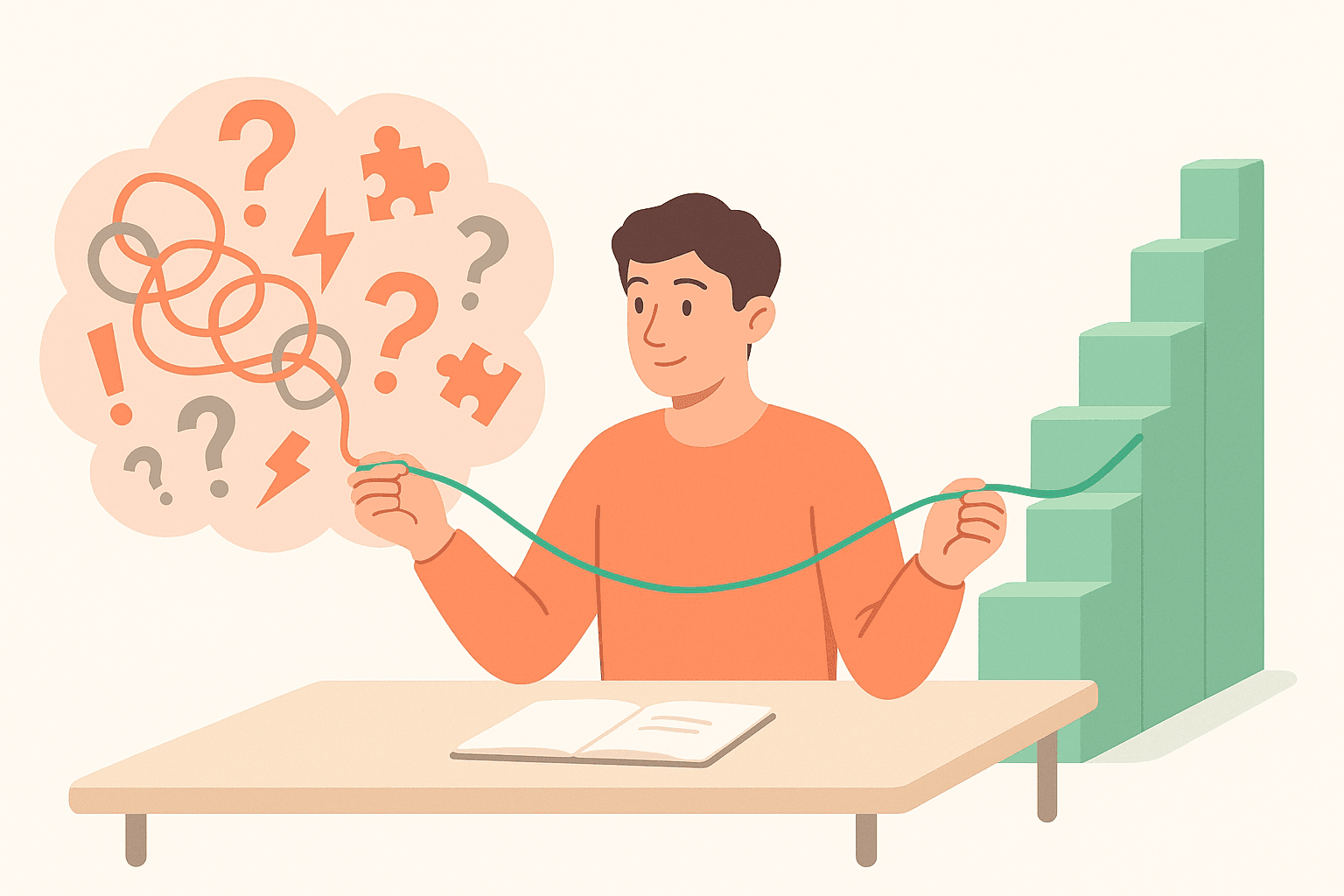
Table of contents:
Problem-Solving Skills, in Real Human Terms
It's not just "being good in a crisis"
Problem-solving is the ability to meet a difficulty, figure out what's actually happening, and move it toward some kind of workable outcome. Not the movie version where someone slaps the table, says one brilliant sentence, and saves the company before lunch. Real life is less cinematic. Usually it looks like noticing a snag early, asking one smart question, spotting the weak link, and fixing it before the whole day turns into a group emergency no one ordered.
People with this skill don't live problem-free lives, obviously. They just don't get hypnotized by problems. That's the difference.
They look past the obvious mess
A big part of problem-solving is telling the difference between what's visible and what's actually wrong underneath. A late project isn't always a "lazy team" problem. It might be a vague brief, a bottleneck in approvals, or three people quietly doing the same task because nobody compared notes. Sound familiar?
Good problem-solvers tend to ask, "What exactly is breaking here?" before they reach for blame, speeches, or an all-hands meeting everyone secretly dreads. And that matters, because most bad fixes aren't malicious. They're just aimed at the wrong target. Like trying to fix a leaking pipe by painting over the damp patch. Very busy-looking, very useless.
They separate facts from stories
Another piece of the skill is mental sorting. Facts, assumptions, feelings. All three matter, sure - but they are not the same creature. If a client goes quiet, the fact is silence. The story might be "they hated the proposal." The feeling might be panic, which, to be fair, loves dressing up as certainty.
People who solve problems well can slow that blur down. Not because they're robots. Not because they never feel stress. They just don't let fear write the diagnosis. This is where analytical thinking quietly earns its keep: it helps you test the evidence before reacting, and stops your first explanation from becoming your final one. That tiny distinction saves time, money, and a frankly embarrassing number of misunderstandings.
They stay useful, then test what works
When things wobble, good problem-solvers stay useful. Not serene, let's not get carried away. Their heart may still be tap-dancing in their chest. But they keep enough space in their head to ask, "What's the next useful move?" In a glitch, deadline slip, family mix-up, or tech tantrum, they look for traction instead of narrating the apocalypse.
That's why these people become oddly valuable when the room gets tense. They help restore direction. They can choose a step, test a fix, and adjust without collapsing into panic - or the opposite problem, endless committee-style circling where everyone talks and nothing actually moves.
And then there's the practical side: problem-solving is not just analysis, it's experiment. You try one route. You see what changes. You learn something. If the fix works halfway, you tweak it. If it flops, you don't marry it out of pride and defend it till winter. You move on. Over time, strong problem-solvers build a kind of feedback instinct. They notice patterns. They remember what broke before. They get better at catching root causes earlier. So yes, intelligence helps, of course it does - but even more than that, this skill is trained attention plus a willingness to act. Less "maybe it'll sort itself out." More "right, where's the lever?" This is also where learning ability quietly pulls more weight than people expect, because the faster you can absorb feedback from what worked and what failed, the less often you repeat the same mistake in a slightly different outfit.
What Starts Changing When You Get Better at It
The same mess stops showing up every Tuesday
One of the nicest changes is that problems stop breeding in the dark. When you know how to diagnose and fix issues properly, you spend less time doing the same repair again and again with fresh irritation each time. The buggy process gets simplified. Often that starts with better planning, which turns recurring chaos into a set of visible steps instead of one more weekly scramble. The messy handoff gets clarified. The weird tension gets addressed before it hardens into a two-week silence and a lot of strained "all good!" messages.
Good problem-solving saves energy because it cuts repeat mess. And repeat mess - sneaky thing - is one of the biggest drains in adult life.
People trust you more when things get awkward
It also changes how other people experience you. At work, at home, in friendships, in the boring little logistics of everyday life, the person who can meet a snag and bring some order to it becomes deeply valuable. Not flashy. Valuable. You're easier to trust with responsibility because you don't turn every obstacle into blame, panic, or a dramatic disappearing act. In fact, this is often where leadership gets stronger, because people naturally rely more on someone who can steady the room and help everyone move toward a solution instead of adding more noise.
In messy moments, people start looking your way for the next sensible move. That kind of trust matters for your career, yes, but it matters socially too. People relax around someone who can think under friction. And honestly, isn't that the kind of person we all want nearby when the group chat catches fire?
Your confidence stops feeling so flimsy
There's a quieter benefit too, and it might be the sweetest one. Better problem-solving reduces helplessness. Instead of feeling trapped inside every complication, you start sensing options. Not perfect options - life is not a luxury buffet - but real ones. If that trapped feeling has become your default response, it can be a sign of learned helplessness, where the brain starts expecting effort to change very little, and that expectation can quietly make everyday problems feel bigger than they are.
That shift does a lot for confidence. Confidence gets stronger when you know how to deal with trouble, not just when you hope trouble stays far away. You become less rattled by glitches because your brain has rehearsed the move from "Oh no" to "Okay, what are the pieces here?" That's a much sturdier kind of self-belief, less glitter, more backbone.
Progress survives imperfect conditions
This skill also speeds up growth in a slightly unfair way. Big plans rarely die because the goal itself was impossible. More often they die because the road got bumpy and nobody knew what to do next. If you can unblock a stuck project, work around limited resources, or come up with a decent Plan B when Plan A falls over with a thud, you keep moving while other people stall.
That matters in work, sure. But also in health, relationships, money, routines, parenting - anywhere life refuses to behave neatly, which is to say everywhere. A person who can solve problems doesn't need ideal conditions to make progress. They need enough clarity to make the next move. That's different, and it's huge.
Dread loosens its grip a little
And here's a side effect people don't always expect: life starts feeling less crowded by dread. Problems don't become fun, don't be ridiculous. But they stop feeling like strange monsters sent specifically to ruin your week. You get more mentally flexible. You see alternatives sooner. You waste less energy on pure resistance.
Problem-solving is practical, yes, but it changes your emotional life too. More steadiness. And if pressure tends to flood your system before your brain can get traction, building steadier nerves helps you stay available to the problem instead of getting swallowed by the feeling of it. More agency. More of that clean inner feeling of, "This is annoying, but it's handleable." If you've been living in low-grade dread for a while, that shift can feel almost luxurious.
What Weak Problem-Solving Quietly Does to a Life
Small issues grow teeth
When problem-solving is weak, small problems get weirdly dangerous. The missed message turns into a client issue. The tiny misunderstanding becomes that chilly relationship tension where everyone says "nothing's wrong" in a tone that could freeze soup. The software glitch eats half a day because nobody paused long enough to isolate what actually broke.
And no, this is not always about intelligence. Often it's avoidance, rushing, or that hopeful little fantasy that the problem will somehow resolve itself while you answer a few more emails and avoid looking directly at the smoke.
You fix the symptom and keep the engine noise
Another very common pattern: symptom-chasing. You fix what's loud, not what's causing the noise. So the same issue keeps coming back in a new costume. The team is "bad at communication" every month. The budget is "always a bit tight." The home routine "just keeps collapsing." Maybe. But maybe the instructions are muddy, the process has a bottleneck, expectations were never agreed, or nobody is actually making a decision.
In a lot of cases, stronger responsibility is what finally breaks the cycle, because someone owns the decision and follows it through instead of waiting for the mess to become self-cleaning. Without problem-solving, people live in permanent patch mode. Tape here, apology there, last-minute workaround, repeat. It's tiring in such a specific, soul-nibbling way.
Friction starts feeling personal
Emotionally, the cost can be rougher than it looks. Every obstacle starts to feel personal. You hit friction and immediately slide into anger, shame, blame, or that blank freeze where you reread the same sentence six times and absorb exactly nothing. A surprisingly common hobby, that one.
That pattern quietly feeds procrastination too. If problems feel humiliating or overwhelming, of course you put them off. Then they grow. Then you feel worse. Then you avoid them harder. Charming little cycle. Very efficient, if your goal is misery.
Other people start carrying your unfinished thinking
There's a social cost as well. When someone can't break problems down or move them toward resolution, other people end up carrying that load. A manager steps in. A partner sorts it out. A more practical friend quietly rescues the plan. Once or twice, fine. Life happens. But when it becomes a pattern, trust starts slipping.
Not always because you're incapable. Often because you start feeling unreliable when reality gets inconvenient. And opportunities shrink fast when that happens. Important work usually goes to the people who can untangle knots, not just point out that the string is everywhere.
Self-trust wears thinner than you notice
Maybe the deepest cost is this: you stop trusting yourself with complexity. New projects feel heavier than they are. Unexpected changes feel more threatening than they need to. You tell yourself you need more time, more certainty, better conditions, cleaner timing - when often what you really need is a better way of facing problems as they arrive.
Without that method, life can feel weirdly cluttered and unfair. With it, the exact same life becomes much more workable. Not easier, necessarily. Just more manageable. And that changes a lot.
Ways to Train the "Figure It Out" Muscle
Take one real problem and force extra options
Start with a live problem, not some imaginary self-improvement worksheet that makes you feel organized for twelve minutes. Pick one real snag and force yourself to come up with three possible responses, including one that feels slightly odd. If your workload is spilling over, could you delegate part of it, automate one small step, or change the order instead of staying late again and muttering into a granola bar?
This trains flexibility. A lot of people don't suffer because there are no solutions. They suffer because they fall in love with the first obvious one and stop looking.
Use the half-hour rule
Another useful drill is the half-hour rule. The next time something goes wrong, give yourself thirty minutes to make one useful move. Not solve the whole thing. Just break the paralysis. Clarify the misunderstanding. Restart the system. Ask the missing question. Draft the temporary workaround.
Problem-solving gets stronger when your brain learns that action can begin before certainty shows up. So much wasted time hides inside the phrase "I need to think about it," when what you actually need is to touch the problem. Even lightly. Even imperfectly.
Split the situation into three columns
When your thoughts are tangled, separate the situation into three simple buckets: what you know, what you assume, and what you feel. Let's say you missed a deadline. What you know: the work was late. What you assume: the team didn't care. What you feel: irritation, embarrassment, maybe both at once because life likes a combo pack.
That separation is oddly calming. It stops you arguing with your own imagination and gets you back into contact with reality. Keep it short. Scraps of paper count. The goal isn't elegant stationery, it's clarity.
Go deeper with the Five Whys
For recurring problems, the Five Whys method is still one of the handiest little tools around. Ask why the issue happened, then ask why again about that answer, and keep going until you hit something structural. "The launch stalled." Why? "Assets were late." Why? "No one owned the deadline." Why? "Roles were fuzzy." Ah. Now we're somewhere useful.
If you want that insight to actually change something, add a bit more structure so the fix becomes repeatable instead of a one-time flash of clarity. The point isn't to generate five clever sentences. The point is to stop treating surface symptoms as complete explanations. That habit alone can save an absurd amount of rework.
Keep a tiny record of solved problems
At the end of the day, jot down two or three problems you solved and how you solved them. Small ones count. The printer died. The meeting overlapped. The parcel vanished. The child refused shoes as if shoes were a human rights violation. Write it down anyway.
This builds a memory bank of methods, and it helps more than people expect. If you want the skill to stick, explain one of your solutions to someone else - in a meeting, to a friend, in a short note to your team. Teaching forces your thinking to get clearer. And clear thinking travels well.
Should You Work on This Next?
Not always. Some people genuinely need stronger problem-solving. Others are blaming "bad problem-solving" when the real issue is exhaustion, chronic overload, shaky confidence, or a work setup so chaotic that nobody could solve things neatly inside it. If you're running on fumes, asking yourself to become brilliantly resourceful by Friday is... a bit ambitious.
It helps to choose the right growth focus first. Otherwise you end up trying to improve problem-solving, discipline, confidence, boundaries, and emotional stability all at once, which is a very efficient way to get nowhere in five directions. Look at the pattern honestly. Do you mostly get stuck because you freeze at obstacles, chase symptoms, or keep repeating the same avoidable mess? Then yes, this skill probably deserves your attention.
If the pattern looks less like confusion and more like inconsistency, it's worth checking whether discipline should be your next growth focus, because sometimes the issue isn't that you can't solve the problem - it's that you don't follow through on the simple fix you already know.
If you want a cleaner read on that, AI Coach can help you sort your priorities and see what to strengthen first. It gives you a short assessment and a simple three-day starting plan, which is often far more useful than vaguely promising yourself to "get better at handling things" and then forgetting all about it by Thursday. Been there, honestly.
Frequently Asked Questions (FAQ)
What are problem-solving skills in simple terms?
They're the ability to notice a problem, understand what's really causing it, and move it toward a workable answer. Not a perfect answer every time. A workable one. In real life, that means less freezing, less guessing, and fewer repeat messes.
Can problem-solving skills actually be learned, or are some people just born with them?
They can absolutely be learned. Some people grow up around calmer, clearer models of thinking, so they seem "naturally good" at it. But the skill itself improves with practice: breaking issues down, testing responses, finding root causes, and reviewing what worked instead of treating every setback like random fate.
Why do I freeze when a problem shows up, even if I'm smart?
Because intelligence and nervous-system regulation are not the same thing. A problem can trigger stress, embarrassment, urgency, or an old fear of getting it wrong. Then the brain goes foggy. Often the first fix isn't "be smarter." It's making the problem smaller, clearer, and more immediate: what's one useful move you can make in the next thirty minutes?
What is the difference between problem-solving and decision-making?
Decision-making is choosing between options. Problem-solving is bigger than that. It includes spotting the issue, understanding the cause, generating options, choosing one, testing it, and adjusting if needed. So yes, decision-making lives inside problem-solving, but it's not the whole beast.
How do I know if I'm fixing symptoms instead of the real cause?
If the same problem keeps returning in slightly different packaging, that's a strong clue. You may be fixing what's visible rather than what's driving it. This is where methods like the Five Whys help. They push you past the first explanation, which is often tidy, convincing, and incomplete. Annoyingly incomplete, sometimes.
Are problem-solving skills only important at work?
No - not even close. They matter in money, parenting, relationships, health, household routines, travel, scheduling, all of it. Any part of life that includes inconvenience - so, every part - gets easier when you can stay useful instead of spiraling, blaming, or avoiding.
What if there is no good solution, only a less bad one?
That still counts. Mature problem-solving isn't about waiting for a flawless option to descend from the heavens in soft lighting. Sometimes the job is simply to reduce damage, buy time, protect what matters most, or choose the trade-off you can live with. Real life is rude like that.
Can emotions and good problem-solving exist together?
Yes. You do not need to become a fridge. Strong problem-solvers still get frustrated, scared, irritated - all of it. The difference is that they learn to separate what they feel from what they know. Feelings can inform the situation. They just shouldn't be left alone with the steering wheel.
Do creative people solve problems differently from analytical people?
Often, yes, though both styles can work beautifully. Analytical people may be quicker to break issues into parts and trace cause and effect. Creative people may spot unusual routes faster. The strongest problem-solvers usually borrow from both: clear diagnosis first, fresh options second, practical test after that.
What is one small daily habit that improves problem-solving fast?
At the end of the day, write down one problem you handled and exactly how you handled it. Keep it concrete. Over time, this builds pattern recognition. You stop seeing every new problem as a fresh cosmic insult and start seeing methods, levers, and repeatable moves. Which is, frankly, a much nicer way to live.