
Stress resistance is the ability to stay steady when life starts banging pots in your kitchen. If you snap at people, freeze under pressure, or carry one awkward email in your chest like a brick all day, chances are this skill is thinner than you'd like. And yep, that hurts: work feels heavier, conversations get messier, and even small problems arrive dressed like disasters.
The good news is that stronger stress resistance doesn't turn you into a robot. It gives you space. A breath between trigger and reaction. If that sounds like exactly what your week has been missing, keep going.
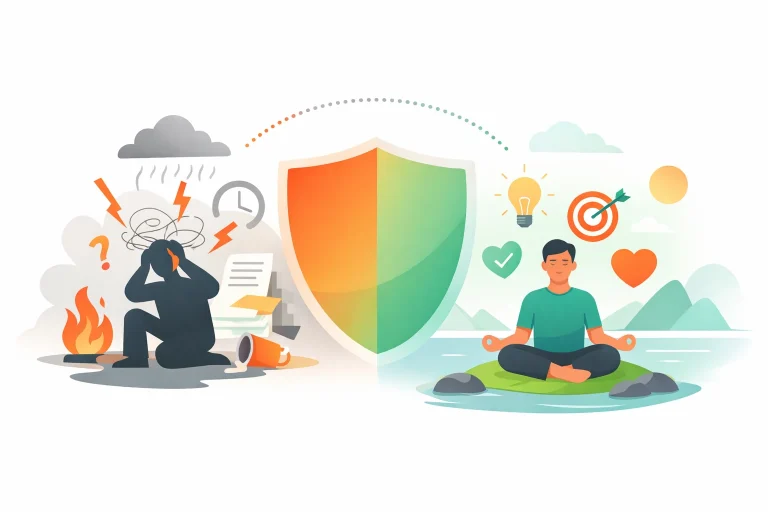
Table of contents:
What stress resistance actually looks like in real life
It is not "never feeling stressed"
Let's clear up the big misunderstanding first. Stress resistance does not mean you float through chaos with a saintly smile, untouched, moisturized, enlightened. It means stress shows up, but it does not grab the steering wheel. Your pulse may jump. Your thoughts may speed up. Still, some part of you stays online and says, "All right. What matters most here?" That's the heart of it. In those moments, logical thinking becomes a quiet ally: it helps you separate facts from interpretations, so stress can warn you without writing the whole story for you.
In psychology terms, this is close to emotional regulation and cognitive flexibility. In ordinary human terms, it's the difference between a smoke alarm and a house fire. One alerts you. The other takes the curtains.
Calm on the outside, clear on the inside
A stress-resistant person usually keeps a workable level of composure in difficult moments. They do not rush to answer every provocation. They can listen when someone is sharp, sit through uncertainty, and make a decision without adding extra drama of their own. Notice, this is not passivity. They still act. They just don't let panic make all the choices.
You can often spot this in small things. They ask one more question before reacting. They don't send the furious message at 11:43 p.m. They can enter a tense meeting, feel the tension, and not become the tension.
Endurance matters too
Stress resistance is also about stamina. Some situations are not explosive; they're just long. A sick parent. A hard quarter at work. Job search limbo. A toddler who has decided sleep is a colonial construct. In these stretched-out seasons, the skill shows up as patience, consistency, and the ability to keep functioning without falling apart every third day.
This doesn't mean people with strong stress resistance never get tired. They do. The difference is that they notice strain earlier and adjust before the wheels come off. They recover on purpose, not only after collapse.
It includes the body, not just the mind
Here's the sneaky part: stress resistance lives in the body as much as in thoughts. Jaw clenched. Shoulders up by your ears. Breath tiny and fast. The nervous system always leaves footprints. People with this skill tend to notice those signals sooner. They know when they're getting flooded, and they have ways to come back down a notch.
So, the core signs are pretty simple. They stay present under pressure. They manage emotional surges instead of being dragged by them. They think clearly enough to choose a response. And when stress lasts for a while, they keep their balance better. Not perfectly. Just better. Honestly, that's already a lot.
What gets easier when this skill grows
Decisions stop being little accidents
When stress resistance gets stronger, your decisions improve almost immediately. Not because you become brilliant overnight, but because your brain is less hijacked by urgency. You stop treating every ping, delay, or raised eyebrow like a five-alarm emergency. That gives you room to sort signal from noise. And that space matters because intuition works best when it is not drowning in panic; you can notice a gut feeling without confusing it with raw alarm.
In practice, this means fewer impulsive replies, fewer "why did I agree to that?" moments, and fewer choices made just to escape discomfort fast. You begin acting from priorities, not from adrenaline. That alone can save relationships, money, time, and an embarrassing number of follow-up messages.
Your relationships breathe easier
People feel safer around someone who can stay grounded. Not cold. Grounded. If you don't explode, shut down, or turn every tense moment into a courtroom drama, others relax a bit too. That steady presence also shapes how charisma actually works in a real person, because people are drawn not only to energy, but to someone who can hold tension without spreading it. Hard conversations become possible. Feedback becomes less threatening. Conflict stops feeling like a trapdoor.
And there's another quiet gift here: you stop taking quite so many things personally. Not everything is rejection. Not every short email is contempt. Not every bad mood in the room belongs to you. That shift is like taking a backpack of bricks off your spine.
You keep your energy for what actually matters
Low stress resistance is expensive. It burns fuel on anticipation, rumination, and emotional aftershocks. High stress resistance doesn't erase pressure, but it reduces waste. You recover faster after setbacks. You spend less time replaying conversations in the shower like some very disappointing podcast.
That means more usable energy for work, family, exercise, creativity, sleep, even simple enjoyment. A lot of people think stress resistance is about surviving more. I'd put it differently. It helps you leak less.
Confidence becomes less fake and more solid
There's a kind of confidence built from image, and then there's the sturdier kind built from experience: "I've been under pressure before. I know how I tend to wobble. I also know how to come back." Stress resistance builds the second kind. That is also why confidence changes your life so deeply: when you keep showing yourself that pressure does not automatically break you, self-trust starts to feel solid instead of staged.
You trust yourself more because you've seen yourself handle friction without turning into a tornado. That matters in interviews, leadership, parenting, dating, public speaking, money decisions - anywhere uncertainty likes to show off. The real reward is not looking impressive. It's feeling less at the mercy of every hard moment. That's freedom, honestly. A very practical kind.
What life feels like when stress resistance is weak
Small triggers become big events
When this skill is underdeveloped, daily life gets noisy fast. A delayed train becomes a ruined morning. A vague message from your boss becomes a personal apocalypse. Someone interrupts you, and your whole nervous system acts like a car alarm in a quiet street. It's exhausting, and also a bit confusing, because part of you knows the reaction is too big - but that knowledge arrives late.
This is where people often start calling themselves "too sensitive," "bad under pressure," or "just an anxious person." Sometimes anxiety is part of the picture, sure. But often it's also a regulation problem. The system overheats quickly.
The body stays on guard
Weak stress resistance rarely stays in the realm of thoughts. It settles into the body. Poor sleep. Headaches. Tight neck. Stomach acting dramatic for no good reason. That tired-but-wired feeling, where you're exhausted and still somehow unable to rest. If that sounds familiar, you know the vibe. It's like your body forgot how to put the phone on silent. And if that strain starts feeling less like alarm and more like heaviness, numbness, or a daily struggle just to function, it may help to look at depression in everyday life, not just in definitions, because not every inner collapse is "just stress" wearing a louder name.
Over time, this constant activation makes everything harder. Focus gets patchy. Patience shrinks. Even pleasant things feel less pleasant because the background tension never fully leaves the room.
Work and goals start slipping
Low stress resistance can quietly sabotage performance. Not always through dramatic failure - more often through inconsistency. You avoid difficult tasks because they spike discomfort. You rush because pressure makes you frantic. Or you overprepare, overcheck, overthink, and still feel behind. Same panic, different costume. For many people, this is exactly where avoidance takes over, and when procrastination runs the show, the quiet costs start piling up in missed chances, background guilt, and work that keeps getting emotionally heavier.
The result is frustrating. You may be capable, smart, even very hardworking, but your output doesn't match your potential. Not because you lack talent. Because pressure keeps eating bandwidth that should have gone into the task itself.
It chips away at self-respect
This part stings the most. When you regularly lose your balance under stress, you begin doubting yourself. You promise to "be calmer next time," then snap again, freeze again, spiral again. After a while, shame moves in. You stop trusting your reactions. You may even avoid opportunities, not because you don't want them, but because you don't want the internal storm that might come with them.
That is why this skill matters. Not for productivity worship. Not to become impressively unbothered. But because living in constant inner overreaction is lonely. And heavy. A person can carry that for years, sure - people carry all sorts of things - but it costs.
How to build stronger stress resistance without pretending to be zen
Put a gap between trigger and response
The first move is beautifully unglamorous: slow the first reaction. When something irritating happens today - a rude comment, a mistake, a delay, a weird email - do not answer instantly. Give yourself one minute. Breathe out longer than you breathe in. If a full minute feels absurd, count to ten. Yes, really. Old advice survives for a reason.
This tiny gap interrupts the automatic chain of stress, impulse, action, regret. It teaches your nervous system that urgency is not always authority. You can feel activated and still choose.
Read the body before it starts shouting
Several times a day, scan for physical tension. Forehead. Jaw. Shoulders. Hands. Stomach. Most people discover they've been wearing their stress like invisible armor. The trick is not to judge it. Just notice, then loosen one thing. Drop your shoulders. Unclench your teeth. Put both feet on the floor. Stand up and stretch for thirty seconds.
It sounds almost insultingly basic, I know. But stress resistance grows through repetition, not grand gestures. If you notice that these small practices keep disappearing the moment life gets messy, it may help to explore how to strengthen self-discipline without becoming a joyless robot, because calm becomes far more reliable when it is backed by follow-through, not just good intentions. A calmer body gives the mind a fighting chance.
Name what's happening instead of becoming it
When the emotional wave rises, ask yourself two blunt questions: "What am I feeling right now?" and "What is this feeling trying to protect?" Maybe you're angry because you feel dismissed. Maybe you're anxious because you're afraid of messing up publicly. When feelings stay unnamed, they run the place from the basement. Once named, they become easier to work with.
You can also create one short stabilizing phrase and use it on purpose. Something like, "This is temporary." Or, "Slow is steady." Or, "I can handle one step." Not magical. Just a handrail.
Practice calm while doing hard things
Pick one difficult task and do it at a deliberately calm pace. A tricky phone call. A packed inbox. A tense conversation with a family member. Speak a little slower. Break the task into pieces. Finish the first piece before dramatizing the other nine. This matters because stress resistance is not built only in reflection; it's built in motion, in the middle of actual life.
Then give tension somewhere safe to go. Walk around the block. Do a short workout. Put on one song and breathe until it ends. Sit in silence in your car for two minutes before going inside. In the evening, jot down one moment when you managed yourself better than usual. What helped - the pause, the breath, the slower voice, the question instead of the snap? Keep that record. It becomes evidence. And one more thing: choose a small "anchor" object, maybe a ring, bracelet, coin, or smooth stone. When stress spikes, touch it and exhale. Silly? Maybe. Effective? Often, yes.
Should this be your next growth focus?
Not necessarily. That's the honest answer. Some people don't need to start with stress resistance right now; their real bottleneck is boundaries, confidence, planning, sleep, grief, or just plain overload. Life has seasons, and each season asks for a different tool. If pressure spikes mostly when you're dealing with new tools, feedback, or unfamiliar tasks, it may be worth looking at what changes when learning stops feeling like a threat, because sometimes the stress is less about pressure itself and more about how your mind meets the unknown. And if the unknown itself makes your whole system tighten, it is also worth exploring how to loosen fear of change without pretending to love uncertainty, because what looks like weak stress resistance is sometimes a deeper struggle with change wearing a more familiar name.
It helps to choose on purpose. Otherwise you end up trying to fix everything at once, which is a very efficient way to feel busy and change almost nothing. If pressure knocks you off course daily, this skill is probably worth attention. If not, your growth point may be somewhere else. If you're torn between inner steadiness and self-belief, it may help to ask do you need to work on confidence right now, because sometimes what looks like weak stress resistance is partly a confidence gap under pressure.
If you want a clearer picture, there's a tool called AI Coach. It helps you see which skill is most worth working on first and gives you a simple plan for the first three days. Sometimes that outside mirror is useful - not because it knows your life better than you do, but because it helps sort the noise.
Frequently Asked Questions (FAQ)
What is stress resistance in simple words?
It's the ability to stay functional under pressure. Not perfectly calm, not emotionless - just able to think, choose, and act without being completely run by panic, anger, or overload.
Is stress resistance something you're born with, or can you develop it?
Both temperament and life experience matter, but this skill can absolutely be developed. Nervous systems learn through repetition. Pausing, naming emotions, relaxing physical tension, and practicing calm during difficult tasks gradually change how you respond.
What's the difference between stress resistance and suppressing emotions?
Suppression is "I feel this, but I must shove it down." Stress resistance is "I feel this, but it doesn't get to run the meeting." One disconnects you from yourself. The other helps you stay connected while still behaving wisely.
How do I know if I have low stress resistance?
Look for patterns. Do small problems feel huge? Do you snap, freeze, or spiral fast? Does your body stay tense for hours after minor stress? Do hard conversations or deadlines knock you off balance for the whole day? Those are common signs.
Can a very emotional person still be stress-resistant?
Yes. Emotional depth and stress resistance are not enemies. A person can feel things strongly and still regulate themselves well. The key issue is not intensity of feeling; it's whether the feeling hijacks behavior.
How long does it take to improve stress resistance?
You can notice small shifts in a couple of weeks if you practice daily, especially with body awareness and response delays. Deeper change usually takes longer because stress habits are old, automatic, and stubborn. Still, even tiny gains feel noticeable pretty fast.
Does stress resistance mean I should tolerate bad conditions longer?
No, and this matters. The goal is not to become so adaptable that you quietly endure toxic work, constant disrespect, or impossible demands. Good stress resistance helps you assess situations clearly. Sometimes the healthiest response is not "cope better," but "change the situation."
What helps most in the moment when I feel myself boiling over?
First, slow the first move. Exhale longer than you inhale. Relax one area of the body - jaw or shoulders are good places to start. Name the feeling in one short phrase. Then choose the next action: ask a question, step away, or answer later instead of now. Simple beats fancy in real stress.
Do sleep, exercise, and food really affect this skill that much?
Yes. A sleep-deprived, underfed, sedentary nervous system is much easier to knock off center. Stress resistance is not just mindset. It is also biology. Basics are boring, but they work. Research from the American Psychological Association and the CDC both treat stress as a full-body issue, not just a mental one.
When should I get extra help instead of trying to build this on my own?
If stress regularly leads to panic attacks, rage, shutdown, insomnia, physical symptoms, or serious problems at work and home, outside support makes sense. Also if your stress response is tied to trauma, loss, or long-term burnout. Skills help, yes, but sometimes the nervous system needs deeper care, not just better habits.