
Time management is the very ordinary, very life-changing ability to decide what deserves your hours, when it deserves them, and when something simply does not get invited in. When this skill is shaky, your day can feel like a hallway where every door is open and every voice is saying, "Quick thing." By evening you've been active, responsive, mildly heroic even... and somehow the important stuff is still sitting there, arms folded.
That leaves a nasty aftertaste. Guilt when you rest. Panic when you check the clock. That weird little sting of thinking, "Why can other people handle a normal Tuesday and I'm out here negotiating with laundry, email, and one spreadsheet like it's a hostage situation?" If that lands, stay with me.
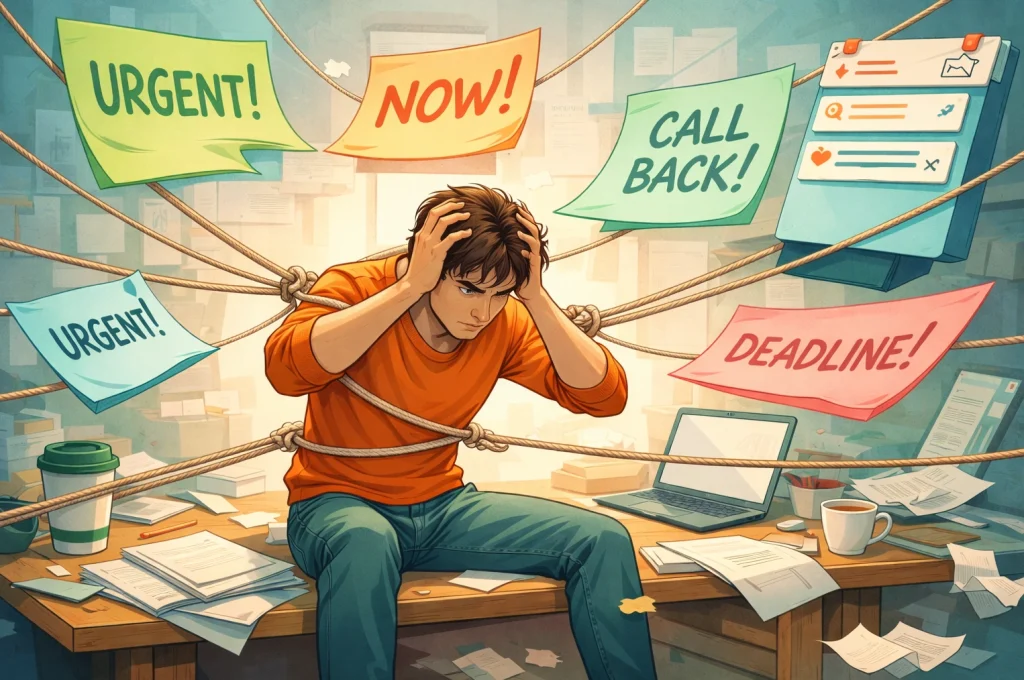
Table of contents:
Time management without the corporate varnish
It is not about cramming more into a day
A lot of people hear time management and picture color-coded calendars, productivity influencers, and someone cheerfully drinking cold brew at 5:12 a.m. Grim image, honestly. Real time management is not the art of becoming a machine. It is the skill of making sane choices about attention, sequence, and limits so your day does not get run by noise.
At its core, this skill shows up in pretty visible ways. You can tell what matters today and what only feels loud. You can start things before they become emergencies. You can finish a task without wandering off to answer three messages, compare kettles online, and suddenly care deeply about reorganizing a drawer. If that restless pull feels familiar, FOMO when "maybe there's something better" never lets you settle may be part of the pattern, because the issue is not only poor focus but the habit of treating every new option as potentially more important than the one in front of you. There is also a big psychological piece here: a person with decent time management stops treating every request as equally sacred. Which is healthy. Your inbox is not a royal decree.
Part of the skill is knowing how long reality takes
One quiet sign of strong time management is accurate estimation. Not perfect estimation. Nobody gets that trophy. But roughly knowing whether something is a ten-minute admin job, a forty-minute thinking task, or a two-hour beast that will eat your afternoon and ask for dessert. This matters more than people think.
Research on the planning fallacy, associated with Daniel Kahneman and Amos Tversky, showed how humans routinely underestimate how long things will take. So a person with better time management learns to distrust the fantasy version of the schedule. They stop saying, "I'll just do that quickly," when experience clearly suggests otherwise. A small change, maybe, but it prevents a lot of avoidable chaos.
Priorities have to become visible, not just noble
Many people technically know what matters. They care about the report, the application, the workout, the family dinner, the sleep. Lovely intentions. But if those priorities never become visible in the calendar or in the shape of the day, they remain decorative. Time management means turning values into actual placement. A meeting gets a slot. Deep work gets a protected window. Errands stop breeding in the corners because they have a home too.
This is where the skill overlaps with boundaries and self-respect. You stop leaving your best mental energy to whatever is left after everybody else has had a bite. You also stop pretending that "sometime later" is a real plan. It isn't. It's mostly a polite graveyard for good intentions.
A workable day always includes friction
Good time managers do one more thing that looks boring and saves lives: they expect interruptions, delays, mood dips, slow starts, traffic, forgotten files, children with suddenly urgent feelings, bodies that are not in the mood for brilliance, the whole human circus. In other words, they plan for life as it is, not as it appears in motivational stationery.
That makes time management less rigid than people assume. It is not only scheduling. It is pacing. It is transition control. It is leaving room between things so one late call does not kick over the next four. It is noticing when your brain works best and not placing your hardest task in the hour usually reserved for staring into tea. Done well, this skill feels less like pressure and more like relief. Ah. At last, the day has edges.
What changes when you stop spending time like loose coins
Important work stops living at the bottom of the pile
One of the first shifts is brutally practical: the things that actually matter start happening before the day gets chewed up by trivia. Not because you suddenly become noble and glowing, but because you stop offering prime hours to low-value clutter. Reports get written. Calls get made. The thing you've been avoiding because it needs a clear head finally meets your clear head. Funny how that helps.
This creates momentum fast. A day with one genuinely meaningful task completed feels very different from a day spent answering twelve minor messages and forwarding documents with the emotional intensity of wet cardboard.
Your stress becomes more proportional
Time management does not erase pressure. Let's not promise miracles. What it does is shrink the amount of pressure that comes from preventable mess. Fewer last-minute scrambles. Fewer double bookings. Fewer moments of realizing, at 9:40 p.m., that the thing due tomorrow morning is still just a concept and a hopeful face.
There is also a nervous-system benefit here. When your day has some shape, your brain stops scanning quite so hard for dropped balls. That constant low-grade alarm eases. You can work, then switch off more cleanly. Or at least cleaner than before, which counts. For a lot of people, this is the hidden gift of time management: not squeezing more output from themselves, but removing a surprising amount of pointless tension.
People trust your word more
This skill has a social effect too. When you manage time well, other people start experiencing you as steadier. You show up when you said you would. You hand things over closer to when you promised. You say no earlier instead of vanishing into optimistic lies like, "Yep, I can totally fit that in."
That changes relationships at work and at home. That matters even more when your role includes helping other people grow, because mentorship skills depend on steadiness, follow-through, and making room for someone else's progress instead of offering rushed advice between five other commitments. Colleagues do not have to chase you. Friends are less likely to get the frantic reschedule text. Partners are not left guessing whether you forgot, overcommitted, or got swallowed by your own tabs again. Reliability is weirdly attractive, in all areas of life. Not flashy. Just comforting.
You get actual leisure, not guilty pretending
And then there is rest. Real rest. The kind where your body is on the sofa and your mind is not still drafting apology emails to your future self. When time management improves, free time feels more earned in the healthiest sense. Not morally earned. Structurally earned. You know what got done, what is parked for later, and what can wait without growing fangs overnight.
This opens space for bigger things too. Learning a skill. Cooking without rushing. Seeing people you love without internally updating a crisis ledger. The odd little dream you keep postponing because normal life feels too leaky already. A well-managed schedule is not glamorous, but it quietly gives your life back to you in chunks. That is no small thing. That is, actually, the whole game for a lot of us.
When time management is weak, the day starts bossing you around
Everything feels urgent because nothing was sorted early
One classic sign of poor time management is that the day arrives already loud. Email looks urgent. Messages feel urgent. Somebody else's forgotten request becomes urgent. The task you postponed twice now is urgent, which is annoying because it did not begin that way. When priorities are unclear, urgency spreads like cheap glitter. Suddenly everything sparkles with false importance and absolutely none of it is fun.
This puts you in reactive mode. You answer the latest ping, then the next, then the next. Hours pass. The meaningful work waits in the corner getting more intimidating by the minute. By afternoon you are tired without feeling satisfied, which is a very specific kind of miserable.
Busyness starts impersonating progress
Another problem is that motion becomes a substitute for movement. You are doing things all day, yes, but the day does not add up to much. Tiny tasks crowd out substantial ones because tiny tasks give quick relief. Reply sent. Form filed. Package ordered. Nice. Meanwhile the proposal, the exam prep, the difficult conversation, the budget review, the exercise session, the meal planning - all the stuff with actual weight - keeps getting bumped. Sometimes that avoidance is not random at all. Fear of change can quietly push you toward safe, familiar tasks, because finishing the proposal or starting the hard conversation might actually change something, and the brain would rather stay busy than deal with that.
There is nothing wrong with small tasks. The trouble starts when they become a hiding place. A person can spend weeks being "so busy" while quietly avoiding the two things that would improve life the most. Painfully common. Also very human.
Self-trust gets dented in small daily ways
This part matters more than productivity people usually admit. Bad time management is not only inconvenient. It can chip away at self-respect. You keep making plans and watching yourself not follow them. You promise you'll start earlier next time. You do not. You tell someone you'll send it tonight. Midnight rolls in looking disappointed. None of this makes you a bad person, obviously. But repeated self-betrayal leaves marks.
After a while, even simple planning feels emotionally loaded. You stop believing your own estimates. You become suspicious of your own good intentions. That creates shame, and shame is a rotten planning partner. It makes the next day heavier before it has even begun.
Rest stops restoring you
Low time management also contaminates downtime. You sit down to relax, but unfinished tasks keep tapping the glass. Because nothing was properly placed, your brain keeps trying to hold everything at once. This is close to what psychologists call the Zeigarnik effect: unfinished tasks stay mentally active. So even when you are technically off, part of you is still hovering over the pile.
That is why poor time management often feels like being crowded, not merely busy. Crowded by loose ends. Crowded by vague obligations. Crowded by the memory of what you forgot. And once evenings start feeling like a messy waiting room for tomorrow's panic, motivation usually gets worse, not better. No wonder people then call themselves lazy. Half the time they are not lazy at all. They are overloaded and badly sequenced.
How to build this skill without turning your life into a spreadsheet cult
Start with a reality log, not a fantasy planner
For three to five days, track where your time actually goes. Not in a punishing way. Just honestly. Note when work starts, when it drifts, how long errands really take, where phone-checking nibbles at the edges, how much time disappears in transitions. Add one extra note beside each block: focused, shallow, tired, interrupted, or scattered. That little energy tag matters.
Most people do not need more ambition first. They need better sight. Once you can see your real patterns, the nonsense becomes obvious. Ah, right, the "quick admin" stretch always swallows an hour. Ah yes, my brain after lunch is soup. Useful. Slightly rude, but useful.
Build your day around anchors, not an endless wish list
Instead of stuffing fifteen tasks into a plan and calling it optimism, choose a few anchors. Think of them as the pieces that give the day shape: one must-do task that moves real work forward, one maintenance task that keeps life from going feral, and one personal anchor such as exercise, cooking, or school pickup. Then leave breathing room around them.
This is much easier to live with than a giant to-do list, because anchors help you protect the backbone of the day. Everything else becomes optional, movable, or deferrable instead of silently pretending to be mandatory. And if you notice that a perfectly reasonable plan keeps collapsing the moment your mood changes, it may help to learn what gets better when discipline stops depending on your mood, because time management only works when the plan survives contact with real life. Even the visual feel of your system matters more than people think; aesthetic sense changes more than your surroundings, and a cleaner, more legible calendar or workspace can reduce friction before motivation has a chance to start negotiating. Your schedule needs a skeleton, not a museum gift shop.
Size tasks before you agree to them
Before putting something into your day, give it a size. Tiny, medium, or heavy works fine. Or twenty minutes, one hour, two hours plus. The exact labels are less important than the pause itself. Ask, "What does this really cost in time and attention?" Include setup, recovery, and the annoying little extras, not only the pure task.
This one habit cuts overcommitment surprisingly fast. You stop treating a doctor appointment like thirty minutes when it really steals half a morning. You stop saying yes to "a quick deck" that obviously wants your evening as well. Estimation is not sexy. It is, though, where sanity begins.
Use a deliberate landing strip between tasks
One reason days get sloppy is that people move from one thing to the next with no reset at all. So create a tiny landing strip. Two or three minutes. Close the tabs. Write the next step for the task you are leaving. Check what the next block is actually for. Then begin. This reduces that mushy middle where you sort of finish one thing, sort of start another, and somehow lose fifteen minutes standing in the kitchen staring at a spoon.
Research on attention residue, particularly Sophie Leroy's work, points to a simple truth: part of the mind stays stuck on the previous task after a switch. A clean handoff helps more than people realize.
End the day by making tomorrow easier
Do not finish work with a dramatic collapse if you can help it. Spend five minutes setting up tomorrow's first move. Open the document you'll need. Leave one sentence about where to resume. Put materials in sight. Decide the first block before your evening brain starts bargaining with you.
This matters because starting is often the expensive part. If tomorrow begins with confusion, you'll reach for easy stuff. If tomorrow begins with a visible first step, you'll move sooner, with less theatre. And if you miss the plan sometimes? Fine. Adjust and continue. That response gets much easier when you are learning how to build optimism without lying to yourself, because realistic hope makes it easier to recover from one messy day without turning it into a verdict on your entire personality. Time management grows through repetition, not through one perfect week where you briefly become a Scandinavian notebook advertisement.
Is this really the skill you need next?
Maybe. Maybe not first. Some people genuinely need stronger time management. Other people are blaming the clock for problems that are actually coming from exhaustion, unclear priorities, people-pleasing, perfectionism, or a workload that would make almost anyone wobble. If your life is structurally overloaded, no planner on earth is going to save it by Thursday.
It helps to find the real bottleneck. If your pattern is repeated lateness, missed deadlines, constant rushing, vague overwhelm, or never having time for what matters most, then yes, this skill probably deserves attention. If the deeper issue is low energy or weak boundaries, start there or your effort will scatter all over the place.
If you want a calmer way to sort that out, AI Coach can help you see which area needs work first and give you a simple plan for the next three days. Sometimes that is more useful than making one grand promise to "get organized" and then getting derailed by one dentist appointment and a badly timed group chat. You know the kind.
Frequently Asked Questions (FAQ)
What does good time management actually include besides using a calendar?
It includes choosing priorities, estimating how long things will really take, protecting focus, leaving room for interruptions, and knowing when to say no. A calendar can help, sure, but time management is bigger than calendar ownership. Plenty of people have beautiful calendars and wildly chaotic days.
Why do I feel busy all day and still end up with very little finished?
Usually because the day is full of low-weight activity, interruptions, and task switching. You are moving, but not necessarily moving the right things. Small jobs give quick relief, so they often crowd out deeper work unless you protect space for it on purpose.
Why am I so bad at guessing how long tasks will take?
Because humans are famously overoptimistic about time. We picture the clean version of a task and forget setup, interruptions, decision time, fatigue, and all the fiddly bits around the edges. That is why sizing tasks before you schedule them is so useful. It trains realism.
Is multitasking actually efficient?
For most thinking work, not really. What people call multitasking is usually rapid switching, and switching has a cost. Attention lingers on the last task, errors go up, and you lose time re-entering the next thing. If the work is simple and automatic, the damage is smaller. If it requires thought, multitasking is often a flashy way to get slower.
How many real priorities can I carry in one day?
Fewer than your optimistic self would like. For most people, one substantial priority plus a small handful of supporting tasks is plenty. You can do more on paper, of course. The question is whether you want a full list or an actual finished day.
What is the difference between time management and productivity?
Productivity is about output. Time management is about how your hours are arranged, protected, and used. Good time management often improves productivity, but they are not identical. A person can be very productive for a short burst while using time terribly and heading straight for burnout.
Why do interruptions throw off my whole day so easily?
Because interruptions do not only steal the minutes they occupy. They also break momentum and leave part of your attention stuck on the previous task. Then you need extra time to re-enter what you were doing. That is why transition rituals and protected work blocks help more than they seem like they should.
Can better time management reduce procrastination?
Often, yes. Not all procrastination comes from poor planning, but a lot of it gets worse when tasks are vague, oversized, or placed in impossible parts of the day. When the next step is small and clearly scheduled, your brain has less room to turn the whole thing into a foggy threat.
How do I manage time when my workday is unpredictable?
Use flexible structure instead of minute-by-minute control. Keep a few anchors, leave buffers, and sort tasks by size so you know what can fit into broken chunks of time. On unpredictable days, rigid plans tend to snap. Loose but intentional plans bend better.
What is one small change that improves time management fastest?
At the end of each day, decide tomorrow's first meaningful task and make the starting point visible. Open the file. Put the notebook out. Leave a short note about the next step. That tiny setup reduces morning drift and stops easy nonsense from grabbing the first hour. Small move, big payoff. I hope it makes your next Tuesday feel a bit less crowded.