
You know that hot little jolt when someone says, "Can we talk about this?" and your whole body reacts as if they just slammed a door? Or when a dry text, a raised eyebrow, one awkward joke at dinner follows you around for hours like a song you did not choose? That is often what touchiness feels like in real life: not "being dramatic," not weakness, just a nervous system that grabs small moments and treats them like personal threats.
If you keep feeling hurt, tense, defensive, embarrassed, or weirdly exposed over things that other people seem to brush off, there is probably something here for you. And if you are tired of replaying tiny interactions like they were major court cases in the theater of your skull, well, good. We can work with that.
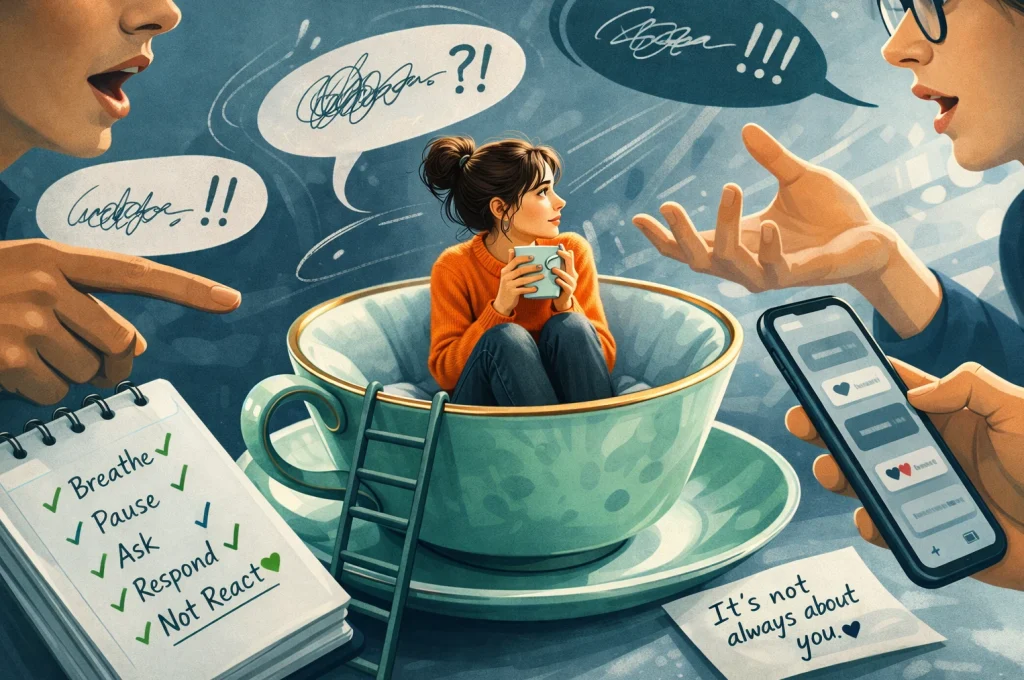
Table of contents:
What life opens up when every comment stops landing like a slap
Feedback becomes information, not a wound
One of the biggest changes is so plain it almost sounds boring. When touchiness eases, you can hear a comment without instantly turning it into a verdict on your worth. Your boss says the draft needs tightening. Your partner says your tone was sharp. A friend says, "That felt off." And instead of your insides going, Fantastic, I am apparently terrible now, you have a bit more room.
That room matters. It lets you sort what is useful from what is clumsy, unfair, or just badly timed. You stop wasting half your energy on the sting itself. You can actually respond to the content. That tends to improve work fast, and relationships too, because people feel less like they have to wrap basic honesty in twelve layers of bubble wrap.
Small moments stop ruining whole days
Touchiness has a sneaky tax. The comment lasted twelve seconds; your rumination lasts six hours. You are making tea, answering emails, pretending to listen in a meeting, and somewhere in the background your brain is still chewing on "Was that rude?" Like a dog with an old shoe. Not helpful. Not elegant. Very human.
When you get less touchy, the recovery time gets shorter. You still notice things. You still have feelings. But they do not colonize the whole day so easily. A weird look from someone at brunch stays a weird look, not the start of a full emotional weather event. That gives you back attention, humor, and frankly a lot of evening peace. That extra mental space does more than calm you down. It also gives you room for play, experimentation, and what growing creativity gives you, because it is much easier to think freely when every imperfect idea no longer feels like a personal threat.
Relationships get less cramped
People around touchy people often become careful in exhausting ways. They soften simple requests, avoid honest conversations, over-explain neutral remarks, or just stop bringing things up. Not because they do not care. Because they are tired of every pebble turning into a cracked window.
As touchiness drops, closeness gets easier. You can ask, "What did you mean by that?" without already loading the cannons. Other people can be more direct without bracing for fallout. Repair gets faster too. Not perfect, obviously. We are still people, not polished table lamps. Still, there is less guesswork, less tiptoeing, less emotional static clogging ordinary conversations.
Your self-respect gets sturdier
There is also a quieter gain here. When every outside reaction hits hard, your self-image becomes flimsy. Too dependent on tone, approval, wording, facial expressions, punctuation... yes, even punctuation. Some of us have had full emotional reactions to a lone "K." in a text. Let us be honest.
When you are less touchy, your sense of self stops wobbling quite so much with every little bump. You do not need everyone to be endlessly gentle for you to stay okay. That is not numbness. It is emotional traction. A more grounded kind of confidence grows there, the kind that lets you hear something uncomfortable and think, "Maybe. Let me look," instead of "I must now either collapse or attack." Lovely upgrade, that. This is also why touchiness often overlaps with the odd logic of feeling like a fraud, because once every raised eyebrow feels like exposure, even ordinary feedback can sound like proof that you were never good enough in the first place.
How touchiness keeps hijacking ordinary days
You personalize things at lightning speed
Touchiness often starts with a very fast meaning jump. Someone forgets to reply. A coworker sounds brief. Your sibling teases you. Your partner sighs while washing dishes. Before the facts have even put their shoes on, your mind has already decided: They are annoyed with me. They do not respect me. I have done something wrong. I am being judged.
That speed is part of the problem. It feels like perception, but often it is interpretation dressed up as certainty. And because the conclusion arrives so fast, you react to the story, not the moment itself. If this reaction gets especially sharp around other people's success, confidence, or praise, it may be tying into when someone else's life starts acting like your report card, which makes neutral moments feel loaded before anyone has actually said much.
Your body flares before your thinking catches up
A lot of touchy reactions are physical first. Tight chest. Hot face. Stomach drop. Jaw set. You go sharp, quiet, icy, over-explaining, whatever your version is. By the time your rational mind wanders in with a clipboard, the emotional fire alarm is already ringing.
This is why "just don't take it personally" is such useless advice. If your system has learned to detect threat quickly, the reaction is not a neat intellectual choice. It is more like your body slamming the brakes on a wet road. You can learn to drive that better, yes. But pretending the skid never happens does not help.
You keep feeding the bruise afterward
Touchiness is rarely only about the first sting. It grows in the replay. You revisit the tone. Rebuild the scene. Imagine what they really meant. Draft seven replies in your head while brushing your teeth. Then maybe you mention it to two friends, who add their own spice, and now the original comment has become a full casserole.
This is one reason touchiness sticks around even in smart, self-aware people. Intelligence can become a very fancy tool for over-interpretation. You are not confused. You are brilliant, articulate, and absolutely capable of inventing twelve painful meanings for one vague sentence. Not ideal.
The pattern often protects something tender
Here is the part people miss. Touchiness is not random. Very often it grows around older sore spots: criticism, rejection, shame, feeling overlooked, never feeling safe to make mistakes, having to read moods too carefully as a kid, stuff like that. So now when a present-day moment resembles the old feeling, your system reacts like it already knows the ending.
Stress makes all this louder. So does poor sleep, burnout, hunger, too much scrolling, and relationships where the signals really are mixed. Which means touchiness is not always "your personality." Sometimes it is sensitivity plus exhaustion plus an old bruise plus one badly worded Slack message. There, the glamorous psychology of modern life. For some people, the sore spot is also tangled up with staying agreeable and easy to like, which is why touchiness can sit right beside what people pleasing quietly does while everyone thinks you are "so sweet"; swallowed frustration builds up, and even mild comments land on already bruised ground.
How to Stop Being Too Touchy
Catch the first sentence your mind writes
The first useful move is tiny. When something stings, pause long enough to notice the instant headline your brain produces. Usually it is something like, "They think I'm incompetent," "I'm being dismissed," "They're disrespecting me," or "I'm in trouble." Do not argue with it yet. Just catch it.
Why? Because touchiness gets power from speed and blur. Once the meaning becomes visible, it stops feeling like pure reality. Now you can ask a better question: "What actually happened, and what am I adding?" Sometimes the added part is true. Sometimes it is spectacular fiction with good lighting.
Work with the body before you work with the story
If your system is flooded, do not start with analysis. Start with regulation. Unclench your hands. Put both feet on the floor. Exhale longer than you inhale for a minute or two. Get up and walk to the sink. Splash cold water on your wrists. Look around the room and name five neutral things. Mug. Window. Lamp. Plant. Sock. Whatever.
This is not mystical. It is practical. A stirred-up body makes harsher meanings feel true. Bring the volume down a notch, then think. People often try to reason their way out of a state their body is still actively producing. That is like trying to edit an email while somebody keeps thumping the desk.
Ask for clarity before you launch a defense
A touchy mind hates uncertainty. It would rather assume than ask. That is exactly where trouble starts. If a remark feels loaded, try a clean question: "What did you mean by that?" "Are you asking for a change, or just pointing something out?" "You sounded frustrated just then. Am I reading that right?"
Simple questions save a ridiculous amount of pain. Not always, of course. Some people really are snide little gremlins. But in many everyday situations, the thing you took as criticism was haste, tiredness, bad wording, or no hidden message at all. Clarity interrupts mind-reading. And mind-reading is, frankly, where touchiness likes to build its summer home. In practice, this is part of learning how to master proactivity, because the goal is not to have no feelings at all, but to choose your next move with a little intention instead of letting the first flare-up run the meeting.
Build a slower response style
You do not have to answer every sting in real time. In fact, many touchy reactions improve dramatically when they are not performed immediately. If you feel activated, say less. "Let me think about that." "I want to respond well, give me a minute." "I'm feeling prickly and don't want to snap." That last one is deeply unglamorous and weirdly effective.
Then come back later, once your pride is not doing cartwheels. If you did overreact, repair it cleanly: "I took that more personally than I needed to." "I got defensive. Let me try again." No grand confession, no self-whipping. Just reset.
And one more thing, maybe the least exciting and most useful: track your predictable weak spots. Are you touchier when you are hungry, rushed, ignored in groups, criticized in public, texting late at night, dealing with certain family members? Good. That is not failure. That is a map. Once you know where the floor gets slippery, you stop acting surprised every time you skid.
Is this the growth focus you need right now?
Maybe. Maybe not. Not everyone who feels hurt easily needs to start by working on touchiness. Sometimes the real issue is exhaustion, grief, burnout, hormone swings, an actually harsh environment, or relationships where people really do take cheap shots and then call you "too sensitive." In that case, making yourself harder to hurt is not the first job. Seeing the situation clearly is.
It helps to look at the pattern without drama. Are you mostly reacting to neutral or mixed signals as if they are personal attacks? Do you lose hours to replaying small comments? Do you get defensive so fast that it keeps messing with work or closeness? Then yes, this is probably worth attention. If the bigger issue is chronic stress, old shame, or poor boundaries, start there, or at least alongside this.
If you want a cleaner read on what deserves attention first, AI Coach can help you sort your current growth priority and give you a simple plan for the first three days. Sometimes that is far more useful than declaring, with great passion, that you will "stop taking things personally" and then getting sideswiped by the next weird email before lunch.
Frequently Asked Questions (FAQ)
What does it actually mean to be too touchy?
It usually means you react to comments, tone, jokes, pauses, or feedback as if they carry more threat or disrespect than they really do. The key issue is not having feelings. It is how fast you personalize things, how intensely you react, and how long the reaction keeps running afterward.
Is being touchy the same thing as being sensitive?
No. Sensitivity can be a strength. It helps you notice nuance, mood, beauty, tension, all sorts of things other people miss. Touchiness is what happens when that sensitivity gets mixed with threat-detection and personal meaning. A sensitive person can be thoughtful and steady. A touchy person often feels poked by things that were not really aimed as attacks.
Why do I take neutral comments so personally?
Usually because your mind is filling in missing meaning at high speed. If you have old history with criticism, rejection, shame, or unpredictable reactions from other people, neutral signals can start to feel suspicious. Add stress or tiredness and the brain gets even quicker to assume, "This is about me, and not in a good way."
Can childhood criticism or rejection make someone more touchy as an adult?
Very often, yes. If you grew up having to scan for disapproval, mockery, mood shifts, or emotional danger, your system may have learned to react early rather than accurately. That adaptation can be useful in a rough environment and exhausting later on. Adult touchiness often makes more sense when you see the older training behind it.
Why am I much more touchy when I am tired, stressed, or hungry?
Because self-control, perspective, and emotional recovery all get worse when your system is strained. A worn-down brain reads more things as threatening and has less patience for ambiguity. That is why the same comment can feel manageable on a good morning and weirdly crushing at 10:47 p.m. on a Tuesday.
How do I stop overreacting to texts and emails?
First, stop treating written tone like solid evidence. Text strips out voice, face, timing, context, all the useful human stuff. Read it once. Notice your first interpretation. Then slow down before replying. If needed, ask a direct question instead of guessing: "Just checking, are you frustrated here or being brief?" Also, late-night texting is a menace. Half the emotional disasters of modern life could probably be reduced by fewer tired people interpreting punctuation in dim light.
What should I say if I realize I reacted too strongly?
Keep it plain. "I got defensive and read more into that than was there." "I think I took that too personally." "Let me restart and answer the actual point." Short works better than theatrical. The goal is not to humiliate yourself. It is to reopen the conversation without pretending nothing happened.
Can touchiness damage relationships even if the other person cares about me?
Absolutely. Caring people can start to feel boxed in around a touchy person. They edit themselves too much, avoid honest topics, or get tired of constant reassurance duty. Over time the relationship becomes less open, not because love disappeared, but because the emotional cost of simple honesty got too high. That can happen in families, friendships, dating, and at work.
How long does it take to become less touchy?
There is no neat deadline. Usually the first signs show up earlier than people expect, though. You notice your triggers faster. You recover quicker after getting stung. You ask for clarity instead of assuming the worst. You send fewer impulsive replies. The deeper the pattern and the older the bruise underneath it, the more patience it takes. Still, progress is often visible before it feels dramatic.
How do I know when the problem is not my touchiness but the environment?
Good question. If several people regularly mock you, nitpick you, give mixed signals, use "jokes" as cover for contempt, or make you feel small and then blame your reaction, the environment may be the real problem. Same if you only feel "too touchy" around certain people and relatively calm everywhere else. Healthy growth is not about becoming numb enough to tolerate bad treatment with a smile pasted on, no thanks.