
Some people do solid work, have decent ideas, even a nice sense of humor, and still keep getting passed over in rooms where life actually moves. Not because they are incapable. Because they stay on the edge too long, waiting to be invited in, while louder people walk off with the conversation, the connection, the chance.
Extroversion is the ability to move toward people instead of watching life happen from three feet away. If you often leave social situations thinking, "I should have said something," this quality may need a bit of training. And if that stings a little, well... good. That sting is usually information.
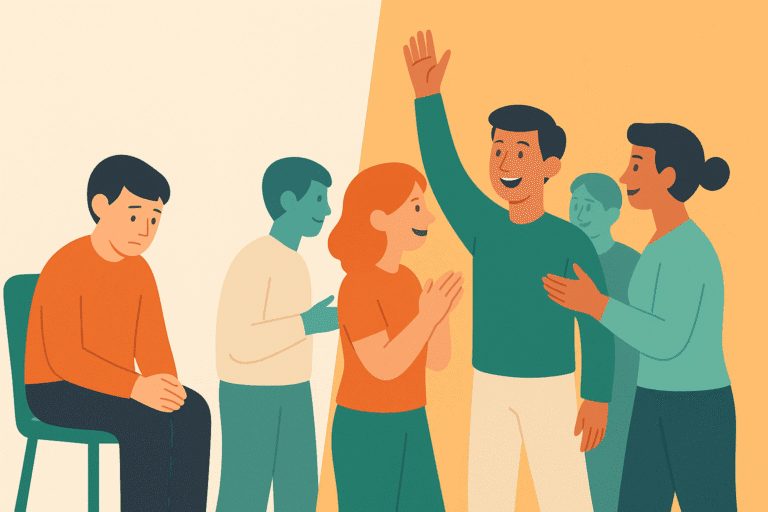
Table of contents:
How extroversion shows up when it is alive
It is not just "talking a lot"
Extroversion gets caricatured badly. People hear the word and picture a human confetti cannon who cannot survive a silent elevator ride. Real extroversion is broader than that. In personality psychology, it usually includes sociability, outward focus, assertiveness, enjoyment of stimulation, and a tendency to feel more energized by interaction than drained by it. So no, it is not only about volume. A person can be warm, curious, quite measured even, and still be strongly extroverted because they naturally move toward people, activity, and shared space.
The key thing is orientation. Their attention goes outward with less friction. New faces feel interesting, not threatening. A group feels like a place to enter, not a wall to study from the hallway. You know those people who somehow start chatting with the server, the person next to them at the workshop, and the friend's cousin nobody else has met yet? That. Not magic. Just outward movement.
They start contact instead of waiting for perfect conditions
One of the clearest signs of extroversion is social initiative. Extroverted people do not always wait for the room to come to them. They ask the question first. They say hello first. They join the circle instead of rehearsing twelve possible openings in their head until the moment dies of old age. This matters more than it sounds, because social life rewards motion. A lot.
That initiative also makes them easier to notice. At work, they are more likely to speak in meetings, introduce themselves across teams, or turn a stiff group call into something that feels, well, alive. In daily life, they are the ones who say, "Come sit with us," or "You two should meet." Often they are not trying to dominate anything. They just do not freeze at the border of contact.
They feed on interaction
Extroverts often process energy in public. Conversation sharpens them. Activity wakes them up. A house full of people, a team brainstorm, a busy event, a spontaneous dinner plan - these things tend to light them up rather than flatten them. That does not mean they never need solitude. They do. It means too much isolation can make them feel stale, undercharged, weirdly flat around the edges.
This is why many extroverted people think out loud. They discover what they mean by saying it. They test ideas in motion, with other humans in the room. Sometimes this is useful and sometimes, let's be honest, a tiny bit exhausting for whoever has not had coffee yet. Still, it is part of the pattern: interaction is not a distraction from life for them. It is one of the main ways life becomes vivid.
They warm the room and lower the social temperature
Another common trait is the ability to reduce awkwardness. Strongly extroverted people often make groups easier to enter. They joke, ask follow-up questions, notice the quiet person, fill the dead air before it turns into a hostage situation. They do not always mean to become the social hinge, but they often do.
And here is the useful nuance: healthy extroversion is not the same as attention hunger. Yes, many extroverts enjoy being seen. Who doesn't, a bit. But the stronger version of this quality is not "look at me constantly." It is "I can create movement, ease, and connection around people." Big difference. That line matters, because without self-awareness, outgoing behavior can slide into arrogance rather than healthy confidence, and people usually feel the difference immediately. One is performance. The other is social usefulness, which is far more valuable in real life.
What gets easier when you build more extrovert energy
Opportunities stop depending on luck so much
A painful amount of opportunity is social. Jobs, collaborations, friendships, dates, referrals, invitations, useful information - a lot of it arrives through people, not through some fair and noble system that rewards quiet merit in a sealed envelope. When extroversion grows, you start increasing your surface area. More conversations happen. More people remember you. That is also why ambition works better when it becomes visible in the real world instead of staying private and unnoticed. More doors open because you were actually there in the room, in the exchange, in the follow-up.
This does not mean becoming fake or "networky" in that creepy business-card way. It means your life stops relying so heavily on being discovered by accident. You become easier to meet, easier to trust, easier to include. That shifts things.
Groups feel less awkward, and you become part of that fix
Extroverted behavior is useful well beyond personal gain. It helps groups breathe. Someone has to break the first layer of stiffness. Someone has to greet the new person, keep a discussion moving, ask the second question after the polite first answer, notice when a room is going cold. If you can do that, people experience you as relieving. Not flashy. Relieving. It also connects with tolerance, because groups soften faster when people feel accepted instead of quietly judged. Which is a very underrated social gift.
At work this can make you unexpectedly valuable. Teams run better when somebody can get people talking without turning every meeting into a talent show. In social life, it means you can help create gatherings that feel warmer and less cliquish. You stop being just a participant and become a bit of a connector. That changes your place in a group, quietly but for real.
Your confidence becomes less theoretical
A lot of confidence advice is suspiciously indoor. Journal about your worth. Challenge your inner critic. Stand like a powerful sandwich board in the mirror. Fine. But social confidence grows best through social repetition. Extroverted behavior gives you that. You say hello, survive it, do it again. You speak in the group, notice the ceiling did not collapse, and next time it gets easier.
In that sense, extroversion can be a training ground for courage. Not grand courage. Everyday courage. The kind that says, "I can enter this space. I can be visible. I can handle a slightly awkward moment without turning it into a personality verdict." That is huge. And weirdly calming.
Life gets more color, feedback, and momentum
There is also a plain human benefit here: more contact usually means more emotional texture. More laughter. More stories. More unexpected invitations. More perspective. People who strengthen extroversion often feel less stuck inside their own head because life keeps bouncing back at them through other humans. Their world gets bigger. Faster too, sometimes. In a good way.
And yes, there is a practical side. Extroverted people tend to gather information sooner, sense shifts in social dynamics faster, and recover from small ruptures more easily because they are already in motion with others. They are not waiting for the perfect moment to reconnect; they reconnect. That matters in friendship, dating, leadership, sales, interviews, community - the whole untidy human circus. You do not need to become the loudest person in every room. You just need enough outward energy that life can find you, and you can answer back.
What the lack of extroversion can quietly cost you
People may not see what you never bring forward
Here is the rude truth: other people cannot value what they never properly encounter. If you rarely start conversations, rarely join discussions, rarely make yourself known, your strengths stay half-hidden. Then a strange bitterness can grow. "Why do others get picked?" "Why do people overlook me?" Sometimes the answer is unfairness, sure. Sometimes the answer is simpler and more annoying: you are not socially present enough for people to build a clear picture of you.
This happens at work all the time. Quiet competence sits in the corner while the more outward person gets remembered, trusted, and asked back into the room. Not always because they are better. Because they are easier to register. Oof, I know.
Isolation can grow without looking dramatic
A lack of extroverted behavior does not always look like deep loneliness with rain on the window and a sad playlist. Often it looks ordinary. You spend more evenings alone than you meant to. You wait to be invited instead of suggesting plans. You tell yourself you are "fine either way," but secretly feel a bit forgotten. People assume you want distance, so they give it to you. Then you get less practice, less ease, fewer chances to belong naturally. The loop tightens.
That is the sneaky part. Social absence can start to feel like personality when it is really just underused skill. You begin thinking, "I guess I'm just not one of those people." Maybe. Or maybe your social muscles have gone sleepy.
Caution starts making decisions for you
When extroversion is weak, hesitation often steps in as manager. You overthink messages. Sometimes that hesitation is really a disguised need to get every social move "right," which is why learning healthy perfectionism can help you loosen up without becoming careless. Delay introductions. Hover at the edge of events. Skip speaking up because your timing might be off, your comment might be obvious, your voice might do that weird thing where it becomes attached to someone else's throat. Charming. The result is not just fewer conversations. It is a smaller life.
And the emotional cost can be sharp. Regret has a very particular taste. So does watching others bond while you stay politely composed and inwardly annoyed with yourself. If that pattern repeats long enough, even simple social acts can start feeling larger and scarier than they are.
Your self-image can shrink around the gap
One missing quality rarely stays neatly in its lane. If you often hold back socially, you may start telling harsher stories about yourself: boring, awkward, forgettable, hard to love, "not a people person." Those labels settle in fast because they seem to explain the pattern. But they are often built on behavior, not truth. A person can look socially passive and still be warm, funny, magnetic even - just under-practiced.
Important nuance, though. The goal is not to pathologize introversion. Some people genuinely prefer less stimulation and fewer social demands. No problem. The real issue is when avoidance, fear, or passivity keeps blocking the relationships, visibility, and chances you actually want. If your private wish is bigger than your outward behavior, that gap deserves attention. That is where the pain usually lives.
How to build extroversion without turning into a performing seal
Keep one opener ready and use it before your brain objects
Do not wait for brilliant social spontaneity. It is overrated. Pick two or three plain, usable opening lines for everyday moments: "How has your day been so far?" "What brought you here?" "You seem to know this area better than I do - any recommendations?" Then use one before your mind starts its little courtroom drama.
The point is not to sound dazzling. It is to reduce startup friction. And like diligence, it grows through repetition rather than through waiting for the perfect mood or a magically confident version of yourself to appear. Extroversion grows when contact becomes easier to begin. One extra question to the barista, the coworker, the person next to you before a class - tiny reps count. They really do.
Reopen old connections instead of always hunting for new ones
People forget this, but extroverted behavior is not only about strangers. It is also about reactivation. Send a quick note to someone you liked but lost touch with: an old classmate, former coworker, cousin, neighbor, whoever. Keep it specific. "Saw your post about the move - how's the new place treating you?" lands better than the dead-eyed "How are you?" that sounds like a bank survey.
This works because old social paths already have less resistance. You are not building warmth from scratch. And once you start doing this regularly, your world feels less scattered. More threaded together.
Give yourself a participation rule for events
If you go somewhere social and then fade into wallpaper, make the assignment smaller and clearer. Before the event, choose a rule: speak to three people, ask one real question in the group, stay long enough to have two non-obligatory conversations, or share one opinion before leaving. Not ten goals. One rule.
This turns extroversion from a vague identity fantasy into behavior you can measure. It also helps to treat awkward moments as small exercises in problem-solving skills, because the real question is usually "What is the next simple move?" not "What is wrong with me?" You went. You participated. You did not just orbit the snacks and slip out at the first polite opening. Progress.
Practice being the bridge
A very trainable form of extroversion is social linking. Introduce two people who might click. Pull the quieter person into the conversation. Mention a shared interest. Help the newcomer get their footing. Funny thing: many people find this easier than "being interesting" themselves, and it still builds the same outward muscle.
It also makes you more likable, because you are creating ease instead of competing for air time. Healthy extroversion is often less about spotlight and more about circulation. Keep things moving. Let people connect. Lovely skill, that.
Use public environments as low-stakes training grounds
If you spend most of your time in sealed little private bubbles, extroversion has nowhere to stretch. So borrow environments that naturally create light contact: a coworking space, community class, volunteering shift, hobby meetup, local market, even the same neighborhood coffee shop often enough that people stop being random furniture and become familiar faces.
Then notice what actually energizes you. Was it the noise? The banter? The sense of belonging? The quick exchange with someone you did not know yesterday? This reflection matters, because developing extroversion is not about forcing endless social marathons. It is about learning which forms of contact make you more alive, and repeating those until they start to feel like part of your normal life.
Should extroversion be your main growth target right now?
Not always. Some people do need more outward social energy. Others are blaming "not being extroverted enough" for a problem that is actually social anxiety, burnout, low self-esteem, bad fit with their environment, or plain exhaustion. If you are running on fumes, forcing yourself into more people, more noise, more events may be the dumbest possible first move. If that sounds familiar, it may help to check whether burnout is already steering the car, because low energy can easily masquerade as low extroversion, and the right next step may be recovery rather than more social effort.
It helps to pick one development priority at a time. A little more self-awareness helps here, because it makes it easier to see whether extroversion is the real bottleneck or just the symptom of something else, Otherwise you end up trying to become more outgoing, more disciplined, more confident, more productive, and somehow perfectly rested by next Thursday. Noble plan. Messy result. If your real pain is missed connection, social invisibility, or constantly holding back in rooms that matter, extroversion may deserve a serious look. But if every social move gets stuck in overthinking, self-editing, and the fear of doing it wrong, it may help to remember that perfectionism is less about excellence than about danger, which means the real first step may be loosening that inner pressure before asking yourself to become more outward.
If you want a cleaner read on that, AI Coach can help sort your current bottleneck and suggest a simple plan for the first three days. Sometimes that kind of clarity is more useful than another month of vaguely telling yourself to "get out there more."
Frequently Asked Questions (FAQ)
What is extroversion in simple terms?
Extroversion is the tendency to move toward people, conversation, activity, and visible participation. In daily life, it looks like starting contact, enjoying interaction, thinking out loud more easily, and feeling energized by social exchange rather than only by solitude.
Can an introvert learn extroverted behavior?
Yes. A person can stay introverted by temperament and still learn more extroverted habits. That usually means getting better at starting conversations, joining groups, speaking up earlier, and tolerating more social visibility. Personality style and trainable behavior overlap, but they are not identical twins.
Is being extroverted the same as being confident?
No. They often travel together, but they are different. Confidence is about trust in your ability to handle situations. Extroversion is more about outward social orientation and stimulation. You can meet confident quiet people and insecure extroverts in the wild every week, honestly.
Can extroverts be shy or socially anxious?
Yes. A person may crave contact and still feel nervous, awkward, or overly self-conscious. That combination can be frustrating because they want the room and fear the room at the same time. In those cases, building extroverted habits helps, but working on anxiety may matter just as much.
How do I know whether I need to develop extroversion?
Look at the gap between what you want and what you do. If you want more connection, more visibility, stronger networks, or easier participation in groups, but keep holding back, there is probably something to work on. If you genuinely like a quieter, lower-social life and it is not hurting your goals or relationships, then maybe this is not your main issue.
Why do extroverts seem to get energy from other people?
Because interaction often stimulates them rather than overloads them. Conversation, novelty, shared activity, and quick feedback tend to sharpen their mood and attention. That does not mean they are "better with people" by default. It means social environments often charge their battery instead of draining it flat.
Can you become more extroverted as an adult?
You can usually become more extroverted in behavior, yes. Adults can train social initiative, visible participation, ease with strangers, and comfort in groups. The deeper temperament piece may not transform overnight, but life can get a lot more outward, connected, and socially flexible with practice.
Does extroversion help at work?
Often, yes. It can help with interviews, networking, collaboration, leadership visibility, client-facing roles, and being remembered in group settings. It is especially useful when work depends on relationships or speaking up. That said, extroversion without listening, empathy, or judgment can turn into noise pretty fast.
Can too much extroversion become a problem?
Absolutely. When extroversion loses balance, it can become interrupting, attention-seeking, impulsive talking, poor listening, or constant crowd-chasing that leaves no room for reflection. Healthy extroversion creates connection. Unchecked extroversion can hog the air in the room and call it charisma. Not the same thing.
How can I act more extroverted at a social event if I usually freeze?
Lower the mission. Do not aim to "become outgoing" in one evening. Give yourself one simple behavioral rule: talk to three people, ask one real question, or introduce yourself before you get comfortable hiding near the wall. Smaller targets calm the nervous system and make action much more likely.
Is extroversion necessary for leadership or success?
No. Plenty of effective leaders and successful people are not strongly extroverted. But some extroverted behaviors do help: speaking up, creating ease in groups, initiating contact, building relationships, and being visible when it counts. You do not need to become the loudest person in the building. You do need enough outward presence that your ideas, value, and character can actually reach other people.