
Ambition is the part of you that looks at your life and says, "We are not turning this into a beige waiting room with flickering lights and magazines from 2017, thanks." When that part goes sleepy, something odd happens: you can be smart, decent, skilled, hardworking - all the respectable things - and still watch louder, scrappier, less polished people walk off with opportunities you quietly wanted.
Not because they were better. Sometimes they weren't. They just aimed. They asked. They made a move while you were still trying to look reasonable.
If you've been trimming your goals down until they fit neatly inside other people's comfort zones, or brushing off your hunger with some version of "eh, it's not that serious," or feeling that little sour jab when someone less capable speeds past you... well, there may be an ambition gap sitting right there. Not a character flaw. Not vanity. More like an engine that's been idling for too long. And once it wakes up - sputtering at first, sure - your effort stops scattering itself all over the place. It starts pulling toward something that actually matters.
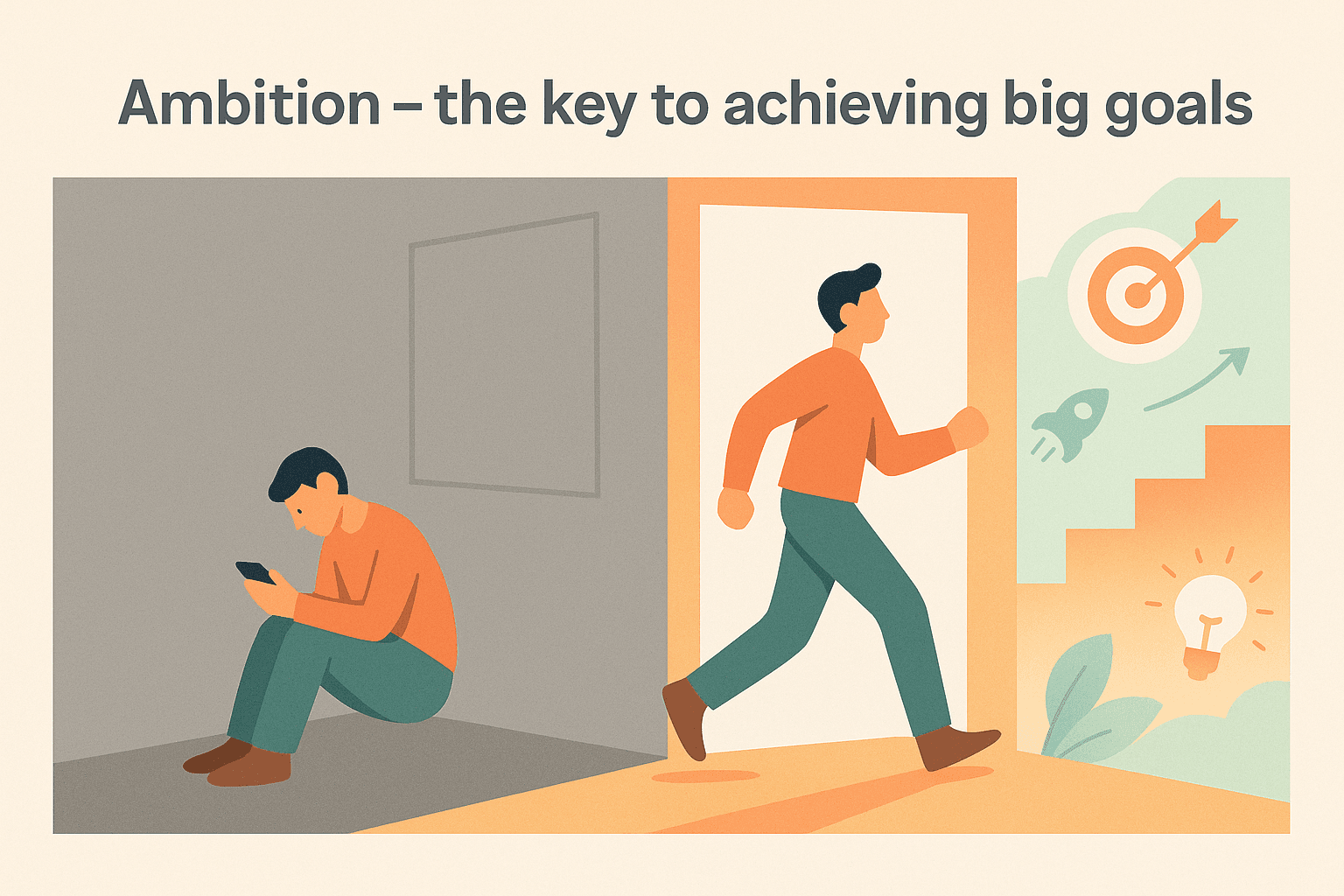
Table of contents:
Ambition, Without the Cartoon Villain Version
It is not just "wanting success"
Ambition gets a weird reputation. Say the word out loud and half the room imagines a ruthless climber in a sharp blazer, aggressively networking near a tray of mini quiches. But real ambition is much less theatrical than that. It's the inner push to reach beyond whatever is easiest, safest, or already within arm's reach.
More mastery. More impact. More range. Maybe more money too - and honestly, why do people get so dramatic about that part? Money is not a personality disorder.
At its healthiest, ambition is not really about applause. It's about refusing to live inside the sentence, "This is probably enough for someone like me." An ambitious person doesn't just hope life gets better out of sheer kindness. They want to shape it. Build it. Nudge it forward with both hands if needed.
Which is why ambition matters so much in motivation psychology. It affects what you aim at, how high you let yourself aim, and how much discomfort you're willing to tolerate on the way. Not infinite discomfort, please. No one needs to become a motivational poster with a cold shower habit. Just... more than autopilot. More than drifting.
You can usually spot it in standards and appetite
In ordinary life, ambition shows up in small, revealing ways. It's in the person who doesn't just finish the thing, but wants it to be strong. The one who tweaks the proposal one more time. Who asks for the bigger project. Who notices someone operating two or three levels above them and thinks, "Okay then. How do I get there?"
There is often a restless edge to ambition, yes. But restlessness isn't always misery. Sometimes it's a healthy kind of dissatisfaction - the kind that comes from sensing empty space in your own potential. Like walking into a room in your house and realizing, hang on, this place could be so much better.
An ambitious person can be grateful for what they have and still know they're not finished growing. Those two things can sit at the same table, no problem.
And yes, comparison belongs in this conversation too. People talk about comparison like it's a raccoon loose in the kitchen - panic, shrieking, everyone pretending they've never seen one before. But used well, comparison can be incredibly clarifying. Ambitious people often compare themselves to stronger performers, sharper peers, tougher standards. Not to spiral, but to calibrate. "Where am I actually weak?" is not a fun question. It is, annoyingly, a useful one.
There is a public side to ambition too
Ambition is rarely a private little candle you keep hidden in a drawer. It affects how you show up in groups, at work, in business, even around friends. People with more ambition are usually more willing to be visible, to compete a bit, to risk being misunderstood or judged. Not because they love judgment - who does? - but because they can survive it.
That gets easier when a person builds a bit more extrovert energy. Visibility stops feeling like social danger and starts feeling like part of the job. You speak up. You put your name on things. You stop acting like your ideas should somehow sneak into the room without being attached to a human being.
This is also why ambition overlaps so naturally with confidence and responsibility. Confidence helps you handle being seen. Responsibility helps you carry the weight of bigger goals once you've admitted you want them. Without those two, ambition can stay trapped as fantasy - lots of heat, not much traction. And without ethics in real life, ambition can become shiny on the outside and hollow underneath, which is a terrible bargain, really.
Healthy ambition is different from status addiction
This part matters more than people think. Healthy ambition says, "I want to build something excellent." Unhealthy ambition says, "I need to outrank people so I can finally feel like a person." From a distance, the behaviors can look weirdly similar for a while. Hard work. Big goals. Long hours. A suspiciously expensive water bottle.
But the emotional flavor is completely different.
Healthy ambition comes from expansion. A desire to use your abilities well. To stretch. To contribute. To become stronger at your craft. The distorted version comes from starvation - the kind where no achievement ever quite lands because the wound underneath is still hungry.
Healthy ambition can admire other people without turning green. It can lose and still learn something. It can want recognition without becoming unbearable about it. The distorted version gets brittle fast: more envy, more ego bruises, more drama around being first, chosen, praised, noticed. So ambition itself isn't the problem. The real question is what it's serving. Growth? Contribution? Self-respect? Or just an old ache in fancy shoes trying to pass as a philosophy?
What Changes When Ambition Starts Pulling Its Weight
Your effort finally gets a destination
A lot of people aren't lazy. They're under-aimed. Very different problem.
They work, answer messages, hit deadlines, buy groceries, survive the week, maybe even keep a basil plant alive for longer than expected - and still feel like life tastes faintly of cardboard. Ambition changes that because it gives your effort a direction. You stop asking only, "What needs to be done?" and start asking, "What am I actually building here?" That question can wake a person up in a hurry.
Once you care about a bigger outcome, discipline feels less like random punishment and more like a system that makes sense. That's where motivational skills come in too: they help keep your energy tied to something meaningful instead of spending it in dramatic little bursts and then wondering why you're flat by Wednesday.
This is one of ambition's quiet gifts. It turns effort from scattered activity into movement with a shape. And when that direction is paired with learning how to be more efficient at work, progress stops feeling like endless effort and starts becoming something you can actually sustain. Less drift. More trajectory. More "oh, this is going somewhere" and less "why am I tired, exactly?"
You become easier to notice, trust, and back
Ambitious people tend to make themselves legible to the world. They apply. They ask. They volunteer for the hard thing. They pitch the idea instead of leaving it in a notes app for eight months like a Victorian secret. In work, this matters more than many people want to admit. Managers, clients, partners, investors - they usually respond to momentum when they can feel it.
Not fake hype. Not chest-thumping. Direction.
There's also a reputation effect. Someone with healthy ambition usually sharpens their skills faster because "good enough" starts irritating them sooner. Over time, that becomes visible. Better work. Better communication. Better timing. Better odds when opportunities show up. That effect gets even stronger when ambition is paired with lifelong learning, because the people who keep updating their skills, thinking, and standards are usually the ones others feel safest betting on when the stakes get bigger.
And yes, ambition can affect your finances too. People who aim higher tend to negotiate higher, pursue bigger opportunities, and stop underpricing themselves just to seem agreeable. Wild idea, I know. It turns out modesty doesn't always pay the invoice.
Your decisions get bolder and cleaner
Ambition helps with decisions because it gives you a filter. If you know you want to lead, create, build, become excellent, or make a bigger contribution, some choices stop looking so tempting. You waste less time pretending every path is equally fine. They aren't. Some roads grow your future. Others just keep you pleasantly occupied, which is not the same thing at all.
That kind of clarity can quiet a surprising amount of inner noise. It gets even easier when you improve your critical thinking, because ambition needs judgment. Otherwise you can spend years chasing goals that look impressive from far away and feel strangely empty up close.
And sometimes you need a bit of growing spontaneity too, because bold decisions are rarely neat. Often you move before every variable has been tamed and labeled. You start the thing before you feel ready. You become a beginner again. Slightly awkward, maybe. Mildly embarrassing at times. That's okay. Ambition doesn't remove anxiety - it just makes the bigger goal more important than the temporary wobble.
You respect yourself more when you stop playing small
This part is easy to miss if you're only thinking in career terms. Ambition isn't useful just because it can help you earn more or move faster. It changes how you feel inside your own life. That shift often connects to what opens up when self-respect gets stronger, because once you value yourself more honestly, bigger goals stop feeling like something meant for other people.
When you keep shrinking yourself to stay manageable, some part of you notices. It goes flat. Irritable. Sometimes weirdly cynical. It's hard to feel deeply alive in a life you're constantly miniaturizing for the comfort of others - or for your own fear, if we're being honest.
But when you let yourself want more, openly and without performing modesty like it deserves a trophy, there is relief in that. Your inner world gets less cramped.
Healthy ambition also protects against that quiet resentment that creeps in when you're always cheering for other people's lives while privately wondering when yours begins. That protection gets stronger when ambition stays connected to benevolence, so other people's progress can inspire you without automatically feeling like an insult.
Have you felt that little internal exhale when you finally admit what you really want? That matters. More than it looks like from the outside.
What Low Ambition Quietly Does to a Life
You settle early, then call it maturity
One of the sneakiest signs of weak ambition is premature acceptance. You decide the bigger role is "not really me." The better income is "for those people." The bold project is "too much hassle." On the surface, this can look grounded, practical, adult. Underneath, it's often retreat dressed in decent manners.
And after enough of that, something sour starts to build.
You tell yourself you're fine, but your reactions give you away. You get sharp when other people talk about their plans. You scroll past someone else's progress and feel that small, mean little pinch in the chest. Not because you're a bad person. Usually because some part of you knows the truth: it isn't that you didn't want more. You stopped letting yourself want it.
Other people begin setting your ceiling for you
When ambition is low, you become easier to arrange from the outside. Employers decide what you're worth. Family decides what's realistic. Friends decide what counts as "too much." Culture has an endless stack of scripts for this: be grateful, don't be greedy, don't stand out, don't make it weird. Some of those messages even sound wise - that's why they work so well.
But if you never develop an internal standard of your own, you end up living under borrowed ceilings. You don't test your capacity. You inherit a shape for your life and then quietly adapt to it, like furniture shoved into the corners of a room. Functional enough, maybe. A little sad too, if we're honest over tea.
Motivation gets flimsy because nothing important is at stake
People often assume low ambition creates comfort. Sometimes it creates boredom instead.
If your goals are too safe, too inherited, too small to wake up your nervous system, your effort never fully clicks into gear. Why would it? There's no stretch. No meaningful prize. No real sense that what you do this month could change your level next month. Then procrastination comes along and takes the blame, which is a bit unfair.
Often the real issue is simpler: the target isn't alive enough for you. Ambition gives desire voltage. Without it, many tasks feel like carrying boxes around a garage without remembering why you moved them in the first place. Exhausting. Pointless. Slightly insulting to the soul, honestly.
Envy, cynicism, and underachievement start teaming up
Suppressed ambition doesn't vanish. It leaks. It comes out as eye-rolling about successful people. As endless critiques of "personal brands" and "networking people" and anyone who dares to be visible. As the conviction that everyone doing well must be shallow, fake, lucky, corrupt, annoying, over-caffeinated - maybe all five before lunch.
Now, to be fair, some successful people are indeed annoying. Humanity has range. But when cynicism becomes your favorite shield, it's worth asking what desire is hiding underneath it.
There's another cost too: chronic underachievement slowly weakens self-trust. If you keep backing away from bigger goals, you start to see yourself as someone who doesn't really go for things. Then when a real chance appears, you hesitate - not because the chance is wrong, but because your identity has already been trained downward.
And one more thing, because this matters: low ambition is not always the core issue. Sometimes it is burnout. Or depression. Or fear of failure. Or years of being shamed for wanting too much. That's an important distinction. Still, if the pattern is "I keep shrinking my life before life even tests me," then ambition deserves an honest look. A kind one, but an honest one.
How to Grow Ambition Without Becoming Exhausting to Be Around
Raise the standard on one ordinary thing
Don't start with a grand five-year empire plan scribbled into a fresh notebook you'll ignore by Thursday. Start with Tuesday.
Pick one task you were already going to do and do it slightly above your usual setting. Sharper presentation. Cleaner proposal. Better questions in the meeting. A workout with real focus instead of vague flailing. A more thoughtful email instead of the half-asleep version you almost sent while eating cereal over the sink.
This works because ambition is partly a taste issue. You train yourself to notice the difference between "finished" and "strong." Once your system gets used to that higher standard, average effort becomes harder to romanticize. Small shift, big effect.
Name a goal that is both exciting and a little embarrassing
Healthy ambition loves to hide in vague language. "I just want to grow a bit." "Maybe do something bigger one day." Lovely. Also foggy enough to disappear into.
Try this instead: write down one goal that makes you feel energized and slightly exposed at the same time. "I want to become one of the best designers in my city." "I want to double my income in eighteen months." "I want to lead, not just support." If the sentence makes you blush a little - good. That's often a sign you've finally touched something real.
Then give it shape. A timeframe. One visible milestone. One reason it matters beyond applause. Ambition gets stronger when desire stops mumbling and starts speaking in full sentences.
Study someone strong without turning them into a deity
Choose one person in your field who is clearly operating above your current level. Don't worship them. That gets weird fast. Study them instead.
How do they present their work? What skills keep showing up? How often do they publish, pitch, practice, speak, follow up? What standard is visible in the way they move through the world?
This is where comparison becomes useful instead of poisonous. You're not asking, "Why am I not them?" You're asking, "What are they doing that I can translate into my own life?" If that kind of learning feels hard, it helps to become more open-minded without becoming gullible, because real growth requires a mix of humility and discernment. Borrow patterns. Borrow tempo. Borrow courage, if you need to. A lot of ambition grows the moment you realize excellence isn't magic smoke. It's repeated behavior. That's less mystical, but much more useful.
Make ambition visible and give it a little friction
Say the goal out loud to one person you trust. Not an audience, not a panel of judges - one person is enough. There is something oddly powerful about hearing your own ambition exist in the air without immediately turning it into a joke.
Then create a simple scoreboard for the next month: output, outreach, practice hours, applications, sales calls, whatever matches your reality. Not for self-punishment. Just for contact with facts, which can be humbling... and useful, and a touch rude.
And here's a good little drill: once a week, choose the task most people around you keep avoiding because it's hard, dull, or intimidating. The tricky client. The clunky software. The public speaking slot. The conversation with a potential mentor. Ambition grows up when you stop circling difficulty and start walking toward it on purpose.
If you want an extra spark, set a benchmark just above someone you respect. Not to obsess over them - that's a fast route to nonsense - but to create a bit of tension in the system. If they publish twice a month, aim for three. If they close five deals, train for six. Clean competition can wake effort up very quickly. Slightly rude. Weirdly effective.
Should Ambition Be Your Priority Right Now?
Not always. Sometimes the real issue is exhaustion, grief, shaky health, money stress, or a life structure that's wobbling in three directions at once. In those seasons, pushing ambition first can feel like revving the engine while the tires are flat. Dramatic sound, not much movement.
It helps to choose your growth focus on purpose. If you try to fix everything at once, you usually end up with a crowded notes app, a guilty mood, and very little actual change. For some people, ambition is the missing spark. For others, the better first move is rest, boundaries, confidence, or plain old stability. Not glamorous, maybe. Still necessary.
If you want a clearer read on that, AI Coach can help you sort your priorities and see which skill is most worth building first. It gives you a short assessment and a simple three-day starting plan, so you're not guessing in the dark or trying to rebuild your whole personality by Thursday. Which, frankly, is a relief.
Frequently Asked Questions (FAQ)
What is ambition in simple words?
Ambition is the drive to go after something bigger, better, or more meaningful than your current baseline. It's the part of you that doesn't want to settle automatically for whatever happens to be available. In everyday life, that might mean mastering your craft, leading a team, building a business, earning more, creating excellent work, or shaping a life that feels fully used rather than half-lived. In plain English: it's the voice that says, "Nope, I'm not done yet."
Is ambition a good thing or a bad thing?
It can become either, depending on what's underneath it. Healthy ambition helps you grow, take initiative, improve your standards, and build a life with intention. Distorted ambition turns into status obsession, comparison fever, or that exhausting feeling that no win is ever enough. So the better question isn't "Is ambition bad?" It's "What is my ambition serving?" Growth and contribution usually lead somewhere solid. Ego hunger gets noisy very fast.
What is the difference between ambition and greed?
Ambition is about reaching, building, improving, expanding your potential. Greed is more about accumulation without enough limits, perspective, or care for impact. An ambitious person may want to do excellent work and be rewarded well for it. A greedy person just keeps grabbing because more never feels like enough. The two can overlap, sure, but they aren't the same animal.
Can ambitious people still be kind and emotionally healthy?
Yes, absolutely. In fact, healthy ambition often makes people less resentful and more generous because they're no longer stuck in quiet self-betrayal. The stereotype of the ruthless climber is only one version - and honestly, not the most interesting one. Plenty of ambitious people are warm, ethical, collaborative, funny, and deeply human. The key is whether ambition is rooted in values and self-respect, not superiority games.
Why do I feel guilty for wanting more?
Often because of old messages. Family rules. Cultural expectations. Experiences where wanting a lot was mocked, punished, or treated like arrogance. Some people learned early that being "good" meant being easy, modest, undemanding, almost invisible. Then adult ambition starts triggering guilt, even when the goal itself is healthy. If that's your pattern, the problem may not be the goal at all. It may be the old meaning still stuck to wanting it. Annoying, isn't it?
Is ambition the same as competitiveness?
No, though they sometimes travel together. Ambition is the desire to reach a high level or meaningful goal. Competitiveness is the urge to outperform other people. You can be ambitious without caring much about direct competition, especially if your standards are mostly internal. And you can be competitive without having deep ambition at all, just chasing little wins for the thrill. Healthy ambition may use competition as fuel, but it doesn't need it to know where it's going.
What if I have big dreams but never seem to act on them?
That usually means the dream isn't yet connected to structure, courage, or emotional tolerance. You may want something sincerely and still avoid it because the next steps feel exposing, uncertain, or hard. This is where ambition needs backup from habits, skill-building, and actual deadlines. A dream with no friction is basically mood lighting. Nice atmosphere. Not enough progress.
Can ambition be developed later in life?
Yes. Very much yes. Plenty of people become more ambitious in their thirties, forties, or later because they finally understand themselves better. Sometimes youth is crowded with borrowed goals; real ambition shows up when you stop acting out someone else's script and pay attention to what you actually care about. It isn't a teenage-only trait. It's a capacity that can strengthen whenever honesty and courage meet.
Does ambition only matter for career success?
No. Career is just where people notice it most easily. Ambition also shapes health, learning, relationships, creativity, finances, leadership, parenting, and personal standards. You can be ambitious about becoming an excellent parent, building a stronger body, writing a book, creating a calmer home, or becoming more useful in your community. It's not only about titles and salary bands. It's about the size of your honest reach.
How can I tell whether my ambition is healthy or coming from insecurity?
Look at the emotional aftertaste. Healthy ambition usually creates energy, focus, curiosity, and a sense of meaningful stretch. Insecurity-driven ambition tends to create panic, obsession with being seen, fragile self-worth, and a constant need to win just to feel okay. Another clue: when someone else succeeds, can you stay connected to your own path? Or does their win erase your sense of value for the day? If it's the second one, the engine may be running more on wound than purpose.