
You know that weird, tightening feeling when something objectively good shows up - and your first reaction is not "great" but "absolutely not, thank you"? A new role. A move. A breakup you've been postponing like an overdue dentist appointment. Even a healthier routine can trigger the same little internal circus: stomach drops, brain starts writing low-budget disaster scripts, and suddenly the messy old situation you complained about all year starts looking... kind of cozy.
That's often fear of change. Not weakness, not some tragic character flaw. More like your system grabbing the familiar with both hands, even when the familiar is quietly wearing you down. If that lands a bit too close to home, stay with me.
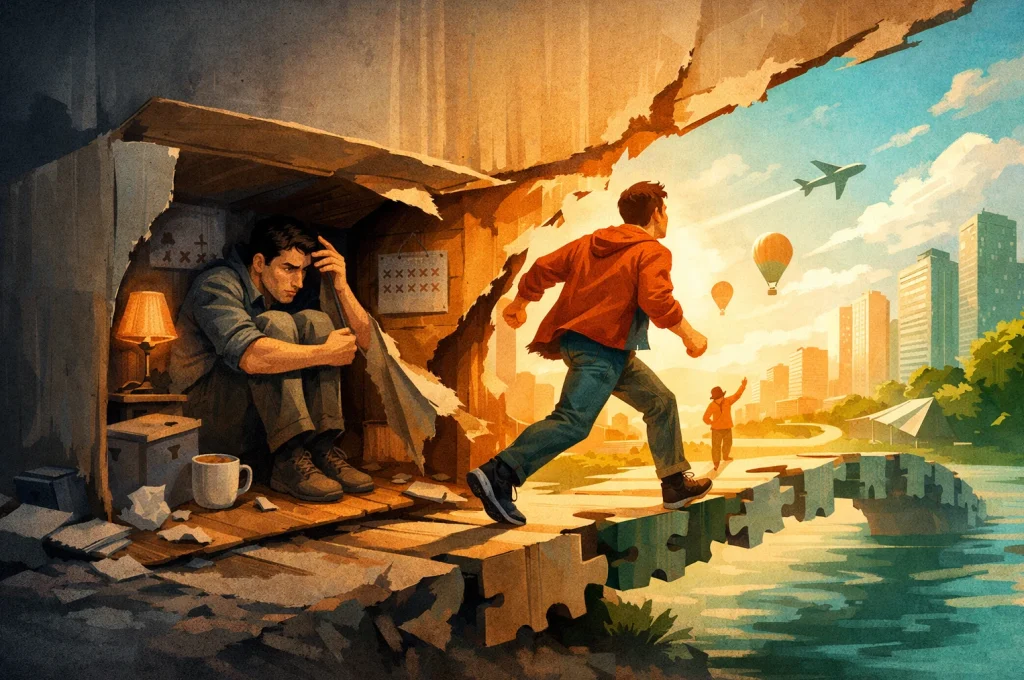
Table of contents:
When Change Feels Dangerous Even Before Anything Happens
It's usually not just about the change itself
Fear of change is rarely a neat little fear of "new things." Usually, the mind hears change and translates it into a whole bundle of hidden threats. What if I fail? What if I regret it? What if people see me differently? What if I lose money, comfort, status, belonging, control - or, honestly, just the story I've been telling myself about my life?
A job offer is not only a job offer. It can feel like an exam you didn't study for. Moving to a new city is not just boxes, train tickets, and trying to remember which one of the cables powers the Wi-Fi. It can feel like losing your bearings, your people, even your old version of yourself. So yes, the reaction can look a bit oversized from the outside. But often your mind is reacting to ten meanings at once, not one event. That's the trick of it.
The brain would rather keep a bad map than have no map at all
Your nervous system loves predictability. Not happiness, necessarily. Predictability. Which is a mildly annoying design choice, if we're honest.
That's why people stay in stale jobs, lopsided relationships, cramped routines, old identities that already feel itchy around the edges. The current setup may be frustrating, but at least the brain thinks it knows where the sharp corners are. Change takes away the old map before the new one is clear, and that in-between phase? It can feel wildly unsafe.
A lot of smart, capable people judge themselves harshly here. "This is ridiculous, I know this would be good for me." Sure. Maybe. But the body is not a spreadsheet. It doesn't calm down just because the logic is tidy. Sometimes it wants continuity more than it wants sense. Inconvenient, yes. Very human too.
Part of you may be protecting an old identity
Change doesn't only alter schedules and surroundings. It pokes at identity, which is where things get tender fast. If you've been "the reliable one," "the quiet one," "the one who never takes risks," or "the person who keeps everything stable," then change can feel weirdly disloyal. Even positive growth can bring guilt along for the ride.
Earning more may change your friendships. Setting boundaries may change how your family talks to you. Getting healthier may force you to notice how long you've been neglecting yourself. And sometimes the hardest part is not the upgrade itself. It's the fear of becoming less understood, less connected, less... familiar to the people around you. Which is why loneliness is not about empty rooms so often overlaps with change: the real fear may be emotional distance, and that deserves to be named out loud.
No wonder people freeze when life opens a door. They're not only choosing a new situation. They're renegotiating who they get to be inside it. That can feel strangely public, even when nobody else is paying nearly as much attention as your brain insists they are.
Old experiences can teach the body to brace early
If past changes came with chaos, shame, loss, or sudden instability, your system may now treat change like a warning siren. Family divorce. Moving constantly as a kid. Being punished for mistakes. A job change that blew up in your face. A breakup that came out of nowhere. The body remembers in blunt, unsophisticated ways.
So when something new begins, you may not think, "Ah yes, I am having a learned protective response." You just feel restless. Snappy. Foggy. Avoidant. Maybe bizarrely tired, like you need a nap after replying to one email. That's one reason fear of change can sit next to that stuck, engine-idling feeling for ages. The pattern is not stupidity. It's protection that forgot to retire.
What Gets Lighter When Change Stops Running the Show
You stop wasting so much energy fighting reality
One of the first changes - and this one is so underrated - is simple relief. When fear of change loosens its grip, you spend less energy mentally wrestling with things that are already happening. A company restructure. Your kids getting older. Your body changing. Friends moving away. Technology updating at work while you glare at the install button like it insulted your mother.
Resistance burns a ridiculous amount of energy. Not because you're weak. Because inner fighting is expensive. Once every shift stops feeling like an emergency, some of that energy comes back. And then, funny enough, you can respond instead of just bracing. Life feels less cramped on the inside. You breathe differently. That matters.
Opportunities start looking testable, not mythical
When fear of change is strong, opportunities tend to put on theatrical costumes. They stop looking like ordinary next steps and start looking like giant, irreversible life bets. So you delay. You circle. You tell yourself you're "waiting for clarity." Sometimes that's true. Sometimes it's fear wearing glasses and pretending to be wise.
With less fear in the driver's seat, a new possibility becomes something you can examine, try, adjust, maybe even enjoy a little. Not destiny. Not doom. Just a chance.
This gets much easier when you stop demanding that every move be flawless, because perfectionism without the weird myths leaves room for trying, learning, and making imperfect progress in public without turning one awkward step into a verdict on your entire future. That shift is huge. It lets you experiment instead of fantasizing or panicking. And if your life has felt suspiciously small lately, that matters more than it may seem.
Your relationships get less stiff and reactive
Fear of change doesn't stay politely inside your head. It leaks into relationships. You may avoid conversations that could improve things. Hold people in old roles because their growth unsettles you. Panic when someone close changes direction, pulls away a little, or simply needs something different than before. That is also why what gets easier when you stop treating disagreement like a catastrophe matters here: change feels less dangerous when you trust yourself to handle the tension, the awkward talks, and the small misunderstandings that often come with it. It also helps to remember that what opens up when you learn to listen properly is often exactly what fear tries to shut down during transition: clarity, reassurance, and the feeling that a hard conversation does not automatically mean disconnection.
When the fear eases, there's more room for real contact. You can let a partner evolve without treating it as rejection. You can update expectations instead of clinging to old agreements that stopped fitting half a year ago. You can even say, "This is new for me, and I'm uneasy," which is a lot cleaner than becoming controlling, sulky, or mysteriously impossible to reach. People tend to feel safer around flexibility than around hidden panic. For obvious reasons, really.
Confidence starts feeling less like a performance
There's also a steadier kind of confidence on the other side of this. Not the loud, shiny, motivational-poster version. More like a grounded sense that you can handle transition without instantly spiraling into worst-case thinking.
That's much closer to what confidence actually is: not certainty that everything will work out, but trust that you can meet what comes next. A person who is less afraid of change is often more creative, more honest, and oddly calmer under pressure. Why? Because uncertainty stops meaning "I'm doomed" and starts meaning "I may need to figure this out as I go." Which, frankly, is a much saner deal.
How Fear of Change Shows Up in Real Life
You dress avoidance up as practicality
This one is sneaky. Fear of change often arrives looking very respectable. Sensible, cautious, realistic, hard to impress. Sometimes that's exactly what it is. Sometimes it's fear in a good blazer.
You keep the job because "now isn't the right time." You don't have the conversation because "they're under stress already." You avoid applying, moving, ending, starting, asking, because "I need to think a bit more." And yes, thinking matters. Of course it does. But if the same doorway has been "under consideration" for nine months, come on now. Something else is going on.
The clue is repetition. When practical caution turns into permanent delay, fear is usually somewhere in the room pretending not to make eye contact.
Your mind turns into a catastrophe factory
Another classic sign is how fast your negative forecasting kicks in. One possible change appears, and your mind immediately builds a chain reaction worthy of a bad disaster movie. If I take the new job, I might underperform. Then I'll lose confidence. Then I'll ruin my finances. Then everyone will discover I was a fraud all along. Efficient, dramatic, exhausting.
These spirals happen quickly, which is exactly why they feel true. But fast is not the same as accurate. This is where problem-solving skills in real human terms become a lifesaver: they pull you back to actual facts, real options, and the next workable step instead of letting your mind produce five fictional disasters before lunch.
People with a strong fear of change often confuse imagined consequences with likely ones. The result is paralysis, constant tension, and a life quietly organized around preventing hypothetical embarrassment. Not ideal, you know?
You cling to familiar pain because at least you know its shape
This is the part nobody enjoys admitting. Sometimes fear of change keeps people loyal to situations that are already hurting them. Not because they like suffering - obviously not. But because familiar discomfort can feel safer than uncertain relief.
A mediocre job. A draining friendship. A relationship that has been emotionally dead since somewhere around last winter. Habits that keep you smaller than you want to be. The logic is bleak but common: at least I know what this pain costs. New territory doesn't come with a receipt.
So people keep choosing the known burden over the unknown possibility. If you've ever watched yourself defend a setup you secretly resent, yeah... this may be part of why. The brain can get oddly sentimental about predictable misery.
Small transitions hit you harder than they "should"
Fear of change isn't only about dramatic crossroads and movie-trailer moments. It can show up in tiny things too. A new manager. Changed weekend plans. A friend acting slightly different. A child switching schools. Even a normal life phase can make your system behave like the floorboards moved overnight.
You get irritable. Flat. Hyper-controlling. Weirdly tired. You start micromanaging details because details feel easier than uncertainty. Then, because life likes adding garnish, you judge yourself for overreacting.
The point is not whether the trigger "deserved" that reaction. The point is noticing that transitions - even small ones - load your system more than you realized. That's useful information. Not a moral failure, not a character indictment. Just information.
Ways to Meet Change Without Letting It Terrify You
Name the actual change, not the whole apocalypse
Start by getting annoyingly specific. What exactly is changing? And what is not?
A lot of fear grows in vagueness. "Everything is changing" is usually not true, even when life feels wobbly and your brain is wearing a siren hat. Maybe your role is changing, but your core skills are still yours. Maybe the relationship is ending, but your friendships, routines, values, and income are not evaporating along with it. Write the change down in plain language. Then write down what remains stable.
It sounds almost too simple, I know. But specificity has a calming effect. It stops the mind from treating one moving part like total collapse. Sometimes that tiny shift in wording is enough to turn the volume down a notch.
Separate discomfort from danger
A lot of people treat the feeling of fear as proof that something is wrong. Not necessarily. Sometimes fear means "important." Sometimes it means "new." Sometimes it means your body hasn't fully caught up with the fact that you are not trapped in an old situation anymore.
Ask yourself: what is genuinely risky here, and what is simply unfamiliar? Those are not the same thing. Moving abroad alone may be both. Updating your resume, setting a boundary, trying a new work routine? Often mostly unfamiliar.
This distinction matters because it changes your next move. Real danger needs protection. Discomfort needs tolerance. Mix those up and you either bulldoze yourself into overwhelm or hide from life entirely. Neither option is especially glamorous.
Use bridge moves instead of heroic leaps
You do not have to become a fearless butterfly by Friday. Most healthy change happens through bridge moves - trial runs, pilot versions, little experiments that let your nervous system collect evidence instead of speeches.
If a full career shift terrifies you, take one course, talk to a few people in the field, freelance on the side for a month. If dating after heartbreak feels like a haunted house, start with one coffee, not a ten-year fantasy and a shared Spotify playlist. If moving cities feels huge, visit twice and map out your first month in boring detail.
Your nervous system trusts lived proof more than big declarations. Give it something solid. Something it can actually touch.
Keep a few anchors boring on purpose
When life is changing, don't make everything experimental at once. Keep some parts dull and dependable on purpose. Same wake-up time. Same morning walk. Same groceries. Same call with the friend who doesn't make you perform or explain yourself like you're in court. In practice, what starts working better when you get more organized is often your ability to handle transition without turning every unknown into a full-body emergency, because a little structure gives your mind fewer loose ends to panic about.
Stability in a few ordinary places gives the mind something to hold onto. That's also part of what discipline quietly gives back: not a smaller life, but enough structure to stay steady while something important shifts under your feet. People sometimes think growth means total reinvention. It really doesn't. During change, a bit of structure can be the difference between adaptation and your whole week turning into emotional soup.
Let yourself grieve the old chapter
Here's the part self-help culture tends to rush past because it's less shiny: even good change can involve loss. New job, lost colleagues. New baby, lost freedom. Better boundaries, lost approval. Healthier life, lost old coping rituals. It's not a contradiction. It's just reality being... reality.
If you don't let yourself grieve what is ending, fear tends to stick around and disguise itself as "I'm not ready yet." Maybe you're not resisting the future so much as refusing to admit the past is actually over. Sit with that for a minute. Not forever. Just long enough to feel it properly.
There's relief there, oddly enough. When grief gets some room, curiosity often comes back. And curiosity - bless it - is much easier to build a life with than constant inner alarm.
Is Fear of Change the Thing You Need to Work on First?
Not always. Some people really do need to loosen their fear of change. Others are already dealing with overload, grief, burnout, shaky finances, or a nervous system that has had quite enough surprises for one season, thank you very much. In that case, forcing yourself into more change just because "growth" sounds noble can be a terrible idea.
It helps to look at the pattern, not the slogan. Are you mostly stuck because you keep avoiding healthy shifts, delaying decisions, and shrinking your world until the familiar feels safer than the possible? Then yes, this may be the knot to work on. But if your real problem is exhaustion, instability, or too many fires already burning at once, start there - or at least alongside this.
If you want a cleaner read on that, AI Coach can help you sort out what deserves attention first and give you a simple plan for the next three days. Which, honestly, is often more useful than just telling yourself to "be braver" while your whole system is quietly begging for a smarter approach.
Frequently Asked Questions (FAQ)
Why am I afraid of change even when I want the change?
Because wanting something and feeling safe enough for it are not the same thing. One part of you may want growth, relief, love, freedom, a fresh start. Another part may be scanning for risk, loss, embarrassment, or instability. That split is common. It doesn't mean you're hopelessly confused. It means your system needs help moving from vague alarm to concrete reality.
Is fear of change normal?
Yes. Very. Most people feel it at some point because change disrupts predictability, routine, and identity - three things the brain gets oddly possessive about. The real question isn't whether fear shows up. The question is whether it offers useful caution or quietly starts running your life. If it keeps you trapped in the same draining loops, it has probably gotten too much say.
Is there a name for an extreme fear of change?
Yes. You may come across the term metathesiophobia for an intense fear of change. But everyday fear of change doesn't need a dramatic label to matter. Plenty of people struggle with it without meeting any clinical threshold. What matters most is how it affects your choices, stress level, and ability to adapt when life inevitably does its thing.
Why do I stay in situations I already know are bad for me?
Often because the known situation feels more predictable than the unknown one. Familiar pain can seem safer than uncertain improvement. That's why people stay too long in dead-end jobs, stale relationships, cramped identities, and habits they complain about every single week. Frustrating? Absolutely. But once you see how heavily the brain values predictability, the pattern makes a lot more sense.
Can fear of change look like procrastination?
Absolutely. It often looks exactly like procrastination, overthinking, endless research, "waiting for the right moment," or needing one more opinion before you act. From the outside it may seem like indecision. Underneath, the issue is often that action would force contact with the new reality - and part of you is still trying to avoid that contact.
How do I handle sudden change that I did not choose?
Start smaller than your mind wants to. Name the facts. List what is still stable. Take care of immediate needs first: sleep, food, money, housing, communication, support. Then move from there. When change is forced on you, trying to emotionally solve the entire future at once usually makes everything worse. Stabilize, then orient, then decide. In that order, if you can manage it.
Is fear of change connected to anxiety or past trauma?
Often, yes. Anxiety can make uncertainty feel more threatening than it really is, and painful past transitions can teach the body to brace early. That doesn't mean every fear of change comes from trauma. But if your reactions feel fast, intense, and strangely disproportionate, older experiences may be shaping the response more than you realized.
How can I tell whether I am wisely cautious or just scared?
A useful test is this: does your caution help you think more clearly and eventually make a decision, or does it keep the decision floating in limbo forever? Healthy caution asks better questions, checks real risks, then moves. Fear of change tends to stay foggy, catastrophize, and suspend the whole thing in emotional amber. One clarifies. The other stalls.
How do I support someone who is terrified of change?
Don't mock the fear, and don't rush them with speeches. Help make the change more concrete. Ask which part feels most threatening. Separate facts from imagined chains of disaster. Encourage smaller bridge steps instead of all-or-nothing leaps. People usually calm down faster when they feel understood and less alone, not when they're told to "just think positive." You've probably seen that backfire in real time.
What are the first signs that I am getting better with change?
You notice the fear earlier, but it stops sounding like absolute truth. You recover faster when plans shift. You make more decisions before perfect certainty appears. You can hold discomfort without instantly labeling it danger. And maybe the nicest sign: opportunities start looking less like traps and more like things you can explore with your eyes open. Quiet progress, maybe - but very real. I hope you give yourself credit for that when it shows up.