
You know that sour little hum after a disagreement - the talk is over on paper, sure, but your body is still in round four while you're in the shower, driving home, loading the dishwasher, pretending to watch something you have not followed for twenty minutes. That's often what weak conflict resolution looks like in real life. Not fireworks every night. Just tension that hangs around too long, sneaks into everything, and makes normal relationships feel oddly heavy.
Conflict resolution is basically the skill of handling friction without turning every disagreement into a cold war, a swamp of guilt, or a tiny emotional kitchen fire. If you keep dodging hard conversations, snapping before you've even understood what's happening, or smiling politely while resentment quietly grows teeth - well. This may be your topic, whether you wanted it or not. Slightly rude, yes. Useful though.
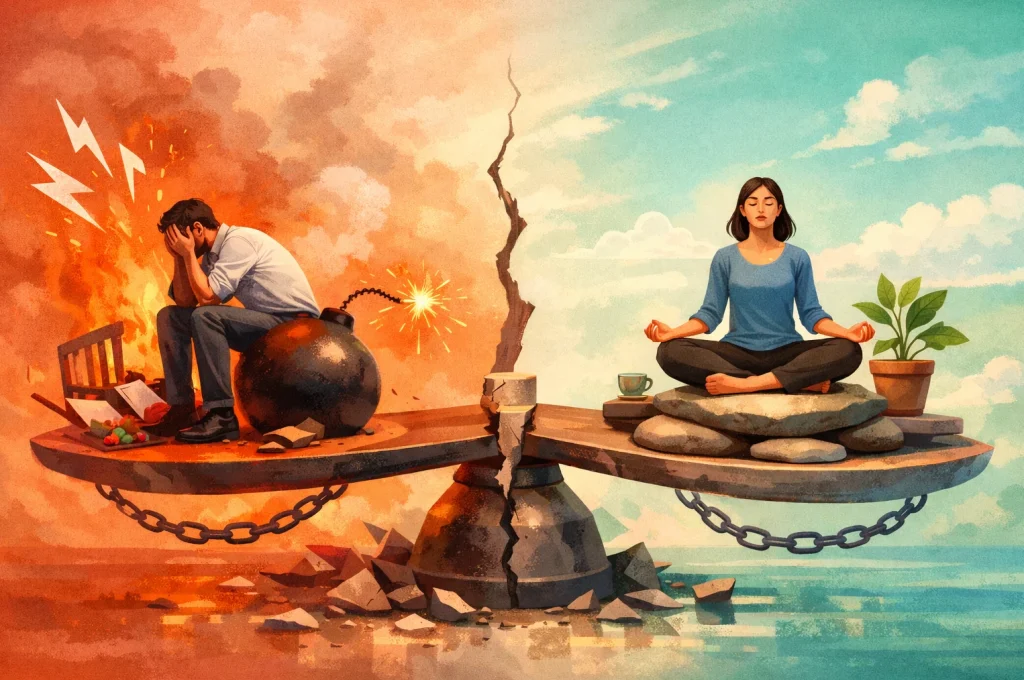
Table of contents:
Conflict Resolution: what this skill looks like before anyone slams a door
It deals with the real issue, not the entire dramatic backstory your brain wrote at 2x speed
Conflict resolution is not just a polished way of saying "be nice." It's the ability to stay with a problem long enough to figure out what actually happened, instead of reacting to the terrifying little movie your mind produced in the first three seconds. The fact might be, "She interrupted me twice in the meeting." The story might be, "She's trying to make me look stupid in front of everyone." Sometimes the story contains something real. Sometimes it's just tired-person cinema with a huge budget and terrible lighting. People who are good at conflict can separate what was visible from what was assumed - not perfectly, not like saints, but enough to stop arguing with a fantasy. That changes everything, honestly.
It keeps the emotional temperature below full rolling boil
Another big part of conflict resolution is regulation. Not perfection. Not monk-on-a-mountain serenity. Just enough steadiness so your words still belong to you. Someone with this skill can usually feel the heat rising and buy themselves one beat - one tiny beat - before speaking. They notice the clenched jaw, the urge to interrupt, the suspiciously brilliant comeback that would absolutely make things worse, and they don't automatically obey it. That pause matters because once a conversation gets flooded with contempt, panic, or defensiveness, the original issue often disappears in the smoke. This gets especially messy if you tend to hear neutral comments as personal attacks, which is why it helps to understand touchiness up close, when ordinary remarks hit too hard before every tense exchange starts feeling like a courtroom scene. At that point you're not solving anything. You're just managing damage in smarter shoes.
It can be direct without turning mean
A lot of people grow up with a very fake choice: stay quiet and "keep the peace," or finally be honest in a way that sounds like getting hit with a verbal frying pan. Real conflict resolution lives in the less theatrical middle. It lets you say, "This is a problem for me," without turning that into, "And now I will explain your entire personality as if I'm filing an incident report." It includes listening, yes, but not the floppy kind where you swallow your own reality just to seem mature. It includes clarity, boundaries, and naming impact instead of attacking character. Which is why this skill matters everywhere - with partners, coworkers, siblings, flatmates, project teams, even that neighbor whose sound system appears to believe in community outreach.
It looks for repair, boundaries, or at least a clean decision
The point of conflict resolution is not to make every disagreement feel tender and healing and wrapped in linen. Some conflicts end in repair. Some end in compromise. Some end in a clearer limit, a changed process, or a polite reduction of contact because two people keep wanting opposite things and - what can you do. That still counts as skillful if the conversation becomes more honest and less destructive. A lot depends on what adaptability really looks like in a person, because conflict rarely follows the neat little script you rehearsed in your head while brushing your teeth. In real life, this skill shows up as staying engaged under tension, asking useful questions, naming your own part without melting into shame, and trying to leave the situation cleaner than you found it. Not perfect. Just cleaner. Which, in some households, is basically wizardry.
What gets easier when you stop treating disagreement like a catastrophe
Problems stop marinating into something nastier
When conflict resolution gets stronger, one of the first things that changes is timing. You bring things up sooner. For some people that gets easier when they build more extrovert energy, because starting an awkward conversation stops feeling like a social cliff dive with no harness. A misunderstanding gets corrected while it is still just one misunderstanding, not a three-week emotional casserole made of assumptions, tone analysis, old annoyance, and that one weird comment nobody forgot. Early conflict is awkward, yes. Late conflict is usually expensive. People with this skill save themselves a mountain of buildup because they don't wait until the issue starts symbolizing everything wrong with the relationship, the job, the group chat, or civilization itself. Tiny mercy. Big payoff.
People trust your honesty more
There's a special kind of relief in being around someone who can hear discomfort without instantly collapsing, retaliating, or vanishing into silence like a Victorian ghost. That person feels safer to be real with. Friends speak up earlier. Partners stop guessing. Coworkers raise concerns before a project starts wobbling. And that matters, because trust is not built through warmth alone. It's also built through repair. When people know a hard conversation will not automatically turn into punishment or ice-age behavior, honesty becomes less risky. Relationships get sturdier. More adult. Less weirdly theatrical.
Work gets cleaner, faster, and less political
At work, conflict resolution has a very practical side. Feedback lands sooner. That also supports your learning ability and makes you easier to teach, because useful feedback only helps if people believe honesty won't trigger drama. Confusion gets cleared up before it mutates into blame. Meetings stop feeling like passive-aggressive puzzle games where everyone says "sounds good" and then immediately complains in private messages. Teams that handle conflict well do not become magical forests of emotional intelligence, obviously. They still disagree. They still get irritated. They just waste less energy on avoidance, mind-reading, and cleanup after preventable flare-ups. That energy goes back into actual work. Lovely concept.
You stop feeling so fragile around disagreement
There's also a quieter, more private benefit. When you learn to deal with conflict directly, disagreement stops feeling like proof that you are rejected, bad, stupid, impossible to love, or secretly doomed. It starts to feel more like what it often is: friction between needs, expectations, habits, or interpretations. Unpleasant? Sure. Fatal? Usually not. That shift can make you calmer in your own skin. Less defensive. Less likely to replay a conversation for six hours while your nervous system behaves as if you just survived a medieval trial. You become more resilient without turning cold, and that's a rare combination - soft heart, steady spine.
How weak conflict resolution quietly complicates a life
You start paying an avoidance tax
Usually the first sign is not yelling. It's delay. You put off the message, the clarification, the boundary, the "hey, that didn't sit right with me" conversation that would have taken five honest minutes yesterday and now threatens to take forty-five spiky ones next week. Avoidance feels efficient at first. Less awkward. Less exposure. Nice, in the moment. Sometimes that is also how self-sabotage sneaks into ordinary life, because postponing one honest conversation can feel protective now while quietly making the whole situation harder later. But the bill arrives later. You keep thinking about the issue in the background. You rehearse what you might say. You edit yourself around the person. You get tired in that sneaky way that makes no sense until you remember: unresolved tension is work. Your body knows it, even when your calendar does not.
The tension leaks out sideways
Conflict almost never stays neatly bottled. If it isn't addressed directly, it tends to ooze into tone, timing, sarcasm, selective helpfulness, brittle politeness, mysteriously delayed replies, or that very particular "I'm not mad" voice that could probably preserve vegetables for winter. So now the issue is not just the issue anymore. It's the atmosphere. Everyone can feel something is off, but nobody has language for it. That's when ordinary interactions start feeling loaded. A simple question sounds sharp. A neutral email looks hostile. The whole room gets that sealed-window feeling. You know the one. Airless. A bit creepy.
Small things show up carrying old weight
When conflict resolution is weak, nothing really leaves. It just stacks. So the next annoyance never arrives alone. It drags in the late payment, the ignored message, the meeting where you were talked over, the weekend you said yes when you meant absolutely not. Then somebody forgets one small thing and gets hit with a reaction that clearly started two incidents ago. The other person thinks, "Why is this suddenly so huge?" You think, "Because it is not sudden, obviously." And there it is: backlog. A manageable moment turns into a referendum on the entire relationship.
Closeness gets replaced by carefulness
Weak conflict skills change the social weather. People stop being straightforward. In families, they talk around the real problem for years and call that harmony. In couples, they become efficient roommates with suspiciously polite logistics. In teams, everyone nods in the meeting and vents later where nothing useful can happen. The surface may look calm, but it's the calm of self-protection, not trust. And internally - this part stings - if every disagreement feels like danger or humiliation, your body starts bracing early. Even mild feedback can feel enormous. That's how poor conflict resolution shrinks a life: not through one giant blowup, but through a hundred smaller moments where honesty felt too risky to even attempt.
Ways to get better at conflict without turning into a therapist robot
Start with camera language
Before a hard conversation, write down what a camera would have recorded. Not what you think the other person meant. Not their whole personality translated into legal evidence. Just the visible part. "You changed the deadline without telling me." "You joked about me in front of the client." "You arrived half an hour late and didn't text." Starting there keeps you from opening with accusations about motives you can't actually prove. It sounds almost too simple, which is annoying, because it works absurdly well.
Prepare one clean opening sentence
A surprising amount of conflict goes off the rails in the first thirty seconds. So help yourself out and rehearse one plain opening before emotion starts improvising jazz. "I want to clear something up from yesterday." "Can we talk about what happened in the meeting?" "There's a pattern that's getting hard for me to ignore." That kind of line opens a door. It doesn't throw a chair through a window. You can still be firm - you're just giving the conversation a fighting chance.
Settle your body before you defend your case
If your pulse is hammering and your shoulders are trying to become earrings, your brilliance may not be at its peak. Before the conversation, do one physical reset. Walk around the block. Unclench your hands. Exhale slowly for a minute. Put both feet on the floor. Lean back instead of forward. Tiny things, honestly. Still useful. Conflict is not only verbal; it's biological too. A calmer body gives you more choices, and having more choices is half the skill right there.
Ask one bridge question before making your speech
When the other person finishes talking, resist the urge to load your rebuttal like a cannon. Ask one question first. "What mattered most to you there?" works well. So does "What did you hear me saying?" or "What would feel different for you after this conversation?" These questions don't make you weak. They make you informed. Very often the fight you think you're having is not the fight the other person thinks they're having, and it's much better to discover that early than after twenty furious minutes and a headache.
End with something testable, not just sincere
Don't end conflict with vague warmth and a hopeful shrug. End it with something visible. What changes next time? Who will do what? What sentence will you use if the issue starts again? When will you check back? Good repair needs handles. Otherwise both people leave feeling heard, which is lovely for about six hours, and then repeat the exact same mess on Wednesday. It also helps to practice all this on lower-stakes friction first - chores, turnaround times, texting habits, meeting interruptions. Big conflicts usually get easier once you stop fumbling the small everyday ones.
Is this the right skill for you to work on now?
Not always. Some people really do need stronger conflict resolution. Others are actually dealing with burnout, chronic people-pleasing, weak boundaries, or relationships where the problem is not poor communication at all but fear, intimidation, or plain old mismatch. Different knot, different fingers. And if your stress comes from trying to handle ten problems as if they all deserve the same urgency, it may help to build prioritization, the skill of deciding what deserves first place, because not every difficult conversation has to happen immediately, but the right one usually should not wait forever either. If your hardest conversations happen in business, it may also help to learn how entrepreneurs can balance caution and risk, because some founders avoid tension until the cost of speaking up gets much higher. A person can only practice this skill properly when their nervous system has at least a little room to stay present.
So it helps to ask what is costing you most right now. Is it unresolved tension? Delayed conversations? Passive-aggressive fog? Arguments that either explode or drag on forever like a suitcase with one broken wheel? Then yes, this probably deserves real attention. If your main problem is exhaustion, shutdown, or not feeling safe enough to speak honestly, start there - or at least start there too.
If you want a clearer read on where to begin, AI Coach can help you sort out your current growth priority and give you a simple plan for the first three days. Sometimes that's more useful than making one more noble promise to yourself about "communicating better" and hoping the sentence somehow does the heavy lifting.
Frequently Asked Questions (FAQ)
What does conflict resolution actually mean in simple terms?
It means dealing with disagreement in a way that reduces damage and increases clarity. Not dodging it, not escalating it for sport, and not pretending that "nobody yelled" means the problem is solved. In practice, it's a mix of calm-enough emotions, clear-enough language, and honest follow-through that moves a conflict somewhere useful.
Is conflict resolution the same as being agreeable or nice?
Nope. Nice people can be awful at conflict if they avoid hard truths until resentment starts writing speeches in the background. Conflict resolution is not about pleasing everyone. It's about being direct without becoming gratuitously cruel, and being open without abandoning your own boundaries. Warmth helps. Spine helps too.
Can one person improve a conflict if the other person is difficult?
Often, yes - though not infinitely, and that part matters. One person can lower the temperature, stop mind-reading, ask better questions, and speak more clearly about the actual issue. That alone can shift a lot. But conflict resolution is not wizardry. If the other person refuses accountability, mocks your concerns, or keeps moving the goalposts, your job may be less "resolve this beautifully" and more "set limits and make decisions accordingly."
How do I bring up a problem without sounding accusatory?
Start with what happened, not with your diagnosis of who they are as a human being. Observable language helps a lot: "When the deadline changed and I wasn't told, it created a problem for me." That lands very differently from "You're inconsiderate and impossible to work with." One names the issue. The other invites a counterattack. If you want the conversation to stay usable, boringly clear is often your friend.
When is it better to pause a conflict instead of pushing through?
Pause when the conversation has stopped being about understanding and started becoming a contest between two overwhelmed nervous systems. If either person is flooded, shouting, going blank, repeating themselves, or reaching for the sort of sentence that will need an apology and maybe a blanket later, take a break. But make it a real pause, not a sneaky escape hatch. Name when you'll return to the conversation.
What if I cry, freeze, or get angry during conflict?
That doesn't mean you're bad at conflict. It means your body is involved - welcome to being a person. The useful move is not to shame yourself for the reaction. It's to learn what helps you come back into enough steadiness to speak clearly. A slower exhale, a glass of water, standing up, taking ten minutes, writing down the core point you don't want to lose... small resets can make a much bigger difference than people think.
Is avoiding conflict always a bad thing?
No. Some conflicts are trivial and simply don't deserve your energy. Some are badly timed. Some are with people who are committed to misunderstanding you, and that's its own strange genre. The problem is chronic avoidance of conflicts that matter. If you keep skipping necessary conversations, the issue usually returns wearing a worse mood and carrying extra luggage.
Can conflict ever be healthy in a relationship or team?
Absolutely. Healthy conflict is often a sign that reality is allowed into the room. People have different needs, standards, ideas, and limits. Friction is normal. The real question is whether the conflict leads to clarity, repair, and better decisions - or just fear, scorekeeping, and emotional smoke damage. A relationship with zero conflict is not always peaceful. Sometimes it's just silent.
How is conflict resolution at work different from conflict resolution in close relationships?
The basics are similar: stay specific, regulate yourself, ask questions, aim for clarity. But at work, the focus usually needs to stay closer to behavior, process, expectations, and impact. You do not need to excavate everyone's inner child before fixing how meetings run. In close relationships, emotion and history naturally carry more weight, so repair usually needs a bit more tenderness and context, not just logistics.
How do I know a conflict should be managed with boundaries instead of fully resolved?
Look at the pattern. If the same issue keeps returning with no real ownership, if the other person treats your honesty as an attack every single time, or if contact leaves you feeling smaller, foggier, and constantly on guard, resolution may not be the main path. Sometimes the healthiest outcome is reduced access, firmer rules, or distance. Not every conflict ends in mutual understanding over tea. Some end in a locked gate and better sleep.